Exam 2 - Module 7 (Autoencoders, Dimension Reduction, Clustering)
 Call Kai
 Learn
Learn Practice Test
 Spaced Repetition
 Match
Match Flashcards
 Knowt Play
1/9

There's no tags or description
Looks like no tags are added yet.
Name | Mastery | Learn | Test | Matching | Spaced | Call with Kai |
|---|
No analytics yet
Send a link to your students to track their progress
10 Terms
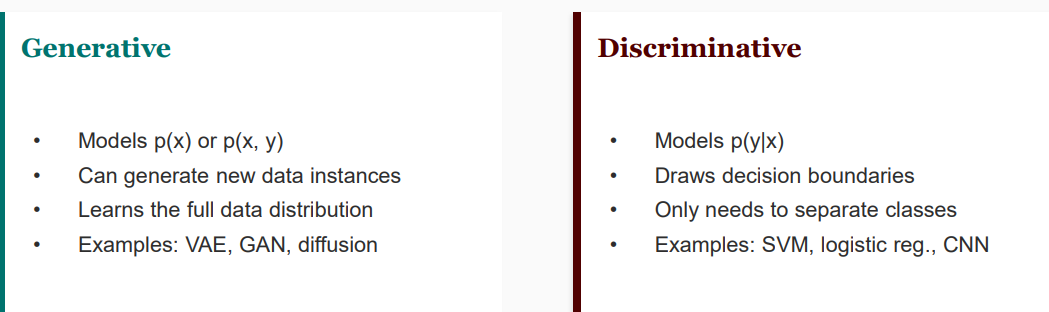
Generative vs Discriminative
Autoencoders
unsupervised neural network that learns to compress data (encoder) into latent reperesentation and then reconstruct it back (decoder) to its original form
Latent space
lower-dimensional representation of the input data
A good latent space and AE Tradeoff
A good latent space is compressed (d≪n) and smooth. Standard AEs can have "gaps" in the latent space that make it difficult to sample new
The latent dimension size controls the information-detail tradeoff
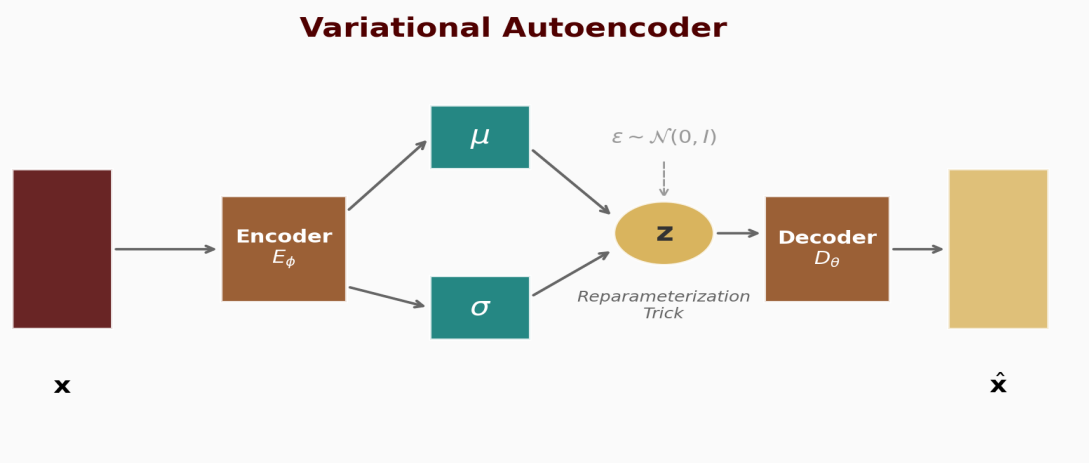
Variational Autoencoders (VAE)
Instead of a point, we get a region of latent space, which makes it smooth and continuous
VAE Loss Function
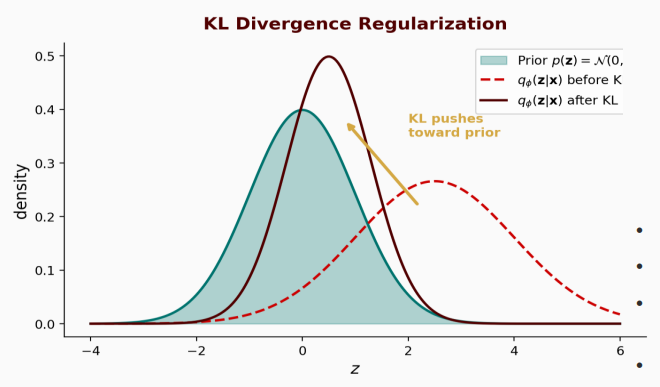
balances reconstruction with regularization (pushing the latent distribution toward a simple prior like N(0,I))
KL Divergence
quantifies the "information loss" and is a is a measure of how one probability distribution differs from a reference probability distribution
Reparameterization Trick
VAE Loss Tradeoff
create highly disentangled features (interpretable) but result in blurrier reconstructions
Generative Adversarial Networks (GANs)