Progress Check #2
 Call Kai
 Learn
Learn Practice Test
 Spaced Repetition
 Match
Match Flashcards
 Knowt Play
1/13

Earn XP
Description and Tags
Be able to identify molecules as being a carbohydrate, lipid, protein, or nucleic acid and justify your choice.
Name | Mastery | Learn | Test | Matching | Spaced | Call with Kai |
|---|
No analytics yet
Send a link to your students to track their progress
14 Terms
Six Key Element
Carbon, Hydrogen, Nitrogen, Phosphorus, Oxygen, Sulfur
Importance of Carbon
Carbon is in carbs, lipids, nucleic acids, and protein all of which are needed to live and support your body. It provides the structures as it can bond with multiple different elements, and double and triple bond so since sequences matter it can create many different forms and functions of living things. ALL OF THE MOLECULES ARE CARBON BASED. CAN FORM 4 COVALENT BONDS ESPECIALLY WITH THE CARBON BASED MOLECULES!
Dehydration Synthesis
A reaction that removes a molecule of water (OH from one monomer H from another). This allows monomers to bond together and form polymers.
Hydrolysis
The bond between two monomers is broken apart by the addition of a water molecule, the H attaching to one monomer and the OH attaching to the other monomer. This allows monomers to break apart, and breakdown the polymer.
Carbohydrates (Carbs)
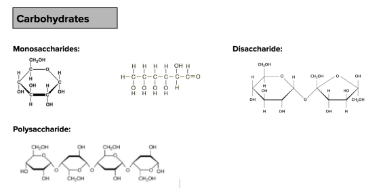
Contains: Carbon, Hydrogen, and Oxygen. Defining feature: It contains equal amounts of Carbon and Oxygen. Typically has rings or chains of rings.
Monomer: Monosaccharide
Lipids
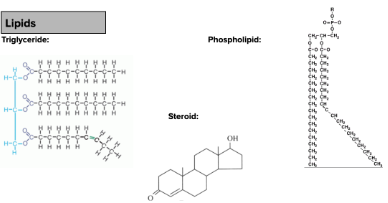
Contains: Carbon, Hydrogen and Oxygen. Defining feature: It contains more Carbon than Oxygen. Typically also has long chains.
Monomer: Fatty acids (and glycerol)
Proteins
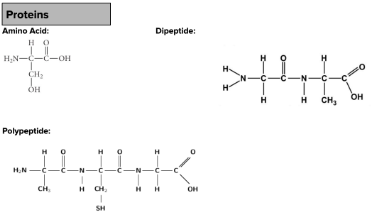
Contains: Carbon, Hydrogen, Oxygen and Nitrogen. Defining feature: Contains N but no P (Usually). One amino side (H2N) and one carboxyl side (-COOH).
Monomer: Amino Acid
Nucleic Acids
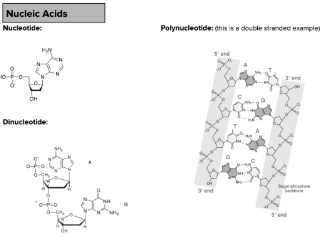
Contains: Carbon, Hydrogen, Oxygen, Nitrogen, and Phosphorus. Defining feature: Contains Phosphorus (and Nitrogen).
Monomer: Nucleotide
Carbs function
Main fuel for cellular work, used as raw materials to manufacture other organic molecules.
Monosaccharides: Signal molecule of sugar, 3-7 carbon atoms, CHO 1:2:1.
Glucose and Fructose
Disaccharides: Two monosaccharides, from dehydration synthesis.
Glucose + Fructose = Sucrose
Polysaccharides: Many monosaccarides, not sweet, long chains of glucose.
Starch, glycogen, cellulose (Starch is how plants store glucose, glycogen is short term animal energy storage, cellulose forms the cell wall).
Lipids function
General: Oily, greasy, waxy, insoluble, hydrophobic, biological fuels, hormones, structural components in cell membranes.
Steroids: Chemical signals cells use to communicate and help to keep the cell membrane fluid/flexible. Type of hormone.
Estrogen, Testosterone
Fats/Triglycerides: Glycerol molecule w/ 3 Fatty acid chains by double bonds, length of hydrocarbon chain and number of double bonds influence the properties. They store food energy for times of food shortage. OCH 1:2:3
Saturated Vs. Unsaturated Fatty Acids: Saturated have max # of hydrogen, solid at room temp (butter), Unsaturated have some double bonded carbon to carbon, have less hydrogen and tend to be liquid at room temp (olive oil).
Phospholipids: Main structural molecule in membranes of all cells, polar head and nonpolar tail, polar head allows interaction with water. CHOP 3:1:3:2
Nucleic acids function
Store and transfer genetic info in a cell (DNA RNA)
Proteins function
Enzymes speed up reactions, many different types of proteins.
Ie, receptor proteins recieve outside signals for cells, defense proteins are the antibodies of the immune system.
Polypeptide chain - structural backbone to proteins, classified as hydrophobic or hydrophilic based on R group. If the sharing is even, then hydrophobic, if the sharing is uneven w/ partial charges then hydrophilic.
They thus fold based on interactions between molecules shape determines function and thus interaction with other proteins. Hydrophobics shrink in, hydrophillics expand.
Protein Denaturation: Changes shape and thus function is lost.
Enzymes!
Molecules that function as biological catalysts, and are reusable, they lower the activation energy required to break bonds/form them. VERY SELECTIVE in the reaction they catalyst.
They lower the activation energy needed and so they speed up the reaction.
Everything is normal.
Temperature increases, denatures the enzyme, loses its shape and function, unravels.
Temperature decreases, molecular motion slows, so the rate of reaction slows, sloth molecules.
Enzymes concentration increases, so does the rate of reaction, more opportunities and bumping in to each other. Opposite when enzyme concentration decreases.
Substrate concentration increases, increases the rate of reaction but levels off once all active sites are filled.
Substrate concentration decreases, rate of reaction decreases but levels off since more active sites are empty while all substrates are in use.
Inhibition: Changes the shape of an enzyme, so no longer fits substrate, no longer catalyze the reaction, or it takes up space and does not preform the action, slowing the rate of reaction.
Competitive vs noncompetitive: Important regulators of cellular metabolism.
Endergonic vs Exergonic
Endergonic, more energy enters than exits.
Exergonic, more energy exits then enters.