3461 Practice final
 Call Kai
 Learn
Learn Practice Test
 Spaced Repetition
 Match
Match Flashcards
 Knowt Play
1/25

There's no tags or description
Looks like no tags are added yet.
Name | Mastery | Learn | Test | Matching | Spaced | Call with Kai |
|---|
No analytics yet
Send a link to your students to track their progress
26 Terms
A contextual menu:
a: shows a menu appropriate to the object selected
b: Displays the content of selected object
c: requires user to enter context in a form
d:has sub menus
A
in the design of collaborative user interfaces, peripheral awareness refers to
A: The ability to communicate with everyone in the collaberative space
B: the ability to add or remove users from the collaberative space
C: the ability to track what others are doing, without explicit cues.
D: the ability to share information with others in real time
C
Screen readers (used by people with vision impairments) have difficulties with:
A: Text to speech shown only in images
B: speed of automated reading
C: use of colour in the user interface
D: text presented in different languages
A
the magical number 7 +/- 2 theory is often used in design. Which of these is an accurate description of the theory?
A: It describes how many colour should be used. You should have 7 +/- 2 distinct colours used at any given time because that is the limit of what people can reliably differentiate.
B: Menus should not be too long. Include only 7 +/- 2 items per drop down menu
C: it describes the relative size of fonts on a screen. You should never have more than 7 +/- 2 different size lettering visible at once because it gets too cluttered.
D: Humans can typically only keep 7 +/- 2 items in working memory at any one time, so interfaces should not require user to memorize more than that.
D
A disadvantage of a between subjects study is that
A: Ordering effects may impact results
B: you need fewer participants
C: variability between participants can have unexpected effects
D: it can only be conducted in the lab
C
A positively skewed distribution on a histogram means that
A: majority of scores are concentrated towards the lower side of the scale
B: Majority of scores are concentrated towards the higher side of the scale
C: Majority of scores are concentrated around the mean
D: Distribution is normal
A
Cognitive walkthroughs emphasize
A: effectivness
B: learnability
C: memorability
D: efficiency
B
modal dialogs in a human-computer interaction are examples of…
A: Distributed attention
B: Transfixed attention
C: Captured attention
D: Divided attention
E: Selective
C
Which theory that claims people tend to assign human characteristics to computers and other media, and treat them as if they are real social actors
A: Zoomorphic
B: Skeuomorphic
C: Anthropormorphic
D: Media equation
E: Flow
D
Which of the following emotions are both not part of pluchik wheel of emotion
A: trust
B: fear
C: shame
D: disgust
E: admiration
C, E
Semi-Structured interviews are suitable for gathering data from users on which of the following
A: A new system that has not been developed
B: A new system that has been launched
C: An existing system
D: A completly developed new system
E: All of the options
C
Which of the following is true about a focus group (select all that is correct)
A. Responses given in a focus group are verbal, open ended, relatively broad and quantitative.
B. Focus groups are appropriate for exploring a range of ideas, needs, motivations, and feelings that users have about a product you are trying to develop.
C. Similar to a survey, a focus group can help you learn what customers think about your products, services, processes or brand.
D. Unlike survey, the outcome of a focus group discussion cannot be used to guide future product developement or marketing
E. focus groups can only be used to discover factors influencing behaviors and attitudes.
b c
A conceptual model is
a. a high level description of how a system is organized and how it operates.
b. the problem space faced by the designer when gathering user requirements.
c. an interaction paradigm about interaction modes.
d. none of the above.
a
The left justification of an item in a menu best fits into which of the following categories of guidelines
a. proximity
b. repetition
c. organization
d. communication (visual design)
d
On a mobile device, an advantage of an on-screen virtual keyboard is:
A. One handed usability
B. Absence of tactile feedback
C. Adaptability to different languages or contexts.
D. Availability of accelerometers.
c
The following list represents what
Names of people
Clothes worn by an organization
actions performed by a person or animal
emotions like smiling or crying
surroundings of an object or person
location of objects
clolours
A. Elements a UI must contain
B. Elements to be describled in an alt text
C. Design guidelines of animated interfaces.
D. Elements of a modern UI
E. Elements a menu must contain.
B
What are the two main categories of emotional intereaction. How do they differ?
Emotional design and affective computing.
Emotional design is when a technology induces emotions. Affective computer is when the technology recognizes and responds to users emotions.
Explain Norman’s cognitive levels of emotional level and the design implications
Visceral - unconcious, wow feeling when you see a new car.
Behavioural - sub-conscious, how you feel when driving the car
Reflective - conscious, how you feel after you drove the car
Design implications are that visceral can be designed for the looks feels and sounds, behaviral is for how the product works and how to use it, and reflective is the meaning of the product and how it makes the user feel.
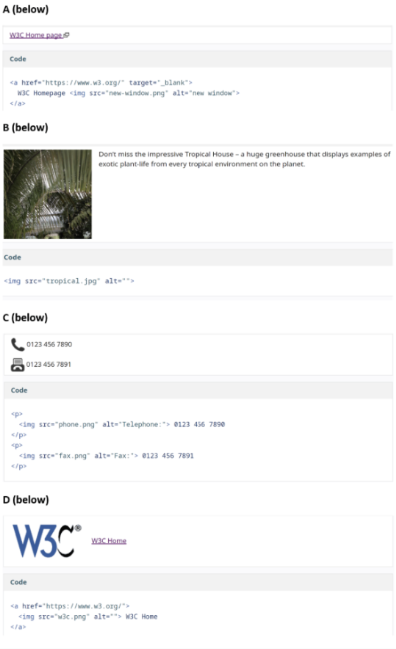
Identify/state the type of image used in each of the four pages below. Explain what each image helps to achieve in each page.
A - Functional (link) - navigation
B - Informative/content image - Supports understanding
C - Icon - Clarifies info quickly
D - Logo (functional) - branding + navigation
What are the three main benefits of external cognition. Give 2 examples of each.
reduces memory load.
reminders app on phone to remember tasks
google calander appointments
computational offloading - use external aids to carry out computations
doing two digit multiplication on calculator instead of mentally
using a spreadsheet to automatically calculate totals and averages
Annotation - highlighting notes and important information
highlighting key points in a textbook
writing comments on a pdf or adding sticky notes
Cognitive tracing - representing steps so you can stack and follow thinking process
writing out each step when solving a math problem
following instructions when building lego
You just finished completing the development of the system you proposed in eecs 3461 and you are looking for the best way to evaluate your system so you can have enough information and feedback from potential users to make improvements. You would like to conduct a think aloud usability testing, which is the most popular technique for usability evaluation developed by clayton lewis at ibm. However, you realized that it has its challenges.
What other suitable usability testing method would you use in place of think aloud.
breifly decribe the method covering its sailent features
why would you want to use this method in lieu of think aloud (provide 3 reasons)
Method: Cognitive Walkthrough
A cognitive walkthrough is a usability evaluation method where evaluators go through tasks step-by-step from a new user’s perspective, asking at each step whether the user would know what to do, notice the correct action, and understand the feedback.
Salient Features
Focuses on learnability for first-time users
Evaluators simulate a user completing specific tasks step-by-step
Uses structured questions like:
Will the user know what to do?
Will they see the correct option?
Will they understand the result?
Does not require real users (can be done by designers/experts)
Why use this instead of Think-Aloud (3 reasons)
No need for participants
Think-aloud requires recruiting users, while cognitive walkthrough can be done internally, saving time and effort.Avoids unnatural behavior
In think-aloud, users may act differently because they are forced to verbalize thoughts; cognitive walkthrough avoids this bias.Better for early-stage systems
It works well even with prototypes or incomplete systems, whereas think-aloud works best with a more polished product.
John and mary are developers at a bank. They have been tasked with the responsibility of designing a public website for the bank. Briefly list and describe the core elements of web accessibility that are instrumental to the implementation of a bank website that is accessible to as many users as possible.
What happens if one of the elements in the implementation cycle of web accessibility is not realized?
The core elements of web accessibility are
WEt AA WUD
W - Web content - text, image, audio, video, what is displayed on the website
E - Evaluation tools - to ensure accessibility, such as html validators, colour checkers, to make sure alternate text is redable by the screen reader. If one of the elements in the implementation cycle of web accessinbility is not realized, the site will only be accessible to peopel without disabilities, and not universally to anyone, regardless of disability. that part will be compromised
A - Authoring tools - word press, wix, where is the site hosted
Assistive technology - Tools used by people with disabilities to access web content. Examples include screen readers, voice input software, and screen magnifiers. Websites must be compatible with these technologies.
W - Web browser - where the public website is used, Google Chrome, Safari, FireFox
U - users - the customers of the bank
D - Developers - (John, Mary, designers on their team, and other developers)
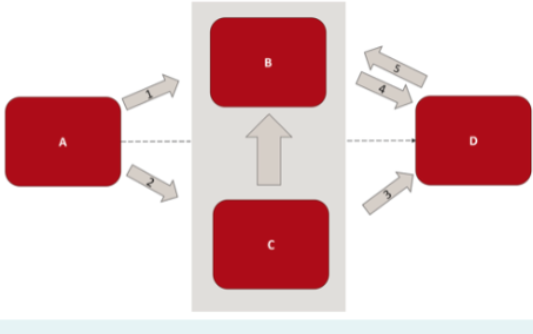
The figure shows a schematic of how the design team creates an effective system.
Identify what each component (A,B,C,D) stands for.
Briefly, in one sentence, state what eah component is about
What other terminology (one for each) for refering to A, B, and D
State what the numbered arrows (1,2,3,4,5) represent
A - Conceptual Model (high-level explanation of what the system does)
B - Representation model(what is actually shown to the user, on the screen, what the system is)
C - Implementation model (implementation details to show how the system actually works behind the scenes, the code)
D - Mental model (users belief on how the system works)
Alternate names for ABD: A - designers conceptual model, B - System image, D - users mental model
1 - Guides, 2 - Guides, 3 - Manifests, 4 - manifests 5 - conforms
ultamate goal is to have conceptual model match mental model.
One example of moel mismatch between conceptual model and mental model is the user thinks a heating system works like a water tap; turn all the way up for max heat when the conceptural model is like a light switch, on and off.
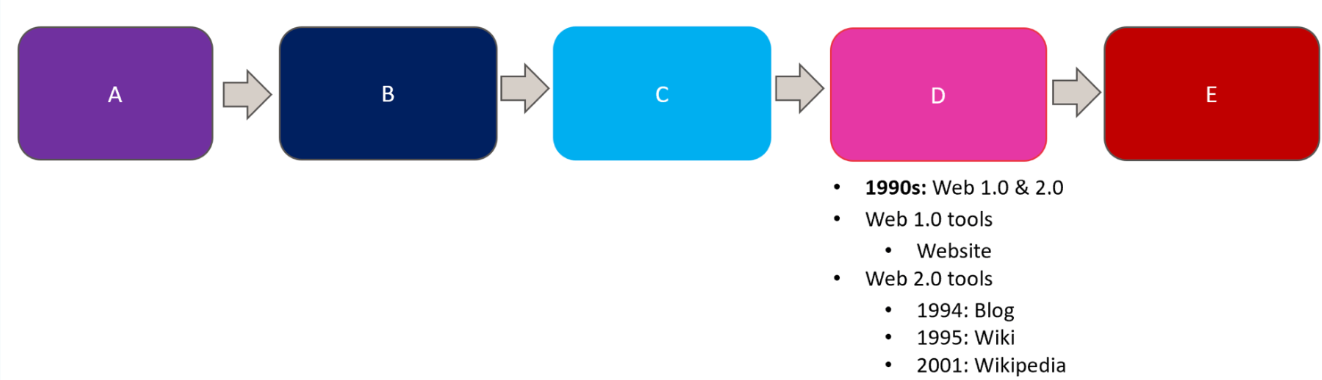
Lists the 5 major stages.
Video windowing tech belongs wo which stage and why
What are the two major downsides of video window tech when it was tested
If there was a sixth “C” what would it be. Give two example applications that would fall under it
Computational -1945
ENIAC
UNIVAC
Communication - 1961
Email
Bulletin board
Collaberation - 1980s
Video conference
Video Window
Smartboard
Creation - 1990s
Web 1.0 - Website
Web 2.0 - Wikipedia
Connection - 2000s
Social Media
Facebook
Youtube
sixth c would be cognative for AI
A. List and describe briefly in one sentence two dark patterns under the sneaking category
B. provide or breifly describe in one sentence an example application in which each dark pattern is used.
C List and describe briefly in one sentence two dark patterns under the misdirection category
D. provide or breifly describe in one sentence an example application in which each dark pattern is used.
A.
Two dark patterns under sneaking are hidden costs, where extra fees are only revealed at checkout, and sneak into basket, where additional items are added to a user’s cart without clear consent.
B.
An example of hidden costs is airline or shopping websites that add shipping or service fees at the final payment step; an example of sneak into basket is online stores that automatically include add-ons like warranties or accessories in the cart.
C.
Two dark patterns under misdirection are bait and switch, where a user’s action leads to an unexpected outcome, and trick questions, which use confusing wording to manipulate users into agreeing to something unintentionally.
D.
An example of bait and switch is clicking a “download” button that instead installs additional software, while trick questions are used in sign-up forms where confusing wording causes users to accidentally opt into subscriptions or emails.
Assume you want to create and launch a fashion based e commerce website. You did a user study amoung your target population on their online shopping behaviours and preferences, and you have the following colletion of comments/observations from your participants
Q1. I love wearing beutiful shoes and sunglasses to my friends brithdays
Q2. My fav fashion ware that I buy online includes coats and trousers
Q3. I like buying my siblings backpacks and shoes from amazon whenever I travel to my home country
Q4. My girlfriend loves Gucci dresses amd pants
Q5. I love shopping fanny packs (waist bags) and sunglasses online for my mother.
Q6. My wife loves tote bags and dresses from Nordstorm website.
Use all of the three steps to grounded theory coding process to organize the above comments into meaningful themes for the E-commerce website.
Affinity diagram
Bottom Wear(pants/trousers, Dresses) - Q2: trousers,Q4: Gucci pants,Q4: Gucci Dresses, Q6: Nordstorm dresses
Shoes - Q1: Beautiful Shoes, Q3: shoes
Bags Q3: backpacks, Q5: fanny packs, Q6: nordstorm tote bags
Upperwears - A2: coats
Sunglasses - Q1 sunglasses, Q5 sunglasses
From the affinity diagram, I have mapped a response to what categories I can display into the bigger themne on my website. I have mutliple categories put into themes with relationships between them. Themes are bottom wear, shoes, bags upperwar, and sunglasses.
Axial coding: organize the labels and analyze data with affinity diagrams to come up with categories of what the data can belong to into the table, such as sunglasses, backpacks, dresses, shoes, and pants (bottom wear)