Week 3 - Day 2
 Call Kai
 Learn
Learn Practice Test
 Spaced Repetition
 Match
Match Flashcards
 Knowt Play
1/23

There's no tags or description
Looks like no tags are added yet.
Name | Mastery | Learn | Test | Matching | Spaced | Call with Kai |
|---|
No analytics yet
Send a link to your students to track their progress
24 Terms
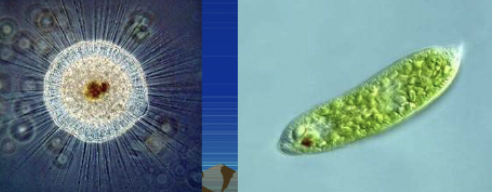
What are protists?
diverse group of eukaryotic organisms, mostly single-celled, live in many environments
NOT plants, animals, or fungi, but share some characteristics with each group
No longer considered kingdom because some protists more closely related to plants, fungi, or animals than other protists! (all are diff)
paraphyletic group, not a true kingdom
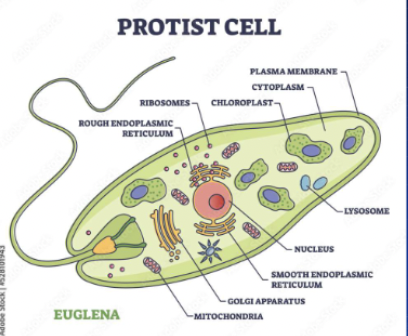
What are key cellular features of protists?
Have a nucleus and membrane-bound organelles (eukaryotes)
Possess a well-developed cytoskeleton
Can have asymmetric shapes
Able to change shape over time
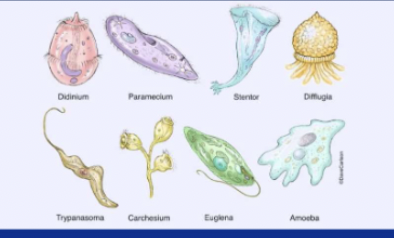
What are some examples of protists?
Protists make up much of diversity of eukaryotes.
Organisms in most eukaryotic lineages are protists
Amoeba, Paramecium, Euglena, Diatoms, Dinoflagellates
Why are protists important for eukaryotic diversity?
Make up a large portion of eukaryotic diversity
Most eukaryotic lineages are protists
Include many evolutionary groups (e.g., SAR clade, Excavata, Archaeplastida, Unikonta)
Why do Protists Matter?
Make up much of eukaryotic diversity
Form the base of aquatic food chains
Produce much of the world’s oxygen
Some cause disease
Help scientists understand the evolution of complex life
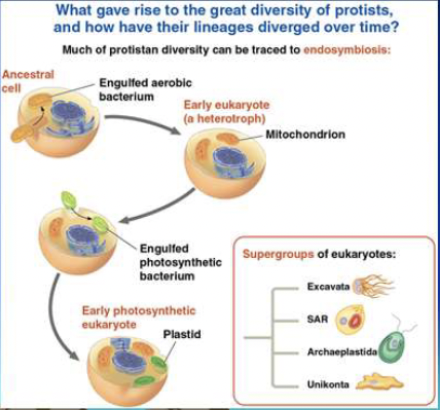
What gave rise to the diversity of protists?
Ancient origins
Endosymbiotic events (mitochondria, plastids)
Adaptation to many environments
Multiple nutritional strategies
Rapid evolution in single-celled organisms
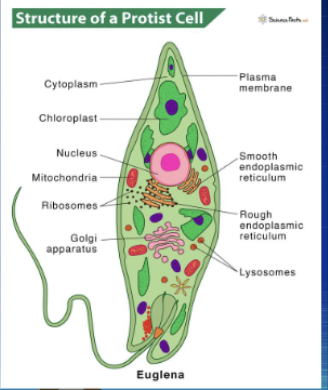
Why and how do protists show structural and functional diversity? (physical features wise)
because they evolved early and adapted to diverse environments.
Protists vary widely in cell structure shape, and complexity and cell coverings
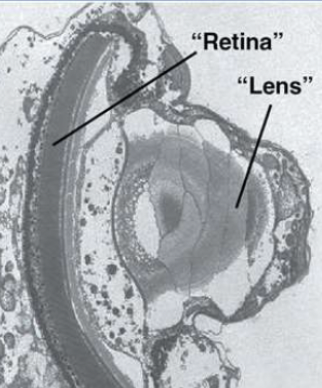
What unique structural feature do some protists have?
Some unicellular protists have unique organelles not found in most other eukaryotic cells.
Some dinoflagellate protists have eye-like organelle called an ocelloid
Functions like a lens + retina
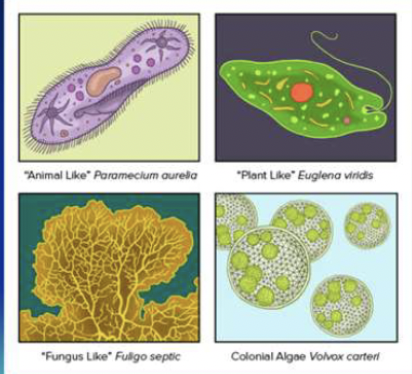
What contributes to the functional diversity of protists? (how they live and behave)
Protists evolved early and adapted to many environments
Show diversity in:
Modes of nutrition
Reproduction
Ecological roles
Can resemble:
Animal-like, plant-like, or fungus-like forms
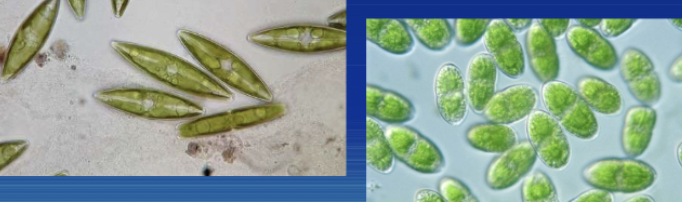
How are protists nutritionally diverse?
Photoautotrophs → photosynthesis (chloroplasts)
Heterotrophs → absorb or ingest food
Mixotrophs → combine both strategies
Some are parasites with specialized nutrient uptake
→ Protists are the most nutritionally diverse eukaryotes
What is endosymbiosis and why is it important in eukaryotic evolution?
Endosymbiosis = process by which one organism lives inside another
Evidence shows of protist diversity has origins in endosymbiosis
Led to origin of key eukaryotic organelles and enabled protists to acquire new metabolic abilities.
Origin of Eukaryotic Cells
Ancestral prokaryotes formed symbiotic relationship when host cell engulfed aerobic bacterium.
Instead of being digested, bacterium evolved into mitochondrion (from aerobic bacteria) + Chloroplasts (from photosynthetic bacteria)
Gave early protists efficient aerobic respiration, allowing larger, more complex cells to evolve + gain new metabolic abilities
Significance: Marks origin of eukaryotes, including all protists
What are the four major supergroups of eukaryotes?
Understanding of evolutionary relationships among protist groups changes rapidly!
Current hypothesis divides all eukaryotes (including protists) into four
supergroups
Excavata
SAR clade (Stramenopiles, Alveolates, Rhizarians)
Archaeplastida
Unikonta
→ All eukaryotes (including protists) are grouped into these lineages
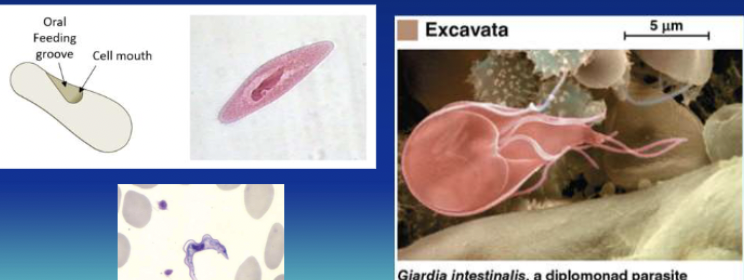
What is the first supergroup?
Excavata
Includes: Parabasalids, Diplomonads, Euglenozoans
Often have a feeding groove
Some are parasites
Example:
Giardia intestinalis → causes intestinal infections
What is the second supergroup?
SAR
Major eukaryotic supergroup
Includes three clades:
Stramenopila
Alveolata
Rhizaria
Examples:
Diatoms (photosynthetic stramenopiles)
Rhizarians (amoebas with threadlike pseudopodia, e.g., Globigerina)
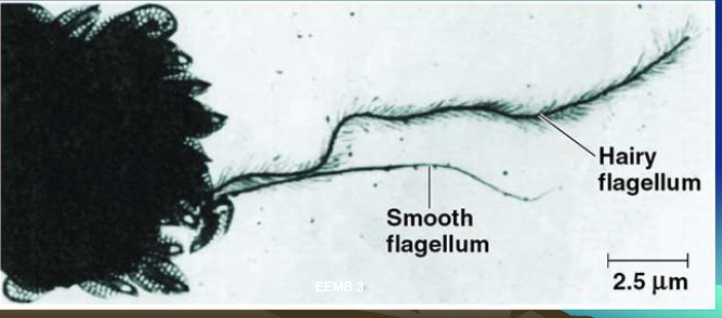
What is Stramenopila?
the S in SAR
Stramenopiles include some of most important
photosynthetic organisms on Earth.
• Most have “hairy” flagellum paired with “smooth” flagellum.
• Diatoms, oomycetes, and brown algae are three important
groups.
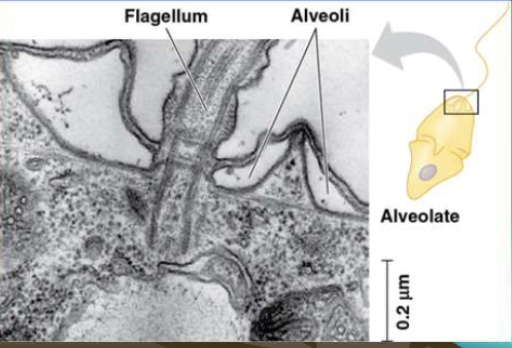
What is Alveolates?
have membrane-enclosed sacs (alveoli) just under plasma membrane.
Three clades are dinoflagellates, apicomplexans, and ciliates.
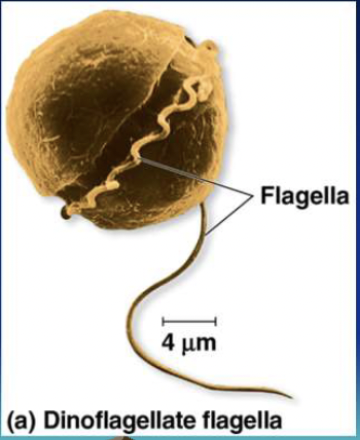
What are Dinoflagellates?
sub category of Alveolates
major components marine and freshwater phytoplankton.
Major primary producers/key in nutrient cycling
Important symbionts in coral reefs
Have two flagella housed in grooves of armor-like cellulose plates that surround cell
Beating spiral flagella causes dinoflagellates to spin as they move through water
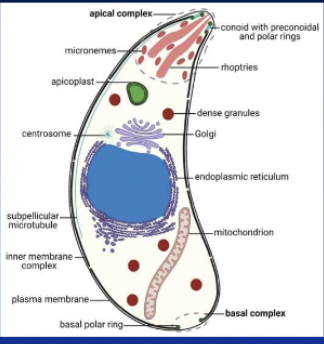
What are apicomplexans?
another subunit of alveolates
Nearly all apicomplexans parasites of animals
Spread through host as infectious cells called sporozoites
Apex (cell end) contains complex of organelles specialized forpenetrating host cells and tissues
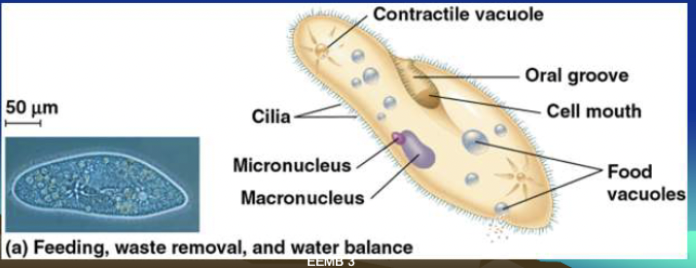
What are ciliates?
last subunit of alveolates
named for use of cilia to move around and feed on bacteria or other protists.
Cilia may completely cover cell surface or be clustered in few rows or tufts.
Well developed organelles
Two nuclei
9+2 filament pattern
What are the two types of nuclei in ciliates and their functions?
tiny Micronucleus:
Small
Genetic/reproductive role
Can be diploid or haploid
large Macronucleus:
Large
Controls cell functions (metabolism, growth)
Contains multiple copies of genome
Each cell has one or more of each type