Patho - Obesity
 Call Kai
 Learn
Learn Practice Test
 Spaced Repetition
 Match
Match Flashcards
 Knowt Play
1/101

There's no tags or description
Looks like no tags are added yet.
Name | Mastery | Learn | Test | Matching | Spaced | Call with Kai |
|---|
No analytics yet
Send a link to your students to track their progress
102 Terms
Obesity is best defined as
an excessive accumulation of fat in the body
Obesity contribues to
numerous chronic diseases
early mortality & morbidity
Most studies use one of three commonly accepted measures to define obesity of adults. Which of the following is not a typical accepted measure?
Volumetric scale
BMI < 18.5:
underweight
BMI 18.5-24.9:
normal
BMI 25.0-29.9:
overweight / preobese
BMI 30-34.9:
class 1
BMI 35.0-39.9
class 2
BMI ≥ 40.0
class 3
Waist circumference is used to determine
an individual’s measure of abdominal fat and to elucidate disease risk
Excess abdominal fat is a predictor of
cardiovascular disease
Waist circumference provides an independent prediction of risk beyond
BMI
Increased risk for premature death and disability when men have wait circumference
>40 in
Increased risk for premature death and disability when women have wait circumference
> 35in
Waist circumference has a
ceiling effect
Waist circumference is NOT linked to
hyperthyroidism
Waist to hip ratio is
Graded and highly associated w/ MI
Waist-to-Hip Ratio for women
85% of higher
Waist-to-Hip Ratio for men
90% or higher
Waist-to-Hip Ratio takes into account differences in
body conformation and distribution of adiposity
Obesity is considered
a pandemic
What is the global prevalence of obesity?
affects 300 million across the world
Obesity has begun to replace
other known causes of mortality
Obesity is second to _______ as leading cause of preventable deaths
cigarette smoking
What is the prevalence of obesity in the US?
65% of adults`
Over time obesity prevalence has
increased
Growth in percentage of people who are now overweight/obese is occurring across
all ages
___ % of children 2 to 5 are obese
13.9
____% of children 6 to 11 are obese
18.4
_____ of adolescents 12 to 29 are obese
20.6
There is a strong link between ______ and ______.
physical inactivity; body weight
Obesity is ultimately an imbalance between
energy intake and energy expenditure
What are known contributors to obesity?
inactivity and energy dense-diet
Which of the following is not a typical environmental factor of obesity?
INC cost of unhealthy food
Which of the following is not a risk factor of obesity?
low glycemic diet
Which of the following best explains how neuroendocrine dysfunction can affect body weight regulation?
It disrupts CNS signaling pws that regulate food intake & BW
Metabolic changes in which structure are associated with obesity?
hypothalamic-pituitary-adrenal (HPA) axis
Changes in the hypothalamic-pituitary-adrenal (HPA) axis results in all of the following except
fewer ATPase pumps
The metabolic events associated with obesity causes all of the following except:
decreased blood pressure
Energy Regulation Systems involves dysfunction of all of the following except
Ca2+ pumps
It is thought that individuals who are obese have
fewer ATPase pumps
Na+/K+/ATPase pump dysfunction resutls in individuals with obesity
utilizing less energy and expending fewer calories.
Chronic sleep deprivation is defined as
sleeping only 4-5 hours/24-hour cycle
Chronic sleep deprivation alters levels of
leptin and ghrelin
Leptin regulates
long-term food intake
Ghrelin stimulates
appetite
Increased wake time might lead to
increased calorie consumption
Which three leading causes of death is obesity associated with?
CVD, cancer, diabetes
Which type of diabetes is often associated with obesity?
type 2
Excessive food intake stimulates
hyperinsulinemia
Excess glucose in circulation is stored in one of two places:
Liver as glycogen
Fat as triglycerides
Obesity + DM results in
hypertrophy & hyperplasia of fat cells
Rising ____ rates and poor management of the disease are linked to obesity
asthma
Link to inability of the person with obesity to take a deep breath results in
reactive airways / asthma
Women with obesity may be more likely to develop
asthma
Functional impairments of obesity includes all of the following except
DEC risk for falls
Individuals with a BMI greater than 59 have been documented with
lymphedema
BMI of >59 is the threshold where
lymphatic flow becomes impaired
Why are the lymphatic concerns with BMI of 59 and above?
Lymphatic vessels become
compressed / inflamed
Women who are obese face high risk of developing health problems during
prenatal development
Complications of obesity include increased risk of all of the following except:
Brief labor
Maternal obesity linked to
higher risk of child developing obesity
Which of the following statements is not true about the other clinical manifestations of obesity?
Individuals will have no difficulty becoming pregnant.
What is key for the treatment of obesity?
prevention
prevention of obesity involves a combo of
healthy eating, reg PA, and maintaining healthy weight
A physcial exam of obesity should include all of the following except:
Assessment of body mechanics
In addition to BMI, Waist circumference, and waist-to-hip ratio, what are measurements can be used for obesity?
Skinfold measurements
Bioelectrical impedance analysis
In bioelectrical impedance analysis, greater fat mass =
Larger impedance
Commonly used BIA machines lack
reliability
What is a major aspect in treatment for the person who is obese?
weight loss
A 10% loss in body weight is regarded as
the standard that improves health (variable)
What are interventions used for weight loss?
regular exercise, support groups, dietary changes, weigh ins
What medications are used for the management of obesity?
OTC and prescription
Which of the following is not a goal of mediations for obesity?
increase appetite
Medications for obesity is Highly controversial and provides
short-term benefits
Medications for obesity should be paired with
exercise, diet, and behavior change
Which of the following is not a MOA for GLP-1 Receptor Agonists (Ozempic)?
Fast gastric emptying, making people feel fuller longer
GLP-1 Receptor Agonists (Ozempic) is a proven benefit for
Reduction in blood glucose levels.
WL
Prevention of metabolic diseases
Which of the following is not a criteria when bariatric surgery is considered?
Minor attempts have failed
What is the gold standard for obesity surgery?
Laparoscopic Roux-en-Y gastric bypass
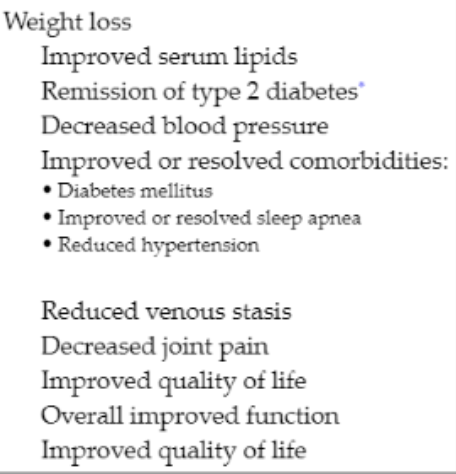
Potential benefits of weight loss
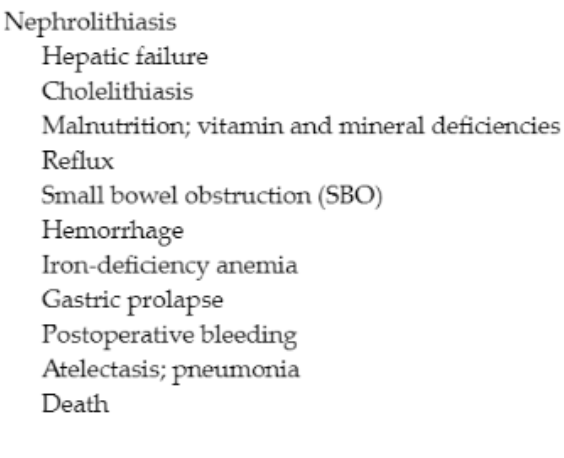
Potential complications of weight loss
What deficiencies is associated with surgery for obesity?
vitamin and mineral
Obesity post-operative complications can include all of the following except:
Acute inflammation of UE
behavioral and lifestyle changes are the foundation of
prevention and intervention
While lifestyle programs are the most successful in creating durable change, it is still affected by
intrapersonal and environmental factors that are hard to control
Obesity requires a treatment that addresses
the person as a whole
Treatment confined to dietary measures alone
prognosis is not good
An incremental change like10-20lb decreased can provide
substantial changes in risk factors
Addition of exercise can reduce _____ fat to a greater degree than _______ fat loss.
visceral; subcutaneous
A relationship between obesity and back pain has
not been established
Severe obesity (BMI >40) is consistently link with
back pain
Increased odds ratio of 1.7 to 9.9 of work-restricting pain in
obese subjects as compared to general populatio
There is an association between
obesity and knee OA
NO association between
obesity and hip or general OA
Individuals with moderate and severe obesity have decreased
mobility
While not statistically associated, there is a trend for individuals with higher BMIs being unable to
complete static balance tests
Muscle has to apply greater force to move
a larger mass (make exercises more challenging)
Exercises that require lower VO2max may have
greater adherence
Exercise should be prescribed with
same principles as when prescribing for healthy individuals