Special Senses: Ear Anatomy, Hearing, and Equilibrium
 Call Kai
 Learn
Learn Practice Test
 Spaced Repetition
 Match
Match Flashcards
 Knowt Play
1/86

There's no tags or description
Looks like no tags are added yet.
Name | Mastery | Learn | Test | Matching | Spaced | Call with Kai |
|---|
No analytics yet
Send a link to your students to track their progress
87 Terms
What are the two special senses located within the ear?
Hearing and Equilibrium
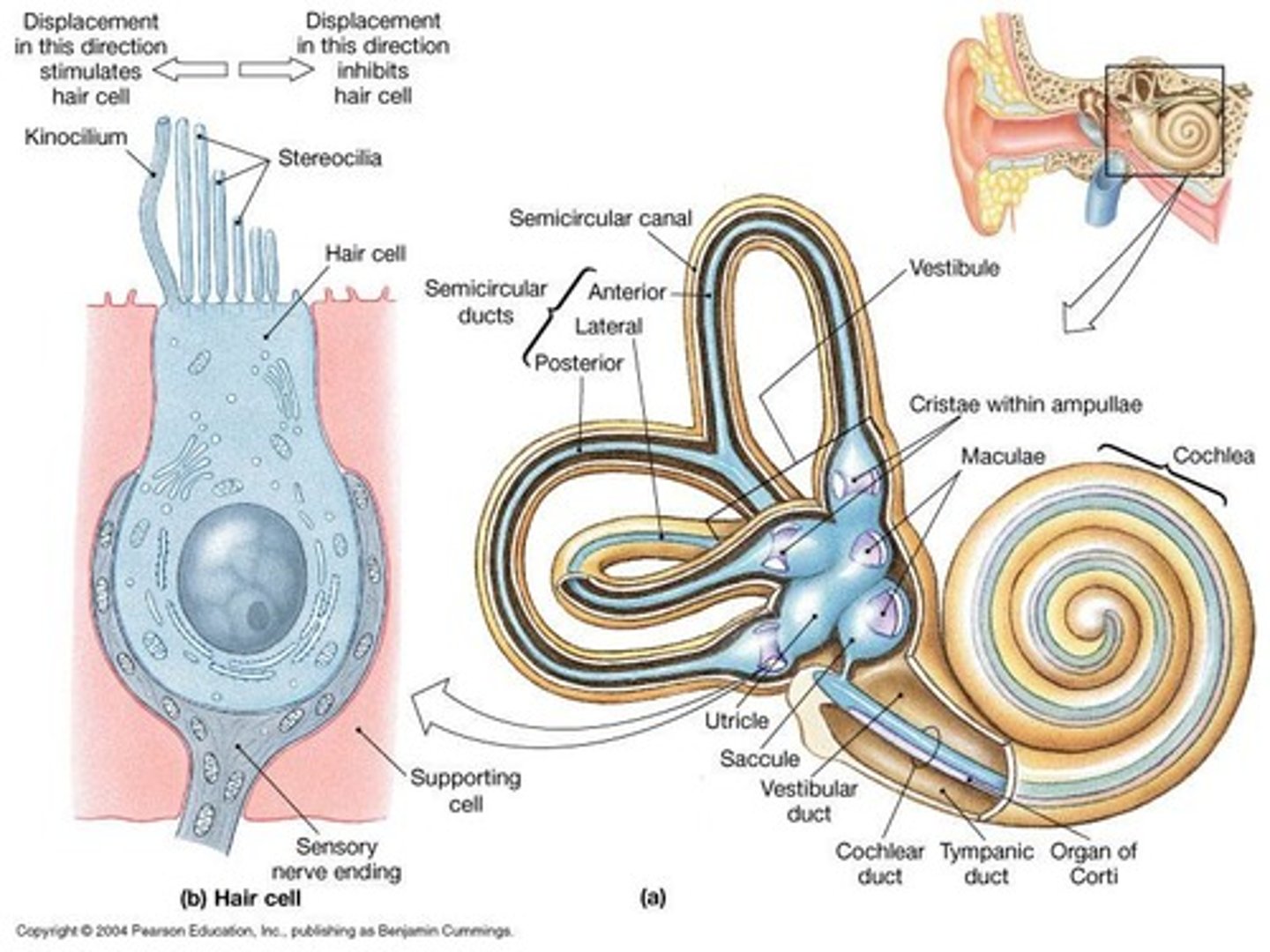
What are the three main areas of the ear?
External ear, Middle ear, Inner ear
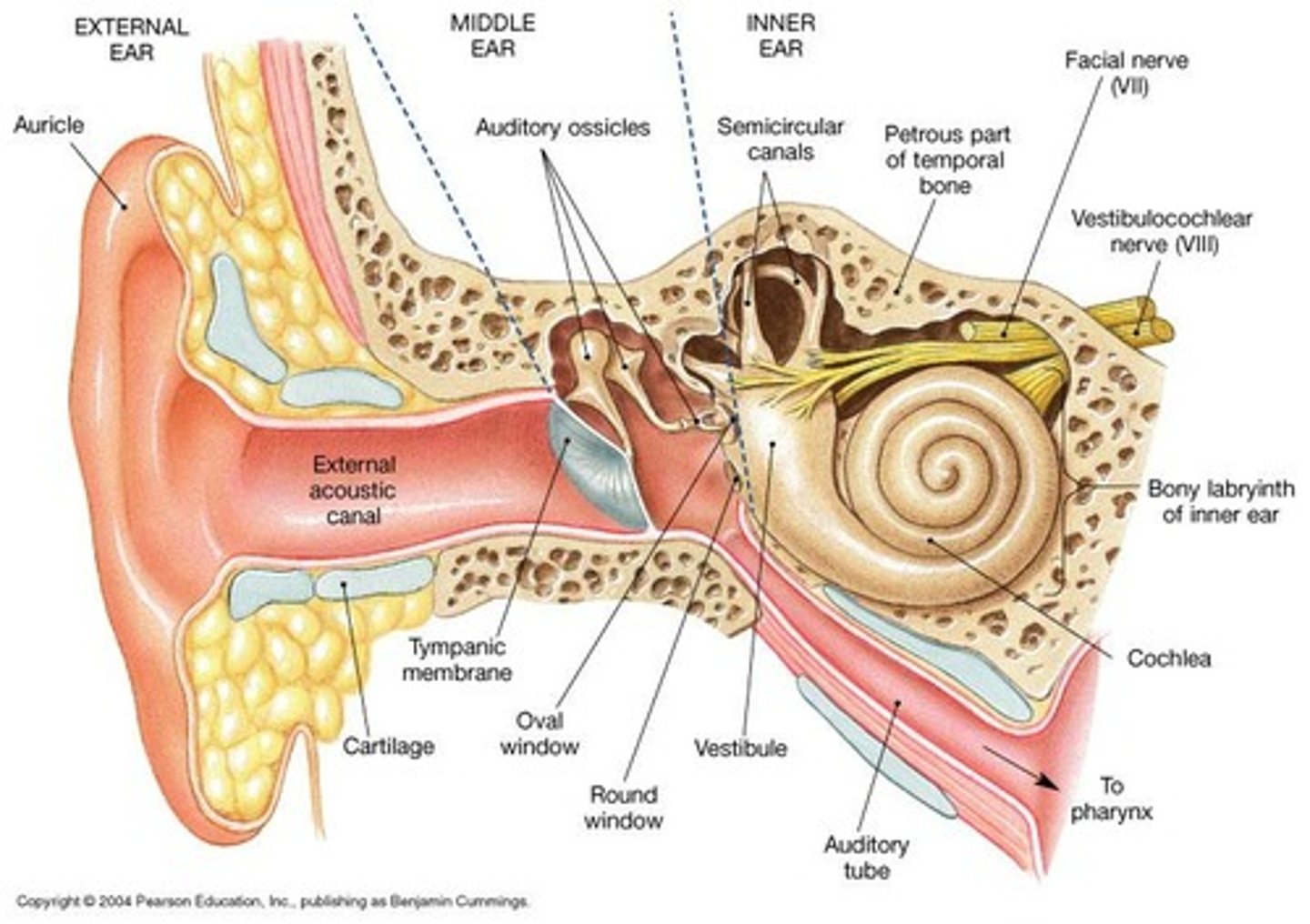
What is the function of the external ear?
Collects soundwaves and directs them to the Middle Ear
What does the Middle Ear do?
Transmits and directs soundwaves to specific portions of the Inner Ear
What is the Tympanic Membrane commonly known as?
Eardrum
What connects the Middle Ear to the nasopharynx?
Pharyngotympanic tube or Eustachian Tube
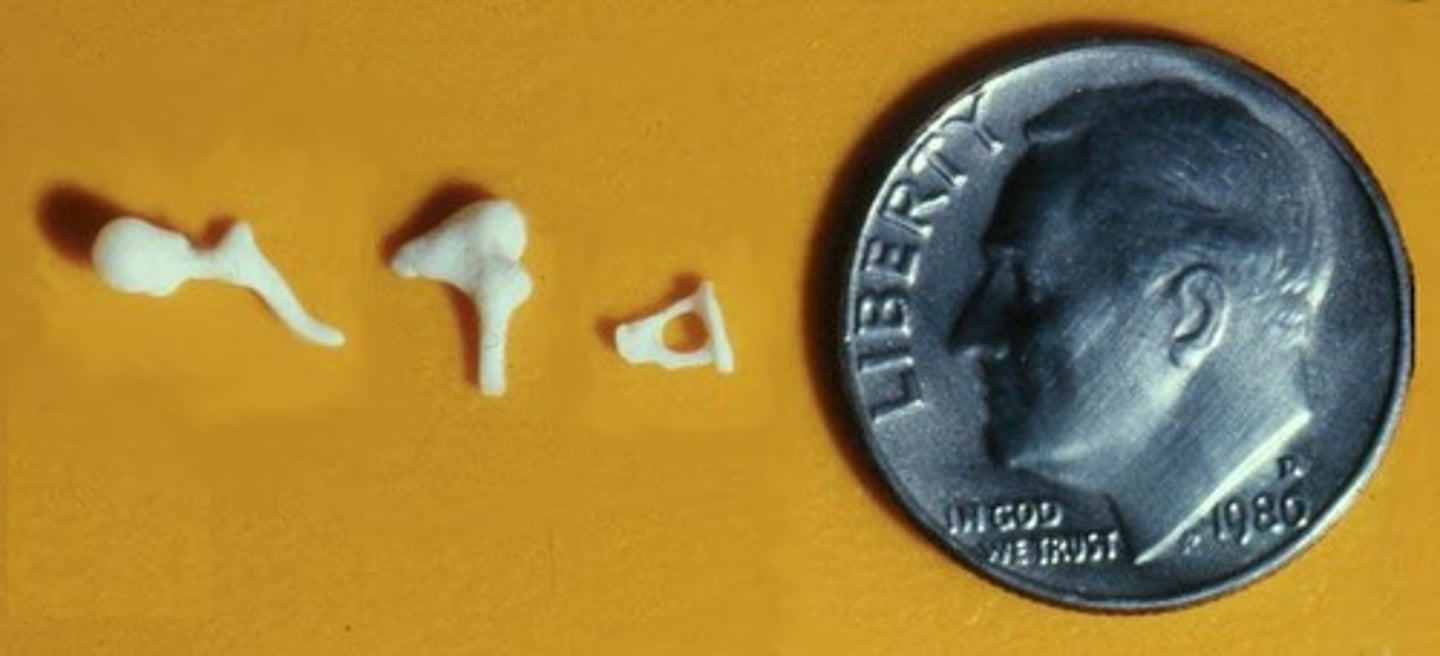
What are the three auditory ossicles in the Middle Ear?
Malleus (Hammer), Incus (Anvil), Stapes (Stirrup)
What is the role of the Tensor tympani muscle?
Stiffens the eardrum by pulling on the malleus
What does the Stapedius muscle prevent?
Excessive movement of the stapes on the oval window
What fluid fills the membranous labyrinth in the Inner Ear?
Endolymph
What is the composition of endolymph?
High potassium and low sodium concentration
What are the two main components of the vestibular complex?
Vestibule and semicircular canals
What is the cochlea responsible for?
Housing the cochlear duct and receptors for hearing
What are hair cells?
Sensory receptors of the auditory system and vestibular complex
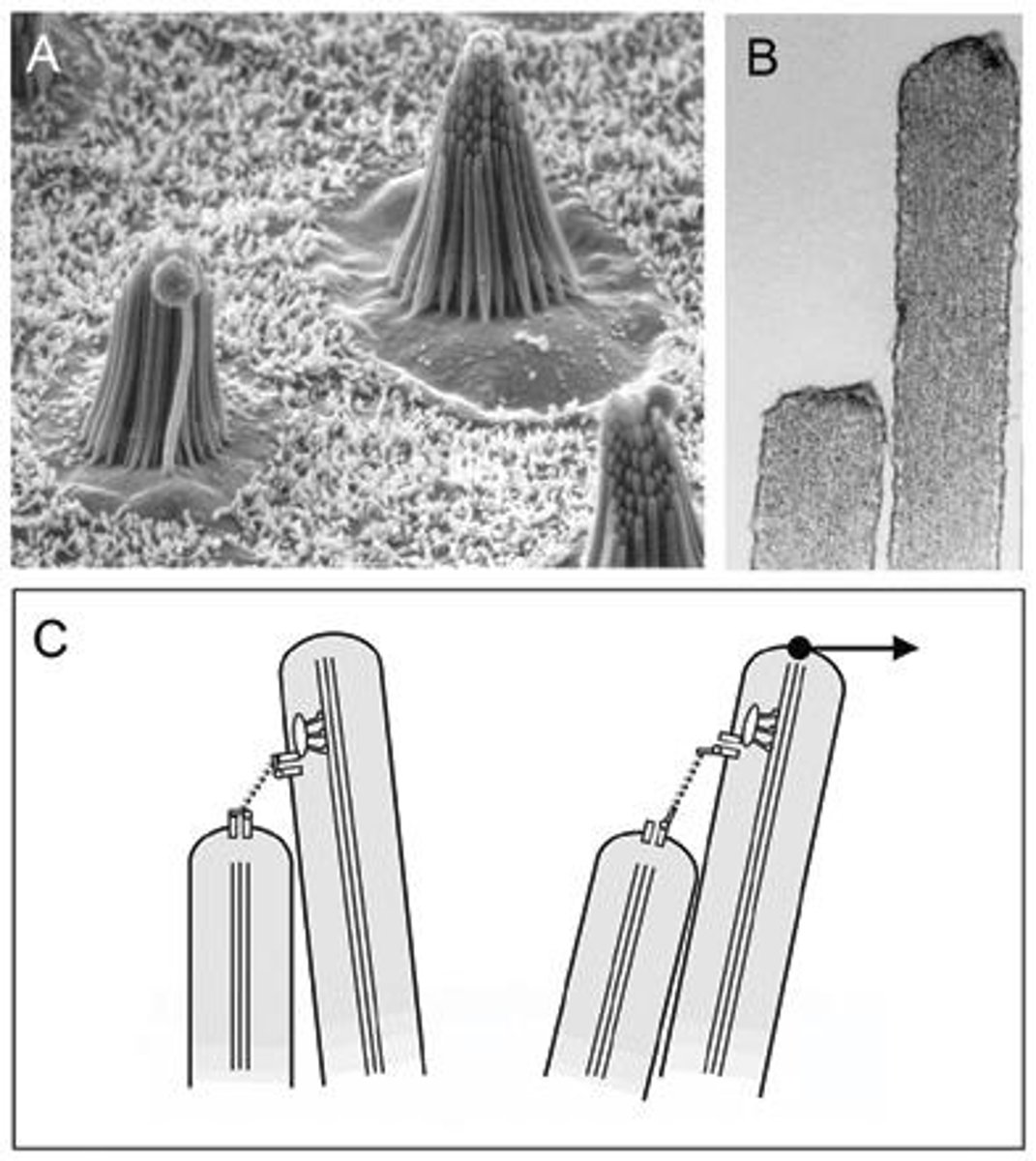
How do hair cells detect movement?
Through mechanotransduction via mechanically gated ion channels
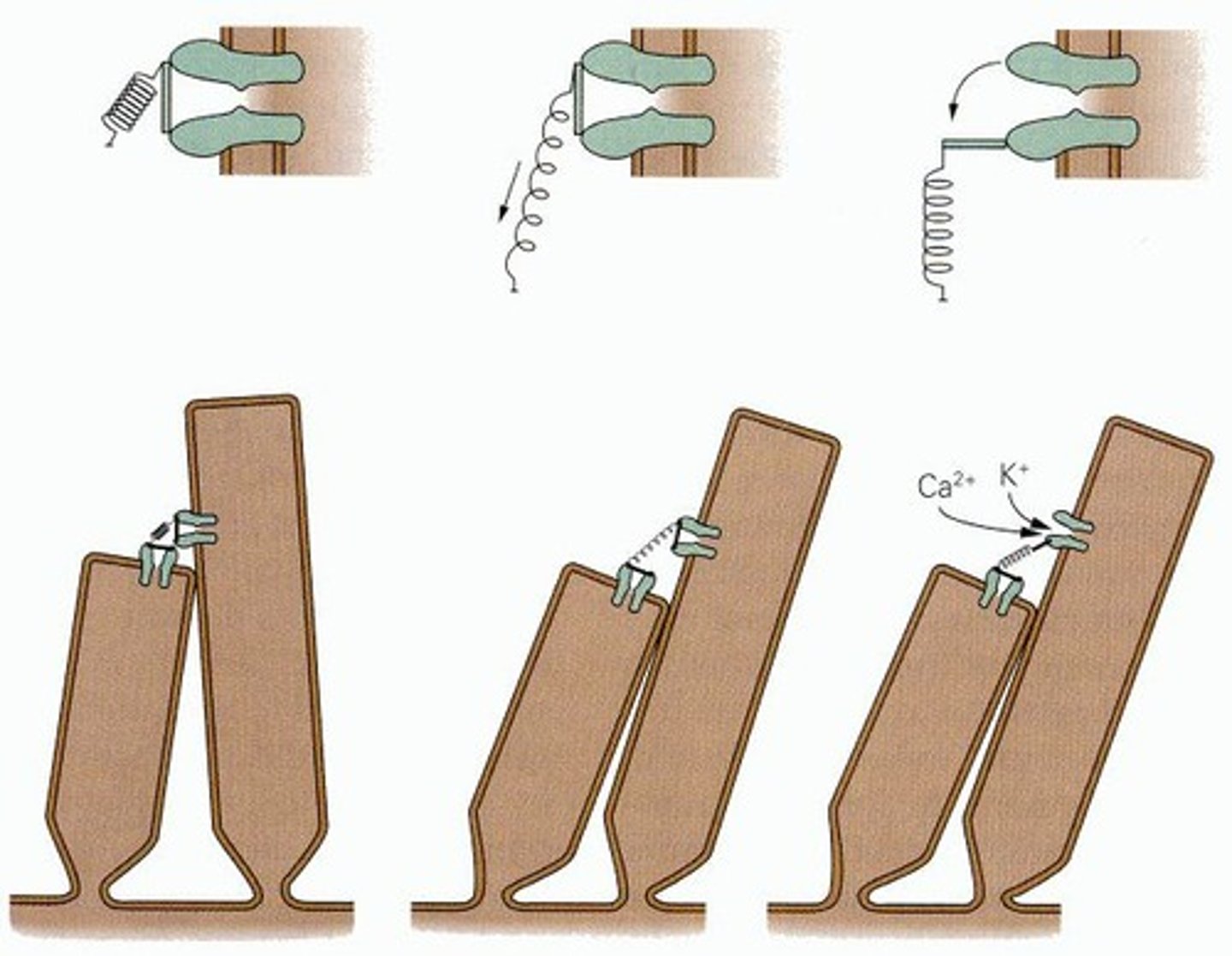
What happens when stereocilia move towards the kinocilium?
It creates a change in membrane potential and increases action potentials
Where are the organs for hearing located?
Within the cochlear duct in the cochlea
What is the Spiral Organ of Corti?
The structure in the cochlear duct where hair cells are organized
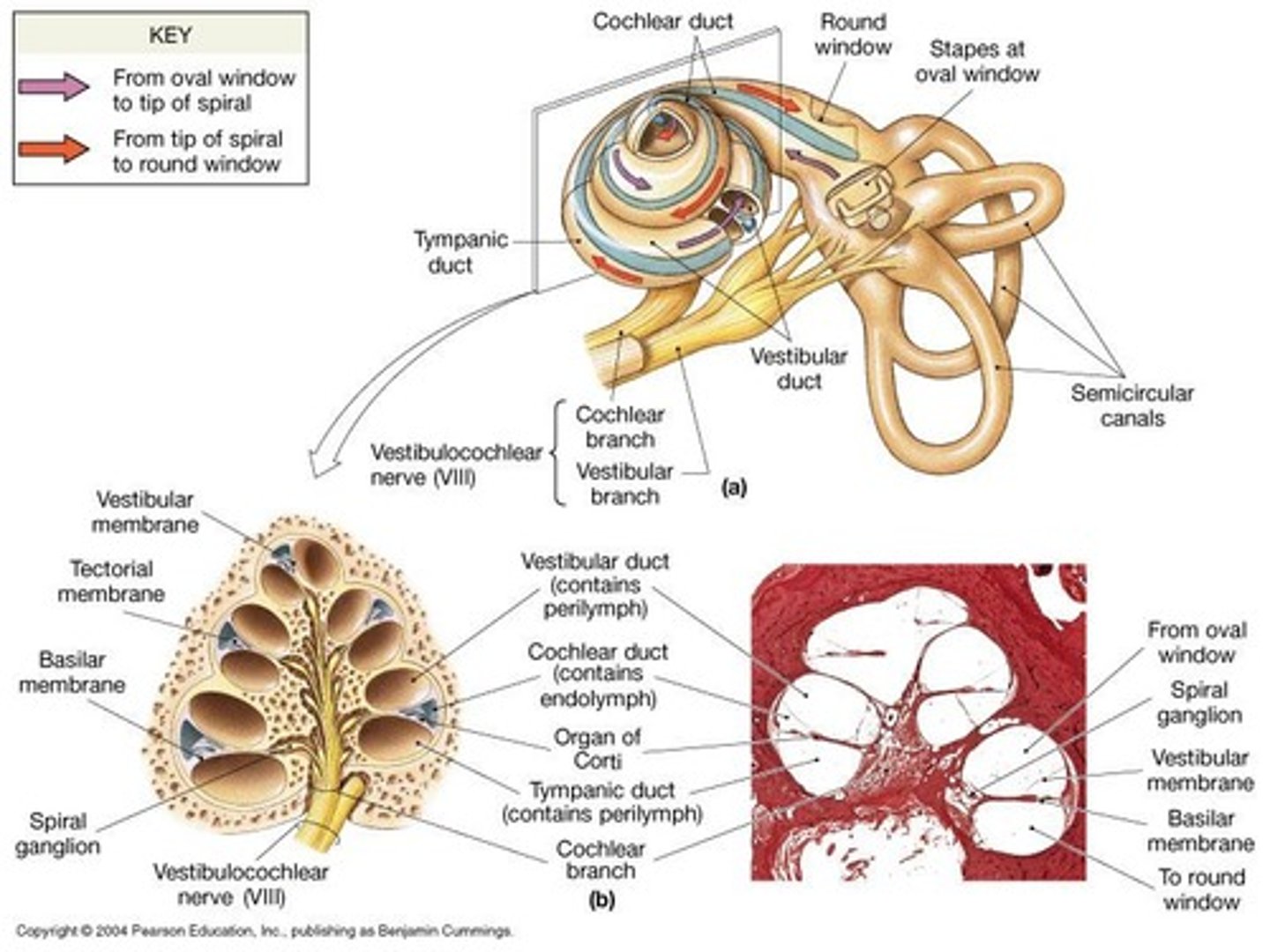
What is the role of the oval window?
Transmits vibrations from the stapes to the inner ear
What is the function of the vestibule?
Contains receptors important for sensation of gravity and linear acceleration
What is the role of perilymph?
Fluid that fills the tympanic duct and vestibular duct surrounding the cochlear duct
What occurs during sound transduction?
Sound vibrations are transformed into waves in the perilymph
What is the significance of the tympanic membrane's size compared to the oval window?
The tympanic membrane is 22x larger, allowing for considerable amplification of sound
What connects the stapes to the oval window?
The stapes connects to the oval window, which in turn connects with the Scala Vestibuli.
What are the three main parts of the cochlear duct?
Scala Vestibuli, Scala Media, and Scala Tympani.
What is the function of the organ of Corti?
The organ of Corti transforms sound into electrical signals and is located on the basilar membrane.
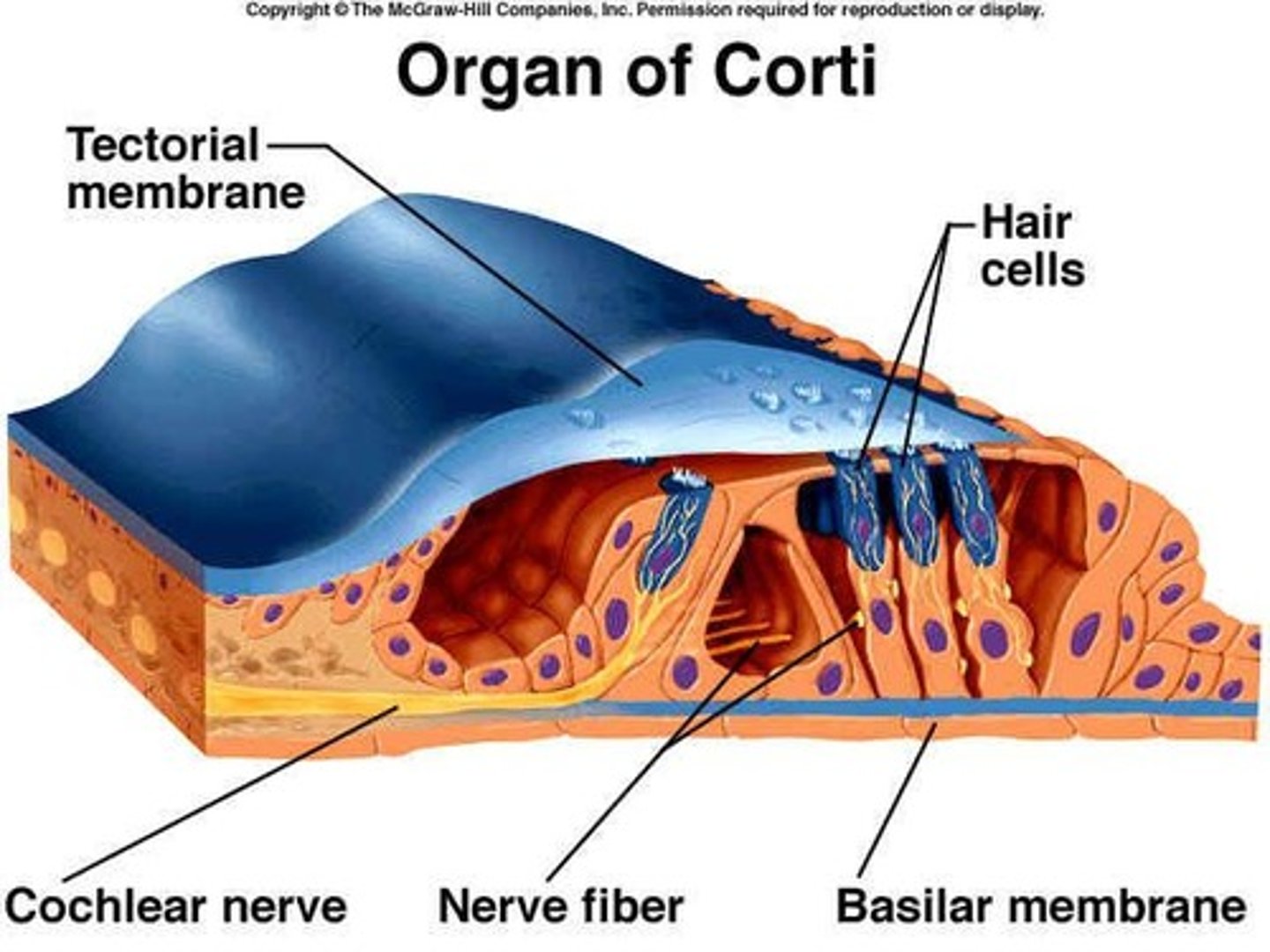
What separates the Scala Vestibuli from the cochlear duct?
The vestibular membrane.
What happens to the hair cells in the organ of Corti when pressure waves occur?
The hair cells bend against the tectorial membrane, initiating membrane potential changes.
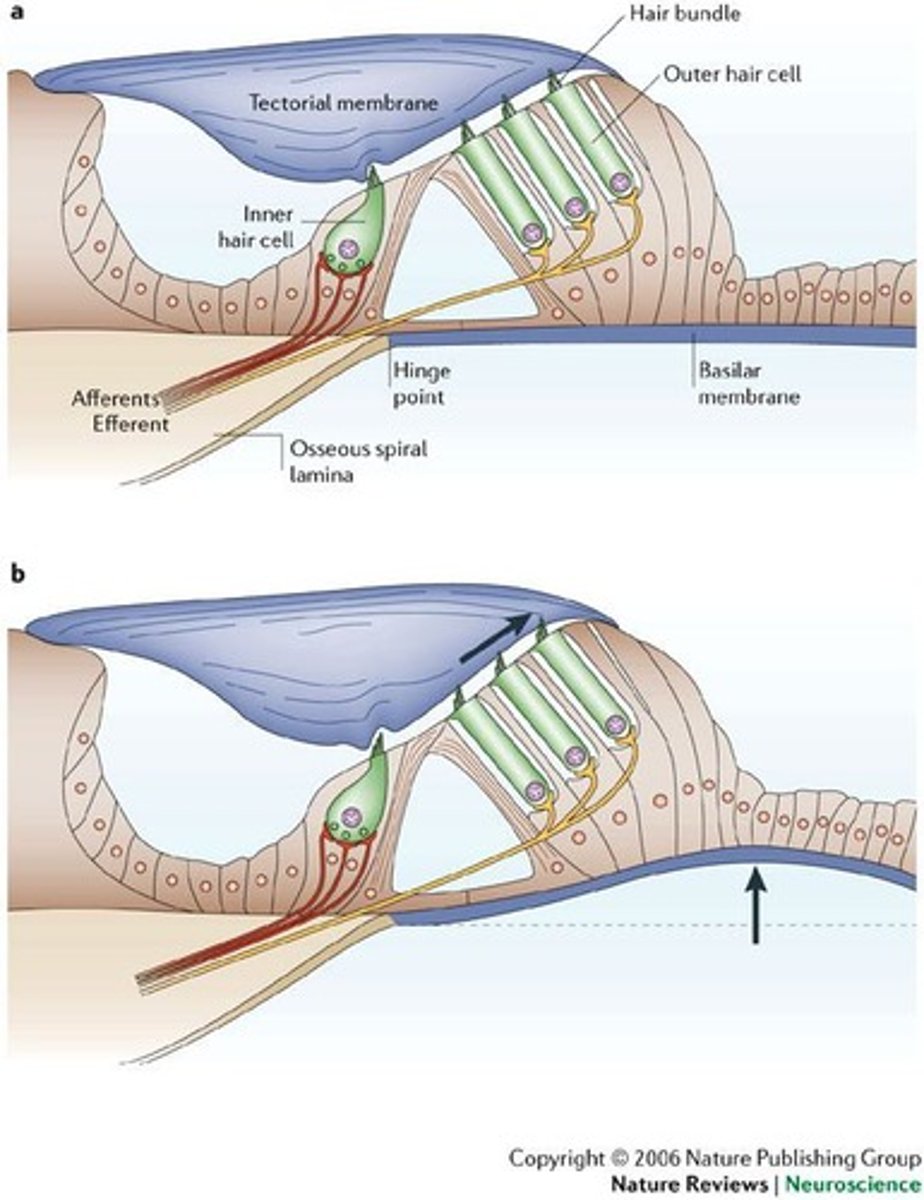
What is the difference between inner and outer hair cells in the organ of Corti?
Inner hair cells connect to afferent nerve fibers for hearing, while outer hair cells are mostly connected to efferent fibers for modulation.
How is sound defined?
Hearing is the detection of sound, which travels in pressure waves.
What determines the frequency of a sound wave?
The wavelength of the sound wave.
How is frequency expressed?
In Hertz (Hz), which is the number of waves per second.
What is the formula for calculating wavelength?
Wavelength = Speed of sound / Frequency of sound.
What is the relationship between pitch and frequency?
High pitch corresponds to high frequency and short wavelength; low pitch corresponds to low frequency and long wavelength.
What is amplitude in the context of sound waves?
Amplitude is the change in pressure as the sound wave passes by, related to the energy carried by the wave.
How is sound intensity measured?
In decibels (dB).
What does a decibel level of 60 dBA indicate?
It is a sound a million times louder compared to the quietest sound a human can hear.
What decibel range is considered very quiet?
Sounds from 10 to 20 dB.
What decibel levels are considered uncomfortable for hearing?
Sounds between 110 and 120 dB.
What are the dangers of sounds ranging from 120 to 140 dB?
They can cause eardrum rupture and instant hearing loss.
What is the role of the basilar membrane in hearing?
It supports the organ of Corti and vibrates in response to sound pressure waves.
What is the helicotrema?
The point at the end of the cochlea where the Scala Vestibuli and Scala Tympani are not separated.
What is the relationship between amplitude and sound energy?
Higher amplitude waves carry more energy and are perceived as louder sounds.
What is the significance of the tectorial membrane?
It interacts with hair cells in the organ of Corti to facilitate sound transduction.
What is the first step in the physiology of hearing?
Sound waves travel toward the tympanic membrane, which vibrates.
What role do the auditory ossicles play in hearing?
They conduct the vibrations from the eardrum into the inner ear.
What frequency range can the eardrum resonate with?
Between 20 and 20,000 Hz.
How do the tensor tympani and stapedius muscles function during loud sounds?
They contract to reduce the amount of movement of the ossicles.
What is the main function of the middle ear?
To act as an impedance-matching device to efficiently transmit sound waves.
Why is the middle ear important for sound transmission?
It transforms acoustic energy to mechanical energy, increasing efficiency.
How does the tympanic membrane compare to the stapes footplate?
The tympanic membrane is much larger, allowing greater force per area at the footplate.
By how much does the middle ear increase sound energy reaching the cochlea?
Approximately 22 times.
What is the role of the cochlea in hearing?
It contains the sensory epithelium and dissipates energy through the round window.
What happens to the basilar membrane as the fluid wave passes over it?
It moves in a wave-like fashion, causing vibrations that vary with frequency.
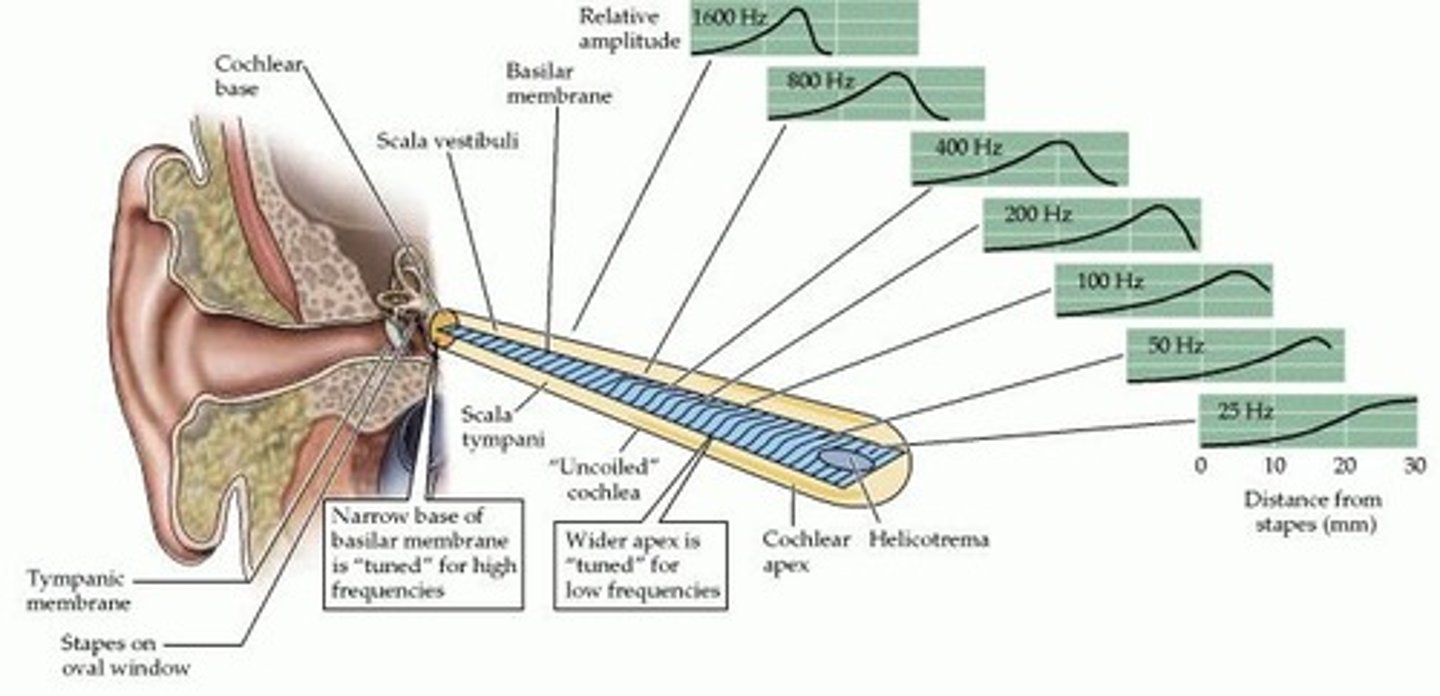
Where does the greatest vibration of the basilar membrane occur?
At the helicotrema for low frequencies and closer to the oval window for high frequencies.
What is tonotropic organization?
The arrangement where specific sound frequencies are received by specific receptors in the inner ear.
What occurs when the basilar membrane is displaced by the perilymph wave?
The kinocilium and stereocilia of hair cells bend, causing ion channels to open.
What ions cause depolarization in hair cells?
Inward K+ and Ca2+ currents.
What neurotransmitter is released by hair cells upon depolarization?
Glutamate.
What is the role of the cochlear nerve in hearing?
It transmits neural impulses from hair cells to the auditory centers of the brain.
Where do the bipolar cells of the cochlear nerve synapse?
In the cochlear nucleus in the medulla oblongata.
What happens to auditory information after it leaves the cochlear nucleus?
It crosses over to the superior olivary nuclei and informs the inferior colliculi.
How does sound information reach the auditory cortex?
Through the medial geniculate nucleus of the thalamus.
What is the significance of tonotropic organization in the auditory cortex?
It allows specific frequencies to be processed, similar to the cochlea.
What would happen if a stroke occurred in the blue area of the primary auditory cortex?
The patient would lose the ability to hear low-frequency sounds.
What is the function of the round window in the cochlea?
It dissipates energy from the vibrations of the stapes.
How long does it take for a wave to travel the length of the cochlea?
Approximately 5 milliseconds.
What is the role of the tectorial membrane in hearing?
It interacts with hair cells to facilitate the opening of ion channels.
What is the function of the spiral ganglion in the cochlea?
It contains the cell bodies of bipolar neurons that transmit auditory information.
What is conduction deafness?
Hearing loss due to sound conduction problems, such as wax buildup or a perforated eardrum.
What is sensorineural deafness?
Hearing loss caused by damage to neural structures, including hair cells or the cochlear nerve.
What is tinnitus?
A condition characterized by ringing or other noises in one or both ears, typically not caused by external sound.
What does the vestibular complex provide information about?
Equilibrium, balance, and spatial orientation.
What are the two components of the vestibular system?
The semicircular canals for rotational movements and the vestibule for linear accelerations and gravity.
What fluid fills the semicircular ducts?
Endolymph fluid.
What is the function of the ampulla in the semicircular canals?
It contains the crista ampullaris, where hair cells are attached, detecting rotational movement.
How do semicircular canals detect head rotation?
Inertia of the endolymph pushes against the cupula, deflecting hair cells and creating action potentials.
What happens when the head stops rotating?
The fluid continues moving in the direction of the initial rotation, causing a sensation of deceleration.
How do the semicircular canals work in pairs?
When one canal is stimulated, its corresponding partner is inhibited, allowing the brain to determine rotation direction.
What can cause vertigo?
Disagreement between the signals from the left and right semicircular canals, often due to infections or damage.
What is the vestibule's role in the ear?
It connects the cochlea and semicircular canals and contains the utricle and saccule for detecting linear acceleration.
What are the maculae in the vestibule composed of?
Hair cells surrounded by support cells, extending into the otolithic membrane.
What do otoliths do in the vestibule?
They make the otolithic membrane top-heavy, aiding in the detection of head position relative to gravity.
How does head tilting affect the otolithic membrane?
It causes the membrane to slide over the macula, bending stereocilia and affecting hair cell depolarization.
What is the orientation of the utricle and saccule?
The utricle lies horizontally, detecting horizontal motion, while the saccule is vertical, detecting vertical motion.
What is the vestibulo-ocular reflex (VOR)?
A reflex that stabilizes images on the retina by coordinating eye movements with head and body movements.
What issues might people with vestibular disorders experience?
Difficulty focusing on objects or perceiving that objects are moving, often leading to sensations of vertigo.