econ exam 2
 Call Kai
 Learn
Learn Practice Test
 Spaced Repetition
 Match
Match Flashcards
 Knowt Play
1/42

There's no tags or description
Looks like no tags are added yet.
Name | Mastery | Learn | Test | Matching | Spaced | Call with Kai |
|---|
No analytics yet
Send a link to your students to track their progress
43 Terms
When an economy is not producing at its potential output, which of the following is likely?
The actual price level is unexpected.
The nominal wage represents
the wage measured in terms of the dollar value of the goods and services a worker can purchase with it.
The short-run aggregate supply curve shows a(n)
direct relationship between the actual price level and real GDP supplied.
Select the statement that most accurately presents sticky-wage theory.
Wages do not adjust immediately to changes in economic conditions, leading to temporary imbalances in supply and demand.
At the potential level of output, there is no seasonal unemployment.
False
The fact that some resource prices are fixed by contracts helps explain why firms
increase output in the short run when the price level increases.
The slope of the short-run aggregate supply curve depends on how sharply
the marginal cost of production rises as real GDP expands.
Suppose Jayden's salary increased from $100,000 to $200,000 per year between 2014 and 2024 and the price index increased from 100 to 300 during the same period. Which of the following statements best describes Jayden's situation?
His real income has decreased and money income has increased.
If the price level in an economy turns out to be higher than that expected by workers and firms, then firms will
increase the quantity supplied more than the economy's potential output.
Cyclical unemployment in an economy will be zero when
the economy is producing its natural level of output.
If nominal wage rates increase by 5 percent per year and the price level increases by 3 percent per year, which of the following is correct?
Real wages will increase by 2 percent per year.
What is the correct definition of the short run?
a period during which some resource prices, especially those for labor, remain fixed
The longer the unemployment rate remains above the natural rate, the higher the natural rate. This theory is known as historical analysis.
false
The consumption function relates consumption spending to
disposable income.
A decrease in the price level in an economy will
increase the level of aggregate quantity demanded.
An economy’s investment demand curve shows the inverse relationship between the quantity of investment demanded and the market interest rate, other things held constant.
true
Government outlays equal
the sum of government purchases and transfer payments.
Historically, consumption spending in the United States has
remained approximately constant as a percentage of income.
Movement along the aggregate expenditure line is caused by a change in the level of income.
true
The main determinants of investment are the interest rates and expected profit.
true
Assuming that there is no capital depreciation and no business saving, what is the relationship between GDP and aggregate income in an economy?
GDP is equal to aggregate income.
If planned spending exceeds the amount produced, how would a firm like John Deere satisfy an increased demand for tractors initially?
by drawing down tractor inventories
What is the formula for the simple spending multiplier?
1/(1 – MPC)
If the spending multiplier is greater than 1.0, a $200 billion increase in autonomous investment will cause
equilibrium real GDP demanded to increase by more than $200 billion.
Which of the following is not true about a change in the price level?
It will shift the aggregate demand curve.
If the marginal propensity to save (MPS) is 1/8, the value of the simple spending multiplier is
8
The marginal propensity to consume (MPC) is
the relationship between a change in consumption and a change in income.
A failure in coordination between workers and employers is most likely to cause an inflationary gap.
False
Unexpected events that affect aggregate supply, sometimes only temporarily, are
supply shocks
Suppose the actual and expected price levels in an economy are initially equal. However, the actual price level falls eventually due to a change in economic conditions. Which of the following will occur in the long run?
The short-run aggregate supply curve will shift to the right.
Short run equilibrium in the aggregate demand–aggregate supply model is defined by the intersection between:
the aggregate demand curve and short-run aggregate supply curve
The more the short-run output exceeds an economy’s potential,
the greater the upward pressure on the price level.
Which of the following supply shocks will shift the long-run aggregate supply curve rightward?
an increase in agricultural output
Which of the following is true of a recessionary gap?
In the long run, this gap closes when resource suppliers negotiate lower resource payments.
In the long run, a decrease in aggregate demand will lead to a(n)
decrease in the price level and no change in the output level.
The historical example of the 1970s OPEC oil embargo represents a _______ for the United States.
negative short-run aggregate supply shock
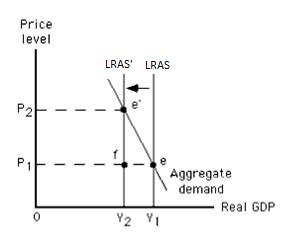
Refer to Exhibit 12.9, which shows the long-run equilibrium in the aggregate demand–aggregate supply model. The movement from Y1 to Y2 in this exhibit could have been caused by a(n)
|
The amount by which actual output falls short of potential output is called
a recessionary gap.
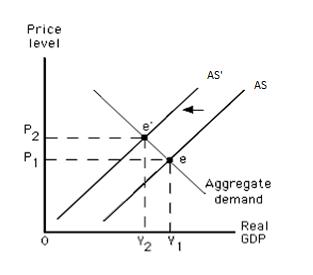
Refer to Exhibit 12.6 which shows the equilibrium price level and real GDP in an aggregate demand–aggregate supply model. Which of the following economic changes is depicted by a movement from point e to point e'?
A decrease in short-run aggregate supply
In the long run, the price level in an economy is determined solely by
the aggregate demand curve.
Which of the following supply shocks would shift the aggregate supply curve inward?
a decrease in agricultural output
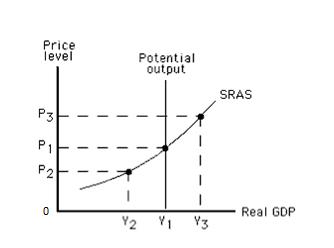
Refer to Exhibit 11.1, which shows the short-run aggregate supply curve of an economy. If the actual price level exceeds the expected price level, then
the equilibrium output is likely to be Y3 in the short run.