Ch. 15: The Cognitive Approach
 Call Kai
 Learn
Learn Practice Test
 Spaced Repetition
 Match
Match Flashcards
 Knowt Play
1/47

There's no tags or description
Looks like no tags are added yet.
Name | Mastery | Learn | Test | Matching | Spaced | Call with Kai |
|---|
No analytics yet
Send a link to your students to track their progress
48 Terms
George Kelly’s “man-the-scientist” perspective.
Like scientists, people constantly generate and test hypotheses about their world. Just as scientists try to predict and control the things they study, we all want to predict and control as many events in our lives as possible. Not knowing why things happen or how the people around us might act can be quite unsettling.
How do we satisfy this need for predictability?
We constantly engage in a process Kelly compared to template matching. That is, our ideas about the world are similar to templates that we place over the events we encounter. If they match, we retain the templates. If not, we modify them for a better prediction next time. For example, based on past observations, you may have generated a few hypotheses about one of your instructors. One hypothesis is that this person is stuffy and arrogant. Whenever you see this instructor, you compare what you see with what you expect. If your hypothesis is verified (the instructor acts the way stuffy people act), you continue using it. If not (outside the classroom he or she is warm and charming), you discard the hypothesis and replace it with a new one that better fits the data. Like scientists, we retain or reject hypotheses based on our findings.
personal constructs
In Kelly’s theory, the bipolar cognitive structures through which people process information.
No two people use identical personal constructs, and no two people organize their constructs in an identical manner.
Kelly described personal constructs as bipolar. That is, we classify relevant objects in an either/or fashion within our constructs.
When I meet someone for the first time, I might apply the personal constructs friendly–unfriendly, tall–short, intelligent–unintelligent, and masculine–feminine to construct my impression of this person. I might decide that this individual is friendly, tall, intelligent, and feminine. But the bipolar nature of personal constructs does not mean that we see the world as black and white with no shades of gray. After applying our first construct, we often use other bipolar constructs to determine the extent of the blackness or whiteness.
For example, after determining that this new acquaintance is intelligent, I might then apply an academically intelligent–commonsense intelligent construct to get an even clearer picture of what this person is like.
Kelly maintained that differences in personality result largely from differences in the way people “construe the world.”
If you and I interact with Jacob, I might use friendly–unfriendly, fun–boring, and outgoing–shy constructs in forming my impression. But you might interpret Jacob in terms of refined–gross, sensitive–insensitive, and intelligent–unintelligent constructs. After we both talk to Jacob for a while, I might act as if I’m interacting with a friendly, fun, and outgoing person. You might respond to Jacob as if dealing with a gross, insensitive, and unintelligent person. It is also possible that two people use the same constructs but construe the world differently. That is, I might think someone intelligent, and you might see the same person as unintelligent. Further, two people’s constructs might be similar on one pole but not the other. I might use an outgoing–reserved construct, whereas you use an outgoing–melancholy construct. If that were the case, what I see as reserved behavior you might see as sadness.
Personal Construct Systems
Because I tend to use the same constructs when meeting people, I probably have a characteristic way I interact with others that is different from yours. In other words, relatively stable patterns in our behavior (i.e., our personalities) are the result of the relatively stable way we construe the world. To get a rough idea of your own personal constructs, ask yourself what you tend to notice about people when you first meet them. The first few thoughts that come to mind are probably some of the constructs you typically use to make sense of other people and their behavior.
However, unlike many theorists, Kelly rejected the notion that psychological disorders are caused by past traumatic experiences:
Rather, he argued, people suffer from psychological problems because of defects in their construct systems. Past experiences with an unloving parent or a tragic incident may explain why people construe the world as they do, but they are not the cause of the person’s problems.
Kelly placed anxiety at the heart of most psychological problems. We become anxious when our personal constructs fail to make sense of the events in our lives. We have all had this experience on occasion. An upcoming interview will cause more anxiety if you have no idea who you will meet or what kind of questions you will be asked. Similarly, when you can’t understand why certain people treat you the way they do or you don’t know how to behave in certain situations, you probably feel confused, disoriented, and anxious.
Relationship problems are particularly unsettling when you don’t know why things are going poorly and have no idea how to put the relationship back on track. You may have experienced this frustration when you said to someone, “I just don’t understand you anymore.” Kelly’s goal as a therapist was to help clients “try on” new templates and thereby regain their ability to make sense of their worlds.
Clarence finds that when he meets people, he tends to categorize them very quickly into one of two categories, approachable or unapproachable. Those who are categorized the first way are people to whom he stays open to developing a friendship, while those who are categorized the second way are people he opts not to spend time around unless he has to. These “either/or” style categorizations are an example of
personal constructs.
idiographic traits.
projected selves.
idealized schemata.
personal constructs.
Psychologist George Kelly called the cognitive structures we use to interpret and predict events personal constructs. No two people use identical personal constructs, and no two people organize their constructs in an identical manner. Kelly described personal constructs as bipolar. That is, we classify relevant objects in an either/or fashion within our constructs.
According to George Kelly, the existence of personal construct systems satisfies the basic human need for
.
intimacy.
power.
achievement.
predictability
predictability
Kelly suggested that personal constructs allow us to make predictions about how other people will be or how they will behave. We then used evidence from the world around us to either strengthen or adjust our constructs so that future interactions will be more accurately predictive.
According to George Kelly, who was a practicing psychotherapist, psychological disorders are caused by
past traumatic experiences.
faulty personal construct systems.
neurological imbalances.
disconnects between one’s perceived self and one’s idealized self.
faulty personal construct systems.
Like many personality theorists, Kelly was a practicing psychotherapist who applied his ideas about personality to treating psychological problems. However, unlike many theorists, Kelly rejected the notion that psychological disorders are caused by past traumatic experiences. Rather, he argued, people suffer from psychological problems because of defects in their construct systems.
Cognitive-Affective Units
In the early days of behaviorism (Chapter 13), psychologists sometimes used a “black box” metaphor to describe the relationship between stimuli and responses. In this model, features in the environment (e.g., a loud noise) cause behaviors (e.g., running away). But what happens inside the organism between the stimulus and response is unknown and unknowable, that is, a black box. In contrast, cognitive personality psychologists maintain that the elements between stimulus and response are the key to understanding personality and behavior. In recent years, these psychologists have introduced a large number of these cognitive variables to account for individual differences in the way people act (Mischel & Shoda, 1995, 2008; Shoda, Tiernan, & Mischel, 2002). Some of these variables, sometimes called cognitive–affective units, are shown in Table 15.1.
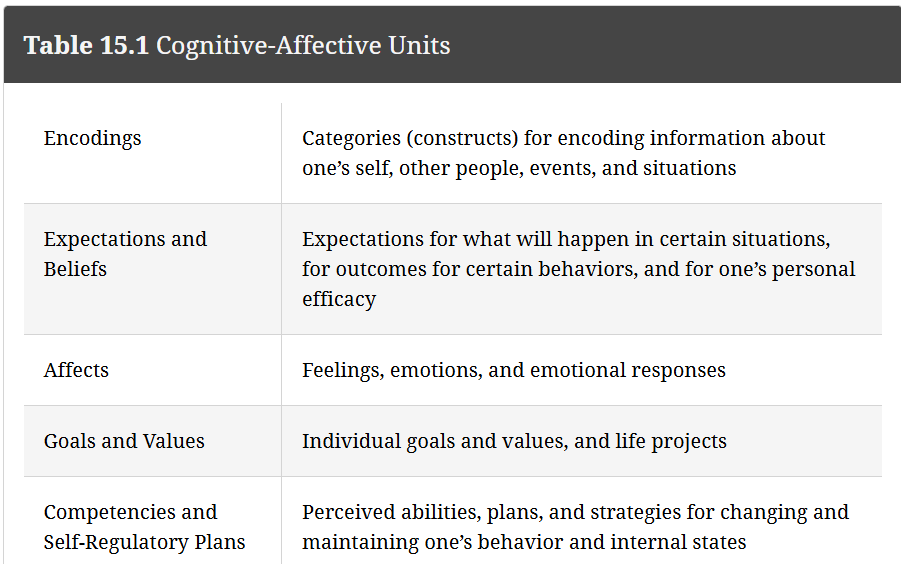
Encodings
|
Expectations and Beliefs
Expectations for what will happen in certain situations, for outcomes for certain behaviors, and for one’s personal efficacy
Affects
Feelings, emotions, and emotional responses
Goals and Values
Individual goals and values, and life projects
Competencies and Self-Regulatory Plans
Perceived abilities, plans, and strategies for changing and maintaining one’s behavior and internal states
Cognitive Model of Personality
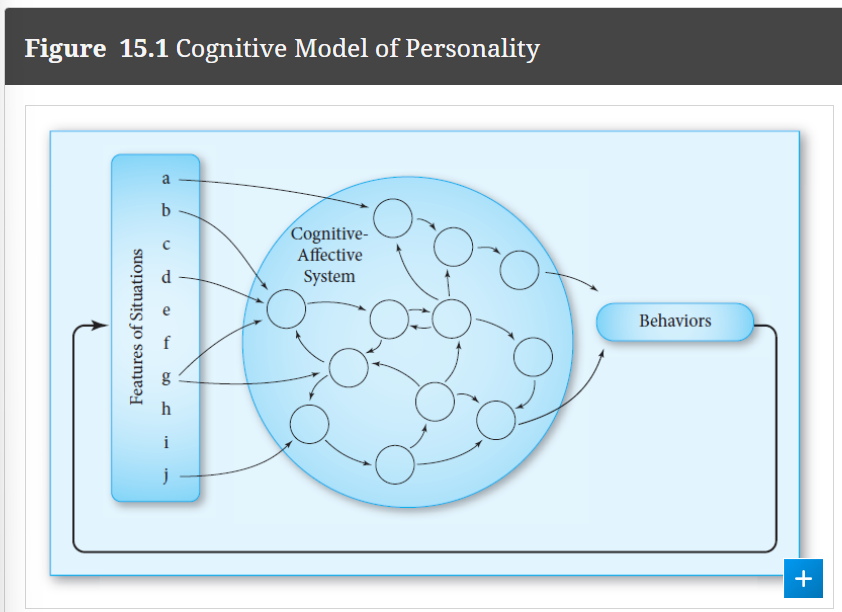
Cognitive variables are part of a complex system that links the situations we encounter with our behavior. An oversimplified illustration of this process is shown in Figure 15.1. How we react to features in the environment, and even whether we notice these features, depends on our cognitive structures. Once perceived, various mental representations—such as expectations, values, and goals—interact with one another to determine how we respond to the situation. Notice also that, as in some of the social learning models, our behavior can then affect the situation.
How do we explain individual differences within this cognitive framework? The answer is that each of us possesses a different set of mental representations. In addition, how easily we access certain kinds of information stored in memory varies from individual to individual. As a result, two people often react to the same situation differently. What one person hears as a clever retort someone else might take as an insult. A Christmas tree will remind one person of religious values, another of family and seasonal joy, and a third of sad memories from childhood.
How did early behaviorists describe the relationship between stimuli and responses (i.e., what happened internally between stimulus input and behavioral output)?
A computer screen
A black box
An animal cage
A train
A black box
In the early days of behaviorism (Chapter 13), psychologists sometimes used a “black box” metaphor to describe the relationship between stimuli and responses. In this model, features in the environment (e.g., a loud noise) cause behaviors (e.g., running away). But what happens inside the organism between the stimulus and response is unknown and unknowable, that is, a black box.
When she overhears another fan using foul language at a professional baseball game, Trina tends to just ignore it. Maddie, on the other hand, will typically ask that other fan to quiet down and remember that children are present. Vondra takes a more direct approach and asks the usher to remove the offending person. A cognitive psychologist might suggest that the variations in their responses to the same stimulus is caused by different
cognitive–affective units.
behavioral schemas.
activating scripts.
ABC combinations.
cognitive–affective units.
In recent years, cognitive psychologists have introduced a large number of these cognitive variables to account for individual differences in the way people act. Some of these variables, sometimes called cognitive–affective units, are shown in Table 15.1.
Information that lets us anticipate what will happen in certain situations, for outcomes, for certain behaviors, and for one’s personal efficacy refers to a cognitive-affective unit called
expectations and beliefs.
affects.
goals and values.
competencies and self-regulatory plans.
expectations and beliefs.
Please refer to Table 15.1 to see a definition of five different cognitive–affective units described by your author.
Cognitive Representations of the Self: self concepts and mental representations
develope young
are relatively stable over tume
Psychologists sometimes refer to this representation as our self-concept.’
esearch indicates that cognitive representations of our selves play a central role in the way we process information and thus how we interact with the world around us.
Self-schemas
A schema consisting of aspects of a person’s life most important to him or her.
Your self-schema consists of the behaviors and attributes that are most important to you.
Because each part of your life is not equally important, not everything you do becomes part of your self-schema.
some people include athlete or physically fit in their self-schemas. Another way of saying this is that these individuals consider their athletic activities a part of who they are. Researchers find that people who incorporate these identities into their self-schemas are more likely to stick with regular exercise programs than those who do not
According to a self-schema analysis, the items that were easy to answer are those for which you have a well-defined schema.
dependence vs independence schema study(?????????????)
Much of the early research on self-schemas was based on this reasoning. Participants in one study were classified as possessing either a strong independence schema or a strong dependence schema or as aschematic (Markus, 1977). Later, these participants were presented with a series of adjectives on a computer screen. Their task was to press either a ME or a NOT ME button to indicate whether the adjective described them. Fifteen of the adjectives were related to independence (e.g., individualistic, outspoken) and 15 to dependence (e.g., conforming, submissive). As Figure 15.3 shows, people with strong independence schemas pressed the ME button quickly on the independence-related adjectives but took longer to respond on the dependence-related adjectives. Participants with strong dependence schemas responded in the opposite pattern. Aschematics showed no difference in making these judgments for any of the words.
In addition to allowing for rapid processing of schema-relevant information, self-schemas provide a framework for organizing and storing this information.
Consequently, we would expect people to retrieve information from memory more readily when they have a strong schema for a topic than when the information is stored in a less organized manner. To test this hypothesis, researchers presented college students with a series of 40 questions on a computer screen (Rogers, Kuiper, & Kirker, 1977). Participants answered each question by pressing a YES or a NO button as quickly as possible. Thirty of the questions were written so that people could answer easily without using their self-schemas to process the information. For these questions, participants simply answered whether a word was printed in big letters, whether it rhymed with another word, or whether it meant the same thing as another word. However, for 10 questions, participants had to decide whether the word described them. That is, they had to process the information through their self-schemas.
What the participants were not told was that afterward they would be asked to recall as many of the 40 words as possible. As shown in Figure 15.4, when participants answered questions about themselves, they were more likely to remember the information than when the question was processed in other ways. The researchers point to this finding as evidence for a self-schema. When asked whether a word describes them, participants processed the question through their self-schemas. Because information in our self-schemas is easy to access, the self-referent words were easier to remember than those not processed through self-schemas. But might this finding be explained in other ways? Could it be that the self-referent question was simply harder than the other questions, thus causing participants to think about it more? Apparently not. When people are asked if a word describes a celebrity—a question that also requires some thinking—they don’t recall the words as well as when they are asked about themselves (Lord, 1980).
self-reference effect
being able to recall info that relates to the self easier than words that do not.
Researchers also find that we often relate new information we encounter to something about ourselves. For example, when a friend tells you she went to Paris, you might think of your own visit to Paris. Moreover, information processed in this self-related manner should be more readily accessible in memory than information we are unable to relate to ourselves.'
students were significantly more likely to remember a friend’s birthday when that birthday was close to their own. That is, if you and your friend both have birthdays in November, you are more likely to recall that friend’s birthday than if your friend had been born in April.
Possible Selves
Cognitive representations of the kind of people we think we might become some day.
Our behavior is directed not only by cognitive representations of the way we think of ourselves at the moment, but also by representations of what we might become. You might think about a future self with a lot of friends, with a medical degree, or with a physically fit body. Psychologists refer to these images as our possible selve
These include roles and occupations we aspire to, such as police officer or community leader, as well as the roles we fear we might fall into, such as alcoholic or divorced parent.
include the attributes we think we might possess in the future, such as being a warm and loving person, an overworked and underappreciated employee, or a contributor to society. In a sense, possible selves represent our dreams and aspirations as well as our fears and anxieties.
stable over time
serve 2 functions:
First, they provide incentives for future behavior. When making decisions, we ask ourselves whether a choice will take us closer to or further away from one of our future selves. A woman might enter an MBA program because this decision moves her closer to becoming her powerful business executive possible self
The second function of possible selves is to help us interpret the meaning of our behavior and the events in our lives. A man with a professional baseball pitcher possible self will attach a very different meaning to an arm injury than someone who does not think of himself this way.
Because possible selves guide many of our choices and reactions, they can be useful in predicting future behavior.
Other research has tied possible selves to problem behaviors. One team of investigators examined possible selves in juvenile delinquents (Oyserman & Markus, 1990; Oyserman & Saltz, 1993). Significantly, more than one-third of the juvenile delinquents had developed a criminal possible self. In addition, very few of these adolescents possessed possible selves for more conventional goals, such as having a job. Because possible selves are indicative of our goals, fears, and aspirations, we should not be surprised if many of these youthful offenders were to become adult criminals.
gender differences in the possible selves
female high school and college students are less likely than males to see themselves in traditionally masculine roles in the future. University women are less likely than men to have a possible self that includes a career in a math, science, or business (Lips, 2004). Male students are less likely than women to see themselves in careers related to arts, culture, and communication.
High school girls who have female friends interested in science and who receive encouragement from their peers are more likely to develop a scientist possible sel
Same-gender role models also help. High school girls who see women scientists and business leaders are more likely to incorporate these occupations into their possible selves.
Elisa’s grandfather asks her, “Tell me who you are, honey!” The 8-year-old child says, “I’m a 2nd grader, I’m a big sister, and I’m a good girl!” These most important attributes that Elisa notes about herself comprise her
self-schema.
cognitive identity.
self-esteem.
projected self.
self-schema.
Self-schemas are cognitive representations of ourselves that we use to organize and process self-relevant information. Your self-schema consists of the behaviors and attributes that are most important to you. Because each part of your life is not equally important, not everything you do becomes part of your self-schema.
Researchers examining the relationship between self-schemas observed a number of elementary school children. Some children used words that identified prosocial as part of their self-schema, while others did not. What did the researchers observe in the behavior of these children?
All children were equally likely (or unlikely) to give valuable tokens to other children, demonstrating a strong disconnect between self-schema and actions.
Those who identified as prosocial were more likely than those who did not to give valuable tokens to other children, suggesting that our self-schema is predictive of our actions.
Children who felt they were prosocial were actually less likely than others to give valuable tokens to others children, suggesting that self-schemas are a defensive compensatory device for actions.
Whether or not children gave valuable tokens to others was found to be unrelated to self-schema but strongly related to whether or not the class was discussing generosity as a topic that day.
Those who identified as prosocial were more likely than those who did not to give valuable tokens to other children, suggesting that our self-schema is predictive of our actions.
Various studies have found that our behaviors tend to be well-predicted by our self-schemas, indicating that our understanding of ourselves is related to the ways in which we behave. However, what is the direction of cause? Do our self-schemas cause our actions, or do our actions cause our self-schemas? Perhaps both answers are correct.
Stuart is a relatively unpleasant person. He is somewhat short with servers in restaurants, is rude to telemarketers who are just doing their jobs, and finds it easy to laugh at other people for their own shortcomings. Stuart is aware that his personality is somewhat rough but believes that he can change and be much kinder to others. The idea of a more friendly, amicable identity represents Stuart’s blank 1 self.
possible
prospective
forecasted
defensive
possible
Possible selves are cognitive representations of the kind of person we might become someday. These include roles and occupations we aspire to, such as police officer and community leader, as well as the roles we fear we might fall into, such as alcoholic and divorced parent. Possible selves also include the attributes we think we might possess in the future, such as being a warm and loving person, an overworked and underappreciated employee, and a contributor to society.
Cognitive (Behavior) Psychotherapy
today many therapists combine cognitive approaches to therapy with procedures from traditional behavioral therapies.
People become anxious and depressed because they harbor anxiety-provoking and depressing thoughts. Consequently, the goal of most cognitive therapies is to help clients recognize inappropriate thoughts and replace them with more appropriate ones.
For example, imagine a man who suffers from intense social anxiety (Chapter 8). A cognitive therapist might explore the kinds of thoughts the man tells himself when he anticipates a social encounter. These thoughts most likely include statements like, “I don’t know why I’m going to this dumb party” At the first awkward moment, he will conclude that things are going as poorly as anticipated, and all the nervousness and embarrassment he dreads are likely to follow. A cognitive therapist might help the man to replace these self-defeating thoughts with more appropriate, positive ones
cognitive psychotherapy does not work for everyone and may be limited to psychological problems that are based in irrational and self-defeating thinking.
Cognitive-behavioral therapies have been found to be especially effective for treating emotional disorders like depression and anxiety
Not only do these treatments relieve the symptoms of emotional disorders, but people who have gone through cognitive-behavioral therapies are less likely to experience a relapse in the future.
Rational Emotive (Behavior) Therapy developed by albert ellis
A psychotherapy procedure introduced by Ellis that examines the irrational reasoning causing emotional problems.
According to Ellis, people become depressed, anxious, upset, and the like because of faulty reasoning and a reliance on irrational beliefs. Ellis described this as an A-B-C process.
For example, suppose your boyfriend/girlfriend calls tonight and tells you the relationship is over. This is the A, which Ellis calls the Activating experience. However, when clients seek out psychotherapy, they usually identify the reason as the C, the emotional Consequence. In this case, you are probably feeling depressed, guilty, or angry. Of course, an emotional reaction to breaking up is entirely appropriate. But if your reaction is severe and starts interfering with your ability to go to work or attend classes, you might benefit from some cognitive counseling.
If you were to seek that counseling from someone like Ellis, you would be asked how you could logically go from A (the experience) to C (the emotion). Why should a personal setback or loss cause such a strong negative reaction? The answer is that you must be using a middle step in this sequence, B—the irrational Belief. The only way you could logically conclude from breaking up with your partner that you should be severely depressed is that you are also saying to yourself something like “It is necessary for me to be loved and approved by virtually every person in my life,”’
Ellis maintained that each of us harbors and relies on a large number of these irrational beliefs
The goal of rational emotive therapy is twofold. First, clients must see how they rely on irrational beliefs and the fault in their reasoning. Second, the therapist works with the client to replace irrational beliefs with rational ones.
This person, who was an early advocate of cognitive therapy, developed the techniques that became known as rational emotive therapy.
Beck
Koffka
Seligman
Ellis
Ellis
One of the earliest advocates of cognitive therapy was Albert Ellis, who developed rational emotive therapy. Consistent with the tendency to blend cognitive and behavioral treatments, toward the end of his career, Ellis referred to his approach as rational emotive behavior therapy. According to Ellis, people become depressed, anxious, upset, and the like because of faulty reasoning and a reliance on irrational beliefs.
After her first application to a graduate school is met with a rejection letter, Kami decides that there is no point in applying to any other schools. “I obviously don’t have the credentials they are looking for, so why waste my time?” These thoughts lead her to feel very sad and disappointed with herself, which, in turn, cause her to stop putting in her usual level of effort in her classes. In the Rational Emotive Therapy model, Kami’s thoughts about the rejection letter exist at the blank 1 stage.
A
B
D
C
B
If you were to seek that counseling from someone like Ellis, you would be asked how you could logically go from A (the experience) to C (the emotion). Why should a personal setback or loss cause such a strong negative reaction? The answer is that you must be using a middle step in this sequence, B—the irrational Belief.
Which of the following would be an example of what a rational emotive therapist would call a “subtle and tricky” irrational belief?
I want people to approve of me, so I must always have everyone’s approval.
I want others to be considerate of my needs, so they must treat me in a fair and considerate manner at all times.
I want to have a safe and comfortable life, and because I try to help others have a safe and comfortable life, my living conditions should always be easy, convenient, and gratifying.
I want to be good at what I do, so my functions must always be without flaw of any kind.
I want to have a safe and comfortable life, and because I try to help others have a safe and comfortable life, my living conditions should always be easy, convenient, and gratifying.
Please refer to Table 15.2 to see some examples of obvious or subtle and tricky irrational beliefs. Note how one type of faulty belief might be more resistant to change than another type.
how does one go about measuring personal constructs? Of
Of course, a therapist might obtain some idea of a client’s construct system during therapy sessions. But Kelly and his colleagues needed an efficient way to identify personal constructs that could also be easily understood by clients. His solution was the Repertory Grid Technique.
Repertory Grid Technique.
Kelly and his followers developed several variations of this technique (Caputi, Viney, Walker, & Crittenden, 2012; Fransella, Bell, & Bannister, 2003), but the essential procedure consists of two steps (Bell, 1990). First, the test taker creates a list of elements. The items on this list can be anything the person encounters in life, but most often the list consists of specific people the test taker knows. Second, the test taker’s personal constructs are elicited by comparing and contrasting various elements on the list.
Role Construct Repertory Test, more commonly known as the Rep Test.
The most common version of the grid technique is the Role Construct Repertory Test, more commonly known as the Rep Test. A shortened version of the basic Rep Test procedure is presented on pages 392–393. Therapists begin by asking clients to provide a list of 24 people from various personal experiences—for example, a teacher they liked, the most interesting person they know, and so on. The therapist then presents clients with three of the names from this list and asks, “In what important way are two of these people alike but different from the third?” A client might say that two of them are warm people and that the third person is cold. In Kelly’s terms, this client has used a warm–cold construct to categorize the three people. The process is repeated with three different names from the list. Perhaps this time the client will divide the people along an outgoing–shy or a generous–miserly construct. Kelly suggested that about 20 trials, or “sorts,” provide the therapist with a useful sample of the client’s principal constructs.
In one variation of the Rep Test, the therapist takes away one of the three names and replaces it with a new one. This procedure can be useful in identifying clients’ difficulties in applying new constructs to new situations. To examine self-concepts, therapists sometimes present the client’s name along with two names from the list. Again, clients are asked how two of the three are alike and one is different. In another variation of the procedure, therapists take the list of constructs generated from the client’s initial Rep Test and ask the client to evaluate each person on the list according to the construct. This step creates a grid similar to the one shown in Table 15.3 and allows the therapist and client to look for patterns across a broad set of information.
when is the rep test used?
The Repertory Grid Technique has been widely used by therapists and clinical psychologists to obtain a visual map of how clients and those suffering from various psychological disorders construe the world (Feixas, Erazo-Caicedo, Harter, & Bach, 2008; Winter, 2003). But the grid technique has also been used by researchers when studying such diverse topics as communication within a large organization (Coopman, 1997), teaching effectiveness (Chitsabesan, Corbett, Walker, Spencer, & Barton, 2006), profiles of specific criminal types (Horley, 1996), and career counseling (Savickas, 1997). Since its inception, researchers have conducted thousands of studies using variations of the Repertory Grid Technique (Neimeyer, 2001; Saul et al., 2012).
limitation to rep test
Like other assessment procedures, the grid technique also has its limitations. One concern is that, unlike other personality measures, the Repertory Grid Technique does not generate a simple test score. Although various number-generating systems have been developed, the procedure still allows for a large degree of interpretation on the part of the therapist. Another limitation concerns the many assumptions underlying the test. One assumption is that the constructs used during the test are relatively permanent. That is, we assume clients are not using these constructs for the first time in the testing session and never again. A related assumption is that the people on the list are representative of the kind of people clients are likely to deal with in their daily lives. Constructs used only for unique people that clients rarely encounter are of little use in understanding how clients deal with the majority of people with whom they interact.
Kelly was particularly concerned about what he called the “most precarious” assumption underlying the procedure. That is, that people are able to describe the constructs they use. Kelly recognized that words may not exist to adequately describe many constructs. And even when clients find appropriate words, therapists may interpret those words differently. For example, a client’s definition of aggressive may be quite different from a therapist’s. In this case, the therapist would end up with a misleading impression of how the client views the world.
Which of the following is the most commonly used version of the repertory grid technique?
The Q-Sort Repertory Test
The ABC Dyadic Repertory Test
The Draw-a-Person-House-Thing Repertory Test
The Role Construct Repertory Test
The Role Construct Repertory Test NOT The Q-Sort Repertory Test
The most common version of the grid technique is the Role Construct Repertory Test, more commonly known as the Rep Test. It involves developing lists of people who satisfy specific criteria, and then seeking out common themes between those individuals.
While the repertory grid technique has been used both in psychology as well as other fields, it does have some limitations. They include which of the following choices?
It does not generate a simple test score that can be easily interpreted.
It cannot be used with people who are not from the same population as those on whom the test was normed.
It takes a very long time to administer and, as such, can be very expensive.
It requires great familiarity with computers and comfort using technology.
It does not generate a simple test score that can be easily interpreted.
Like other assessment procedures, the grid technique also has its limitations. One concern is that, unlike other personality measures, the Repertory Grid Technique does not generate a simple test score. Although various number-generating systems have been developed, the procedure still allows for a large degree of interpretation on the part of the therapist.
Researchers examining the repertory grid technique have applied it to a number of different areas, including all but which of the following?
Communication within large organizations
Profiles of specific criminal types
Contract negotiations for sports and Hollywood figures
Career counseling
Contract negotiations for sports and Hollywood figures
In addition to its application for psychopathology, the repertory grid technique has also been used by researchers when studying such diverse topics as communication within a large organization, teaching effectiveness, profiles of specific criminal types, and career counseling.
Strengths of the Cognitive Approach
cognitive approach to personality is that many of the ideas evolved out of and were developed through empirical research findings. Most of the cognitive structures used to account for individual differences have been subjected to extensive investigation in controlled laboratory experiments. In many cases, personality psychologists have borrowed ideas and research procedures from social and cognitive psychologists investigating similar phenomena. Moreover, cognitive models of personality have been modified as investigators learn more about cognitive structures and processes through their ongoing research.
fits with the current mood, ziteguist of current psychology..
cognitive approaches to psychotherapy have become particularly popular in recent years. Even therapists who identify with other approaches to personality sometimes incorporate aspects of cognitive therapy in their practice.
Criticism of the Cognitive Approach
A frequent criticism of the cognitive approach is that the concepts are sometimes too abstract for empirical research. What exactly is a “personal construct” or a “possible self”? How do we know if a schema is being used? How many schemas are there, and how are they related? More important, how can we study their influence on behavior if we can’t agree on clear operational definitions?
A related question is whether we need to introduce these concepts to account for individual differences in behavior. For example, strict behaviorists might argue that they can explain the same phenomena with fewer constructs. Introducing schemas or possible selves may be unnecessary and perhaps even an obstacle to understanding personality. Applying the law of parsimony, it is incumbent upon cognitive theorists to demonstrate how their approach can explain personality better than other, less complicated approaches.
no single model to organize and guide theory and research. Basic questions about how various cognitive structures relate to one another and to other aspects of information processing, such as memory, remain unanswered. A related problem concerns the relationship between the various cognitive structures introduced by researchers and theorists. Is a personal construct different from a schema? A comprehensive model would help researchers understand precisely what these terms mean and how they are related.
One strength of the cognitive approach discussed in the textbook is
the fact that it goes against the current way of thinking in the field, or zeitgeist, in order to prompt new, creative approaches.
a decidedly positive tone when previous approaches had been very negative.
its formulation out of empirically validated research findings.
its specificity, so that psychologists from other approaches cannot “water down” their models with a few cognitive ideas here and there.
its formulation out of empirically validated research findings.
One strength of the cognitive approach to personality is that many of the ideas evolved out of and were developed through empirical research findings. Most of the cognitive structures used to account for individual differences have been subjected to extensive investigation in controlled laboratory experiments.
Martin has long been opposed to the popularity of the cognitive approach, arguing that the concepts championed by cognitive theorists
are too abstract to be truly measured in any meaningful, empirical way.
do not exist and contribute nothing to the human condition.
are simply reformulations of previous concepts, owing mostly to the psychoanalytic and psychodynamic models.
are not relevant to today’s population, and are outdated and outmoded as a way of thinking.
are too abstract to be truly measured in any meaningful, empirical way.
A frequent criticism of the cognitive approach is that the concepts are sometimes too abstract for empirical research. What exactly is a “personal construct” or a “possible self”? How do we know if a schema is being used? How many schemas are there, and how are they related?
When it comes to the cognitive approach to personality, one significant issue that may be restricting the model’s applicability is
its lack of attractiveness based on its limited usefulness within psychology.
the fact that it cannot be extended with any true purpose beyond psychology.
the general lack of empirical research to support any of its claims.
the fact that there is no single model upon which to guide theory and direct research.
the fact that there is no single model upon which to guide theory and direct research.
Another source of concern about the cognitive approach to personality is that there is no single model to organize and guide theory and research. Basic questions about how various cognitive structures relate to one another and to other aspects of information processing, such as memory, remain unanswered.