DAT Bootcamp: General Chemistry
 Call Kai
 Learn
Learn Practice Test
 Spaced Repetition
 Match
Match Flashcards
 Knowt Play
1/100

There's no tags or description
Looks like no tags are added yet.
Name | Mastery | Learn | Test | Matching | Spaced | Call with Kai |
|---|
No analytics yet
Send a link to your students to track their progress
101 Terms
How to fill electron orbitals?
based on the s, p, d, and f blocks
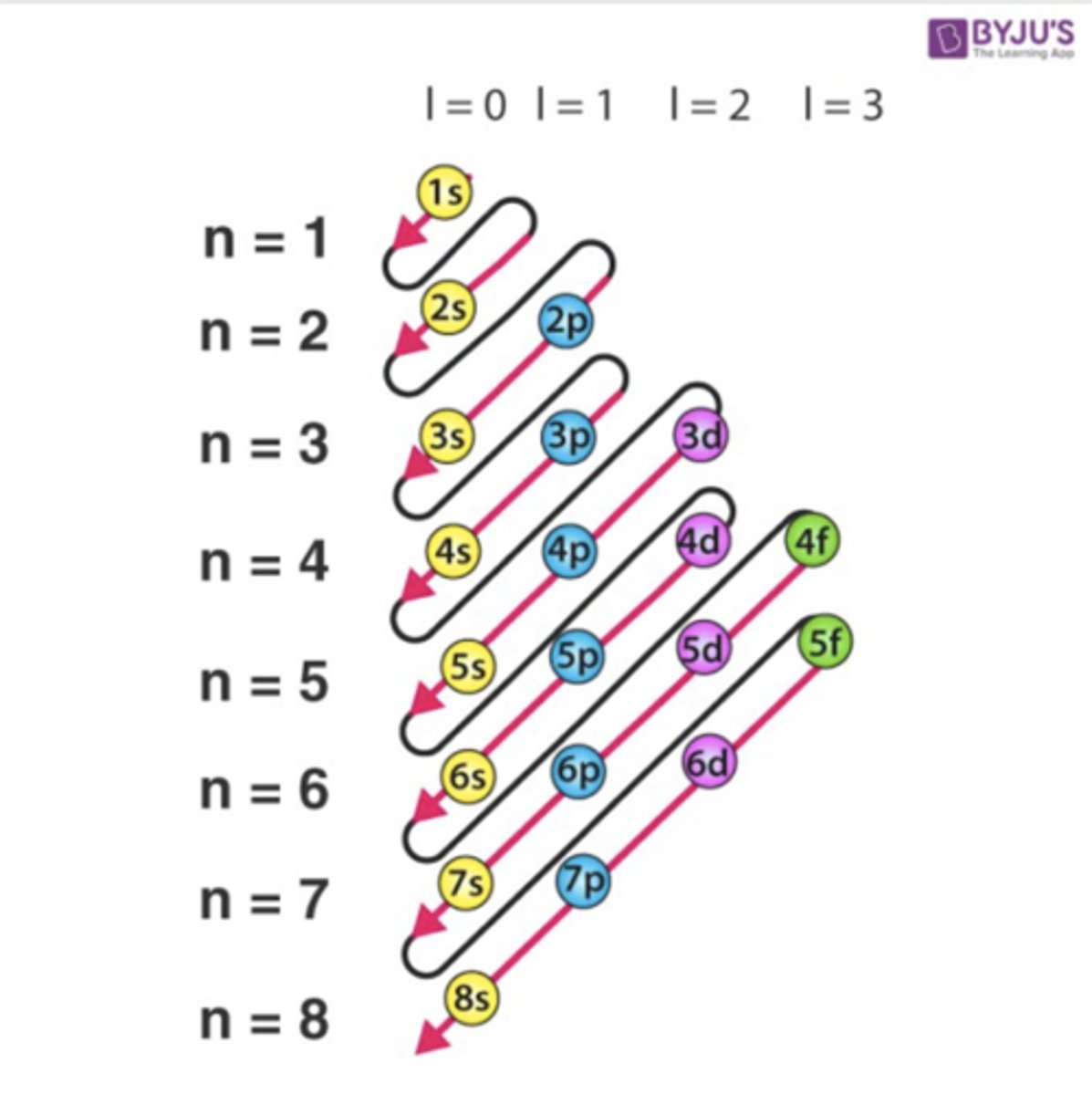
Type: Hund's Rule states that [multiple/single] electrons with the [same/opposite] spin must occupy each ____________ before additional electrons with the [same/opposite] spin can occupy the same orbitals
Hund's Rule states that single electrons with the same spin must occupy each equal-energy orbital before additional electrons with opposite spins can occupy the same orbitals
Type: Aufbau Principle states that a(n) ______ occupies the [highest/lowest] energy orbital that can [receive/repel] it.
Aufbau Principle states that an electron occupies the lowest energy orbital that can receive it.
The electrons whose orbitals are __________________ away from the nucleus (those with the largest principle quantum number, n) are the atom's valence electrons.
furthest
The ______________ electrons are the highest energy elections and the ones that play a role in chemical reactions.
valence
For elements in the _____ block, the ___ shell electrons are also valence electrons.
d
Type: The higher an electron's principle quantum number (n), the [closer/further] the distance from the [valence electrons/nucleus/orbit], the [higher/lower] the energy, and the [higher/lower] the reactivity.
The higher an electron's principle quantum number (n), the further the distance from the nucleus, the higher the energy, the higher the reactivity.
___________ atoms have an unpaired electron.
paramagnetic
Paramagnetic substances are [attracted to/repelled by] magnets.
attracted to
All electrons in ________ atoms are paired.
diamagnetic
Diamagnetic substances are slightly [attracted to/repelled by] magnets.
repelled by
If an element has an [odd/even] number of electrons, it is paramagnetic.
odd
If an element has an [odd/even] number of electrons, then it is paramagnetic OR diamagnetic. You have to use the energy diagram to figure it out.
even
Energy of a Photon equation:
hf = hc÷λ
The energy of a photon is directly related to its ______________.
frequency
The energy of a photon is inversely proportional to its ____________.
wavelength
As the energy of a photon increases, the frequency will [increase/decrease] and the wavelength will [increase/decrease].
increase; decrease
Frequency is the inverse of _____
wavelength (f = 1/λ)
The Octet Rule refers to the tendency of atoms to prefer to have [number] electrons in the valence shell (so they can behave like ______).
eight; noble gases
When atoms gain an electron they become ___________ charged.
negatively
When atoms lose an electron, they become ___________ charged.
positively
Ionic Compounds are composed of _____ and ______ atoms connected through _____ bonds.
metal; non-metal; ionic
(exceptions being the polyatomic ions)
Molecular Compounds are composed of _____ and ______ atoms through ______ bonds.
non-metal; non-metal; covalent
_____________ determines if the sharing between electrons is equal or unequal.
Electronegativity
___________ Covalent Bonds are molecular compounds with an uneven sharing of electrons caused by a significant different in electronegativity.
Polar
______________ Covalent Bonds occur when nonmetal atoms do not have a significant electronegativity difference between them.
Nonpolar
What is Lattice Energy?
Type: Lattice Energy is the energy required to completely [bind/separate] a(n) [covalent/ionic/hydrogen] compound's [cations/nucleus/neutrons/valence electrons] from its [anions/nucleus/neutrons/valence electrons].
Lattice Energy is the energy required to completely separate an ionic compound's cations from its anions.

The larger the charges = the [larger/smaller] the lattice energy
larger
The shorter the bond distance = the [larger/smaller] the lattice energy
larger
Each triple bond is one _____ and two _____ bonds.
(Think sigma and pi bonds)
σ; π
Each single bond is one _____ bond.
(Think sigma and pi bonds)
σ
Each double bond is one _____ and one ________ bond.
(Think of sigma and pi bonds)
σ; π
The equation for Formal Charge is:
___ - ___ - ___
WORD BANK: Lone electrons, Pairs of electrons, Valence electrons, Half the number of electrons shared in bonds, Half the number of neutrons shared in bonds, Polyatomic ions
Valence electrons - lone electrons - half the number of electrons shared in bonds
A __________ is a column and elements within here have similar properties.
group
A ______________ is a row and elements within here do not necessarily have similar properties.
period
Type: Group 1 are ________ Metals with [high/low] ionization energies because they want to [gain/lose] an electron to act like a noble gas. They are [explosive/stable/acidic] in water and form [covalent/ionic] compounds.
Group 1 are Alkali Metals with low ionization energies because they want to lose an electron to act like a noble gas. They are explosive in water and form ionic compounds.
Type: Group 2 are _________ Metals with [high/low] ionization energies. They have [higher/lower] ionization energies than Group 1. They react with _____, but not as violently as Group 1. These atoms are [less/more] reactive as you move down the group.
Group 2 are Alkaline Earth Metals with low ionization energies. They have lower ionization energies than Group 1. They react with water, but not as violently as Group 1. These atoms are more reactive as you move down the group.
Type: Halogens have [low/high] electronegativity and [low/high] electron affinity. They are easily [oxidized/reduced] and want to have [one extra/one less] electron. Halogens are highly reactive with [metals/metalloids/non-metals]. They are [number] valence electron(s) away from a full octet.
Halogens have high electronegativity and high electron affinity. They are easily reduced and want to have an one extra electron. Halogens are highly reactive with metals, They are one valence electron away from a full octet.
Type: Noble gases are [diatomic/monotonic] gases with [high/low] chemical reactivity. This means they are [unlikely/likely] to form chemical bonds. They have [full/empty] valence electron shells.
Noble gases are monotonic gases with low chemical reactivity. This means they are unlikely to form chemical bonds. They have full valence electron shells.
Type: D block are _____________ Metals that form brightly colored compounds due to the way that __-orbitals allow electrons to [repel/absorb] colored light and be moved to [lower/higher] energy levels. They have multiple _______ states (Ex: Iron(III), Iron(II), etc)
D block are Transition Metals that form brightly colored compounds due to the way that d-orbitals allow electrons to absorb colored light and be moved to higher energy levels. They have multiple oxidation states.
The distance from its nucleus to the outside of its outermost orbitals is the __________.
Atomic Radius
How do we calculate Bond Length?
atomic radius of first element + atomic radius of second element
An increase in the number of energy shells (n) = a(n) [increase/decrease] in size
increase
When dealing with atoms of the exact same element, if you give an atom an electron (create an anion) the atom [increases/decreases] in size.
increases
When dealing with atoms of the exact same element, if you take away an electron from an atom (create an cation) the atom [increases/decreases] in size.
decreases
Ionization Energy is the amount of energy to do what?
Type: the amount of energy required to ______
the amount of energy required to strip an electron from an atom
Why is ionization energy opposite of atomic radius?
Type: The [larger/smaller] the atom, the [further/closer] the electrons are to the nucleus meaning they are being pulled very [closely/loosely]. The larger an atom, the [further away/closer the] electrons are from the nucleus, making it easier to pull them away.
The smaller the atom, the closer the electrons are to the nucleus meaning they are being pulled very closely. The larger an atom, the further away electrons are from the nucleus, making it easier to pull them away.
Electron Affinity is the energy produced when...?
Type: The energy produced when an atom [loses/accepts] an electron. It is the [opposite/same] as ionization energy.
The energy produced when an atom accepts an electron. It is the opposite of ionization energy
Unlike electronegativity, [atom], not fluorine, has the highest electron affinity.
chlorine
The __________ gases are excluded from the electron affinity trends.
noble
What is the formula for Kelvin?
K = C° + 273
1 cm³ converts to 1 ___ and 1 ___
mL, cc
What is the formula for Pressure?
P=F/A
(Pressure = Force/Area)
1 atm = ____ torr = ____ mmHg
760, 760
Type: Ideal Gas Assumptions states volume or size is [significant/insignificant], collisions are [elastic/inelastic], average kinetic energy depends on [only volume/only temperature/only pressure/both volume and size/both temperature and pressure]
Ideal Gas Assumptions states volume or size is insignificant, collisions are elastic, average kinetic energy depends on only pressure
Gases behave most ideally at [high/low] temperatures and [high/low] pressures.
high; low
Boyle's Law states [mass/pressure/volume] is [inversely/directly] related to [volume/pressure/temperature].
volume; inversely; pressure
Charle's Law states [mass/pressure/volume] is [inversely/directly] related to [gas/pressure/temperature]
volume; directly; temperature
Avogadro's Law states [mass/pressure/volume] is [inversely/directly] related to the number of [gas/liquid/solid] molecules
volume; directly; gas
Combined Gas Law equation:
P₁V₁/nRT₁=P₂V₂/nRT₂
Ideal Gas Law enables us to calculate what?
Type: Enables us to calculate a _____ that we don't know when dealing with _________.
Enables us to calculate a gas that we don't know when dealing with PV=nRT
Gas Density equation
P(MM)/RT
Dalton's Law of Partial Pressure equation
Ptotal = Pa + Pb ...
Types of Intermolecular Forces: (3)
Hydrogen Bonding (strongest), Dipole-Dipole, London Dispersion Forces (hydrocarbons, other nonpolar molecules)
Hydrogen Bonding is strong because of the [high/low] electronegativity of F, O, N.
high
Dipole-Dipole Forces are caused when two bonded atoms have significant __________ differences.
Dipole-Dipole Forces are caused when two bonded atoms have significant electronegativity differences
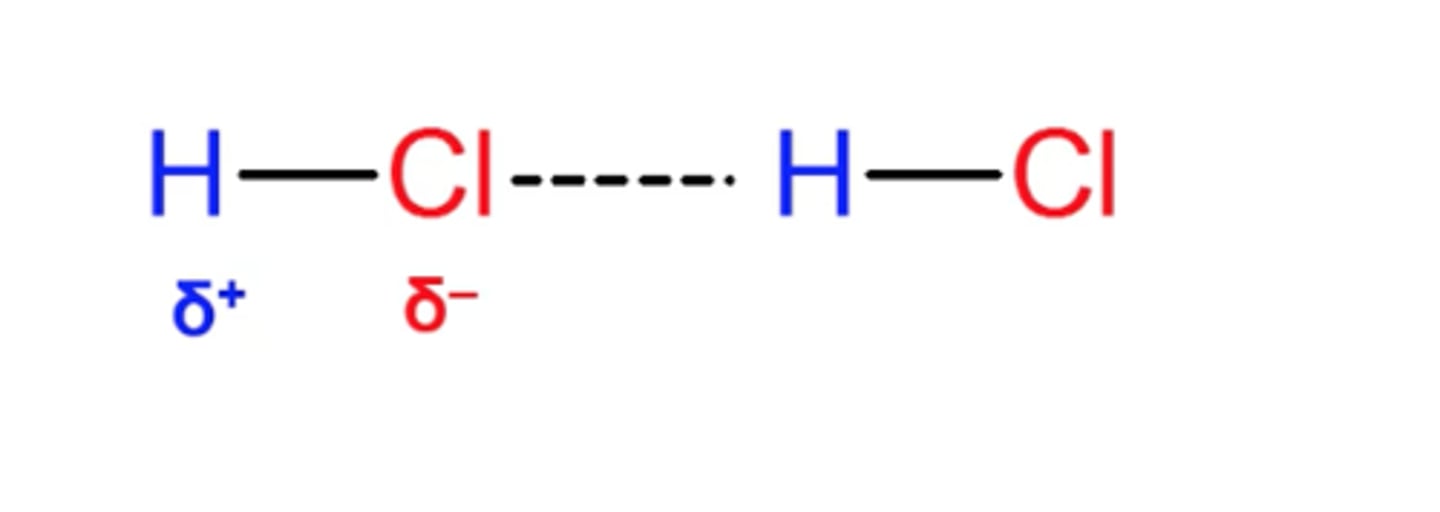
Dipole Dipole only apply to _____, ______ molecules that do not have an ____ bonded to an O, N, and F.
polar; non-ionic; hydrogen (H)
Dispersion Forces are [polar/nonpolar].
Do they have similar electronegativities?
nonpolar; no
(there is not an uneven sharing of electrons because they have similar electronegativities; they have momentary partial charges from the electrons moving around each other)
Higher IM (Intramolecular) forces = [higher/lower] Heat of Vaporization
higher
(needs more heat to get molecules to separate and turn into a gas)
Higher IM forces = [higher/lower] Vapor Pressure
lower
Vapor Pressure is the [upward/downward] pressure exerted by the substance on the _____.
upward; atmosphere
Boiling occurs when the pressure exerted by the liquid towards the atmosphere [is less than/equal to/more than] the pressure exerted by the atmosphere down on the liquid molecules.
equals
@ Higher altitudes, there is lower atmospheric pressure and the boiling point [increases/decreases].
decreases
What are the 4 classes of solids?
ionic, metallic solids, covalent network, molecular
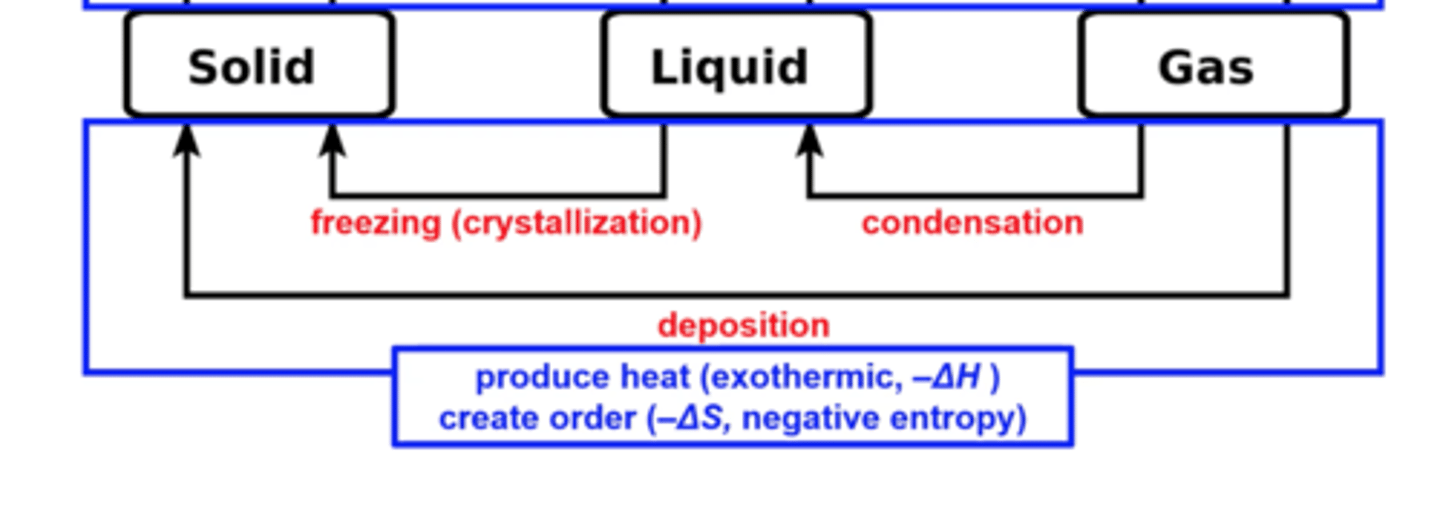
Phase Changes: solid --> liquid --> gas [require/produce] heat.
This is an [exergonic/endothermic] reaction.
require heat; endothermic
(+∆H and +∆S)
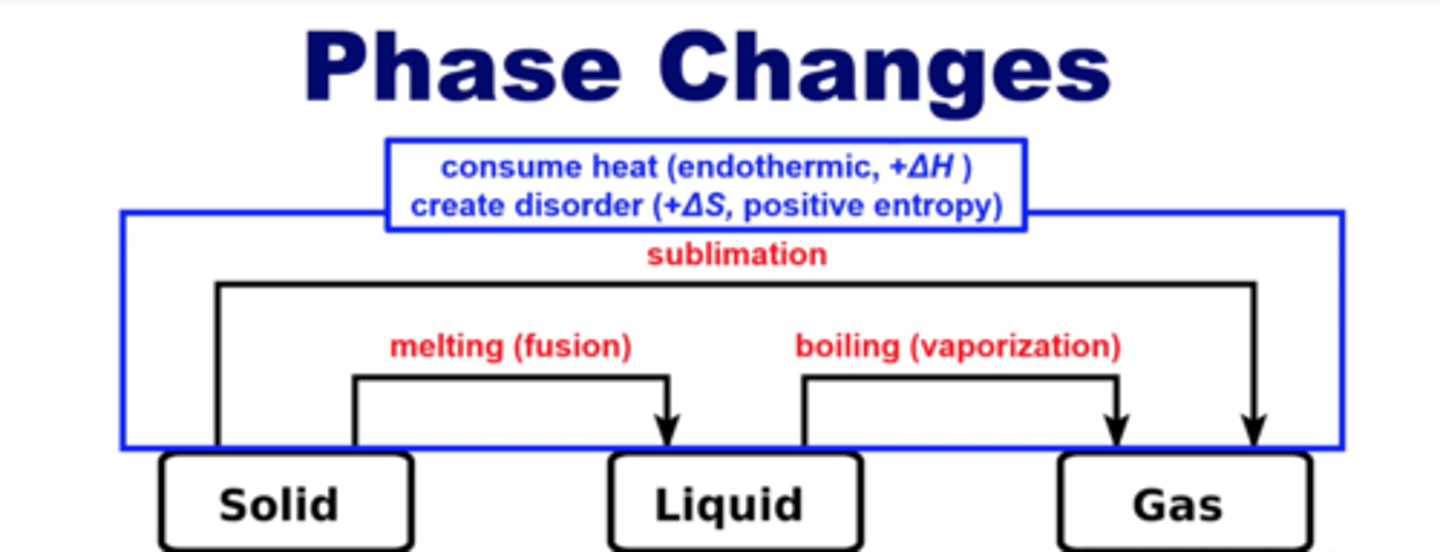
Phase Changes: gas --> liquid --> solid [require/produce] heat.
This is an [exergonic/endothermic] reaction.
produce heat; exothermic
(-∆H and -∆S)
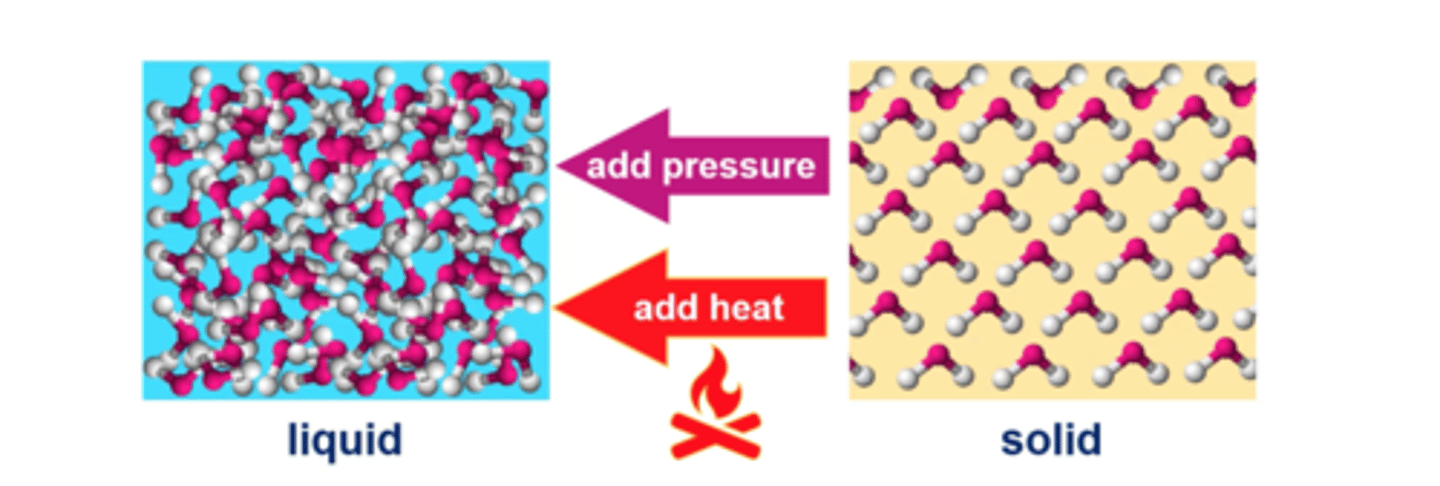
Water is denser as a __________ than as a solid.
liquid
(because of its bent shape that puts more space in between molecules when as a solid)
Like dissolves _________.
like
(meaning that polar solutes dissolve in polar solvents and nonpolar solutes in nonpolar solvents)
The substance in a solution that is present in a larger amount.
Solvent
(ex: table salt + H₂O, the water is the solvent)
The substance in a solution that is present in a smaller amount
Solute
(ex: table salt + H₂O, the table salt is the solute)
Solubility Rule #1 states most ionic compounds that have group 1 metal cations, nitrate, perchlorate, acetate, ammonium are [soluble/insoluble] in water.
soluble

Solubility Rule #2 states most ionic compounds that have silver, lead, sulfide, hydroxide, dimercury, carbonate, phosphate are [soluble/insoluble] in water.
insoluble
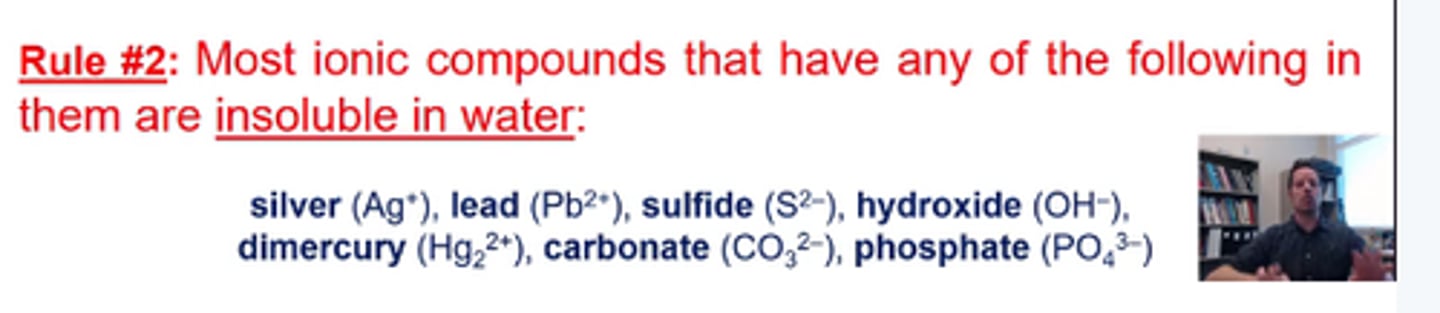
The [solubles/insolubles] trump the [solubles/insolubles] when it comes to solubility.
solubles; insolubles
Steps to generating a Net Ionic Equation:
1. Balance the chemical equation.
2. Use your solubility-rule knowledge to label everything as (s), (l), (g) or (aq).
3. Cut all the (aq)'s "in half," separating their cations from their anions.
4. Cancel out all the species that are exactly the same on both sides. The canceled-out species are called spectator ions.
Solids are more soluble at [higher/lower] temperatures
higher
(ex: melting sugar in hot coffee)
Gases are less soluble at [higher/lower] temperatures
higher
(more energy helps them escape the liquid; raising the temp causes them to move faster and they are more likely to escape the liquid)
Gases are more soluble at [higher/lower] pressures
higher
(more pressure forces gas into the liquid)
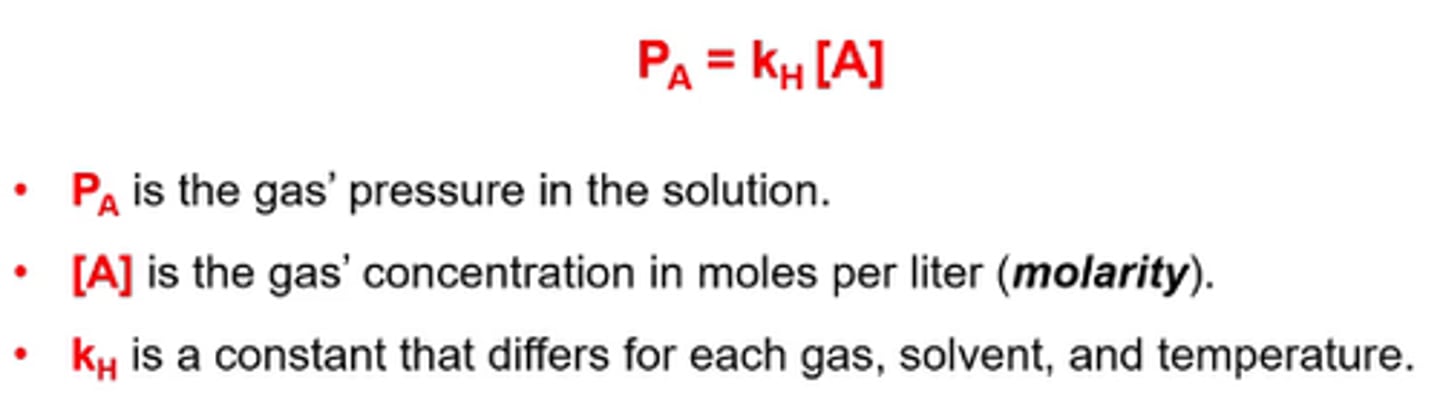
Henry's Law states in a sealed vessel containing a dissolved gas, the gas's ______ and ________ are [inverses/proportional/unequal].
concentration; pressure; proportional
Colligative Properties are properties of a solution that change as you add more [solution/solute/precipitate]
solute
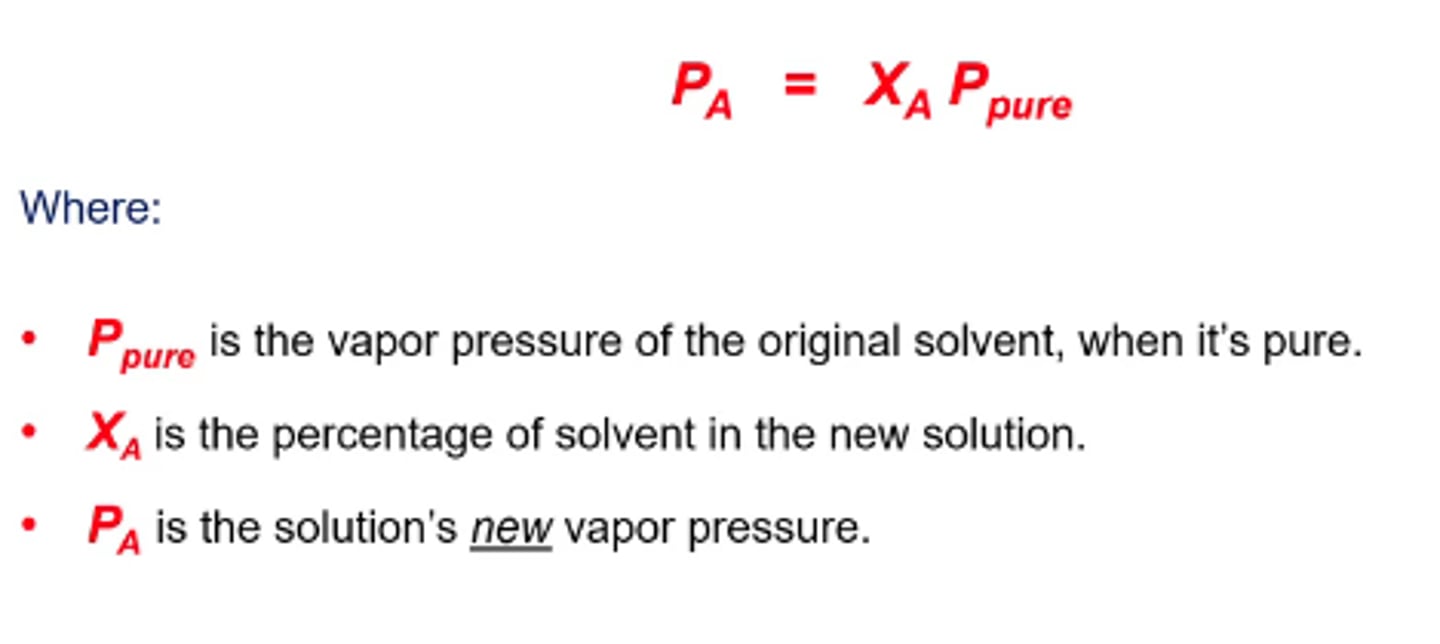
Raoult's Law states as boiling point [increases/lowers], vapor pressure [increases/decreases].
as boiling point increases, vapor pressure decreases
Osmosis
the natural flow of water from one area to another in order to balance those area's solute concentration
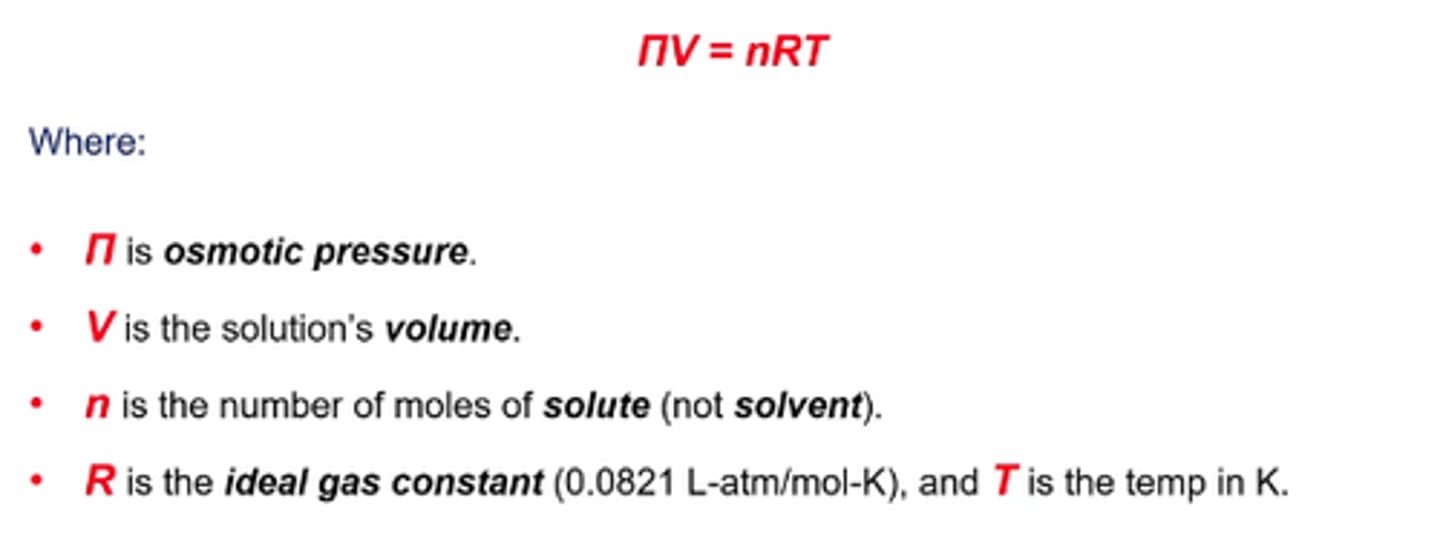
Osmotic Pressure
the pressure that would have to be applied to a pure solvent to prevent it from passing into a given solution by osmosis, often used to express the concentration of the solution.
Chemical Kinetics
the study of how fast reactions occur, aka the reaction rate
Rate Law
allows you to compare the rate relative to the concentration
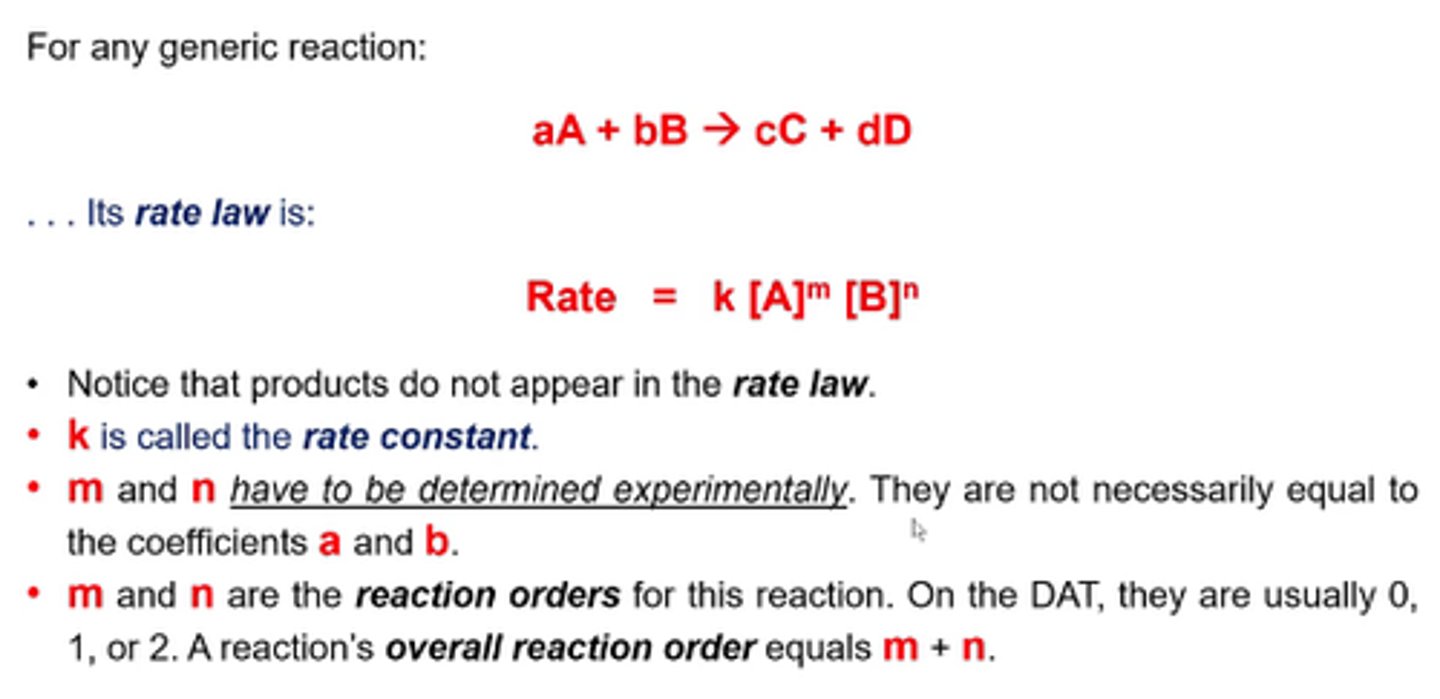
The reaction's overall reaction order can be found by adding up all of the superscripts in _____ units, and taking the answer's absolute value.
k
Graph for straight line 0 order rate law:
[concentration]
![<p>[concentration]</p>](https://knowt-user-attachments.s3.amazonaws.com/f513460d-bbd7-4f7a-baff-bd66ea688b2d.jpg)
Graph for straight line 1 order rate law:
ln[concentration]
![<p>ln[concentration]</p>](https://knowt-user-attachments.s3.amazonaws.com/70fbb5b2-0fda-4477-b996-5eed7f093819.jpg)
Graph for straight line 2 order rate law:
1/[concentration]
![<p>1/[concentration]</p>](https://knowt-user-attachments.s3.amazonaws.com/cbf30756-16c0-4d81-9ca8-d8cdb8aed956.jpg)
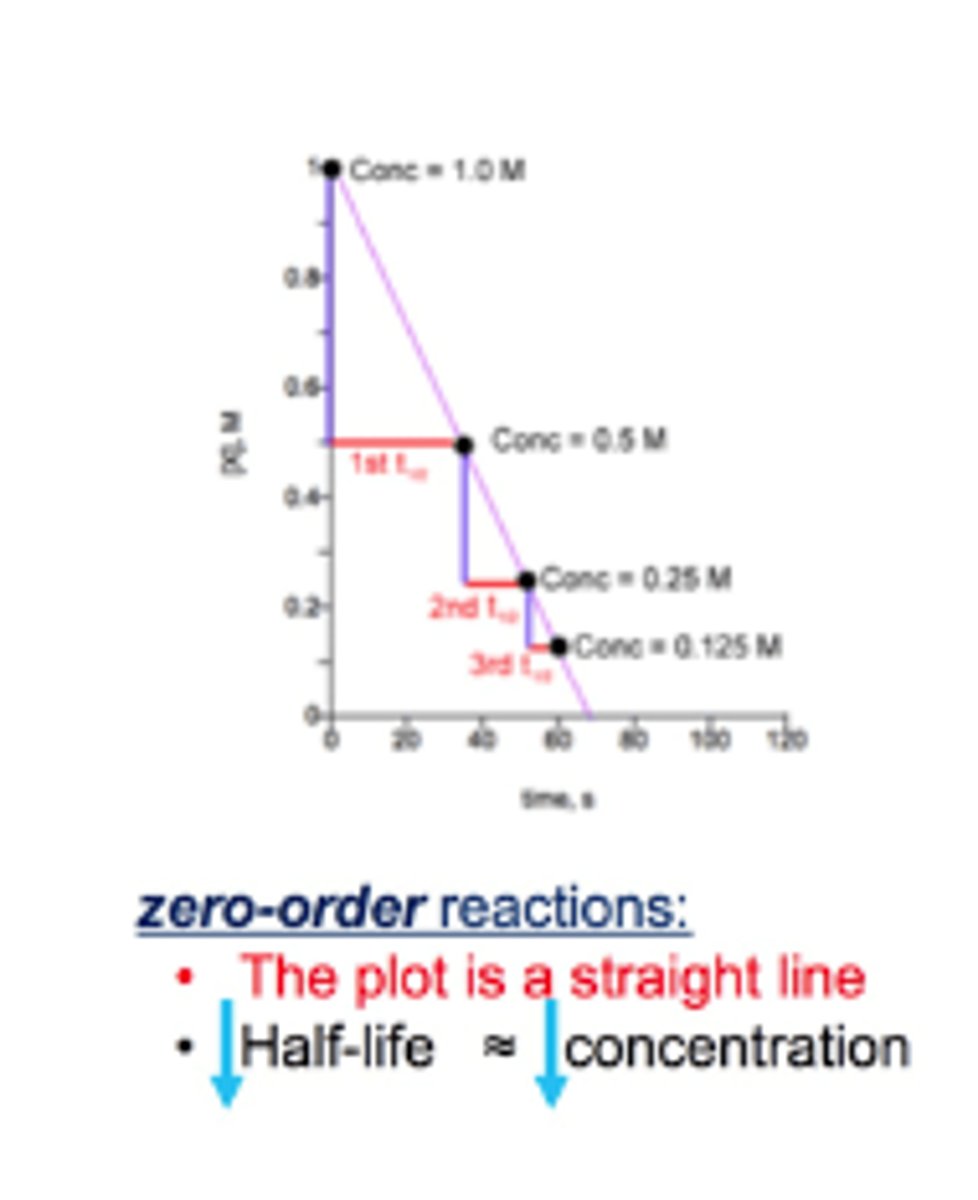
0 order rate law concentration vs. time graph:
- straight line
- half life decreases while concentration decreases
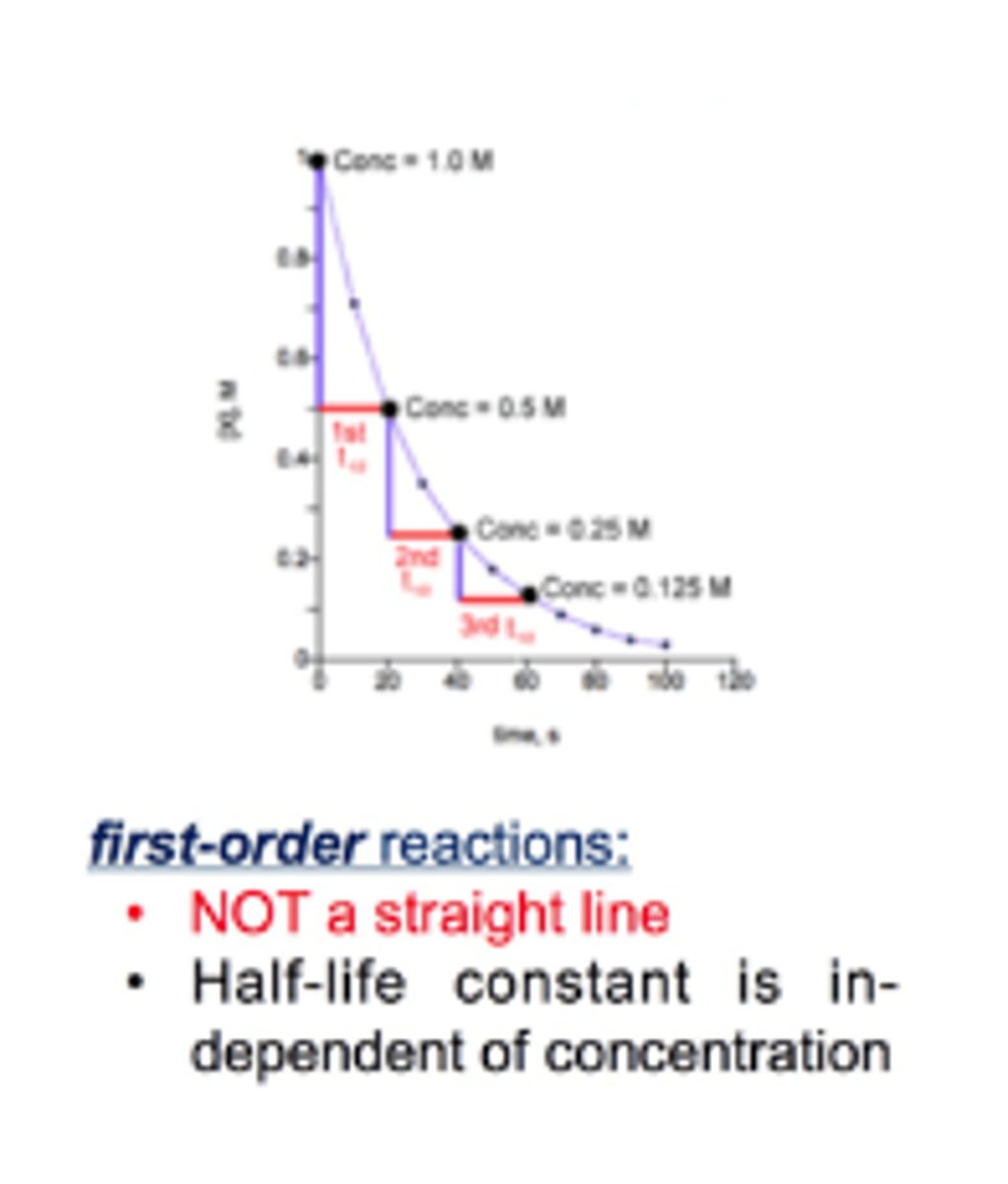
1st order rate law concentration vs. time graph:
- not a straight line
- half life constant is independent of concentration