A&P 1: JOINTS & MOVEMENTS
 Call Kai
 Learn
Learn Practice Test
 Spaced Repetition
 Match
Match Flashcards
 Knowt Play
1/19

There's no tags or description
Looks like no tags are added yet.
Name | Mastery | Learn | Test | Matching | Spaced | Call with Kai |
|---|
No analytics yet
Send a link to your students to track their progress
20 Terms
Joints are part of the ___________ system, and are integral to the body's structural __________ stability as well as its ability to move.
Muscuskeletal , stability
Joints are classified on the basis structure and function. List three STRUCTURAL components.
1) Fibrous
2) Cartilaginous
3) Synovial
Joints are classified on the basis structure and function. List three FUNCTIONAL components.
1) Synarthrosis = non movable (still; ex: skull sutures)
2) Amphiarthrosis = slightly movable (a little bit; ex: your pubic bone or joints between your ribs)
3) Diarthrosis = freely moveable (your shoulder, knee, and hip joints)
The suffix -osis means "condition," "disease," "abnormal increase," or "process".
Name some characteristics of fibrous joints
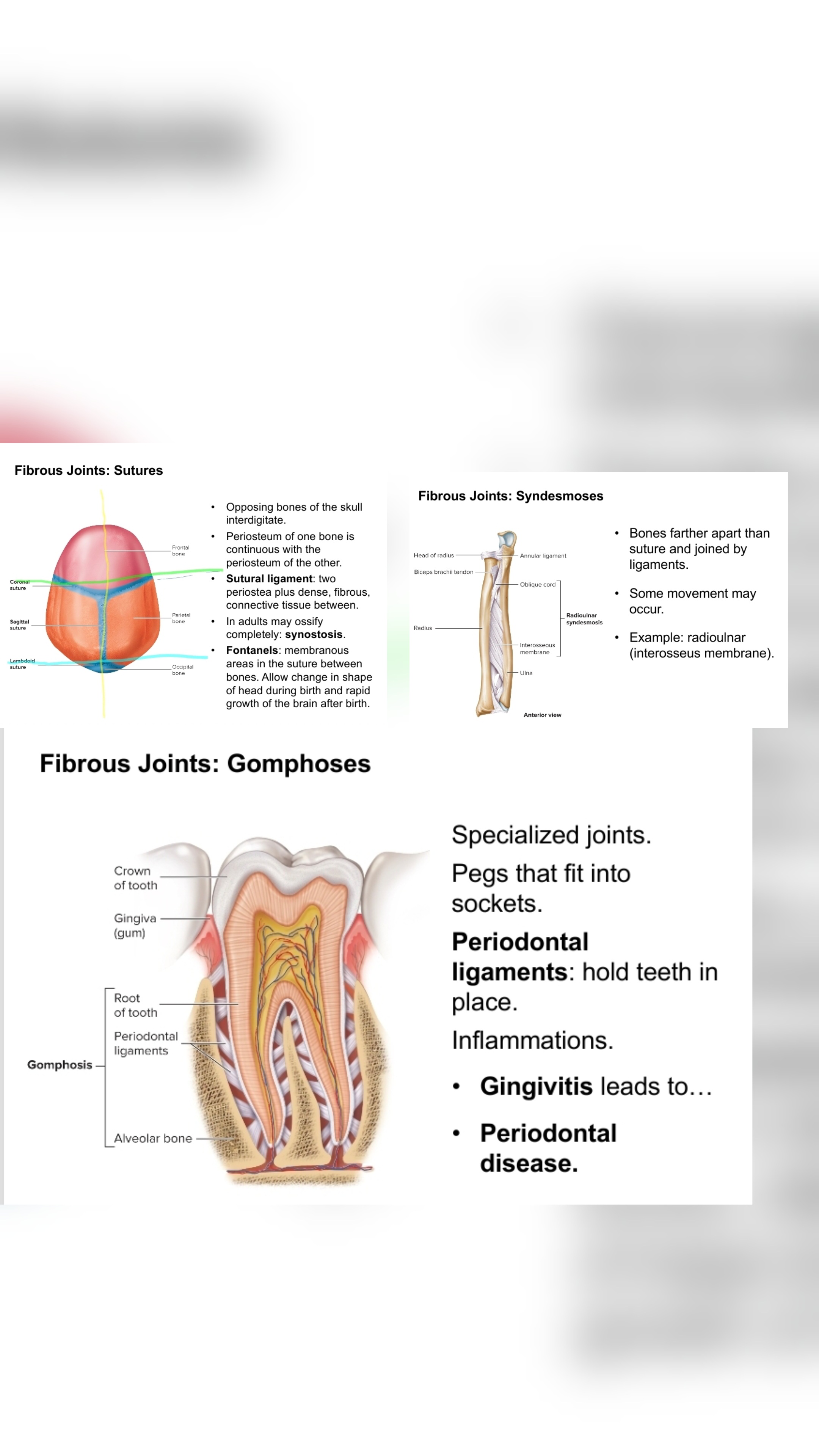
Exhibit little to no movementand have no joint cavity. They are united by fibrous connective tissue.
Commen examples include SUTURES → skull bones joined together, SYNDESMOSES → bones connected by a ligament or interosseous membrane (radius-ulna, tibia-fibula), and GOMPHOSIS → which are a periodontal ligament that hold your teeth in place.
Name some characteristics of cartilaginous joints.
Cartilaginous joints unite two bones by pad of cartilage. There are two kinds.
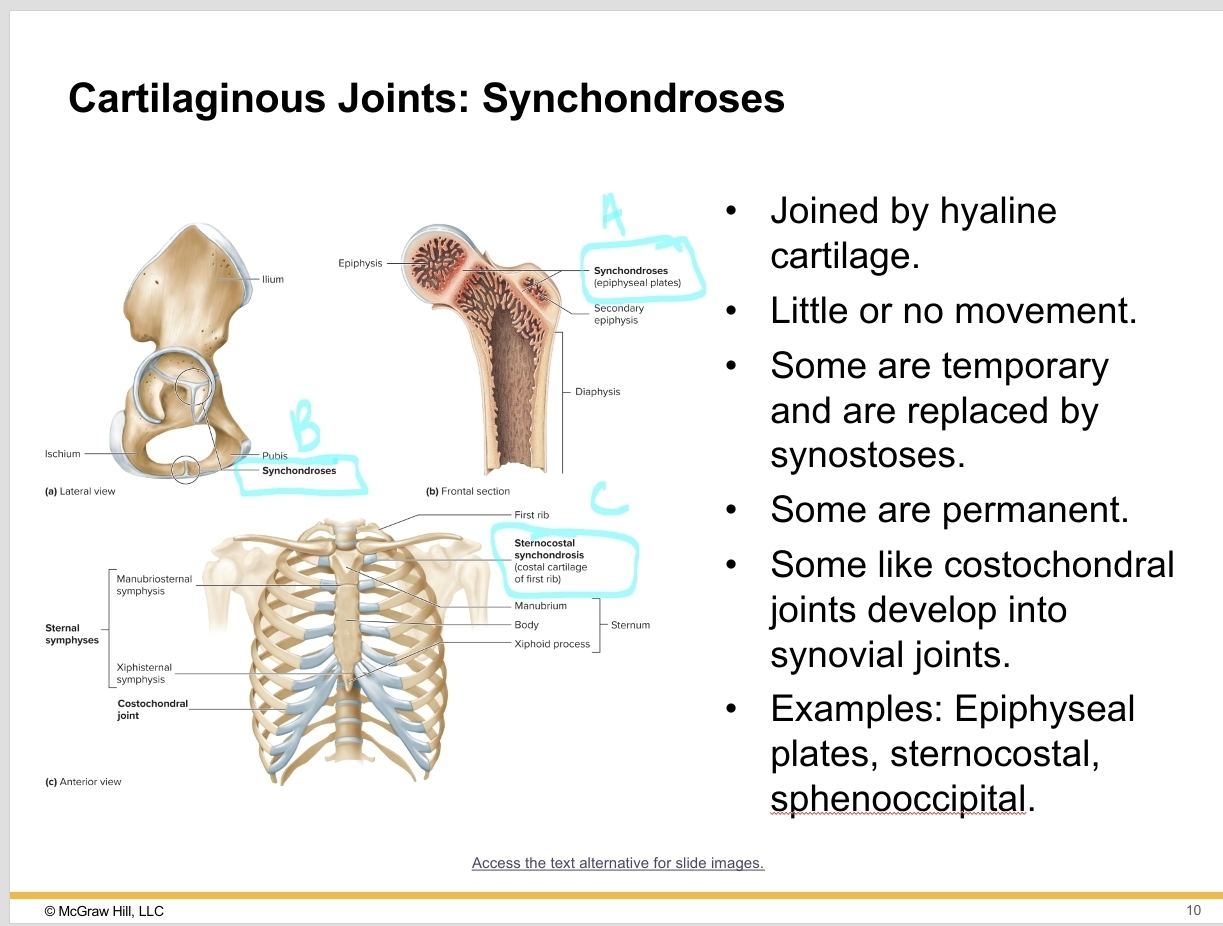
SYNCHONDROSES → Joined by hyaline cartilage. Enable little to no movement. They are temporary because they can be replaced by synostoses.
SYMPHYSIS → Joined by uniting one or more fibrocartilage. Slightly movable
Note: when you see the word chondrocytes, think cartilage.
Epiphyseal plates, first sternocostal joint, and spheno-occipital joint are examples of which cartilaginous joint (synchondroses/symphyses/ or synovial?
Synchondroses
Pubic symphysis, intervertebral discs, manubriosternal joints are examples of which cartilaginous joint (synchondroses/symphyses/ or synovial?
Symphyses
Cartilaginous synovial joints contain ______, and allow for considerable movement. Most joints of the ________ skeleton are synovial joints
Fluid
Appendicular
What structures make up a synovial joint?
Articular cartilage – hyaline cartilage covering bone ends
Joint cavity – contains synovial fluid
Fibrous capsule – outer layer of dense irregular connective tissue
Synovial membrane – inner layer that produces synovial fluid
Synovial fluid – lubricates and nourishes the joint