Lab 4: Electrophilic Aromatic Substitution (Friedel-Crafts Alkylation)
 Call Kai
 Learn
Learn Practice Test
 Spaced Repetition
 Match
Match Flashcards
 Knowt Play
1/36

There's no tags or description
Looks like no tags are added yet.
Name | Mastery | Learn | Test | Matching | Spaced | Call with Kai |
|---|
No analytics yet
Send a link to your students to track their progress
37 Terms
What does electrophilic aromatic reaction refer to?
when an atom (a hydrogen) attached to an aromatic system is replaced by an electrophile (think of aromatic nitration, aromatic halogenation, aromatic sulfonation, acylation, and alkylation)
what is going on in this experiment molecular wise
a Friedel-Crafts will occur between an unknown tertiary alcohol and 1,4-dimethoxybenzene (an acitvated electron rich aromatic system)
what is the electrophile
the carbocation
what are the two ways the electrophile can be generated?
alkyl halide and a Lewis acid
protonation of a secondary/tertiary alcohol
what is the nucleophile
Benzene ring
why does dialkylation occur
because after one alkylation, the product is usually more electron rich than the original starting material. dialkylation will occur if there is excess of the alkyl halide/alcohol
list of techniques
filtration, melting point, IR, and HNMR
reagents
1.4-dimethoxybenzene (structure, MW, MP)
Glacial acetic acid (structure, MW, density)
Sulfuric acid (structure, MW, density)
Methanol (structure, MW, BP)
Water (structure, MW, BP
describe procedure broaldy
add the 1,4-dimethoxybenzene, alcohol, and glacial acetic acid into an Erlenmeyer flask
make sure your flask is in an ice bath and add 5 mL of sulfuric acid into the stirred reaction in a dropwise manner. let the mixture stir for 10 minutes
add 15 mL of ice cold water to quench the reaction and isolate the product
filter off any of the white solid product (vacuum filtration)
rinse the crude product in the Buchner funnel with some DI water and ethanol
dissolve in hot methanol and recrystallize
filter again
get mass
what are the Lewis acid/base pairs
Lewis acid: the electrophilic species (electron acceptor)
Lewis base: pi electrons in the aromatic ring (electron donors)
what is the effect of substituent group
electron withdrawing group: decrease reactivity (the ring wants to be electron rich to donate electrons)
electron donating: increases reactivity (ring wants to be electron rich)
what way do electron donating groups direct to? what about electron withdrawing groups?
donating: meta directors
withdrawing: ortho/para (include the halides)
what are the two primary effects that govern the reactivity of this reaction
inductive effects: withdrawal or donation of the electrons via the sigma bond (look at EN differences and bond polarity of functional group)
resonance effect: withdrawal or donation of electrons through a pi bond (pi orbital overlap between the ring carbon and adjacent substituent atom)
is this reaction exothermic or endothermic?
exothermic
boiling point of water
100
boiling point of methanol
65
boiling point of glacial acetic acid
118
melting point of water
0
melting point of methanol
-98
melting point of glacial acetic acid
17
what are all the safety descriptions (4)
acutely toxic
chronically toxic
flammable
corrosive/caustic
what is the catalyst for this experiment?
concentrated sulfuric acid
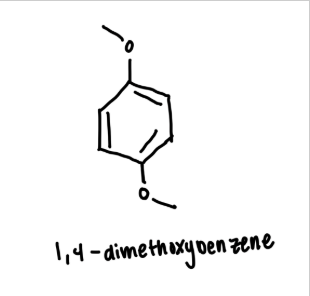
Provide the name and the structure of the aromatic starting material used in today’s Friedel-Crafts experiment. Generate the structure using ChemDraw and upload it as a jpeg image.
1,4-dimethoxybenzene
what solvent will be used to recrystallize the product
hot methanol
Classical Friedel-Crafts reactions employ an aluminum trichloride reactant to form an electrophilic reaction intermediate. How does today’s experiment differ from the “classic” reaction? Be specific and detailed in your answer. You must answer in complete sentences to receive credit.
the classic one uses an alkyl halide or acyl halide and aluminum trichloride (Lewis acid catalyst) to form the electrophilic intermediate
our experiment will be using an unknown tertiary alcohol as the precursor to the electrophilic intermediate instead AND we will be using sulfuric acid (a Bronsted Lowry acid) to protonate the hydroxyl group and facilitate the loss of water (forms the carbocation)
what solvent will be using to precipitate the product?
water (specifically cold water)
name three different types of electrophilic aromatic substitution reactions
nitration
halogenation
sulfonation
What is the purpose of the ice-cold water addition? What happened to your reaction solution when the water was added?
the water isolates the product and quenches the reaction (turned the solution from a cloudy orange brown solution to an opaque white solution)
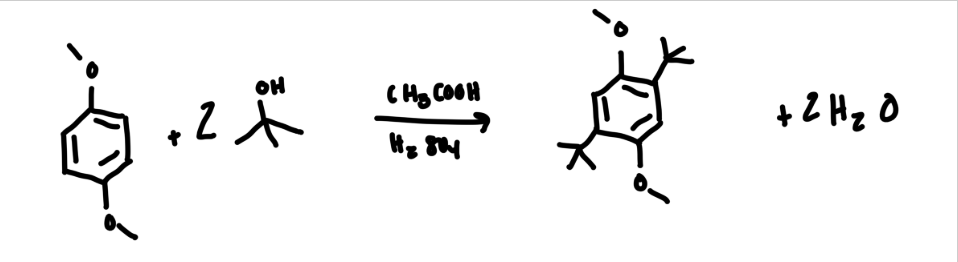
balanced equation
see photo
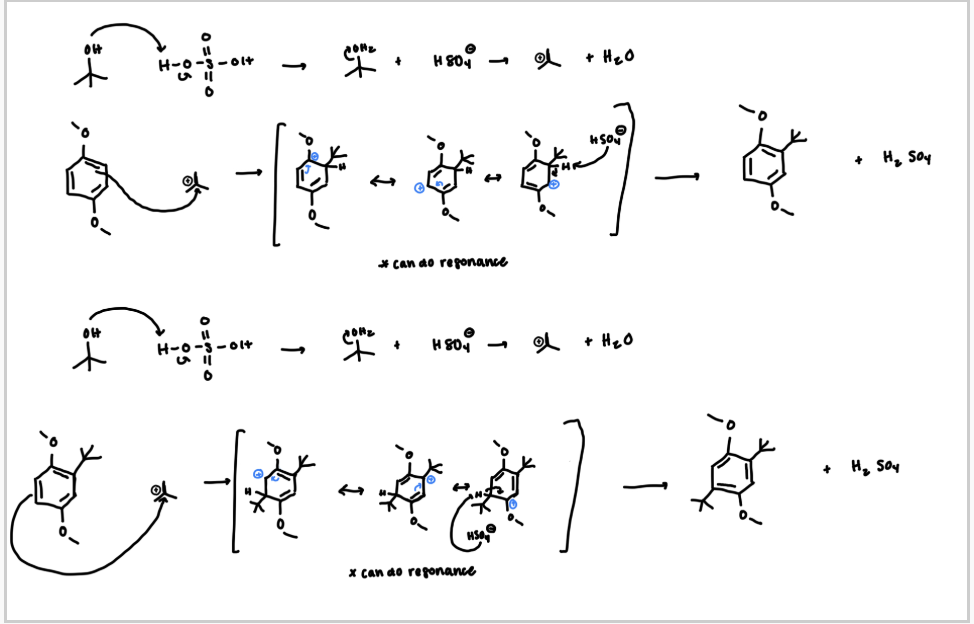
mechanism
for this experiment, OH will be protonated by sulfuric acid, and water will leave as a LG
nucleophilic attack of the pi electrons on the electrophilic carbocation
remember resonance of the carbocation on the ring
then deprotonated sulfuric acid will eliminate the alpha hydrogen to restore aromatacity
*the whole process is repeated again for dialkylation
limiting reagent
1,4-dimethoxybenzene
Compare and contrast the IR spectra of your starting material and your final product. Can you identify the unknown tertiary alcohol due to the presence (or absence) of IR absorption bands particular to a specific functional group?
No: there were not any significant changes functional group wise. two tert-butyl groups were added for our unknown but this did not add any unique functional groups compared to what was already present (mainly addition of sp3 C-H bonds but those were already there)
how could you tell your reaction went to completion based on HNMR
because i compared the starting material HNMR and the final product HNMR. the starting and the final had the same peaks but there was one new distinct peak in the product (representing the additional hydrogens that are present in the final). the new peak confirmed the reaction took place successfully
how did i determine my unknown (very basic description)
i looked at the total number of hydrogens in the starting vs the final and determined the difference. looking at the number of hydrogens added, i saw which R groups lined up with this the most
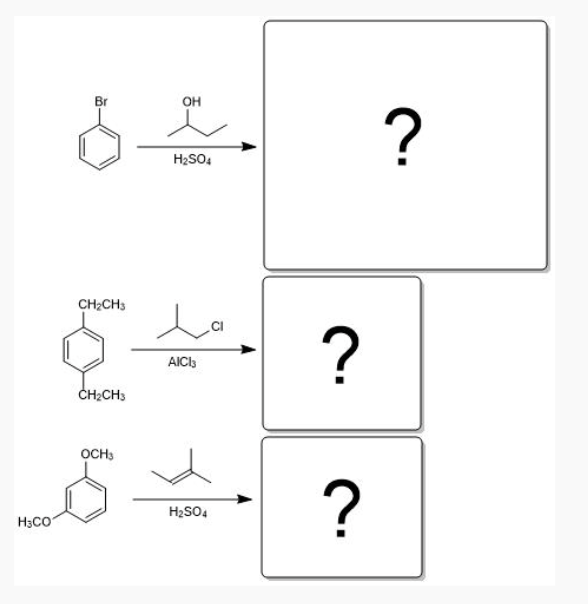
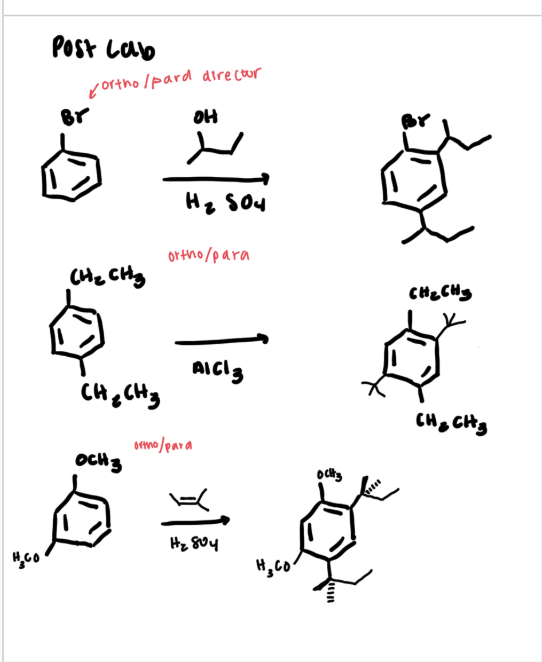
Provide structures for the major, disubstitution Friedel-Crafts product(s) of the following reactions:
see photo
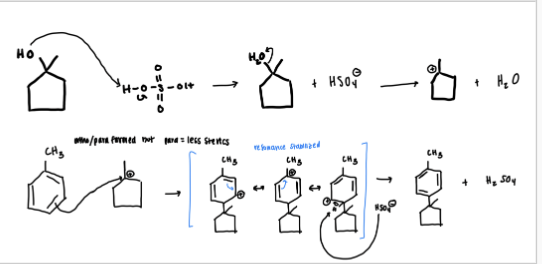
Provide a detailed mechanism for the Friedel-Crafts alkylation reaction provided below. You must clearly show how the electrophilic species is generated as well as all possible resonance forms of any conjugated intermediates formed during the course of the reaction:
same procedure of protonating hydroxyl, water leaving, nucleophilic attack on most stable carbocation, resonance, and elimination to restore aromaticity
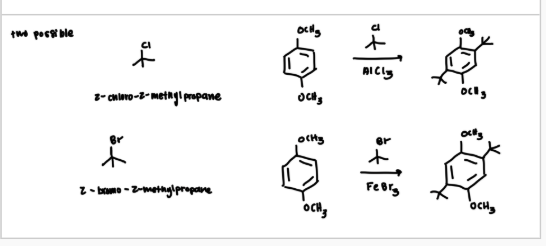
Provide structures for two compounds that could be used in place of tert-butyl alcohol to form 1,4-di-tert-butyl-2,5-dimethoxybenzene from 1,4-dimethoxybenzene via a Friedel-Crafts reaction:
basically using the traditional method of having an acid halide but switching between Br and Cl