Environmental Psychology: Theories, Approaches, and Mental Health Impacts
 Call Kai
 Learn
Learn Practice Test
 Spaced Repetition
 Match
Match Flashcards
 Knowt Play
1/47

There's no tags or description
Looks like no tags are added yet.
Name | Mastery | Learn | Test | Matching | Spaced | Call with Kai |
|---|
No analytics yet
Send a link to your students to track their progress
48 Terms
Attention Restoration Theory (ART)
Kaplan+Kaplan:
-Improved cognitive performance
-Mental fatigue can be restored by natural environments
->Soft fascination (effortless attention)
->Coherence/extent (coherent physical environment of sufficient scope to foster connection to elements in the environment)
->Compatibility (match between personal goals and environment)
->Voluntary/directed attention requires effort, but involuntary attention/soft fascination does not)
Directed Attention Fatigue
Voluntary/directed attention requires effort but involuntary attention/soft fascination does not.
Stress Reduction Theory (SRT)
Ulrich:
-Recovery from stress
-SRT focuses on our innate, affective response to nature.
Biophilia Hypothesis
E.O. Wilson
-Humans possess an innate affinity for life and lifelike processes.
Objectivist Approach
Visual quality is viewed as inherent to the landscape
Subjectivist Approach
Visual quality is a construct of the observer
Positivistic Approach
Measurable physical characteristics of landscapes as drivers of preference
Phenomenological Approach
Individual personal experiences as a way to understand the underlying meanings of human-environment interactions.
Ecological Model
Objectivist Approach
-observer is seen as a user of the landscape and a potential disturbance.
Formal Aesthetic Model
Objectivist Approach
-characterizes landscape in terms of formal properties; form, unity, variety, etc. (landscape architects)
The Psychophysical Model
In-between Objectivist and Subjectivist
-aims to establish general relationships between measured physical characteristics of a scene and landscape preferences.
The Physiological Model
Subjectivist Approach
-characterizes the landscape in subjective terms by relying on human judgements of complexity, mystery, legibility, etc.
The Phenomenological Approach
MOST Subjectivist Approach
-how each individual assigns personal relevance to landscape attributes in personal interpretations of landscape encounters
Antropocentricism
Nature is seen as raw material to be turned into wants and needs of humans
Ecocentricism
Natural ecosystems possess value in their own right, independent of their value to humans
Attitudes
A way to evaluate an entity in a positive or negative way. Based on affective (emotion), behavioral (actions), and cognitive (thoughts) components.
Values
Broader constructs which represent standards held by an individual, culture, or religion. The assumption is that specific attitudes develop within a value-based context.
Attitude Activation
(Fazio, 1990):
-Attitudes have to be activated to influence behavior; activation occurs based on the strength of association between the attitude and the object/situation.
Social Norm
Rules and standards that are understood by members of a group, and that guide and/or constrain human behavior without the force of laws.
Injunctive Norm
Approved
Descriptive Norm
Most common
Normative Influence
Uses social norms to encourage eco-friendly behaviors
Informational Influence
Provides knowledge or examples of correct behavior to guide eco-friendly action.
Norm Salience
The extent to which a (specific) social norm is (made) salient determines the degree to which it is activated.
Reference Groups
Social influence results largely from categorizing oneself as a member of a specific group, and then adopting the attitudes and behaviors that are shared by the other members of the group.
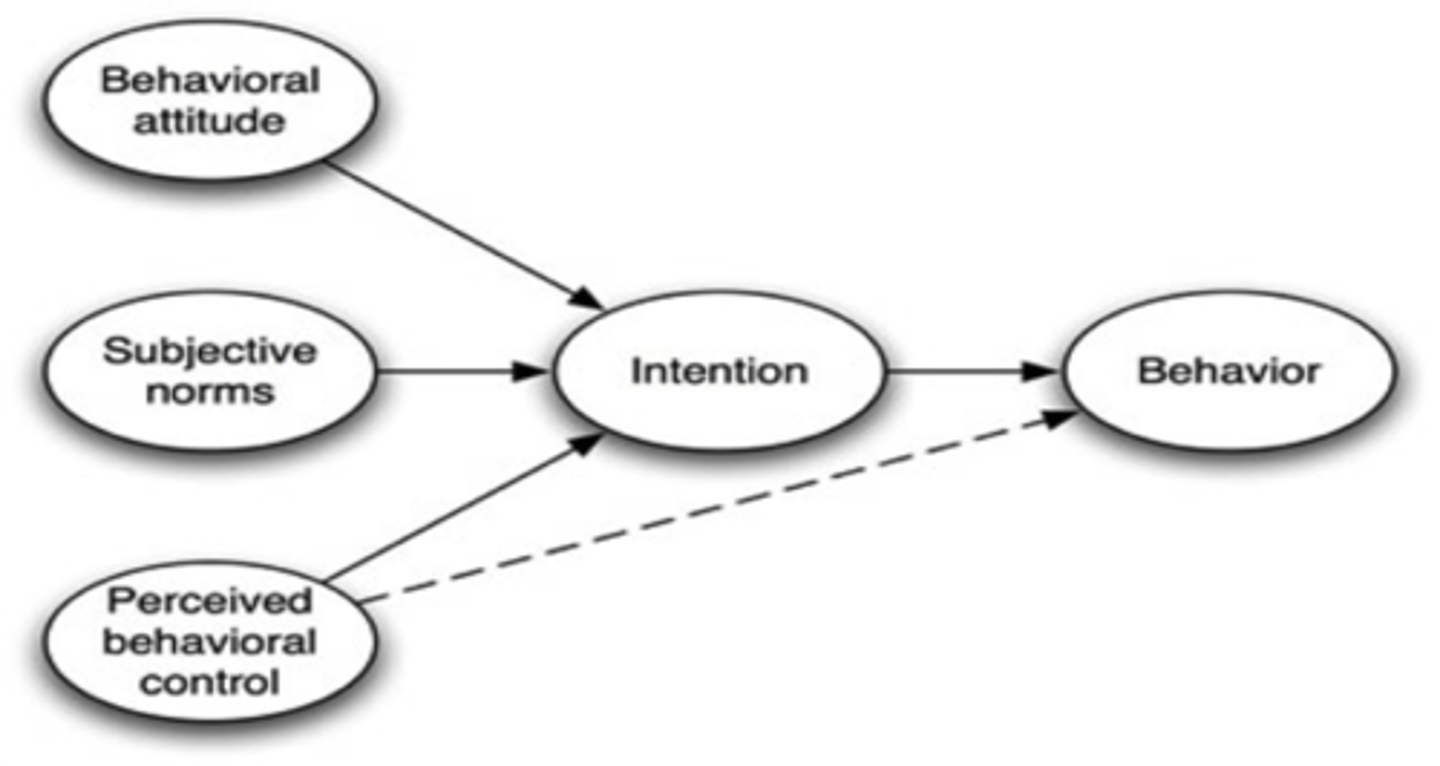
Theory of Planned Behavior (TPB)
Assumes that behavior results from the intention to engage in specific behavior.
Norm Activation Model (NAM)
Pro-environmental actions follow from the activation of personal norms, reflecting feelings of moral obligation to perform or refrain from actions.
->Personal norms activated by:
-Problem awareness (awareness of need)
-Ascription of responsibility
-Outcome efficacy
-Self-efficacy
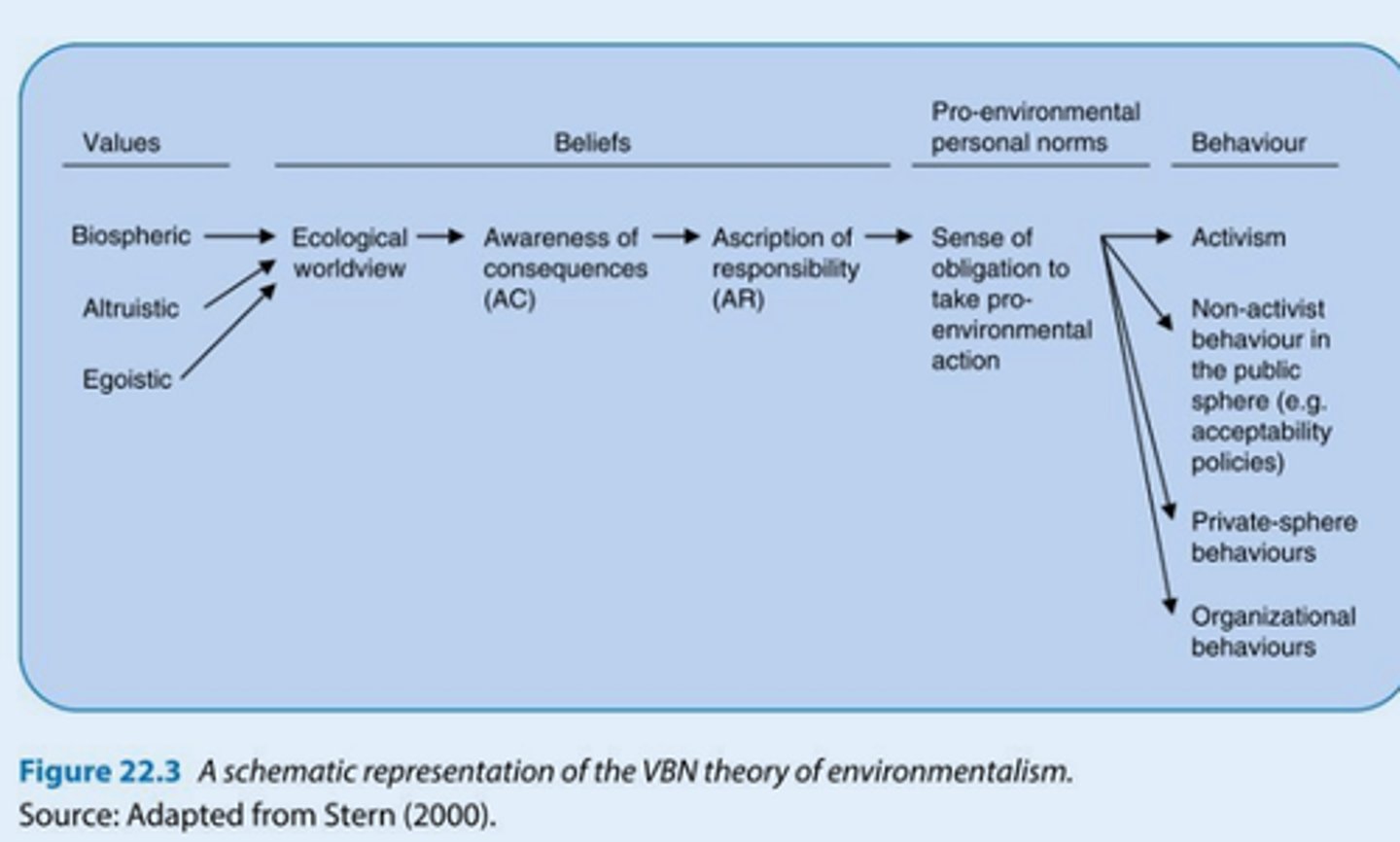
Value-Belief-Norm Theory of Environmentalism (VBN)
Goal Framing Theory
3 goals govern/frame the way people process information and act upon it
->Hedonic Goal; 'to feel better right now'
->Gain Goal; 'to guard and improve one's resources'
->Normative Goal; 'to act appropriately'
-Normative Goals provide the MOST stable basis for pro-environmental behaviors.
Anticipated Emotions
The expectation that engaging in a particular behavior makes us experience positive or negative emotions.
Experienced Emotions
The extent to which engagement in behavior actually makes us feel good or bad
Hedonic View
Acting pro-environmentally can be pleasurable or unpleasurable.
Eudaimonic View
Acting pro-environmentally can be meaningful. Pro-environmental behavior is often regarded as moral behavior.
->Self-signal; people's interpretation of what their actions reveal about their inner traits or dispositions.
Temporal Discounting
Immediate desires override long-term consequences
Psychological Distance
A problem feels far removed from the personal here and now.
Loss Aversion
A heightened negative reaction to giving something up (Delivery matters, rewards may lead to better attitudes than penalties)
Commons Dilemma
Short-term personal gains may conflict with long-term societal needs.
->Social traps:
*Individual good (collective bad trap)
*One-person trap (self-trap)
*Missing hero trap
-Social traps have rewards and punishments that are either separated in time, or the punishments are diluted.
Free Rider Problem
When individuals benefit from collective environmental effects (clean air, etc.) without contributing to the cost, leading to inefficient outcomes.
Hedonic Shopping Motivations
-Adventure; for stimulation, excitement, etc.
-Gratification; to relieve stress, improve mood.
-Role; for pleasure of purchasing gifts for others
-Value; for deals, provides a sense of achievement and winning.
-Social; to bond with friends or family
-Idea; keep up with trends, innovations/new products
Pleasure, Arousal, and Dominance Emotional State Theory (PAD)
-Pleasure; represents how 'good' or 'bad' an emotion feels (extreme happiness vs. unhappiness).
-Arousal; the intensity or activation of the emotional state.
-Dominance; the sense of control or influence an individual feels, from empowered to helpless.
Theory of Supportive Design
Ulrich:
-Healthcare physical and social environments promote well-being if they are designed to foster:
*Access to social support
*Access to positive distractions
*A sense of control over physical-social surroundings
Ambient Environmental Characteristics
Intangible aspects of the environment (lighting, noise, temperature)
Architectural Environmental Characteristics
Relatively permanent aspects of the physical healthcare environment, such as the spatial layout of the hospital, the size and shape of rooms, and the placement of windows.
Interior Environmental Characteristics
Less permanent aspects of the healthcare environment such as furniture, color, plants, and artwork
Eco-Anxiety
A negative emotional state related to the anticipation of future threat posed by changes to the climate (guilt, grief, fear, hopelessness). Can worsen/trigger other pre-existing mental health conditions
Effects of long-term exposure to heat
-Increased aggression
-Ability to thermoregulate impaired
-Risk of mood disorder episode
-Increased substance abuse
-Certain medications are less effective
-Cognitive decline that can become permanent (Loss of ability to focus, decline in decision-making skills, and memory loss. High temperatures imbalance oxidation and reduce reactions -> damages in mitochondria and brain cells)
Long-term effects of natural disasters on mental health
-PTSD
-Grief + Traumatic Bereavement; unexpected and sudden loss of loved ones makes grief more intense
-Chronic Anxiety + Phobias; fear of repeated events
-Depression + Suicidal Thoughts; long-term emotional distress can trigger depressive episode
-Survivors Guilt
-Social Isolation; disasters can disrupt social networks
-Loss of Trust; if disaster response by local authorities is perceived to be lacking
How to build resilience (natural disasters)
-Build self-esteem
-Invest in social support
-Foster hope in the future
-Build coping skills
-Build problem solving and decision-making skills
-Connect with others
->Strong community is the #1 way to successfully reduce the negative mental health effect that disaster has on individuals.