[EMB] 15: DEVELOPMENT OF THE INTERNAL GENITALIA
 Call Kai
 Learn
Learn Practice Test
 Spaced Repetition
 Match
Match Flashcards
 Knowt Play
1/132

There's no tags or description
Looks like no tags are added yet.
Name | Mastery | Learn | Test | Matching | Spaced | Call with Kai |
|---|
No analytics yet
Send a link to your students to track their progress
133 Terms
Sexual Dimorphism
This is the determination whether baby is male or female
Y chromosome
Sexual Dimorphism is dependent on what chromosome?
SRY protein
This is the sex determining region on Y chromosome
SRY protein
Without this protein, there will be no differentiation to male or female
intermediate mesoderm
Where does the gonads differentiate/come from
Both urinary and genital systems are closely related and both arose from the intermediate mesoderm
Why are gonads closely related to development of the kidneys?
at fertilization
When is genetic sex determined?
7th week
Morphologic internal genitalia is seen at what week?
Genital duct system and morphologic genitalia
What becomes evident at 7th week?
Hormones
These are necessary for genital duct development
Testosterone
What hormone is for the male duct?
Estrogen
What hormone is for the female duct?
SRY (sex-determining region on Y) gene
This is the testis determining factor
differentiation or development
SRY (sex-determining region on Y) gene determines the _________________ of the male internal reproductive system
regression
SRY (sex-determining region on Y) gene determines the _______________ of the female internal reproductive system
False. crucial
(T/F) SRY gene is not crucial for the differentiation of the indifferent gonad
male internal reproductive system
If the fetus has a Y chromosome then all of the structures will later on differentiate into what?
True
(T/F) In the absence of SRY protein there will be no differentiation of the male gonads/ductal system, and the female internal reproductive system pursues
diploid number (2n)
At fertilization, zygote acquires _______________ of chromosomes from haploid (n) maternal and paternal gametes
epiblasts
Primordial germ cells come from these embryonic cell
primitive streak
Primordial germ cells migrate from the epiblasts and travel through this structure
Primordial germ cells
These have an inductive influence on the development gonads into ovary or testis
third week
By this week, the primordial germ cells are present near the endodermal cells in the wall of the yolk sac, near the allantois
fourth week
By this week, primordial germ cells migrate along the dorsal mesentery of the hindgut
5th week
By this week, primordial germ cells arrive at the primitive gonads
sixth week
When do primordial germ cells start invading the genital ridges forming gonadal ridge?
gonadal ridge
Primordial germ cells invading the genital ridges results in the combination of epithelium (epiblast) and mesenchyme (from the endoderm cells) forming this structure
Without the migration of these PGCs to the gonadal ridge, sexual differentiation and development will not take place
What happens if there is no migration of the PGC?
Epithelial cells
Before arrival of PGCs these penetrate underlying mesenchyme to form primitive sex cords which are connected to the surface epithelium.
Primitive sex cords
These are an effect of the infiltration of the primordial germ cells
indifferent stages
At this stage, it is still unsure whether the gonads will differentiate into the male or female gonads
indifferent gonad/ bipotential gonad
The gonads during indifferent stages are called?
medulla of the gonadal ridge
primitive sex cords form/infiltrate this
rete testis
At the hilum, these primitive sex cords break and form what
tunica albuginea
As the testis cords separate from the cortex, this is formed
Tunica albuginea
This is the fibrous capsule surrounding the testis
16th week
At around the what week of development, these primitive sex cords become horseshoe in shape
primordial germ cells and sustentacular cells of Sertoli
At 16th week, Sex cords are now composed of what structures which are derived from the surface epithelium
anti-Mullerian hormones
Sertoli cells secrete what hormone and causes the paramesonephric duct to regress
interstitial cells of Leydig
In between the cords lie this which came from mesenchyme
8 th week
interstitial cells of Leydig start secreting testosterone in this week of gestation to influences the differentiation of the ductal system
seminiferous tubules
Testis cords remain solid and canalize during puberty, now called
primordial follicles
2nd generation cortical cords develop and break off into clusters forming this structure
Primordial follicles
These are brought about by pinching from the surface epithelium
primary oocyte (red dots in the figure) or primordial germ cells
Primordial follicles are formed by these structures and are encased by follicular cells that came from the cortex
True
(T/F) At birth, there are approximately 600,000 - 800,000 primary oocytes
F. Females. males will continue to be replenished after birth
(T/F) For males, no new primary oocytes will be formed after birth
40,000
Around puberty, only around _______________ oocytes remain
The development of the ovaries ensues, Medullary cords degenerate, Cortical cords develop and No tunica albuginea
What happens in the absence of Y chrmosome?
The indifferent gonad would develop into the testis, Medullary cords would develop, No cortical cords and Thick tunica albuginea will develop
What happens in the presence of Y chrmosome?
12th week
At what week will the testis go to the inguinal region?
28th week
At what week will the testis go to the inguinal canal?
33rd week
At what week will the testis go to the scrotum?
2nd month
Towards the end of this month, there is a urogenital mesentery that attaches the testis and the mesonephros to the posterior abdominal wall
urogenital mesentery
As the mesonephros degenerate, this becomes a mesentery from the gonads
caudal genital ligament
The urogenital mesentery caudally becomes ligamentous, called the ___________and is accompanied by the gubernaculum, which is a mesenchymal condensation
level of the inguinal region
Prior to the descent of the testis, the gubernaculum terminates around what level between the layers of the internal and external abdominal oblique muscles
scrotal swelling
As the testis start to descend, the extra-abdominal portion of the gubernaculum grows from the inguinal region until it reaches this area
extra-abdominal portion of the gubernaculum
The _________________________ with the increasing intra-abdominal pressure (by the developing organs of the abdominal cavity) pushes the testis to enter the inguinal cana
anti-Müllerian hormone or the Müllerian inhibiting substance
This hormone causes regression of the paramesonephric ducts which are important for female internal reproductive system development
Internal spermatic fascia
What is the corresponding layer covering the Testis of the Transversalis fascia?
No extension (it just arches over the area of the inguinal canal
What is the corresponding layer covering the Testis of the Transversus abdominis
Cremasteric fascia and muscle
What is the corresponding layer covering the Testis of the Internal abdominal oblique aponeurosis
External spermatic fascia
What is the corresponding layer covering the Testis of the External abdominal oblique aponeurosis
Extension of the Scarpa’s fascia
What is the corresponding layer covering the Testis of the Dartos
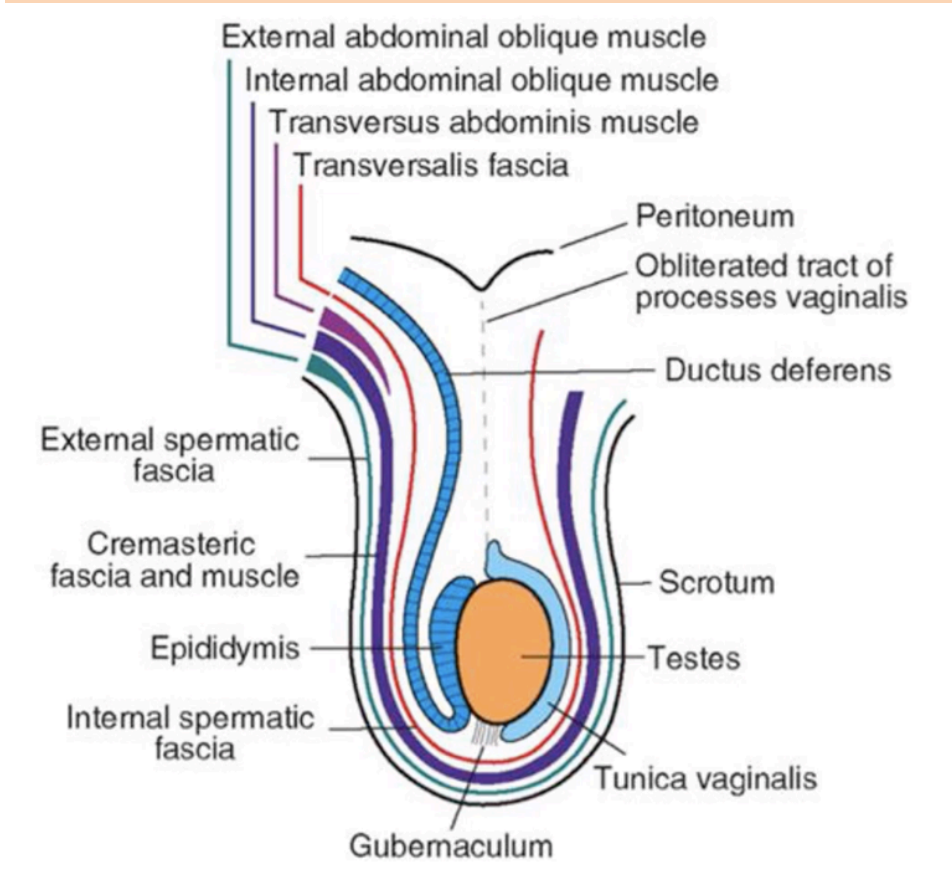
Label
True
(T/F) Descent occurs to a lesser extent in females compared to testes
2 nd part of paramesonephric ducts
These moves mediocaudal while genital ridges (remain) lie transversely
pelvic fold or broad ligament
As the paramesonephric ducts fuse in the middle, it brings with it a fold of peritoneum formation of ____________________________
Congenital indirect inguinal hernia
Descent of intestines into the scrotum because there is an open connection between the peritoneal cavity and processus vaginalis
1 st year after birth
Normally, the connection between the abdominal cavity and the scrotum obliterates at around the what age?
Hydrocele
This is the accumulation of fluid in the incompletely obliterated processus vaginalis
processus vaginalis
In hydrocele there is the irregular obliteration of the what that results in the development of cysts that secrete fluids
Cryptorchidism
There is incomplete or failure of the descent of the testes into the scrotum
ectopic testis
This is a rare congenital condition where a testicle descends outside the normal pathway and settles outside the scrotum, often in the groin, perineum, or thigh
Can be subjected to trauma, Can have torsion and compromise the blood supply and abnormal location results in a higher temperature than what is ideal for spermatogenesis
Possible dangers of ectopic or cryptorchid testes:
Gubernaculum
Mesenchymal condensation that appears to guide the descent of the gonads
gubernaculum testis
What is the male derivative of the gubernaculum?
suspensory ligament of the ovary
What is the female derivative of the gubernaculum cranially?
True ovarian ligament / round ligament of ovary and Round ligament of uterus
What is the female derivative of the gubernaculum caudally?
Paramesonephric duct or Mullerian duct
During the indifferent stage,These will eventually be suppressed/ disintegrate
Mullerian Inhibiting Substance (MIS) / anti-Mullerian hormone
The effects of these hormones produced by sertoli cells are inhibition of female characteristics, and suppression of paramesonephric ducts
Testosterone
The effects of these hormones produced by Leydig cells are stimulation of mesonephric ducts to differentiate Vas deferens, epididymis, seminal vesicle, ejaculatory duct
Dihydrotestosterone
This leads to the development of the External genitalia stimulated along with growth of penis, scrotum, & prostate
efferent tubules
Epigenital tubules that later develop into these tubules connected to the rete testis
paradidymis
The excretory tubules and the paragenital tubules at the caudal pole regress into this
mesonephric duct
Distally, the these elongates and later on would coil and form the epididymis, as well as the vas deferens, seminal vesicles and ejaculatory duct
utriculus prostaticus and the appendix testis
Paramesonephric duct - degenerates and what remains of it are these
Mesonephric tubules
What embryonic structures form the Efferent ductules
Mesonephric duct or Wolffian ducts
What embryonic structures form the epididymis, ductus/vas deferens, seminal vesiclesand ejaculatory duct
Mesonephric (Wolffian) -mAppendix epididymis
Paragenital tubules - Paradidymis
Paramesonephric (Mullerian) -Appendix testis and Utriculus prostaticus
What embryonic structures form the vestigial structures
Paragenital tubules
What forms the paradidymis
the uterine tubes/ fallopian tubes, uterus, and upper portion of vagina.
Presence of estrogen from the ovary stimulates the differentiation of the paramesonephric ducts into →
labia, clitoris, and lower portion of the vagina
Presence of estrogen from the ovary stimulates the differentiation of the external genitalia into →
Cranial vertical part
This part of the paramesonephric ducts opens into the abdominal cavityand develops into the uterine/fallopian tubes
Horizontal part
This part of the paramesonephric ducts crosses the mesonephric duct and forms part of the uterine tubes
Caudal vertical part
This part of the paramesonephric ducts fuses with its counterpart on the other side to form the uterine canal
True
(T/F) The regressing mesonephric ducts in females also have vestigial structures
Epoophoron
Epigenital tubules will become what, while the more caudal portion will become the Paroophoron