Memory
 Call Kai
 Learn
Learn Practice Test
 Spaced Repetition
 Match
Match Flashcards
 Knowt Play
1/99

There's no tags or description
Looks like no tags are added yet.
Name | Mastery | Learn | Test | Matching | Spaced | Call with Kai |
|---|
No analytics yet
Send a link to your students to track their progress
100 Terms
Who created the multi-store model of memory?
Atkinson and Shiffrin (1968, 1971)
What does the multi store model describe about memory?
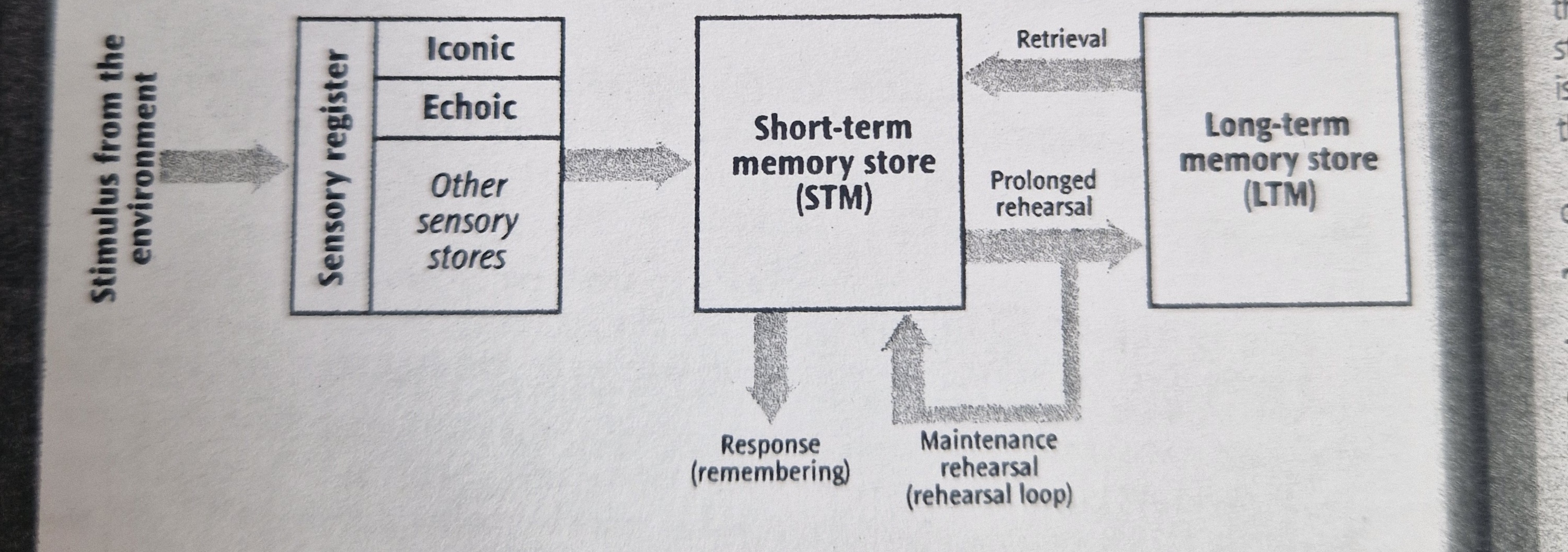
Describes how information flows through the memory system, and suggests memory is made of 3 stores linked by processing.
What are the 3 main stages of the multi store model?
Sensory register, short term memory and long term memory.
Draw a diagram of the multi store memory:
What is coding in memory?
Refers to the way information is changed and stored in memory
What is duration and capacity in memory?
Length of time that information is held in the memory store, capacity is the amount of information that can be stored.
What is sensory register?
An environmental stimulus passes into the sensory register along with other sights, sounds, smells etc.
What is the coding, duration and capacity of sensory register?
Coded in iconic memory (visual information coded visually) and echoic (auditory info coded acoustically)
Duration is less than half a second
Capacity is potentially unlimited
How does information pass from sensory register to STM?
If we pay attention to it it gets passed further into the memory system
What is STM, and what is the coding, duration and capacity of it?
Limited capacity store that is temporary, and can only store a certain number of things before forgetting. Capacity is 7 ± 2 items, duration is around 20-30 seconds unless information is rehearsed and information is coded acoustically (voice in your head).
What is maintainance rehearsal?
Occurs when we repeat material to ourselves over and over, we can keep the info in our STMs as long as we rehearse it.
How does info pass from STM to LTM?
Via prolonged rehearsal
What is LTM and what is the capacity, duration and coding?
Potentially permanent memory store for information that has been rehearsed for a long time. Capacity is believed to be unlimited, duration can potentially last a lifetime, and tend to be coded semantically.
What happens when we want to recall information from LTM?
Has to be retrieved back into STM via retrieval, so none are recalled directly from LTM
Outline research into coding:
Baddeley (1966) gave different lists of words to four groups of participants to remember. Group one was acoustically similar so words sounded similar, group 2 was acoustically dissimilar so words sounded different, group 3 was semantically similar (words with similar meaning) and group 4 (semanitcally dissimilar - different meanings). Participants were shown original words and had to recall in correct order, and they tended to do this worse with acoustically similar words immediately after hearing it (STM). After 20 mins they did worse on semantic similar words, suggesting info is coded semantically.
What was the procedure of the Jacobs study and what did it investigate?
Researched capacity, and developed a technique to measure digit span. Researcher gives, for example, 4 digits, and participant is asked to recall in correct order out loud. If this is correct 5 digits are then read out and so on until they cannot recall it to determine digit span. Mean span for numbers was 9.3, and letters for 7.3.
What is research support for capacity from Miller?
He did a review into published investigations into perception and STM, and this suggests that information is organised into a series of chunks enabled STM to cope with 7 chunks. Chunking enables the capacity of STM to be extended so more information can be stored there
Who did research into duration of STM and what was the procedure?
Peterson and Peterson tested 24 male and female university students, each student took part in 8 trials (trial = one test). On each trial the student was given a consonant syllable (trigram like YGH) to remember and given a 3-digit number. The student was asked to count backwards to prevent mental rehearsal of the consanent syllable. They were told to stop after a different amount of time -3 to 18 seconds - called retention interval. Results suggest that STM has a very short duration unless we repeat it. At 3 seconds 80% could recall it and at 18 seconds only 10% were recalled. Suggests duration is limited to 18 seconds.
What is the procedure of research into duration of LTM, and who did it?
Bahrick and colleagues studied 392 USA participants aged between 17 and 74, and were shown photos of their high-school yearbook, and for each photograph participants were given a group of names and were asked to select the correct ones (photo recognition). For photo recognition, within 15 years it was 90% accurate and for 48 years recall declined to 70%. Free recall was used where they had to recall names of their graduating class. They were tested within 15 years of graduation and were about 60% accurate . After 48 years it declined to 30%. Shows that LTM can last a long time.
What is research support for MSM?
Strength is that research shows that STM and LTM are qualitatively different. Eg, Baddeley found we tend to mix up similar words that sound similar using STM. But we mix up words with similar meanings in LTM. Strength because it shows that coding is different in both of them and supports the idea that stores are separate.
What is a weakness of MSM concerning having multiple types of STM?
The theory states that there is only one type of STM. However there is evidence from people with amnesia. Shallace and Warrington studied KF - found that his STM memory for digits was poor when they read them out loud to him, but when reading digits to himself recall was much better. Other research has showed there could be a STM for noises. Limitation, as it shows the model is too oversimplified and does not include enough detail to provide a full explanation.
How is MSM reductionist?
Environmental reductionism as it tries to explain a complex behaviour by relying on isolated variables operationalised in lab experiments, but memory is a complex phenomenon and many argue reducing memory to isolated variables undermines its complexity.
What case study supports MSM?
HM had an operation to stop epilepsy, and parts of the hippocampus were removed. He did not know the correct date or his age, he couldn’t remember speaking to someone an hour before, and his LTM never improved. His STM was still good showing that the stores are distinct from each other.
What is a weakness of assumptions of rehearsal in MSM?
According to the model the amount of rehearsal you do matters. However, Craik and Watkins found that the type of rehearsal matters more . Maintenance rehearsal is described in MSM but this doesn’t transfer it to LTM. Elaborative rehearsal is needed for long term storage, which occurs when you link it to existing knowledge. This weakens the model as the model doesn’t fully explain how information is transferred to LTM.
How does MSM lack mundane realism?
Many of the research conducted is highly artificial, and use digits and letters instead of real life things like people and places, and used consonant syllables that have no meaning. This means findings cannot easily be generalised to real life scenarios.
What is a weakness of MSM in terms of the types of LTM?
There is evidence to suggest that LTM is not a unitary memory store, and has many different types not explained by the model.
What is a weakness of Baddeley and Peterson and Peterson’s study in terms of artificiality?
In Baddeley’s study, word lists were artificial stimuli that had no personal relation to the participant, so it is difficult to generalise findings when it is not based on real life. When processing meaningful info semantic coding may be used even for STM. This is similar in Peterson and Peterson’s study, where stimuli was artificial, and trying to memorise trigrams is quite meaningless to real life memory activities, so both of these studies lack external validity.
Limitation of the MSM surrounding the use of cognitive processes?
It is based on cognitive approaches so relies on inference. This means that the processes involved cannot be directly measured because they are internal processes, which reduces the generalisability of the model.
What is a limitation of some research conducted a long time ago such as Jacobs in 1887?
Early psychological research often lacked proper control of different variables, meaning that variables such as participants being distracted may have influenced the results of the study. Therefore, confounding variables limit the validity of the research, and mean that the findings cannot be generalised in today’s day and age.
How does brain scan evidence support the MSM?
They have shown that different areas of the brain are active when performing STM tasks (such as the hippocampus), and LTM tasks (motor cortex). This supports the idea that different brain regions are responsible for different memory tasks which in turns supports the theory of the MSM that memory is made of different stores.
How does Bahrick’s study have high external validity but low population validity?
The study used real life memories that are meaningful to participants and replicate real life use of memory. Other studies on LTM with meaningless stimuli had lower recall rates, showing that using meaningful stimuli may reflect real life more. However, the study does lack population validity because it was only conducted on American students, and the findings cannot be generalised to other people such as UK students. This limits the usefulness of the research because we don’t know if other populations would have the same recall. Also, confounding variables such as the participants looking at their yearbook over the years were not controlled, and this could have influenced the results.
What are limitations of the Peterson and Peterson study in terms of demand characteristics and alternative explanations of STM duration?
24 psychology students were used, and this is an issue because the students might have encountered the MSM previously, and could have shown demand characteristics by changing their behaviour to help the experimenter. Also the psychology students may have had better memory recall because they had studied memory improved techniques anyway, so it is difficult to generalise to other populations. The Peterson’s thought they were studying the duration of STM, because they believed that counting down caused decay of the trigrams. However, the findings could have been due to displacement, where due to the limited capacity of STM the numbers could have caused the letters to be pushed out. Therefore the study may be limited in its explanation of duration, because it is possible it was the capacity that was being investigated instead.
What is a strength of Baddeley and Peterson’s research in terms of control variables?
Both used highly controlled lab studies, so extraneous variables could be controlled. This means the studies can be easily replicated to test the reliability, and this then strengthens the validity of the studies.
Who proposed the working memory model?
Baddeley and Hitch (1974)
What is the working memory model?
Explanation of how short term memory is organised and how it functions. This is concerned with the part of the mind active when we are temporarily storing and manipulating information.
What is central executive in WMM?
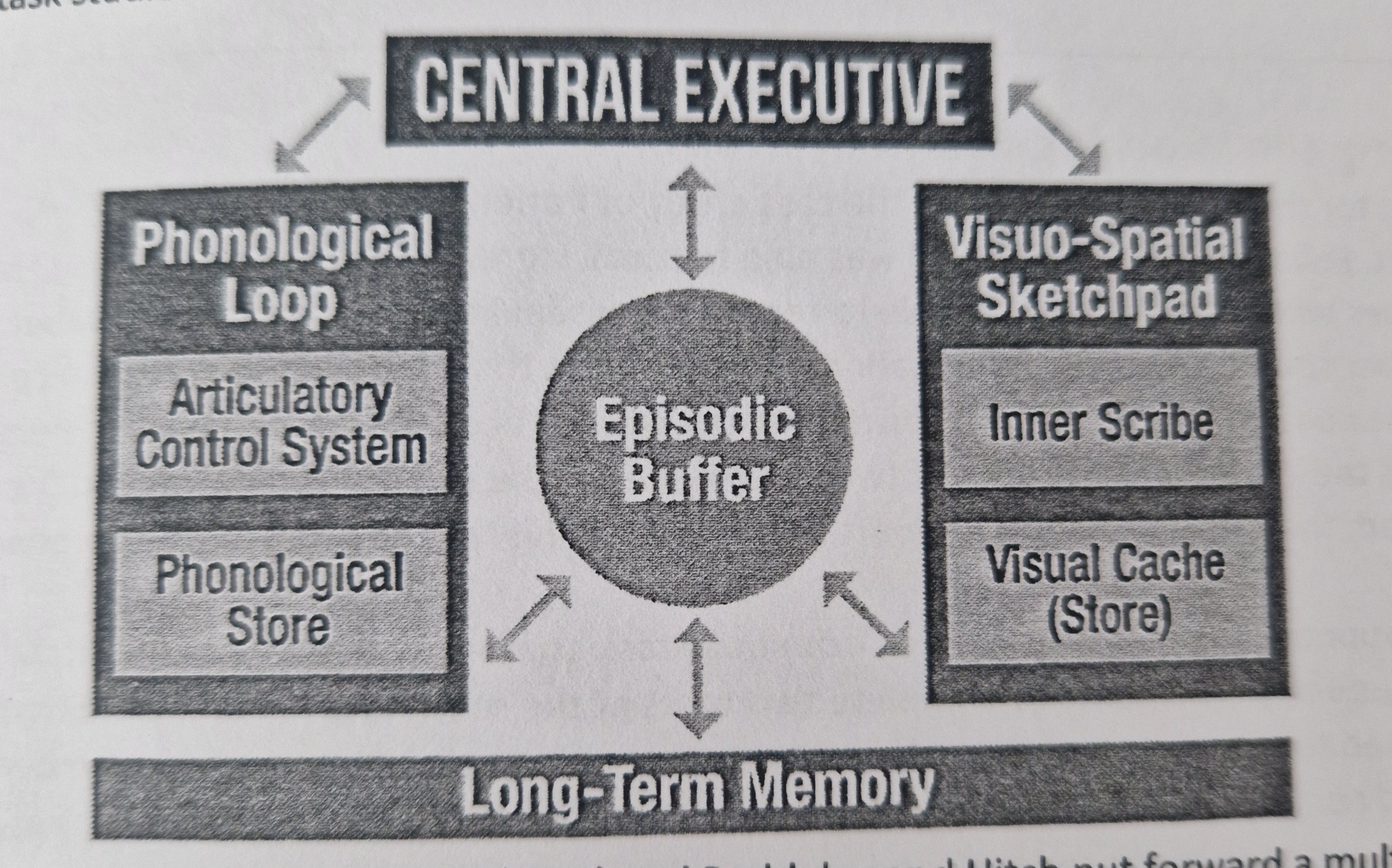
Attentional process that monitors incoming data, makes decisions and allocates slave systems to tasks. It coordinates activities of the 3 subsystems. It has a limited capacity of 4.
What is the phonological loop?
It processes auditory information, and coding is acoustic, and preserves the order in which the information arrives.
What is the phonological loop divided into?
Phonological store stores the words you hear
Articulatory process allows for maintenance rehearsal (repeating sounds or words in a loop to keep them in working memory). Believed to be 2 seconds worth of what you can say.
What is the visuo-spatial sketch pad?
Second slave system, which stores visual/spatial information when required. Has a limited capacity of 3-4 objects. Divided into visual cache storing visual data, and inner scribe, recording arrangement of objects in the visual field.
What is the episodic buffer?
Third slave system, which was added to the model by Baddeley. Temporary store of information, integrating visual, spatial and verbal information processed by other stores and keeping a sense of time sequencing which records events that are happening. Storage component linking working memory to LTM, and has a limited capacity.
Draw a diagram of the working memory model:
What evidence for the working memory model do case studies provide?
Case study of patient KF (Shallice and Warrington). He had brain damage, afterwards KF had poor STM ability for verbal information, but could process visual information presented visually - recall letters and digits but not sounds. Suggests his phonological loop had been damaged. This supports the existence of a separate visual and acoustic store, which increases validity of the theory because it shows STM is more complex and divides it into different stores. However, this evidence is not necessarily reliable because it concerns unique cases with confounding variables like trauma.
What evidence do dual-task studies provide for WMM?
They support the separate existence of the visuo-spatial sketch pad. Baddeley et al showed participants had more difficulty doing 2 visual tasks (tracking light and describing letter F) than doing both a visual and verbal task at the same time. The increased difficulty is due to both visual tasks competing for the same slave system, but doing different tasks they are processed in separate stores so there is no competition. This is a strength as it supports the idea of the WMM that the STM has different systems that process different information such as visual input.
What is a weakness of the WMM in terms of the central executive?
Some argue that the central executive is unsatisfactory. The model does not clearly specify the process of paying attention, and could be too simplistic because there may be multiple components. This means the model is not hugely valid because it misses out parts of the explanation. Baddeley recognised this, and added in the episodic buffer to explain more
How does brain scans evidence support the WMM?
Braver et al gave their participants tasks involving the central executive while doing a brain scan. The researchers found greater activity in the prefrontal cortex. Activity also increased as the task became harder. This supports the WMM because it shows that as the demand on the central executive increases, the activity in the area controlling it increases to fulfill the function.
How might the WMM provide a limited explanation in terms of LTM?
It focuses too heavily on STM, and the link between WMM and LTM is not fully explained. The model is detailed in its explanation of working memory, but it does not show how information is transferred from STM to LTM. Therefore the model is incomplete, and is not detailed enough to explain complex cognitive processes.
How is the WMM reductionist?
It demonstrates experimental reductionism, as it attempts to examine complex behaviour by relying on isolated variables used in lab experiments. This is an issue as it reduces complex cognitive processes down to simple processes that dont fully explain processes.
What is research support for the phonological loop?
Baddeley et al showed that people find it harder to remember lists of long words rather than short words, which is called word length effect. This shows that the capacity of the articulatory process is limited, and supports WMM because it demonstrates how working memory elements only have a certain capacity.
What is interference?
Forgetting because one memory blocks another causing one or more memories to be distorted or forgotten.
How does information get interfered with in LTM?
Once information has reached LTM it can be permanent, but any forgetting of LTM is likely as well can’t access them even though they are available. Interference between memories makes it harder to locate them.
What is proactive interference?
Occurs when an older memory interferes with a newer one, eg teacher has learnt so many names she has difficulty remembering names of the new class.
What is retroactive interference?
When a newer memory interferes with an older one, eg your teacher has learned so many new names she has difficulty remembering names of students last year.
What study investigates the effects of similarity - outline the method:
Effects of interference is worse when the memories are similar, as discovered by McGeoch and McDonald. They studied retroactive interference by changing the amount of similarity between two sets of materials. They had to learn a list of 10 words until they could remember them with 100% accuracy, and then learned a new list. There were 6 groups who had to learn different types of lists. Groups included synonyms, antonyms, unrelated words, consonant syllables, 3 digit numbers, and a control group with no new list.
What were findings of McGeoch and McDonald in the effects of similarity study?
When participants recalled the original list of words, their performance depended on the nature of the second list. The most similar material (synonyms) produced the worst recall, which shows that interference is stronger when memories are similar.
What was the procedure of Baddeley and Hitch study on retroactive inference?
Sample consisted of rugby union players who had played every match in the season, and players who had missed some games due to injury. Length of time from start to end of season was the same for all players, and they were asked to recall the team names they had played against earlier in the season. Players who had played the most games forgot proportionately more games than those who played fewer games. Shows that this is the result of retroactive interference as learning new info interfered with old info.
What is a strength of interference theory in terms of lab study evidence?
There have been thousands of lab studies carried out on interference that support the theory and show that different types of interference are common types of forgetting. For example, McGeoch and McDonald found that forgetting is more common when memories are similar, supporting interference theory. This strengthens the theory because there are numerous studies that all have the same outcome, demonstrating that interference is a valid explanation of forgetting which allows it to be applied to real life scenarios and be generalised.
What is a weakness of lab study evidence of forgetting?
Most research underpinning interference is done in a lab setting, and uses meaningless stimuli like letter combinations that have no meaning in real life. Therefore this limits the ecological validity of many of the studies, because they do not represent everyday examples of interference, so it difficult to use the studies to support interference theory or apply to human memory.
What is retrieval failure?
A form of forgetting that occurs when we don’t have the necessary cues to access memory, so the memory is available but not accessible unless a suitable cue is provided. A cue is a trigger of information that allows access to a memory.
What is encoding specificity principle?
Developed by Tulving via reviewing research into retrieval failure, and it states that if a cue is to help us recall information, it has to be present as encoding when we learn it, and at retrieval. If cues at encoding and retrieval are different or not there, some forgetting will occur. Some cues are linked to information so it is remembered in a meaningful way, such as mnemonic, but some cues such as location (external) and state (internal) are not linked meaningfully but are still present at encoding.
Who conducted the study on context dependent forgetting and what was the procedure and findings?
Godden and Baddeley carried out a study on deep sea divers working underwater, where they must remember instructions given on land. The 18 male and female divers learned a list of words either underwater or on land and were asked to either recall on land or underwater (4 conditions). In 2 conditions the environmental contexts were the same, and in two they were different. Accurate recall was 40% lower in the non-matching conditions, as the external cues available at learning were different from the ones at recall, leading to retrieval failure.
Who did the study on state dependent forgetting, what was the procedure and findings?
Carter and Cassaday gave anti-histamine drugs (hay fever treatment) to their participants, which had a mild sedative effect making the participants slightly drowsy. This creates an internal physiological state different from the normal state of being alert. The participants had to learn different lists of words and passages of prose. 4 conditions were created - 2 had the same state when learning and recalling and 2 had different states. Performance was significantly worse when internal state was mismatched between learning and recalling, so when cues are absent there is more forgetting.
Why is the supporting evidence a strength of retrieval failure theory?
It increases the validity of the explanation, because multiple studies have come out with similar results. Also, both studies did revolve around real life situations such as taking hay fever tablets or diving, which shows that the findings can be valid to apply to some real life scenarios and increases generalisability. Other studies like one done by Darley et al on marijuana found that putting money away while on the drug led to less accurate recall off the drug. This supporting evidence shows the explanation is reliable because multiple studies have similar results even in different situations.
What is a weakness of the explanation in terms of the effect of the context on forgetting?
Baddeley argues that context effects may not be very strong in real life, and different contexts have to be extremely different to have an effect, so recalling something in a different room to where it was learnt may not cause much of a difference. This is a weakness because it limits how far context- dependent forgetting is valid as an explanation of forgetting, and means that findings from different studies lack ecological validity because land vs sea is far more different than normal differences in contexts in real life.
What are some weaknesses of the Godden and Baddeley study?
The experiment was not particularly well controlled, such as it taking place at different times of the day and locations, which could have affected memory. This makes it hard to conclude whether results are due to context differences from location or other variables, limiting generalisability of the findings. It is possible that the divers worked out the experiment aims due to demand characteristics, and results may have been affected by boredom after doing so many trials. Also the differences in context were so extreme that it is difficult to generalise this to real life scenarios where differences in context are less extreme.
How might retrieval failure depend on type of memory tested?
When Godden and Baddeley replicated the underwater experiment but used a recognition test instead of a recall one, there was no context dependent effect and performance was the same in all 4 conditions. This is a limitation of the theory because it limits how you can practically apply it to different situations if context only applies in certain situations, making the theory less practically useful.
How does retrieval failure theory have real life applications?
It has practical applications to examples of forgetting in real life, such as going into a room and forgetting why you went in there. Applying context theory will help recall the information because you recall the environment where you knew the information, and this principle has been used in real life in eyewitness testimony interviews to get the individual to recall information more clearly. This shows how the theory can be applied in settings where people can benefit from understanding memory better.
What is a weakness of ESP in terms of encoding the cue?
We cannot definitely prove that the cue became encoded along with the information, as we can only make assumptions that if the cue leads to recall then it got encoded, and if it did not lead to recall it did not get encoded. Therefore this reduces the reliability of the theory because we cannot prove beyond reasonable doubt that the cue actually causes recall, and whether other factors have also influenced the recall.
What was the procedure of Loftus and Palmer’s study on eyewitness testimony?
First experiment involved 45 American students divided into 5 groups of 9, all of them watched a car crash video and were asked a specific leading question about speed of cars. The verb was manipulated in the question - smashed/hit/bumped/contacted. They found that estimated speed was affected by the verb used. ‘Smashed’ reported an average speed of 40.5mph while contacted reported an average of 31.8%. This showed that the leading question biased the eyewitness testimony
Second experiment involved 150 students who watched the video, one group was asked about the speed when smashing into each other, the other was asked about speed when hitting each other, and a week later they were asked if there was any broken glass (there wasn’t). 32% of those who had the verb smashed reported seeing it, and 14% who had the verb hit reported it. The earlier leading question affected their memory of the event and distorted it.
What is a leading question?
A question which is phrased in a certain way to suggest a particular answer
Why do leading questions affect eyewitness testimony?
Response bias explanation suggests that the wording of the question doesn’t affect the participant’s memories, but influences how they decide to answer and encourages them to choose a certain answer. The substitution explanation suggests that the way a question is worded actually changes the memory, demonstrated in the second part of the Loftus study.
What was the procedure of the Gabbert et al study and what did it investigate?
Wanted to look at the effect of post event discussion on the accuracy of eyewitness testimony. Sample comprised of 60 students and 60 adults. They watched a video of a girl stealing money from a wallet, and participants were either tested in pairs or individually (control). Participants in the co-witness group were told they watched the same video but they seen different perspectives and only one person had actually watched her stealing. They discussed the crime together then were tested with a questionnaire. 71% of participants recalled information they had not seen, 60% said the girl was guilty despite the fact they hadn’t seen her commit the crime. In the control group no one recalled information they didn’t see. This shows that witnesses often go along with each other to win social approval or due to believing others are right - called memory conformity.
What is post event discussion?
Occurs with more than one witness to an event, and they may discuss what they have seen which can influence accuracy.
What is a weakness of studies supporting misleading information in eyewitness testimony in terms of real life application?
Both studies lack ecological validity - as in the car crash study they watched the video from start to finish, and in real life people rarely see the whole event and do not pay attention to details in the same. This makes it unrealistic to crime situations in real life. Also only watching a clip of an event is very different from watching it happen, where emotions can affect memory. This is a limitation as it does not show how false information affects EYT in real life situations which limits the practical usefulness of the studies.
What is a strength of the misleading information theory of eyewitness testimony in terms of practical use?
It has hugely important practical uses in the real world, where the consequences of inaccurate EYT can be very serious. Loftus proposed that leading questions can distort the memory of an event, leading to police officers becoming more careful with how they phrase questions. This makes a difference to the lives of people because it means that criminal cases might have stronger evidence and court cases can be improved via people appearing as witnesses. However, studies may not be as relevant to real life given that in real life cases it is more life and death.
What is a weakness of misleading information in terms of individual differences?
There is evidence that older people are less accurate than younger people when giving eyewitness reports. Anastasi and Rhodes found that people in age groups 18-25 and 35-45 were more accurate than 55-78. However everyone was more accurate when identifying people their own age. This is a weakness of the theory because it cannot be equally applied to all ages, and for some people it may apply less than others.
What is a strength and weakness of the Loftus and Palmer methodology?
A strength is that it took place in a lab, and was highly controlled, and this reduced the chance of extraneous variables being present that affect results, which increases the validity of the results. This also makes it easy for psychologists to replicate the research to see if the same results apply across different populations. However, a weakness of the research is that it lacks population validity, as the study was done on students who may be less accurate at estimating speeds. This means the study lacks generalisability to other populations such as older people who may not be as susceptible to leading questions if they can estimate speeds.
What is the issue with demand characteristics in eyewitness testimony studies?
Participants may not want to appear to let the researcher down, and want to appear helpful and attentive, so if they are asked a question they don’t know, they may try and guess the most ‘helpful’ answer. This means that studies that find leading questions to affect memory may also be affected by demand characteristics, so the participants may know that they didn’t see a certain thing, but it still appears in the results which can invalidate them because the results are not due to EYT question phrasing.
How can anxiety have a negative effect on recall?
It creates physiological arousal in the body which prevents us from paying attention to important cues, meaning recall is worse. The tunnel theory suggests that a witness's attention narrows to focus on a weapon because it is a source of anxiety, so they may not recall other important details.
How did Johnson and Scott investigate the effect of anxiety, and what did they find?
Participants were invited to a lab where they were told to wait in reception, believing they were part of a lab study. They were left alone, and were exposed to two conditions. The first one was ‘low anxiety’ condition where they overheard an argument and a man walked out holding a pen with greasy hands. In the high anxiety condition they heard the same argument, but a man ran out with a bloodied letter-opening knife. The participants then had to pick out the man from 50 photos, and in the first condition 49% of participants were able to correctly identify him, whereas in the second condition 33% were able to.
How might anxiety have a positive effect on recall?
The stress of witnessing a crime creates anxiety through physiological arousal within the body. Fight or flight is triggered which increases alertness and improves our memory for the event because we become more aware of cues in the situation.
How did Yuille and Cutshall investigate the effect of anxiety on eyewitness testimony and what did they find?
They conducted a real life experiment on witnesses of a gun shop robbery where the owner shot the thief dead. There were 21 witnesses, 13 agreed to take part. Interviews were held 4-5 months after the incident and were compared with the original police interviews made at the time of shooting. Accuracy was determined by number of details reported in each account, and witnesses rated how stressed they felt at the time using a 7-point scale and were asked about emotional problems after the event. All major details remained the same, accounts were accurate and the only changes were ones such as colour of items, and age, height and weight. Those who reported the most stress had the highest accuracy (88% compared to 75% for the less stressed group.
How can you explain contradictory findings in effects of anxiety on eyewitness testimony?
According to Yerkes and Dodson, the relationship between emotional arousal and performance looks like an inverted U. Deffenbacher applied the Yerkes-Dodson Law to EWT. This is because lower levels of anxiety produce lower levels of recall accuracy, but memory becomes more accurate as level of anxiety increases. However there comes a point where the optimal level of anxiety is reached, which is the point of maximum accuracy. If eyewitness experiences more stress than this then recall will drastically decline.
What is a weakness of the Johnson and Scott study in terms of the relevance of the weapon focus effect?
The study may test surprise instead of anxiety, and the reason participants focus on the weapon may be because they are surprised instead of scared. This is shown in Pickel’s experiment where scissors, a handgun, a wallet or raw chicken was used in a hair salon video (scissors would be low anxiety and low unusualness). Eyewitness testimony was much poorer in high unusualness conditions. This suggests the weapon focus effect is due to unusualness rather than anxiety or threat, and so tells us nothing about the effects of anxiety on EWT.
Why might the Yuille and Cutshall study lack control?
It is a real life study, meaning that many different things will have occurred since the crime that the researchers have no control over because they interview the witnesses a while after. For example, discussion with other people, accounts read in the media, effects of police interview - post event discussion. This is a limitation of field research because there are many extraneous variables present that could affect recall and potentially make it more accurate which could exaggerate the positive effect of anxiety in this study. This means it is difficult to assess the individual effects of anxiety when the interviews are conducted, as you don’t know whether anxiety is the cause of improved recall.
What are the ethical issues of studying the effects of anxiety in lab research?
It risks causing people psychological harm purely for research purposes, and in Johnson and Scott’s research multiple ethical guidelines were broken. The participants were deceived on the nature of the study and not protected from harm. Exposing some of them to a man holding a knife may have caused extreme anxiety, and this is an issue as they may have left feeling extremely stressed and anxious. This questions the need of such studies, and the cost must be weighed against the benefits.
What is an issue with the Yerkes-Dodson law?
It is too simplistic, because anxiety is very hard to measure accurately as it has many different cognitive, behavioural and physical elements. The inverted U law assumes that only physical arousal is linked to poor performance. This is a weakness because it ignores many other factors that are involved in recall due to anxiety, so may not be a reliable theory to use in explanations of eyewitness testimony.
How might demand characteristics be a weakness of eyewitness testimony studies?
Most lab studies show a filmed and usually staged video, and participants will be aware they are watching a filmed crime for a reason related to the study. Many participants are likely to work out they are going to be asked questions about what they have seen, and this is a weakness because it leads to them paying more attention than might be usual when observing a crime. This means results of the study may not be due to anxiety, and could be influenced by participants working out the aims of the study.
Why might Johnson and Scotts study lack ecological validity?
Although the participants were waiting in the area, they may have anticipitated something was going to happen, which may have affected the accuracy of their judgements. Given that real life studies contradict the findings of this study, the study may not reflect what happens in real life eyewitness cases.
What is cognitive interview?
A method of interviewing eyewitnesses to help them retrieve more accurate memories. It uses 4 techniques all based on well established psychological knowledge of human memory.
Who developed the cognitive interview and what did they argue about it?
Fisher and Geiselman developed it and argued that eyewitness testimony could be improved if police used better techniques when interviewing witnesses. They recommended that such techniques should be based on psychological insights into how memory works, and is founded in cognitive psychology.
What are the first 2 steps of the CI?
Report everything - witnesses are encouraged to include every single detail of the event even if it may seem irrelevant because seemingly trivial events may be important and can trigger other important memories.
Reinstate context - should return to the original crime scene in their mind and imagine the environment and their emotions, this is related to context dependent forgetting.
What are the last two steps of the CI?
Reverse order - events should be recalled in different chronical order to the original sequence from final back to beginning. This prevents people reporting their expectations of how the event must have happened rather than actual events and prevent dishonesty.
Change perspective - should recall incident from other's perspectives, eg how it appears to other witnesses, which disrupts effects of expectations and schema on recall, the schema you have for a certain setting generates expectations of what would have happened and the schema is recalled and not what actually happened.
What is the enhanced cognitive interview?
Fisher et al. developed additional elements of the CI to focus on the social dynamics of the interaction. For example the interviewer needs to know when to establish eye contact and when to not do it. It includes ideas like reducing eyewitness anxiety, minimising distractions, getting witness to speak slowly and asking open ended questions.
What is a limitation of the CI in terms of time it takes?
Police may be reluctant to use the CI as it takes much more time than a standard police interview. More time is needed to establish rapport with the witness and allow them to relax. The CI requires special training and many forces have not been able to provide more than a few hours. This means it is unlikely that the proper version of the CI is used so this is a limitation as it means the practical applicability of the technique is limited.
How might some parts of CI be better than others, and why is this a strength?
Milne and Bull found that using a combination of reporting everything and context reinstatement produced better recall than any of the other conditions. This confirmed the police's theory that some parts of the interview are more useful than others. This is a strength because it suggests that at least two of the two elements should be used to improve police interviewing
What research support is there for the effectiveness of the enhanced cognitive interview?
Research suggests that the enhanced cognitive interview can have special benefits. A meta analysis by Kohnken et al combined data from 50 studies. The enhanced one consistently provided more correct information than a standard interview used by police. This is a strength as it suggests there are real practical benefits to the police of using the enhanced version of the CI. This is beneficial as it gives a greater chance of charging and catching criminals which helps society.
What is a weakness of the CI shown in Kohnken's study?
His study found an increase of correct information (81%) but also a 61% increase in incorrect information when the enhanced cognitive interview was compared to a standard interview. This is a weakness because although the study partially supports the interview it also reduces generalisability if there is an increase of incorrect info.
Why might it be an issue that police evolve their own CI?
It means that police evolve their own methods and techniques instead of following a standard procedure. This makes it hard to evaluate its effectiveness when different scenarios use different methods, and it is hard to judge the effectiveness of the interview. However this is also a strength, because it means police are able to adapt the method to fit different situations, which may mean that the interview is more effective than if everyone followed the same technique, because it might produce better results if adapted.