S7) Queer Theories from Somewhere
 Call Kai
 Learn
Learn Practice Test
 Spaced Repetition
 Match
Match Flashcards
 Knowt Play
1/7

Earn XP
Description and Tags
by Margot Weiss
Name | Mastery | Learn | Test | Matching | Spaced | Call with Kai |
|---|
No analytics yet
Send a link to your students to track their progress
8 Terms
what does ‘ethnographising’ and ‘transnationalising’ queer theory mean?
ethnographising: grounding concepts of queer theory in real life with help of ethnographic descriptions
emphasising positionality, focusing on fluidity, deconstructing norms and centering marginalized voices to understand power dynamics and social relations
transnationalising: expanding queer theroy beyond it’s euro-american frame, understanding gender and sexuality globally
adressing limitations of eurocentric, traditional queer theory, analysing diverse queer experiences across boarders
emphasis on situatedness of (all) theories, not universal queer theory → instead queer theory of some geopolitical locations
PLURALITY OF QUEER THEORY
what understanding of the role of queer anthro does she criticise?
un/undertheorised → queer anthro doesn’t produce own theory, it just applies queer theory in ethnographies
voices and experiences of queer people are seen as data or evidence, not modes of theory
theory and data are not dividable, they constitute one another
anthro: data provider of situated knowledge, seems local and descriptive vs. queer theory portrayed as universal and unsituated
(universal) queer theory is only ethnographised, it is only applied not expanded
how are genealogies/the “origin story” of queer theory political?
queer theory is seen as unsituated and concepts seen as universal, but:
theories are situated and contextual!
queer anthro as origin of many queer theories innovations
genealogies challenge idea of a fixed, stable origin for queer identity/theory
origin story emerged from activist movements, challenged heteronormativity, destabilises fixed categories of identity, …
(V) sexuality in classic ethnographies
Malinowksi (1927): sexuality dominates almost every aspect of culture
Margaret Mead (1928): sex before marriage and same-sex relations, criticises sexual repression
C. Vance (2004): anthropologists as fearless investigators that break through erotophobic intellectual taboos
1960s/70s: women studies
ethnographic male bias, missing representation of women
Moore & Strathern, critique on women studies: self ghettoisation (focus on women makes it seem like women are v different from men)
postcolonial critique and intersectionality
Mohanty: assumption of universal repression of women reproduces essentialised assumption of gender, no uniform category of ‘woman’
Crenshaw, intersectionality: gender works alongside different discriminary lines (ethnicity, race, sexual orientation, age, religion, dis/ability)
sex/gender system as socially constructed ‘set of arrangements’ (Gayle Rubin)
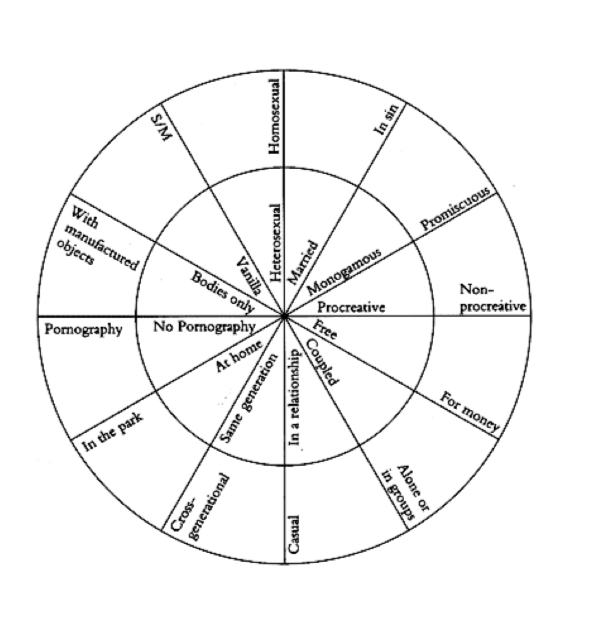
charmed circle (Gayle Rubin)
hierarchal system of sexual value
focus on sexual normativity (instead of sexual identity)
much of the oppression of women is borne by, mediated through and constituted within sexuality
queer anthro - recent key aspects
strong interest in masculinity (fragile, toxic, hegemonial masculinity)
combination of gender and sexuality (sexual rights, anti-genderism)
new focus on bodily materiality
fazit
it’s not abt what gender “is”, it’s about how femininity and masculinity are created performatively and how they are normed societally
researching gender requires intersectionality
queer anthropology was never just “generating data” it also created theories
queer theory is situated and “from somewhere”