StemUp: AQA A level Physics 3.3.2 Refraction, diffraction and interference
 Call Kai
 Learn
Learn Practice Test
 Spaced Repetition
 Match
Match Flashcards
 Knowt Play
1/88

There's no tags or description
Looks like no tags are added yet.
Name | Mastery | Learn | Test | Matching | Spaced | Call with Kai |
|---|
No analytics yet
Send a link to your students to track their progress
89 Terms
What is path difference in wave interference? (2)
- Path difference is the difference in distance that two waves travel from their sources to a specific point.
- It determines whether they interfere constructively or destructively.
What does a coherent light source emit? (1)
A coherent light source emits waves that have the same frequency and the same wavelength.
Why is constant phase difference important in coherence? (2)
- A constant phase difference allows the waves to consistently interfere.
- This produces a stable pattern.
Why are lasers used in interference experiments? (1)
Lasers produce coherent light with a fixed phase relationship and single wavelength.
How does laser light help create clear interference patterns? (2)
- Laser light gives well-defined and stable patterns.
- This is ideal for diffraction and double slit experiments.
What is meant by a complete cycle in a wave? (1)
A complete cycle is a wave with an angle of 360 degrees or 2*pi radians.
What is meant by waves being in phase? (2)
- Two waves that are both at the same point in their wave cycle are in phase, they would also have the same displacement and velocity.
- Two points with a phase difference of zero or a multiple of 360 degrees (2*pi radians) are in phase.
What is meant by waves being out of phase? (2)
- Two points with a phase difference of odd multiples of 180 degrees (pi radians) are exactly out of phase.
- Waves are usually only in phase if they come from the same source, for example, a laser.
What happens to light as it passes through the slits in Young's experiment? (2)
- Light diffracts when passing through the two narrow slits.
- These are about the same width as its wavelength.
What do the slits act as in Young's experiment? (1)
The slits act as two coherent sources, emitting overlapping wavefronts.
Where and why do bright fringes form in Young's experiment? (2)
- Bright fringes appear where waves meet in phase and interfere constructively.
- This occurs when the path difference is a whole number of wavelengths (nλ).
Where and why do dark fringes form in Young's experiment? (2)
- Dark fringes form where waves meet out of phase and interfere destructively.
- This occurs when the path difference is (n + ½)λ.
What is the result of the interference in Young's double slit experiment? (2)
- Interference produces a pattern of alternating bright and dark fringes.
- This is referred to as an interference pattern.
What does Young's double slit experiment and the interference pattern look like? (3)
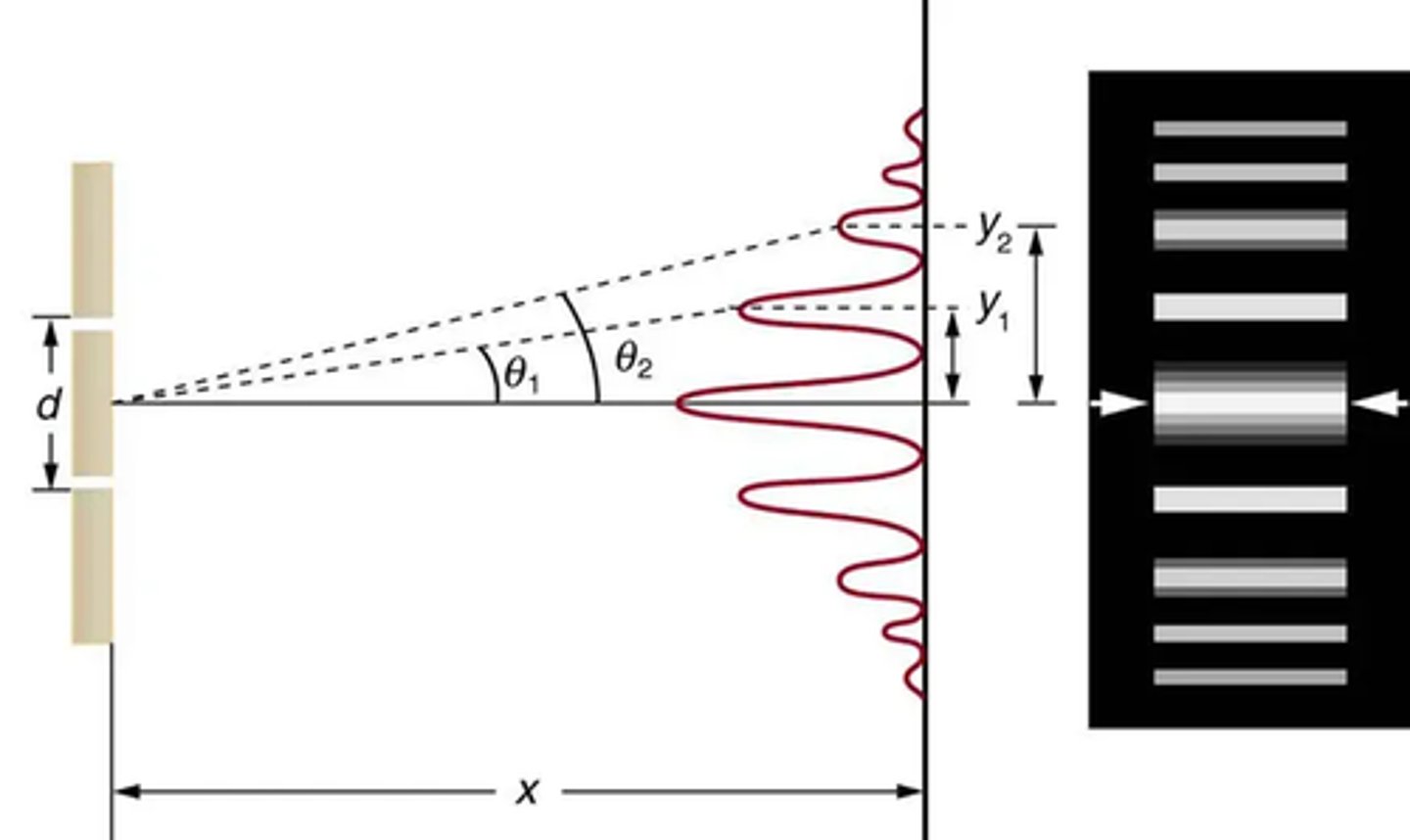
What is the equation for fringe spacing in the double slit experiment? (2)
- The equation is: w = λD / s.
- Where w is fringe spacing (m), λ is wavelength (m), D is slit-to-screen distance (m), and s is slit separation (m).
How does using white light affect the interference pattern from the Young's double slit experiment? (2)
- White light creates a central white fringe with a wider, less defined pattern.
- The outer fringes show a spectrum, where violet is closest to the centre, red is furthest away.
Why should laser safety goggles be worn? (1)
Laser safety goggles protect your eyes from damage caused by direct or reflected laser light.
Why must lasers not be shone at reflective surfaces? (1)
Reflections can redirect the beam unpredictably and dangerously.
Why should a warning sign be displayed during laser use? (1)
A warning sign alerts others to the laser hazard and helps prevent accidental exposure.
Why should lasers never be aimed at a person? (1)
Lasers can cause permanent and severe eye injury.
How can sound be used to demonstrate interference? (2)
- Two speakers connected to the same signal generator produce coherent sound waves.
- Then, a microphone detects regions of high and low intensity, known as an interference pattern, like light's bright and dark fringes.
What wave behaviours are shown in Young's double slit experiment? (1)
Young's double slit experiment shows diffraction and interference, which are characteristics of waves.
What does Young's experiment suggest about electromagnetic radiation? (1)
Young's experiment shows that light behaves as a wave under certain conditions.
Why did Young's experiment challenge earlier theories of light? (2)
- Young's experiment revealed wave behaviour.
- Whereas older theories treated light as made of particles.
How did Young's experiment change scientific understanding of light? (2)
- Young's experiment provided strong evidence for the wave theory of light.
- This overturned earlier particle-only views.
How did the scientific community respond to Young's findings? (1)
Young's conclusions were reviewed and validated through experiments and peer review.
What is diffraction? (1)
Diffraction is the spreading of waves as they pass through a gap or around an obstacle.
What does diffraction look like graphically? (2)
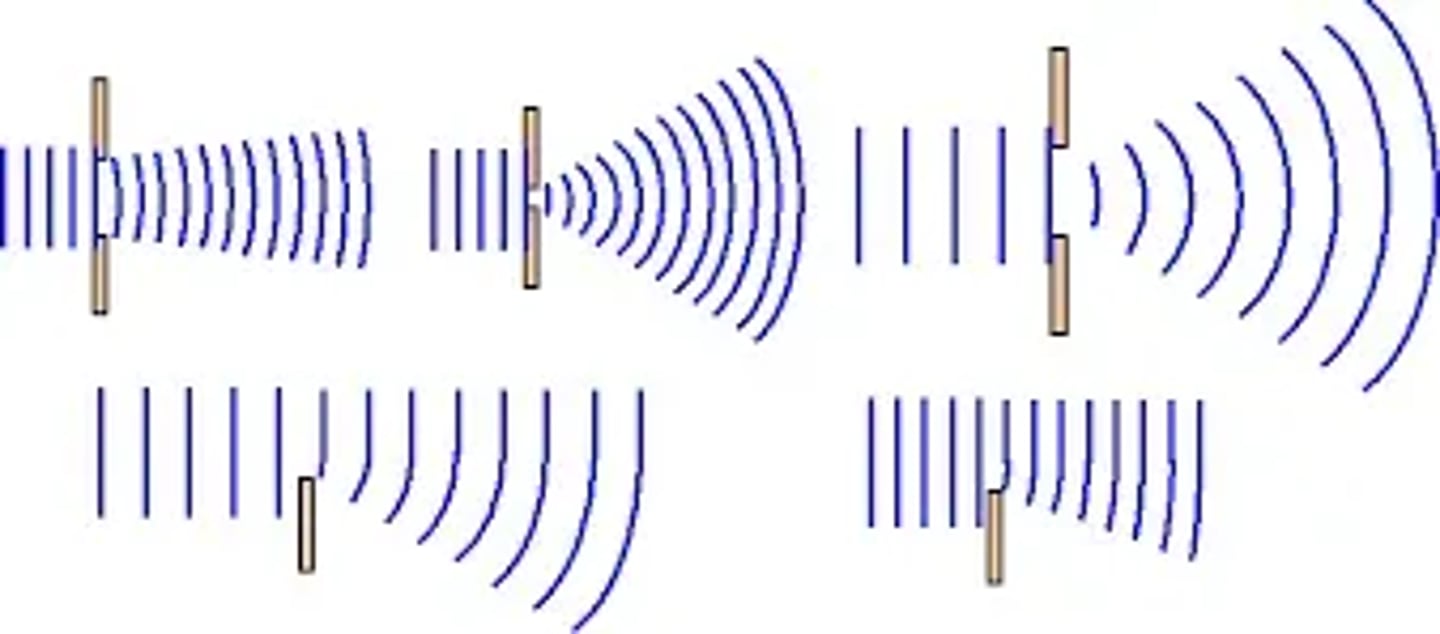
When does maximum diffraction occur? (1)
Maximum diffraction happens when the gap is roughly the same size as the wavelength.
What happens when the gap is much wider than the wavelength in diffraction? (1)
When the gap is much wider than the wavelength, little diffraction occurs, and the waves mostly pass straight through.
What happens when the gap is smaller than the wavelength in diffraction? (1)
When the gap is much smaller than the wavelength, most of the wave is reflected, and little passes through.
What is meant by monochromatic? (1)
Monochromatic refers to when waves have the same wavelength and frequency, resulting in the same colour.
What is seen in a single-slit diffraction pattern with monochromatic light? (2)
- A central bright fringe appears that is twice as wide as the others.
- Alternating dark and bright fringes appear due to interference.
What does a single-slit diffraction pattern with monochromatic light look like? (2)
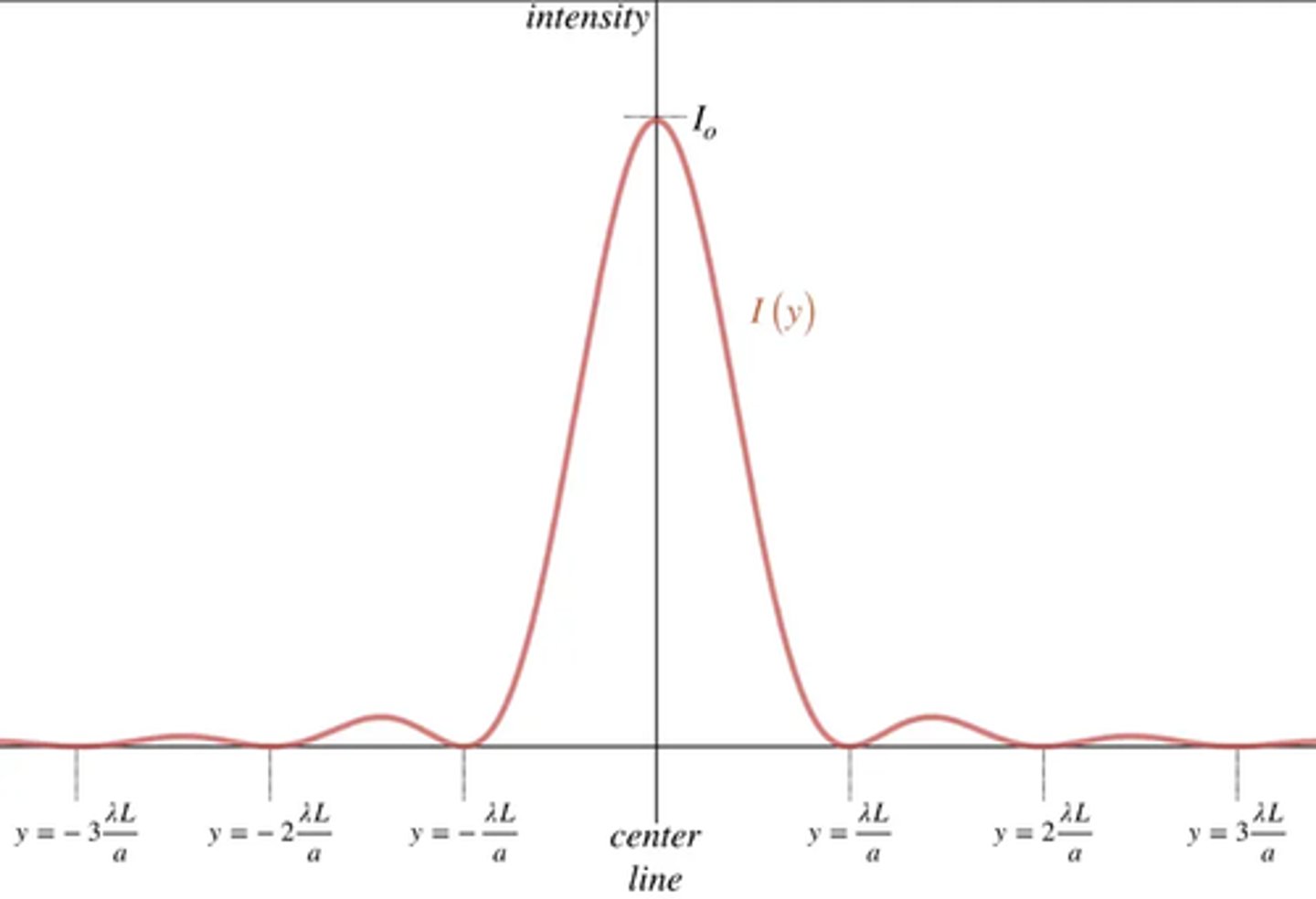
How does the intensity of fringes change in single-slit diffraction? (1)
In single-slit diffraction, the central fringe is the most intense, and intensity decreases further out.
What causes bright fringes in single-slit diffraction? (1)
Bright fringes form where waves meet in phase and interfere constructively.
What causes dark fringes in single-slit diffraction? (1)
Dark fringes form where waves meet out of phase and interfere destructively.
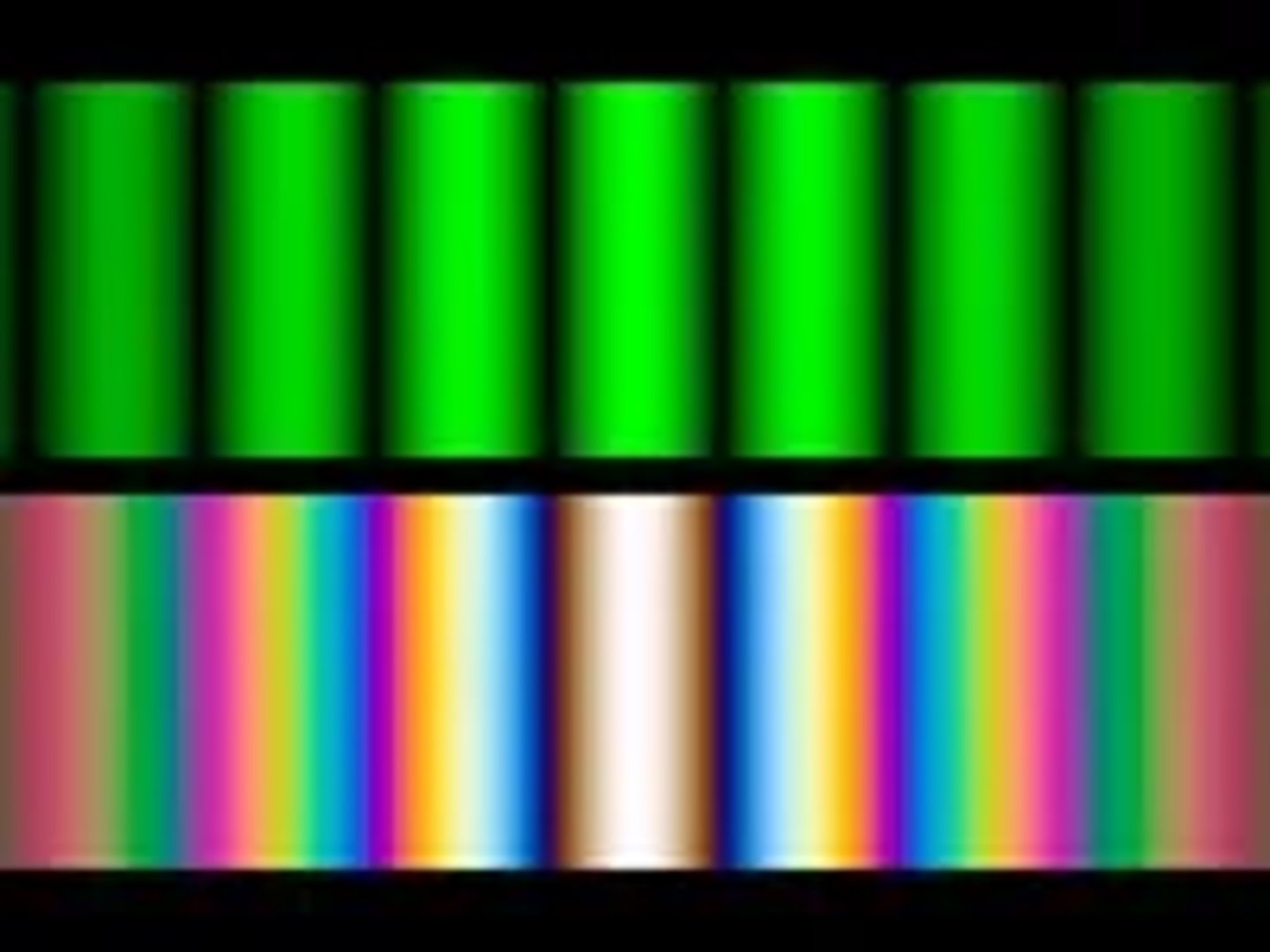
What happens when white light is used in single-slit diffraction? (3)
- When a white light is used in single-slit diffraction, a central white fringe appears with coloured fringes on either side.
- Each wavelength diffracts differently, spreading into a colour spectrum.
- Violet appears closest to the centre, and red appears furthest away.
How does the diffraction pattern differ when white light is used instead of monochromatic light in a single-slit experiment? (2)
- The top pattern is when using monochromatic light.
- The bottom pattern is when using white light.
Why is the central maximum of a single slit diffraction pattern the brightest part of the pattern? (2)
- More photons per second hit the centre, meaning this point has a higher intensity and looks brighter.
- Other points have less photons per second hitting them at a lower intensity, so those points are dimmer.
How does reducing the slit width affect the central maximum in single slit diffraction? (2)
- Reducing the slit width increases diffraction.
- This makes the central maximum wider and dimmer.
How does increasing the slit width affect the central maximum in single slit diffraction? (2)
- Increasing the slit width decreases diffraction.
- This makes the central maximum narrower and brighter.
How does changing wavelength affect the central maximum in the diffraction ? (2)
- A larger wavelength increases diffraction, widening the central maximum and reducing its intensity.
- A smaller wavelength decreases diffraction, narrowing the central maximum and increasing its intensity.
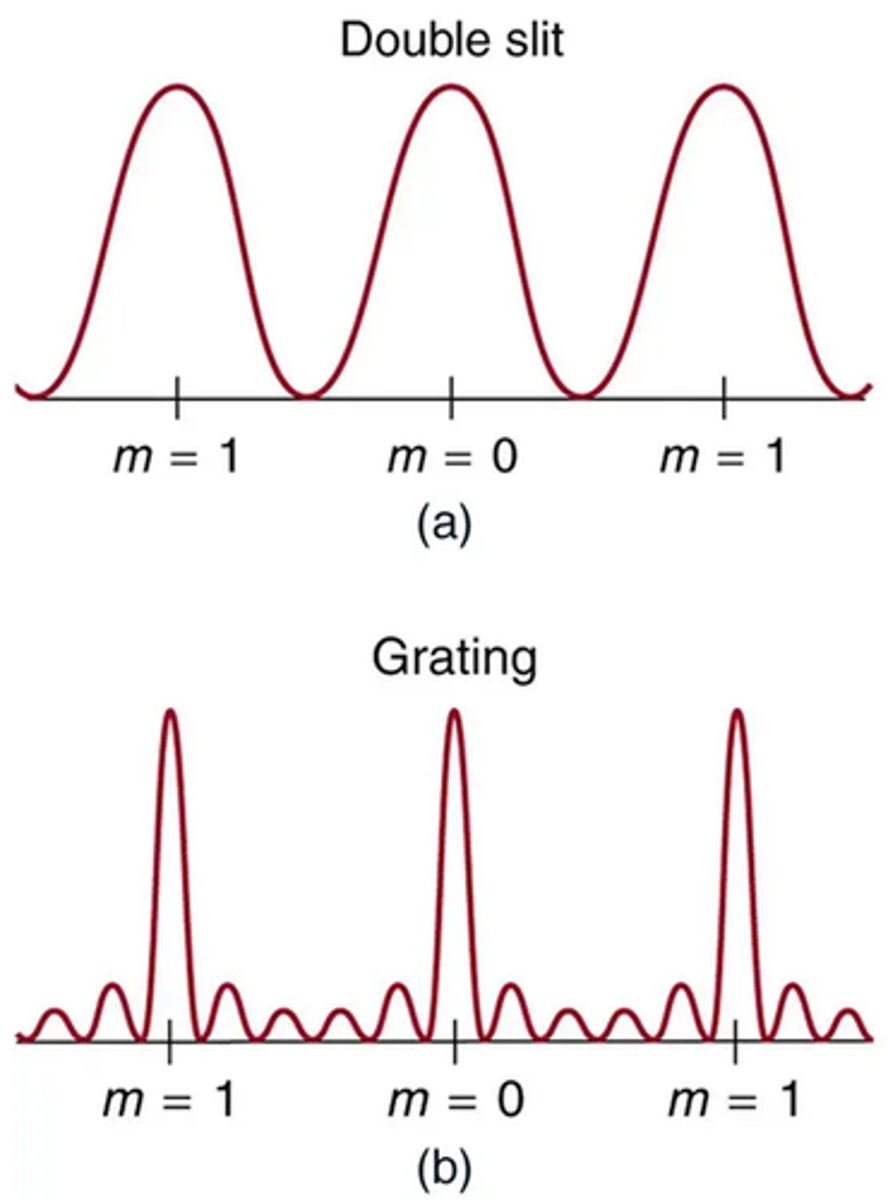
What is a diffraction grating? (1)
Diffraction grating is a slide with many closely and evenly spaced slits.
What kind of pattern does a diffraction grating produce? (1)
Diffraction grating produces sharper and brighter interference fringes than the double slit.
Why is the diffraction pattern from a grating sharper? (2)
- The diffraction pattern is sharper from a grating because more light rays reinforce each other.
- This increases brightness and precision.
How can the diffraction pattern from a single slit and a diffraction grating be compared graphically? (2)
What is the zero order line in diffraction? (1)
The zero order line is the central beam that passes straight through the grating.
What are the first and higher order lines in diffraction? (1)
The first and higher order lines in diffraction are the bright fringes on either side of the zero order line.
What is the diffraction grating equation? (2)
- The equation is: d sinθ = nλ.
- Where d is slit spacing (m), θ is diffraction angle, n is order number and λ is wavelength (m).
What happens to the diffraction angle when wavelength increases? (2)
- When wavelength increases, the diffraction angle θ becomes larger.
- This results in the fringes spreading out more.
What is the path difference at the first order maximum? (1)
The path difference is exactly one wavelength (λ).
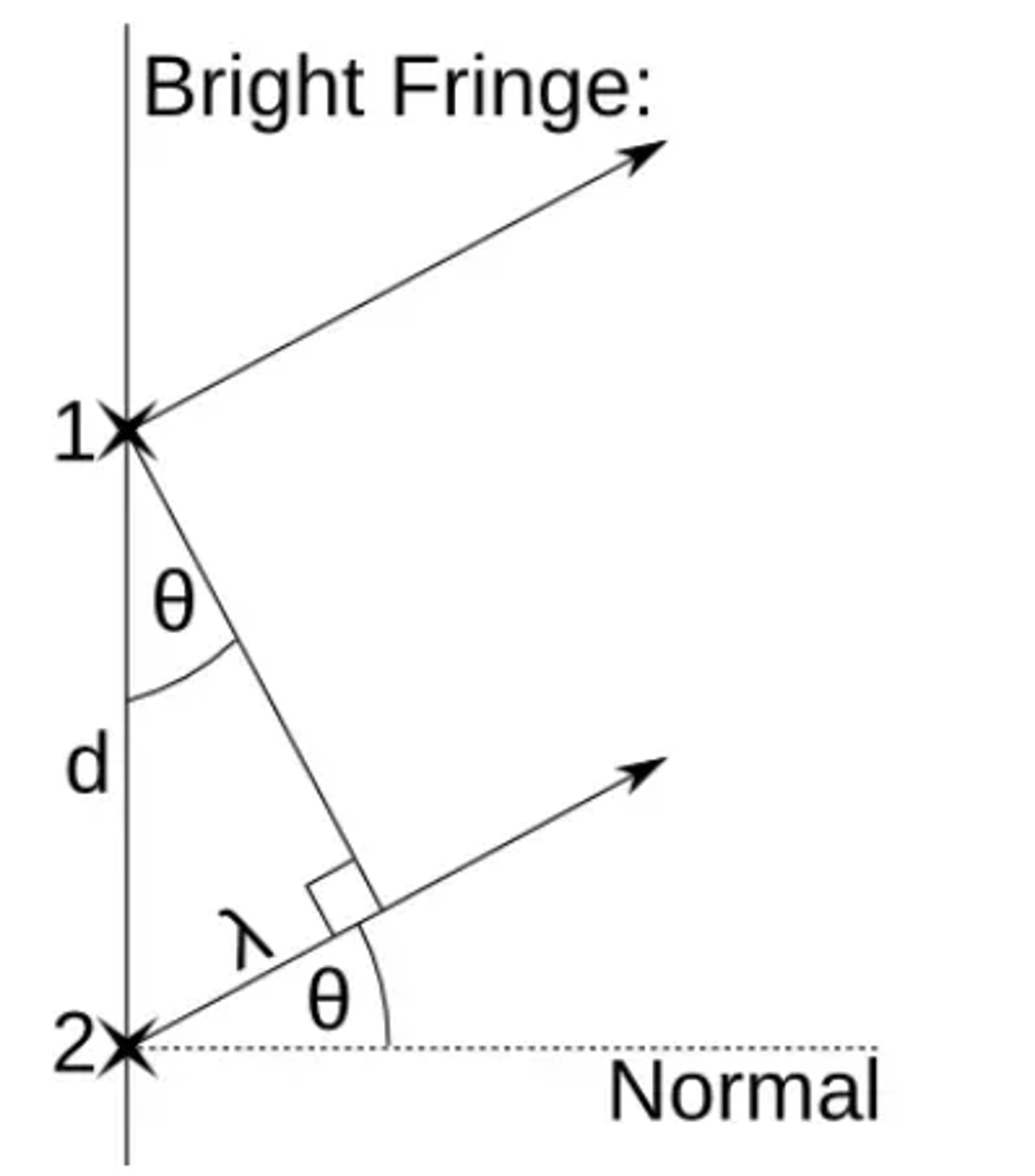
How is the diffraction equation derived for the first order? (4)
- A triangle is formed with slit spacing d and path difference λ.
- Using sinθ = Opp/Hyp gives sinθ = λ / d.
- Rearranging gives d sinθ = λ.
How is the diffraction equation extended to higher orders? (2)
- The general formula is d sinθ = nλ.
- Where n is an integer order.
How are the number of slits in a diffraction grating found? (2)
- The number of slits is given by 1/d.
- Where d is the distance between the slits in the grating (m).
How are diffraction gratings used to analyse starlight? (2)
- Starlight passes through a grating, forming a line absorption spectrum.
- Dark lines show which wavelengths are absorbed by elements in the star.
How does x-ray crystallography use diffraction? (1)
X-rays are aimed at a crystal, they diffract forming an interference pattern.
Why do x-rays diffract in crystallography? (1)
X-ray wavelength is similar to atomic spacing, allowing diffraction.
How does x-ray diffraction allow us to analyse atomic structure? (1)
The diffraction pattern from x-rays are used to calculate the spacing between atoms.
What is the absolute refractive index? (1)
The absolute refractive index measures how much a material slows light compared to its speed in a vacuum.
What is the equation for absolute refractive index? (2)
- The equation is: n = c / cₛ.
- Where c is light speed in a vacuum (m/s) and cₛ is light speed in the material (m/s).
What is the relative refractive index? (1)
The relative refractive index is the ratio of the speed of light in one material and the speed of light in another material.
What is the equation for the relative refractive index? (2)
- The equation is n_rel = c1/c2 = n2/n1.
- Where c1 is the speed of light in the first material (m/s), c2 is the speed of light in the second material (m/s), n2 is the absolute refractive index in the second material and n1 is the absolute refractive index in the first material.
What is the refractive index of air? (1)
The refractive index of air is assumed to be equal to 1.
What happens when a wave enters a material with a different refractive index? (3)
- When entering a material with a different refractive index, a wave changes direction.
- This is called refraction.
- Some light can be partially reflected instead of transmitted.
How does the wave bend during refraction? (2)
- The wave bends toward or away from the normal depending on the optical density.
- If it is more dense it bends towards the normal, if it is less dense it bends away from the normal.
What does refraction at a boundary look like? (2)
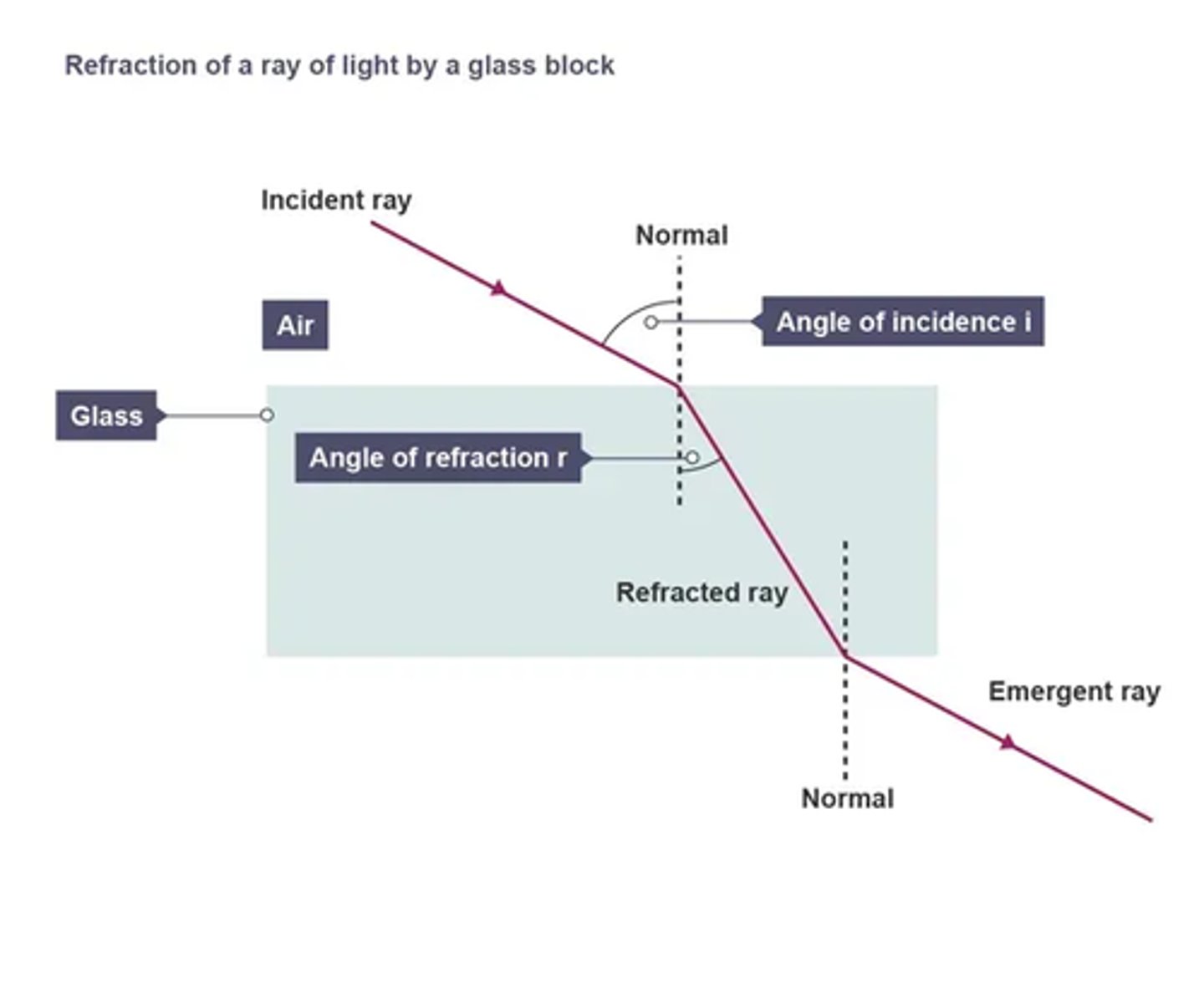
What is Snell's Law? (2)
- The equation is: n₁ sinθ₁ = n₂ sinθ₂.
- Where n₁ and n₂ are refractive indices, θ₁ is the angle of incidence and θ₂ is the angle of refraction.
What happens when light enters a more optically dense material? (1)
When entering a more optically dense material, light slows down and bends towards the normal.
What happens when light enters a less optically dense material? (1)
When entering a less optically dense material, light speeds up and bends away from the normal.
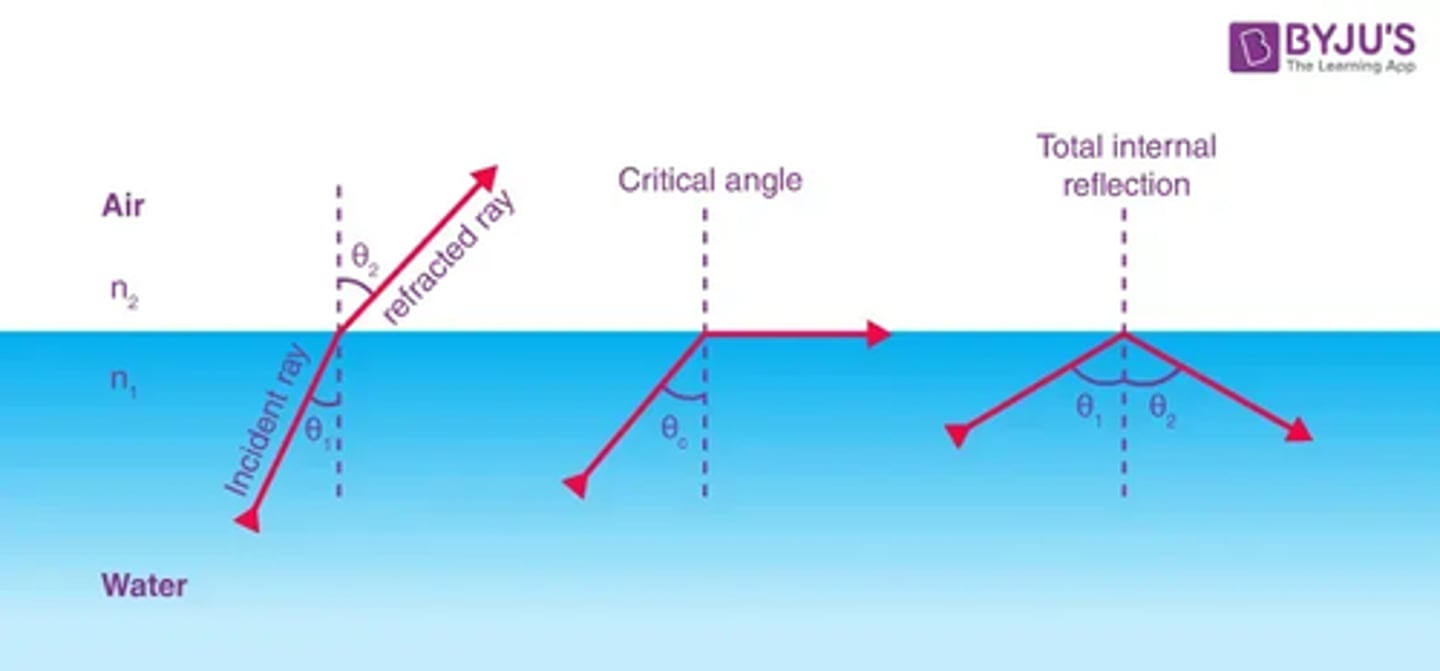
What is the equation for the critical angle? (2)
- The equation is: sinθc = n₂ / n₁, where n₁ > n₂.
- Where θc is the critical angle, n₁ is the denser medium and n₂ is the less dense medium.
What happens when light hits the boundary at the critical angle? (1)
When light hits the boundary at the critical angle, it refracts along the boundary at 90 degrees.
What are the conditions for total internal reflection? (1)
For total internal reflection, the angle of incidence must be greater than the critical angle.
What must be true about the refractive indices for total internal reflection? (1)
Light must travel from a higher to a lower refractive index material for total internal reflection.
What does a diagram showing the process of total internal reflection and the critical angle look like? (2)
How do optical fibres use total internal reflection? (1)
Light reflects inside a high-density core, staying within the fibre.
What does an optical fibre look like? (2)
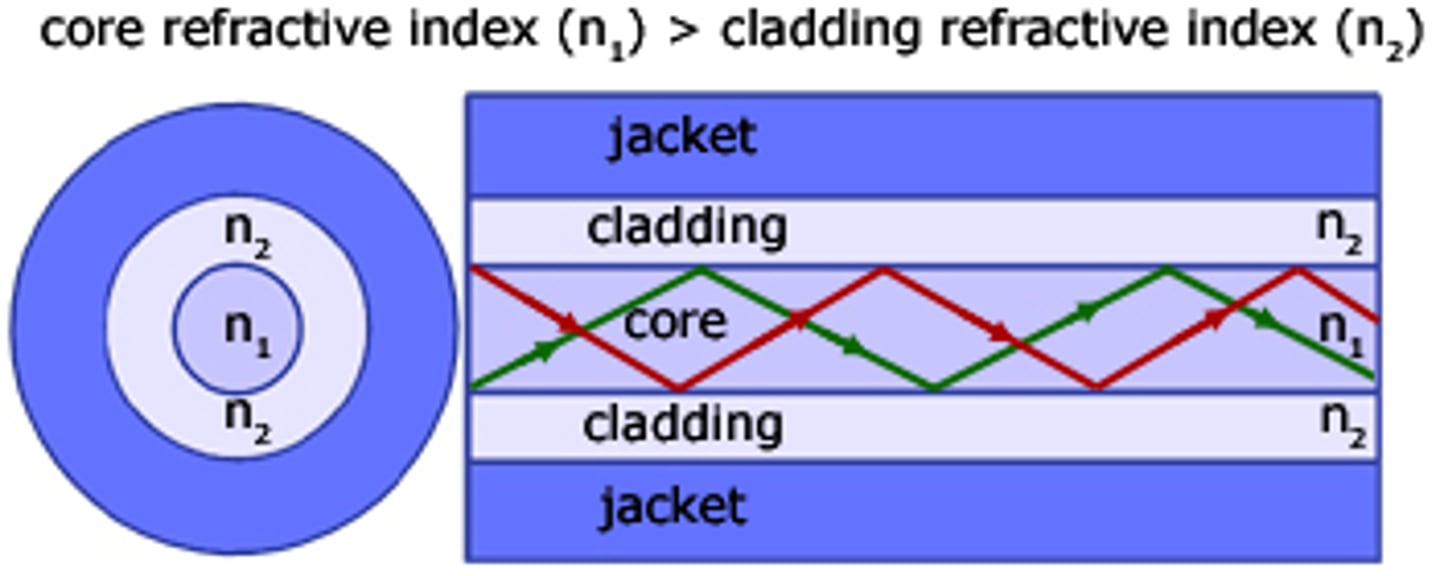
What is the role of cladding for total internal reflection in optical fibres? (2)
- The cladding has a lower refractive index.
- This enables total internal reflection.
What protective purpose does cladding serve in optical fibres? (1)
Cladding protects the core and reduces signal loss from escaping light.
How does light enter optical fibres? (2)
- Light enters at one end of the fibre.
- The light always hits the boundary between the fibre and cladding at an angle larger than the critical angle, due to the narrow fibre. This leads to total internal reflection.
What is absorption in optical fibres? (1)
Absorption in optical fibres is when part of the signal's energy is absorbed by the fibre material.
How does absorption affect signal quality? (2)
- Absorption lowers amplitude.
- This possibly causes partial or total signal loss.
What is dispersion in optical fibres? (1)
Dispersion is when parts of the signal arrive at different times, causing the pulse to spread out in time.
How does dispersion lead to data loss? (1)
Dispersion causes pulse broadening and overlap between pulses.
What is modal dispersion? (1)
Modal dispersion is when rays travel at different angles, taking longer or shorter paths.
How can modal dispersion be reduced? (1)
Modal dispersion can be reduced by using a fibre with a narrow core to reduce path length differences.
What is material dispersion? (1)
Material dispersion occurs when multiple wavelengths travel at different speeds.
How can material dispersion be reduced? (1)
Material dispersion can be reduced by using monochromatic light, which has only one wavelength.
What does an optical fibre repeater do? (2)
- An optical fibre repeater amplifies and regenerates the signal during transmission.
- This reduces absorption and dispersion effects.