PSYCH 230 Exam 3 umich
 Call Kai
 Learn
Learn Practice Test
 Spaced Repetition
 Match
Match Flashcards
 Knowt Play
1/142

There's no tags or description
Looks like no tags are added yet.
Name | Mastery | Learn | Test | Matching | Spaced | Call with Kai |
|---|
No analytics yet
Send a link to your students to track their progress
143 Terms
hormones are?
chemicals, secreted by a group of cells, that travel through the bloodstream to act on targets
endocrine glands release?
release hormones within the body
exocrine glands use ducts to?
use ducts to secrete fluids outside the body
in a study about castration in chickens, dr. berthold found?
what were the 3 groups he studied?
- significant changes in behavior for the castrated & control groups
- in one group, he performed castration & reimplemented one of the testes --> same physical features as in control group
dr. berthold demonstrated that a product released from the testes into the blood was...
NECESSARY for an immature chicken to properly develop into a normal male rooster
(behaviorally & physically)
what are the 2 types of effects hormones can have on the body?
1. organizational - result of long-lasting hormone exposure, permanent structural changes in the brain and body
2. activational - can activate behaviors, but their effects tend to be short-lived
synaptic communication involves?
when a chemical is released into the synaptic cleft for action on the post-synaptic receptors
endocrine communication is when?
a hormone is released into the bloodstream to act on target tissue
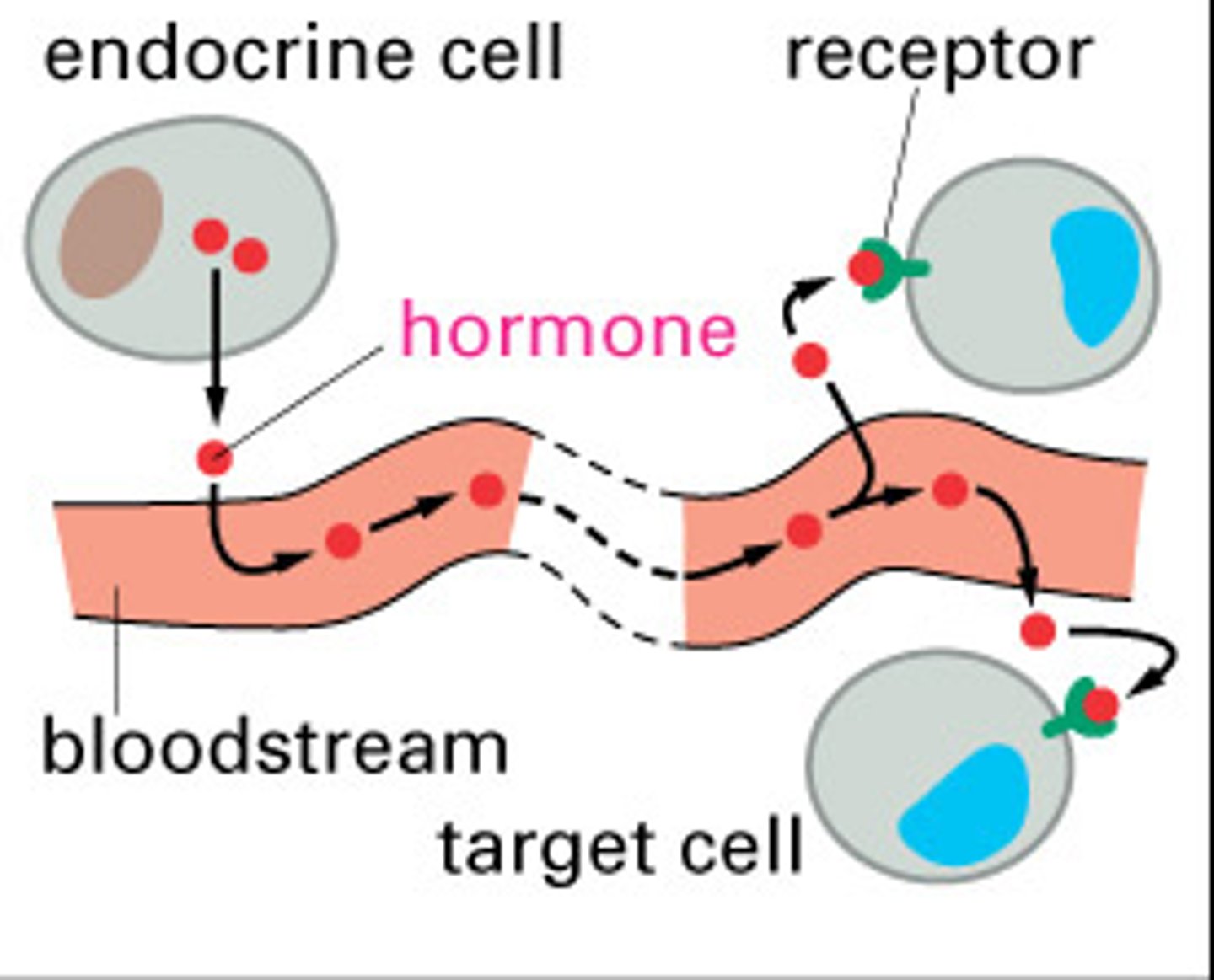
neuroendocrine cells are?
neurons that release hormones into the blood
(action potential fires -> neurotransmitters released -> triggers release of hormones)
what is the paracrine function?
form of local cell-to-cell communication where a cell produces signals that diffuse to nearby cells
what is autocrine function?
when a released chemical acts on the releasing cell (i.e. autoreceptors on neurons)
what are pheromones used for (function)?
- type of hormone
- used to communicate between individuals of the same species
- released into the environment
what are allomones (function)?
- chemicals released by one species to affect the behavior of another species
synaptic vs. endocrine communication
synaptic:
- travels only across synaptic cleft to act on receptor
- fast
- signal travels on a laid path
endocrine:
- can spread anywhere throughout the body, if there is a blood supply
- relatively slower
4 principles of hormone action
- speed
- how do they act (2)
- what cells do they bind to
1. hormones act slowly
2. act by changing the probability or intensity of a behavior, don't make you DO that behavior
3. one behavior can be affected by multiple hormones
4. hormones ONLY affect cells with a receptor for that hormone
What is the chemical structure of peptide or protein hormones?
String of amino acids
What are amine hormones made of?
Modified amino acids
What is the chemical structure of steroid hormones?
Made of 4 rings of carbon atoms
peptide and protein hormones
- what are they made of?
- how long are they?
- found in what animals?
- water soluble/hydrophilic or insoluble?
- made up of a string of amino acids
- peptide hormones = shorter, larger ones are called protein hormones
- most common hormone type is in mammals
- water soluble (CAN'T pass through cell membrane)
amine hormones
- what are they derived from
- what are the 2 classes
- derived from single amino acids
- 2 classes are:
(1) indoleamines
(2) catecholamines
what do protein and amine hormones bind to?
what system do they use? (ionotropic, metabotropic, second messenger)
by binding to specific receptors embedded on the cell membrane
- 2nd messenger system
- relatively fast
steroid hormones
- what are they derived from?
- most come from what 2 areas?
- are they water soluble or not?
- some require some help, what is that called?
- derived from cholesterol
- most come from adrenal glands and gonads
- not water soluble (small, lipophilic, pass through membrane)
- carrier proteins, help stabilize the receptor complex
how do steroid hormones work?
- pass through cell membrane and bind to cell receptors
- steroid-receptor complex binds to DNA in nucleus
- this acts as a transcription factor, controlling gene expression and protein production
- effects are long-lasting, but slow
what is another pathway for steroid hormones?
nongenomic action pathway
- estradiol can have brief but rapid effects involving a neuron's membrane receptors
how are steroid hormones made?
by combining an enzyme + different hormone
what are neurosteroids?
what is aromatase?
steroids made in the brain, including testosterone and estrogen
aromatase = enzyme that can convert testosterone into estrogen
how are hormones released?
what loop regulates them?
regulated by the feedback system
- negative feedback is the most common, where chemical is output & fed back to source until it shuts off
- positive feedback, where output feeds back & amplifies further secretion
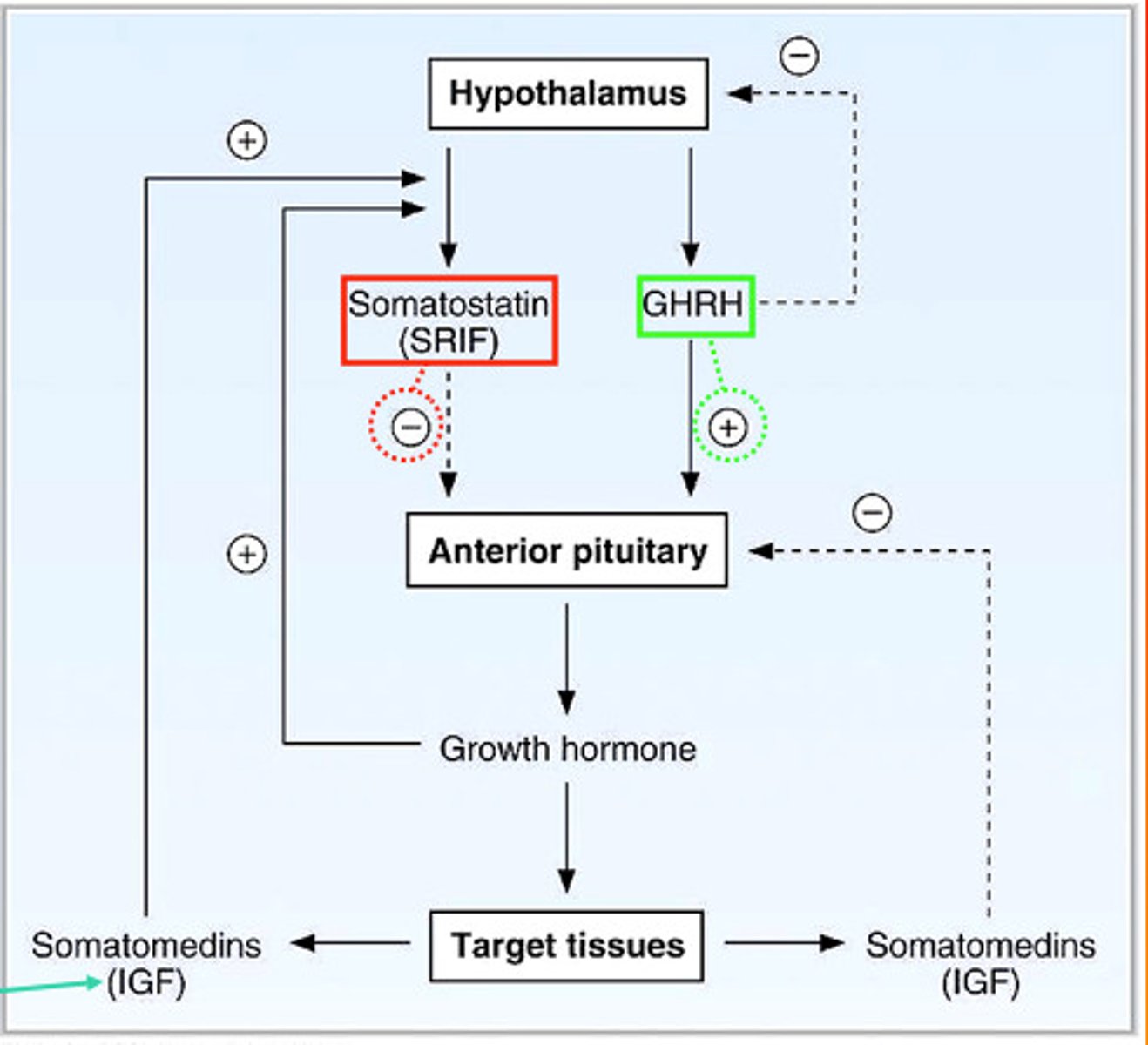
how do the more complex endocrine system (involving the brain) work?
usually proceed through the hypothalamus
1. hypothalamus releases "releasing hormones" to act on anterior pituitary
2. pituitary releases "tropic hormones" that affect other endocrine cells
3. those endocrine cells release signals that affect target cells and generate a biological response
3. negative feedback from endocrine cells go to pituitary and hypothalamus
- they eventually shut off
define hypothalamic-pituitary interactions
brain regulation often involves the hypothalamus, because it directs hormone release from endocrine glands (i.e. pituitary)
- brain detects a hormone's effects, exerts negative feedback loop on the hypothalamus
- pituitary gland releases the hormones
explain the significance of the posterior pituitary
posterior: secretes 2 hormones (oxytocin, vasopressin)
- neurons in the nuclei of the hypothalamus synthesize these hormones
- hormones travel along pituitary stalk & into blood supply in the posterior pituitary
- released into the blood supply of the posterior pituitary, they are called 'posterior pituitary hormones'
explain the significance of the anterior pituitary
hypothalamus communicates with anterior pituitary & uses its neuroendocrine cells to synthesize "releasing hormones"
- axons from those cells converge above pituitary stalk
- releasing hormones are secreted into blood vessels called the hypophyseal portal system
- carried into anterior pituitary and it stimulates this region to release 'tropic hormones'
(they then travel to their targets)
what are the hypothalamic neuroendocrine cells influenced by?
1. circulating messages, i.e. hormones or blood sugar
2. synaptic input from other brain areas
as a releasing hormone, CRH affects the secretion of what tropic hormone?
ACTH (adrenocorticotropic hormone)
as a releasing hormone, GnRH/GnIH affects the secretion of what tropic hormone?
LH (luteinizing hormone)
FSH (follicle-stimulating hormone)
what is sex determination and sex differentiation?
sex determination: process by which the decision is made for a fetus to develop as a male/female
- chromosome driven
sexual differentiation: process by which individuals develop male or female body parts/behaviors
- hormone driven
levels of sexual determination & differentiation
sexual determination:
- chromosomal sex
- gonadal sex
sexual differentiation:
- hormonal sex (testosterone, estradiol)
- morphological sex (brain, 2ndary sex characteristics)
- behavioral sex (behavior)
define bipotential
- when gonads are first made, they are "bipotential" AKA can become either sex
what is the importance of the SRY gene?
determines what gonads are formed
- Y chromosome is the only one with the SRY gene, sex-determining region
- without SRY gene, an ovary forms
what are the 2 purposes of gonads?
1. production of gametes
2. production of steroid hormones
- required for gamete production, development of sex characteristics, reproduction
male gonalds are testes
what is the primary hormone produced by them?
when does production begin?
- primary steroid hormone produced is testosterone, which is an androgen
- testosterone production begins as soon as testes are formed + guides masc. development
female gonads are ovaries
what is the primary hormone produced by them?
when does production begin?
- primary steroids produced are estrogens (i.e. estradiol) and progestins
- steroids are not produced til puberty
what do hormones do, as it relates to sex differentiation?
because hormones are secreted early on by gonads, they can direct sex differentiation
what are the 2 precursors to the male/female systems in utero?
(1) in males - wolffian ducts develop & mullerian ducts shrinks
(2) in females - mullerian ducts form (oviaries, uterus, vagina) and wolffian system degenerates
what does anti-mullerian hormone do if testes are present?
causes regression of the mullerian system & is defeminizing
testosterone masculinizes internal organs by?
how can it work to masculinize external structures?
how can it masculinize the brain?
- promoting development of the wolffian system
- can be converted into DHT via enzyme 5 (alpha-reductase) which masculinizes external structures
- can be aromatized to estradiol via aromatase, masculinizes the brain
*look at chart on lec. 16 for visual!*
what is turner's syndrome?
what is the effect it has on sex differentiation?
treatment?
where the person only has 'X' as a chromosome
- individual develops as a female due to lack of SRY gene with abnormal ovaries
treatment: estrogen supplementary treatment to induce female-typical puberty
what is klinefelter's syndrome?
what is the effect it has on sex differentiation?
treatment?
where the person has an extra chromosome ('XXY')
- masculine body develops due to Y chromosome, but testes are small
- low testosterone production
treatment: hormone replacement therapy for development of secondary sex characteristics
what is congenital adrenal hyperplasia?
what is the effect it has on sex differentiation?
treatment?
where the person has an 'XX' or 'XY' genotype, but lacks enzyme that produces cortisol
- results in large amount of androgens produced from adrenal gland
has a more drastic effect on XX individuals -> exposure to estradiol + excess testosterone
- external genitalia is partially masculinized due to increased exposure to DHT
treatment: exogenous cortisol is given after birth to halt excess testosterone production
what is androgen insensitivity syndrome?
what is its effect on sex differentiation?
treatment?
where person has 'XY' but defective androgen receptors
- individual develops testes due to SRY gene
- hormones produced:
(1) AMH: reduction of mullerian system
(2) testosterone: won't act as it usually would though
phenotype of individual would be FEMALE (shallow vaginal canal, small testes from SRY gene)
treatment: hormonal therapy to develop secondary female characteristics
how does masculinization of the brain occur?
because estradiol (converted from testosterone) masculinizes the brain in early development
- usually occurs in males, because ovaries don't produce hormones until puberty
what is sexual dimorphism?
refers to the condition in which males/females exhibit sex differences in appearance
in rats, how does sex differences show itself in the brain?
through the nucleus of the pre-optic area
- female rat injected with testosterone shows nucleus like a male
- female rat injected at later times, i.e. puberty, shows no effect
*speaks to effect of prenatal testosterone exposure*
what is the organizational effect of estradiol?
- permanently alters the brain by doing things like altering apoptosis, changing connectivity
- occurs early in development during the critical period
why do female brains not get masculinized?
ovary hormones are silent until puberty
maternal estrogen in developing females don't enter the brain
- alpha-fetoprotein binds to the estrogen, keeping it from crossing the brain & preventing masculinization
**alpha-fetoprotein is present in all babies, but it doesn't bind to androgens, so testosterone is free to go
what does a developing nervous system rely on?
1. genetic information
2. experience
3. environment
(biology + nature)
what is a zygote?
fertilized egg (egg + sperm)
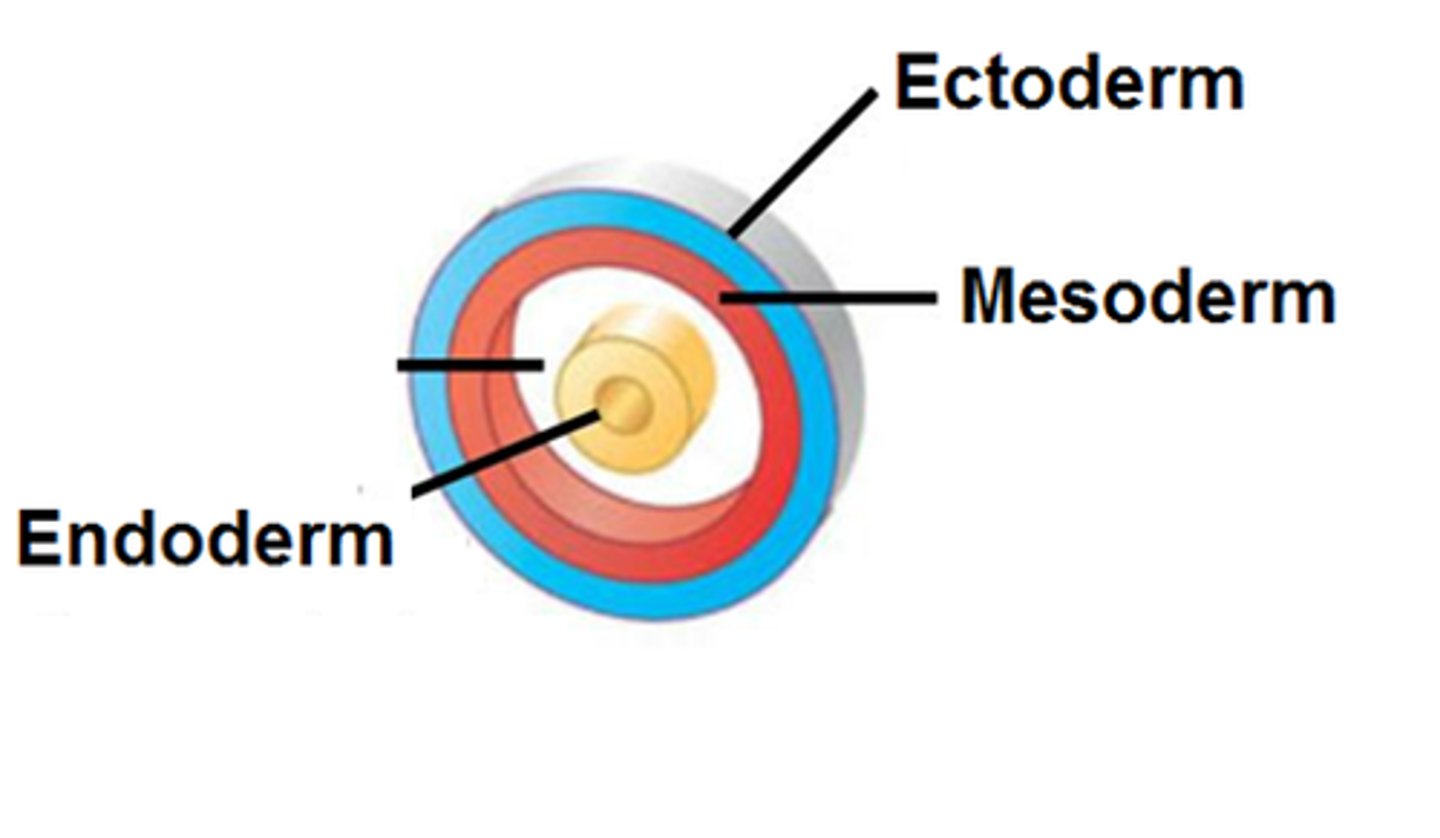
how many layers does the human embryo have, and how does it come to form?
develops 3 cell layers
result of "gastrulation" process
- ectoderm (outer layer that becomes nervous system)
- mesoderm
- endoderm
1. as the ectoderm thickens, what happens?
2. ectoderm is dividing, resulting in?
3. cells continue to push upwards, and the neural ____ becomes _____ and the __NS
4. neural crest cells begin to migrate extensively to contribute to the _____
1. it grows into a flat plate
2. the creation of the neural grove/midline
3. neural groove becomes the neural tube, which will become the CNS
4. formation of the PNS
what are the 3 subdivisions of the neural tube?
1. forebrain
2. midbrain
3. hindbrain
what does the interior of the neural tube become?
ventricular system of the brain + central canal of the spinal cord
what is a genotype?
what is a phenotype?
sum of all genetic information, dependent upon fertilization
sum of all physical characteristics, can change with 'nature'
what does it mean for a "cell to express a gene"?
means the cell has transcribed the gene and started coding for the protein it makes
gene expression helps to guide ____
cellular differentiation!
(when cells become a particular type of cell depending on the gene expressed)
- can also cause long-term behavioral changes
what is epigenetics?
study of factors that affect gene expression, i.e. nature, environment, experiences
what are 2 ways to alter gene expression?
1. histone modification: histones are more tightly wrapped to influence gene expression
2. methylation: CH3 modifies the DNA and reduces expression of genes at following site of methylation
how can maternal care influence behavioral responses?
low maternal grooming can mean more methyl groups & reduced gene expression
less stress hormone receptors = more stress hormone needs to be made for the stress axis to be shut off
- low grooming = more CH3 groups & less stress hormone receptors activated
- high grooming = less CH3 groups & high gene expression
what is lineage in C. elegans?
each cell is mapped and born with specific instructions to its fate
- called "lineage"
cells can be influenced by ___ or ___factors
intrinsic or extrinsic
- intrinsic: cell-to-cell interactions
- extrinsic: environment, alcohol, drugs
how does one develop an intellectual disability?
many ways;
1. lack of oxygen at birth
2. undernourished mothers
3. maternal viral infections or drug exposure
what is PKU (phenylketonuria)?
recessive genetic disorder where the individual doesn't produce an enzyme that metabolizes phenylalanine, amino acid in many foods
- brain can be damaged if this amino acid builds up
- requires strict diet
what is stage 1 of nervous system development?
1. neurogenesis
- production of neurons from non-neural cells
- cells divide through mitosis
- cells are born into ventricular zone, migrate outwards and specalize
- MANY more cells born than needed
what is stage 2 of nervous system development?
define:
- radial glial cells
- cell adhesion molecules
- migrating cells + filopodia
how do the layers of the ________ form?
2. cellular migration
- cells move away from ventricular zone and into cerebral cortex (columns)
- region is filled in as cell migration occurs
- radial glial cells help to populate column (guide cells)
- cell adhesion molecules are proteins on cell surfaces that guide cell migration at further distances
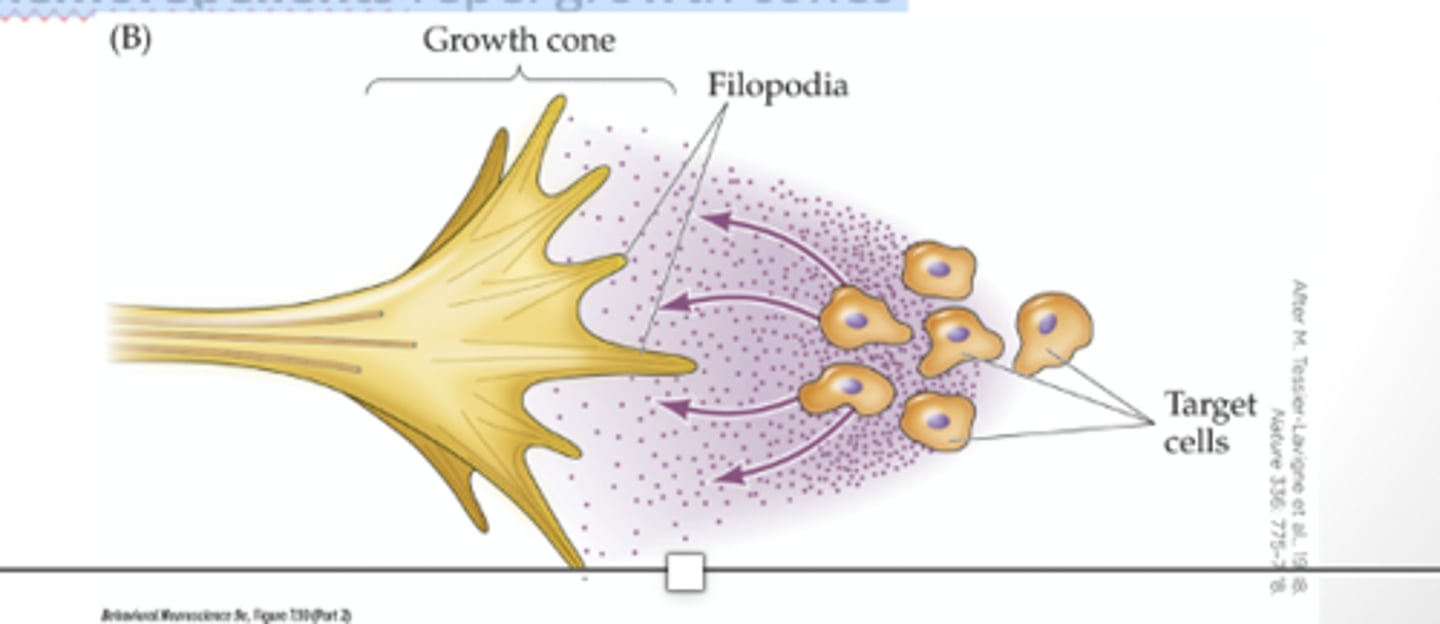
- migrating cells have growth cones that respond to chemicals in the environment (chemoattractant/repellent) which attract or repel certain cones and help things go to the right places
- filopodia are the outgrowth of growth cones, important for detecting environmental signals (like 'dendrites')
**move in an inside out fashion; new cells move over existing cell layers and settle in layers above them**
1 & 6, 5, 4, 3, 2
what is stage 3 of neural system development?
3. cellular differentiation
- type of cell one becomes is based on extracellular factors it comes into contact with, i.e. chemical signals
- when they reach their destination, cells express specific genes to make the protein they need for their cell type
what is the adaptive response to early injury called?
i.e. if a cell is damaged and another cell comes to take its place
regulation
what is stage 4 of neural system development?
4. synaptogenesis
- extensive growth of axons, dendrites, formation of synapses
- extensions emerge from growth cones and synapses form on dendrites and spines
- once axons finish growing, induce glia cells to sheath them in myelin
what is stage 5 of neural system development?
5. cell death
- apoptosis: crucial for brain development
- so many cells are made so it's not a problem to kill them later
- cells have caspases that are expressed only during apoptosis, process is highly regulated (turns on when a cell needs to die)
what factors influence cell death?
neurons that don't get enough ____ factor die
- numerous
i.e. neurons compete for chemicals that target cells make called "neurotrophic factors" + without it they die
- nerve growth factor: produced by targets, taken up by axons of neurons
- brain-derived neurotrophic factor: can save cells from apoptosis
what is stage 6 of neural development?
6. synapse rearrangement
- refines synaptic connections
- continues throughout our lifetime as synapses are often reorganized
- in humans, synaptic remodeling is evident in the pruning of dendrites & axon terminals (cadual-rostral)
what happens with synapse rearrangement in people with fragile X syndrome?
multiple trinucleotide repeats result in DNA instability
- causes normal elimination of synapses & results in excess of immature dendritic spines
- numerous physical and cognitive impacts
what is homeostasis?
process of balancing a constant internal environment despite external conditions
what is thermoregulation?
process of closely regulating body temperature around a set value
endotherms vs. ectotherms
endotherms: generate most of their own heat through internal processes
(i.e. body heats them up)
ectotherms: get heat from their environment
(i.e. get heat through behaviors)
how do endotherms thermoregulate?
is it a positive or negative feedback loop?
use a lot of food energy to produce heat
- allows for independence from environmental conditions
negative feedback system
- deviation from set point = compensatory action taken to return to set value through physiological + behavioral responses
what is the preoptic area (POA) of the hypothalamus important for?
generation of heat/thermoregulation
- i.e. shivering = contraction of blood vessels
what is the importance of the lateral hypothalamus?
controls voluntary regulation of temperature, i.e. turning on a fan when you're hot
what does thermoregulation look like for ectoterms? (3)
1. changing exposure of body surface
2. changing external insulation, i.e. shedding skin
3. changing surroundings
there was an experiment with an iguana
they were exposed to bacteria and given an environment with a heat lamp
- what happened in the control group?
- what happened in the treatment group?
control group: regulated temperature using heat lamp
treatment group (w/ bacteria): iguana's started generating symptoms of a raised body temperature
i.e. their response to killing the virus because they can't generate sweat naturally
why is a balance of fluid and salts important for the body & brain?
our brain and body depend on water
- brain, just itself, is 80% water
- requires proper care
what are our body compartments for fluids? (2)
1. intracellular - fluid contained within our cells
2. extracellular - fluid outside our cells
how does water move in and out of cells?
through osmosis, water is able to move through aquaporins (specialized protein channels)
- passive movement to equalize concentration
- goes from low salt/high water to high salt/lower water concentration
what is osmolality, the 2 types of solutions, and its effect on the cell?
measure of the concentration of particles
1. hypertonic: solution has more salt/low water = water pushed out of cell
2. hypotonic: solution has less salt/more water = water pushed into cell
*excessive movement can severely damage cells*
what is osmotic thirst? the remedy?
osmotic thirst: stimulated by a high extracellular solute concentration/low water
- water loss is caused normally
- can be triggered by eating salty foods
osmosensory neurons respond to changes in osmotic pressure, as water is drawn out of cell
REMEDY: drinking water! brings higher water concentration, stops trying to pull water out of cells
what happens when osmotic thirst occurs?
aldosterone (steroid hormone) is released from adrenal gland in response to thirst signals
- stimulates kidneys to conserve water
if this isn't enough, body stimulates behavioral processes to get you to drink water to remedy thirst
what is hypovolemic thirst? the remedy?
triggered by loss of water volume, but solute concentration is unchanged
- higher solute (outside) and low (inside) = water out
baroreceptors in blood vessels detect drop in blood pressure
- triggers brain to activate thirst response
REMEDY: water AND salts need to be taken in
what is the biological response to hypovolemic thirst?
causes release of vasopressin or antidiuretic hormone from posterior pituitary
kidney releases 'renin' enzyme, triggering hormonal cascade
- end result: angiotensin II
- conserves water through constriction of blood vessels and increased BP
- acts at circumventricular organs to stimulate drinking
how does our body break down nutrients & anticipate _____?
process of digestion is controlled by the nervous system
- anticipates future requirements also
many social, cultural factors may influence when and where we eat
mechanisms in place may trigger us to eat, allowing our NS to anticipate it
4 molecules used for energy
1. glycogen: carb made by combining glucose molecules
2. glycogenesis: process of converting glucose to glycogen
3. glucagon: hormone that mediates glycogenesis & converting glycogen back to glucose
where are lipids put?
into adipose tissue
what happens under prolonged food deprivation periods?
gluconeogenesis kicks in to convert fat/proteins into glucose
glucose transports interact with ___
insulin to bring glucose into cell
- brain does NOT require insulin, however, to get glucose into cells