W10: Culture and Personality
 Call Kai
 Learn
Learn Practice Test
 Spaced Repetition
 Match
Match Flashcards
 Knowt Play
1/19

There's no tags or description
Looks like no tags are added yet.
Name | Mastery | Learn | Test | Matching | Spaced | Call with Kai |
|---|
No analytics yet
Send a link to your students to track their progress
20 Terms
What is culture?
Culture consists of patterns of historically derived and selected ideas and their embodiment in institutions, practices, and artifacts
What are the 3 types of cultures that influence personality? (ETC)
Evoked culture
Transmitted culture
Cultural universals
What is evoked culture (i.e., an evolutionary perspective)?
Cultural differences that are resulted from differing environmental conditions
What are the 2 required prerequisites?
An evolved psychological mechanism that is universal
Environmental differences
What is the degree to which a culture prioritises honor influenced by?
Means of subsistence
Where is the honour culture of southerners evoked from?
From their historical herding communities
What may the high competition for resources in Singapore be evoked by?
High population density
What is transmitted culture?
The transmission of seemingly arbitrary values, beliefs, and ideas from one person’s mind to another through interaction
How is the self defined in Western, individualistic cultures VS non-Western (Eastern), collectivistic cultures?
Western: the self possesses unique abilities, motives and dispositions that separate me from my group (independent)
Eastern: the self is understood as part of a whole (interdependent)
What did the meta-analysis done by Levin et al., suggest about the Western/Asian self-concept divide?
It is overstated
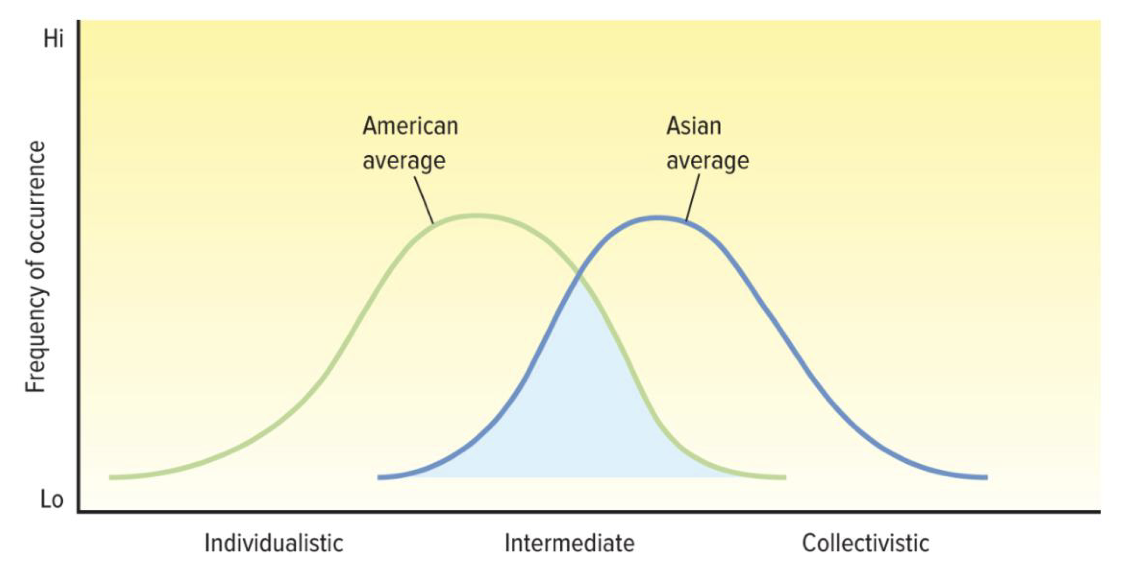
What are 2 criticisms/findings of this theory?
Even though western samples are more independent than interdependent, the difference between western and eastern is much smaller than assumed
Asians are NOT actually more interdependent than independent
What is an alternative explanation in attributing these differences?
Evoked culture; independence/interdependence developed from the environment they were raised in
Are stereotypes about different cultural groups accurate?
They have some level of accuracy compared to national mean trait level
What must we take note of when studying cross-cultural difference in personality?
The reference-group effect
What is the reference-group effect?
Evaluating oneself relative to their cultural norms rather than an absolute standard
Eg. a hardworking student in a high-performing country may rate themselves as “average”
What are 2 cultural universals (features of personality that are present in most or all cultures)?
Emotions
Big 5 personality traits (OCEAN)
What is the difference in what people’s feelings/emotions are related to between Americans and Japanese?
Americans: related to their personal achievement and goals (eg. pride, anger)
Japanese: related to social harmony (eg. friendly feelings, guilt and shame)
What outcomes do aggregate (combined, average) personality profiles in a population shape?
Political outcomes (eg. voter behaviour)
Where are people who are more individualistic more likely to migrate to?
The frontiers (borders)
What are 2 characteristics of cultural influences that does not make people from the same culture have the same personality?
Cultural influences on personality are:
Probabilistic and not deterministic
Plural (originates from many sources) and partial (only one out of the many influencing factors)