Auditory Perception
 Call Kai
 Learn
Learn Practice Test
 Spaced Repetition
 Match
Match Flashcards
 Knowt Play
1/41

There's no tags or description
Looks like no tags are added yet.
Name | Mastery | Learn | Test | Matching | Spaced | Call with Kai |
|---|
No analytics yet
Send a link to your students to track their progress
42 Terms
What are the key functions of hearing?
Alarm/orienting system (links to visual density)
Object classification/identification
Communication by self-generated sound → more evolutionarily advanced
What are sounds?
Spherical pressure waves that travel through the air in all directions, expanding from the sound source
What are the attributes of sound?
Frequency
Amplitude
Complexity
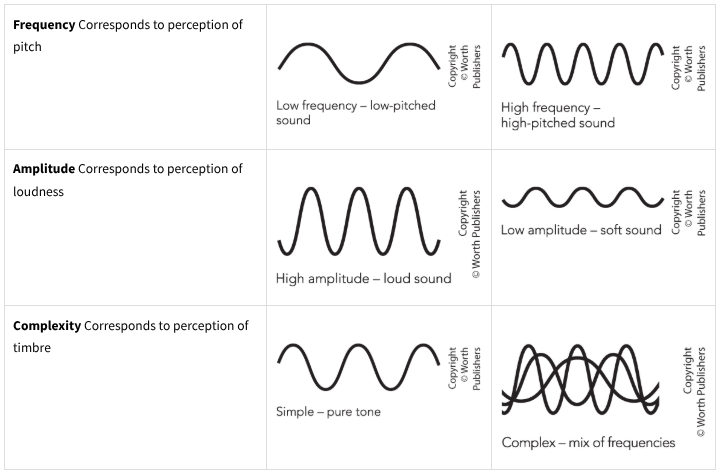
What is frequency?
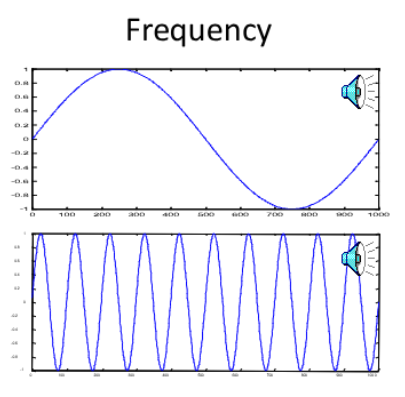
Number of air pressure oscillations per second (why sounds are heard differently)
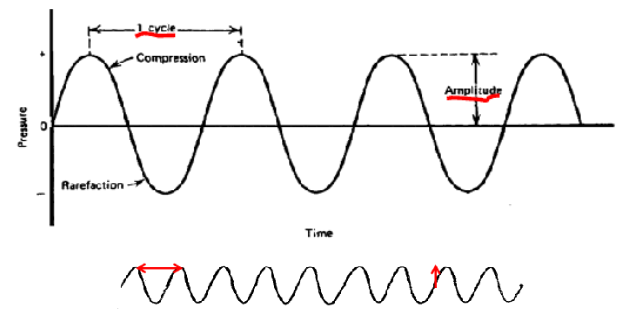
1 cycle /second = 1Hz
Compression + rarefaction (expansion)
Changes in frequency over time allow identification of the location of sounds + allows understanding of speech and appreciation of music
Fundamental frequency = pitch
Changes in the physical frequency of a sound wave are perceived as changes in pitch
Harmonic frequencies = timbre
Which frequencies can we detect?
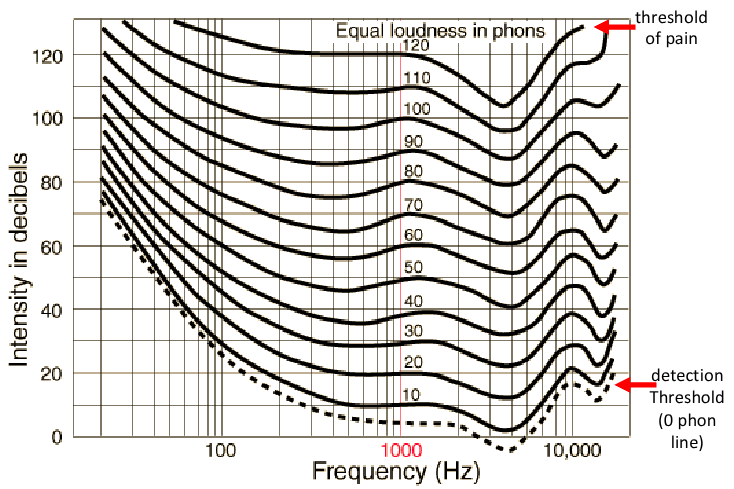
Between about 20-20,000 Hz
Human ear is most sensitive to frequencies around 1,000 to 3,500 Hz
What is amplitude?
Loudness/intensity of sound
Height relative to threshold for human hearing
Any sounds above 85 dB can be enough to cause hearing damage, depending on the length and type of exposure
Contribute texture to auditory perception
Waves diagram
What is a pure tone?
A simple sound wave that first increases air pressure + then creates a relative vacuum
What is complexity? What do complex sounds consist of?
Perception of timbre (experience of sound quality/resonance) -> info about nature of sound (e.g. flute vs piano)
Contribute texture to auditory perception
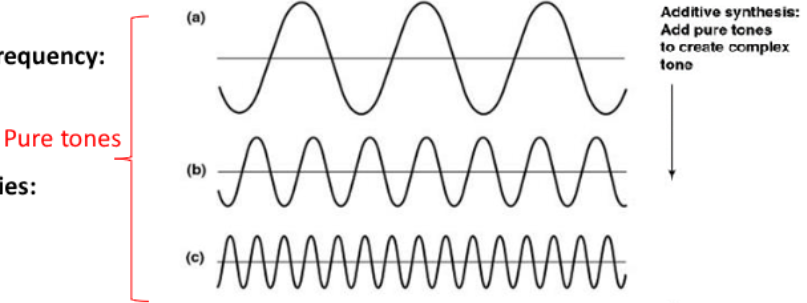
Direct tones → can be described as a sum of pure tones
What do tones consist of?
A fundamental frequency + a set of specific harmonics (which define the timbre)
What does complexity correspond to?
Perception of timbre
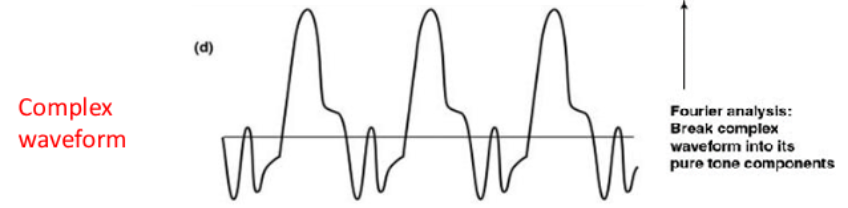
What does a Fourier transform do?
Decomposes any complex signal that evolves over time/space into its constituent oscillatory components
How synthesisers work
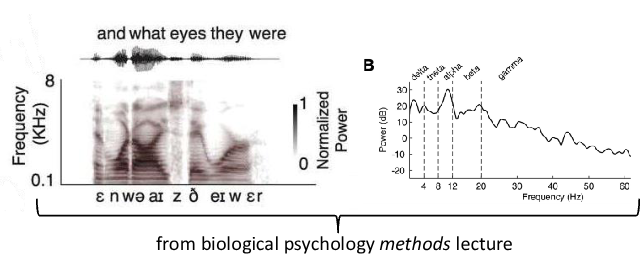
What does signal processing in psychological research involve?
Analysis of image stats (spatial freq), sound properties, waveforms from EEG + MEG
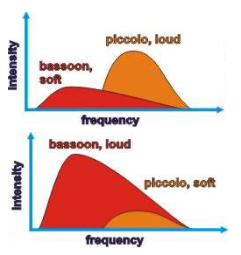
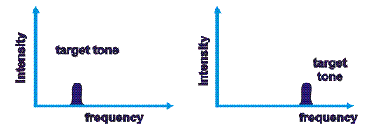
What are psychophysical masking experiments?
Detecting a target tone in the presence of another (masking) tone
Vary intensity of masking tone until the target disappears/reappears → threshold
What is sound pressure level?
Physical measure of sound intensity
Measured in decibels
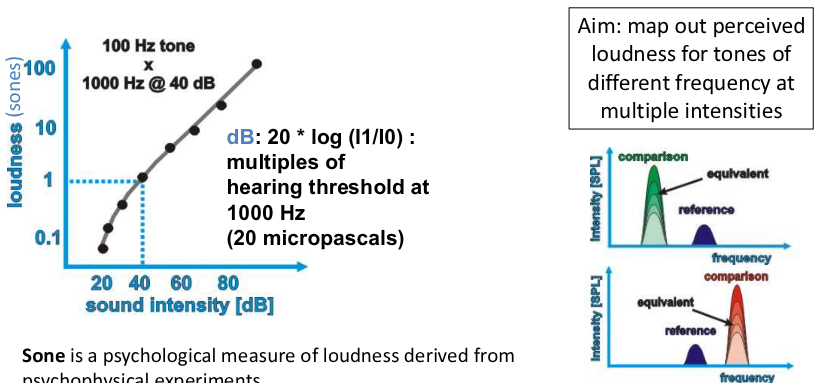
What is a sone?
Psych measure of loudness derived from psychophysical experiments
What process causes sones?
Mind tranduces physical pressures into a perceptual quality whose spacing is different
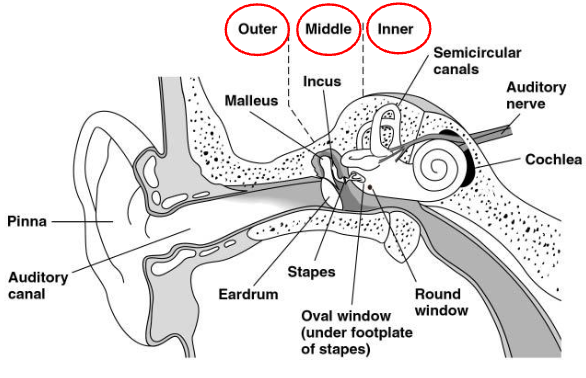
How are sound waves transduced into neural signals?
Outer ear = directional microphone
Middle ear = impedance matching, overload protection
Inner ear = frequency analysis, neural encoding
Outer ear collects sound waves → funnels them towards the middle ear → transmits the vibrations to the inner ear (embedded in the skull) → transduced into neural impulses
Pinna → funnels sound waves into auditory canal → eardrum vibrates in time with sound wave → ossicles pick up eardrum vibrations → amplifies them + passes them along → vibrations of oval window → vibrations of fluid-filled cochlea → fluid carries wave energy to auditory receptors (inner hair cells) → transduce into electrical activity → exciting the neurons of auditory nerve → brain
What is a cochlea? How is it divided along length?
A fluid-filled tube that is the organ of auditory transduction
Divided along length by:
Basilar membrane = a structure in the inner ear that undulates when vibrations from the ossicles reach the cochlear fluid
Wave-like movement stimulates:
Hair cells = specialised auditory receptor neurons embedded in the basilar membrane
Release neurotransmitter molecules → initiates a neural signal in the auditory nerve that travels to the brain
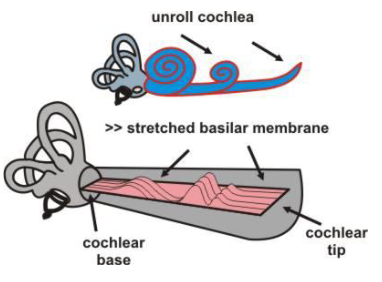
What occurs in the cochlea?
Ossicles transmit mechanical stimulation onto the oval window → generates a wave in the liquid → travels down basilar membrane
Movement of basilar membrane stimulates haircell receptors in the organ of Corti
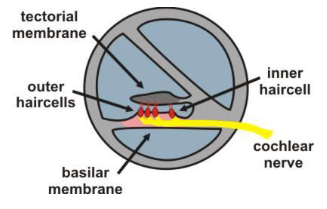
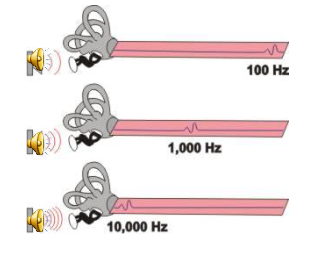
How is sound transduced?
Pure tones lead to basilary membrane oscillations in areas that are responsive to that tone’s frequency
Frequency → location on membrane (place code)
Further frequency tuning is achieved by lateral inhibition in neurons feeding into the auditory nerve
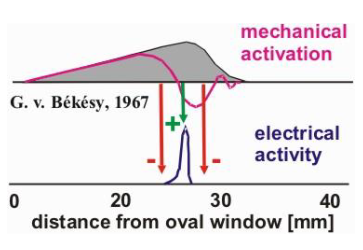
What is a place code?
Used for high frequencies
Active when the cochlea encodes different frequencies at different locations along the basilar membrane
Works best for relatively high frequencies that resonate at the basilar membrane’s base + less well for low frequencies that resonate at the tip
Because low frequencies produce a broad travelling wave → imprecise frequency code
What occurs in the basilar membrane?
Frequency is low → the wide, floppy tip (apex) of the basilar membrane moves the most
Frequency is high → the narrow, stiff end (base) of the membrane moves the most
Movement of the basilar membrane causes hair cells to bend → initiates a neural signal in the auditory nerve
Axons fire the strongest in the hair cells along the area of the basilar membrane that moves the most → the place of activation on the basilar membrane contributes to the perception of sound
What is a temporal code?
Registers low frequencies via the firing rate of action potentials entering the auditory nerve
Individual neurons can produce action potentials at a maximum rate of only about 1,000 spikes per second → temporal code does not work as well as the place code for high frequencies
What did Johnson (1980) argue about action potentials?
Action potentials from the hair cells are synchronised in time with the peaks of the incoming sound waves → provides the brain with precise info about pitch that supplements the info provided by the place code
How does the place code and temporal code work together?
Work together to cover the entire range of pitches that people can hear
How does auditory perception relate to areas in the brain?
Action potentials in the auditory nerve travel to the thalamus + ultimately to the contralateral hemisphere of the cerebral cortex
AKA area A1 = portion of the temporal lobe that contains the primary auditory cortex
Neurons respond well to simple tones, and successive auditory areas in the brain process sounds of increasing complexity (Schreiner et al., 2000)
Has a tonotopic organisation where similar frequencies activate neurons in adjacent locations
LH → analyse sounds related to language
RH → specialise in rhythmic sounds and music
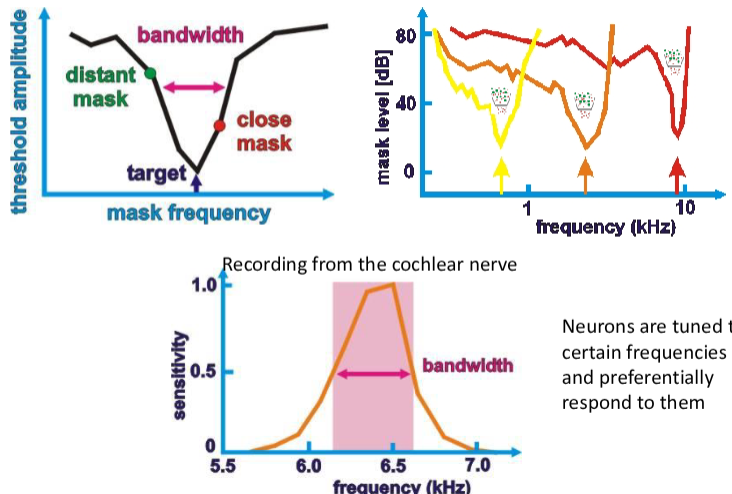
What can frequency tuning curved be measured by?
Masked experiments → neurons are tuned to certain frequencies + preferentially respond to them
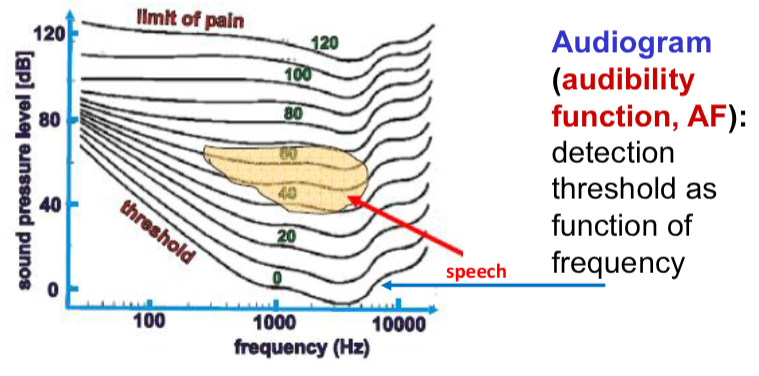
Equal loudness contours (diagram)
What is speech?
Speech sounds cover a wide range of the audible spectrum
Current mobile phone tech only transmits 300-3400Hz
Age-related hearing loss = higher frequencies
Noise-related hearing loss = temp shifts in threshold or permanent damage
Tinnitus = continuous ringing/humming
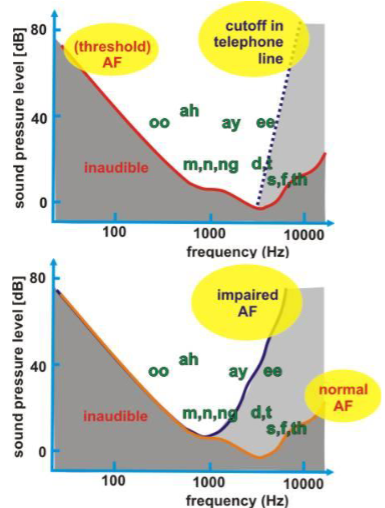
What is conductive hearing loss?
Caused by damage to the eardrum or ossicles to the point that they can’t conduct sound waves effectively to the cochlea (which works normally)
In many cases, meds or surgery can correct the problem
Sound amplification from a hearing aid also can improve hearing through conduction via the bones around the ear directly to the cochlea
What is sensorineural hearing loss?
Caused by damage to the cochlea, the hair cells or the auditory nerve
Happens to almost all people with hearing as they age
Effects:
Sensitivity decreases such that sounds have to be more intense to be heard
Acuity decreases such that sounds smear together on the basilar membrane, making voices harder to understand, especially if other sounds are present
Causes:
Genetic disorders
Premature birth
Infections, meds
Accumulated damage from sound exposure (particularly intense sounds) and aging (these last two causes are hard to tease apart since older people have been exposed to sound for longer)
Hearing aids amplify sounds BUT cannot fix the acuity problem
What is a cochlear implant?
For severe hearing loss
Electronic device that replaces the function of the hair cells
The external parts:mas mic + processor (worn behind the ear) + a small, flat, external transmitter that sits on the scalp behind the ear
Implanted parts: receiver just inside the skull + a thin wire containing electrodes inserted into the cochlea to stimulate the auditory nerve
Sound picked up by the mic is transformed into electric signals by the processor (small computer)
The signal is transmitted to the implanted receiver → activates the electrodes in the cochlea
Where is speech in an audiogram?
What is music?
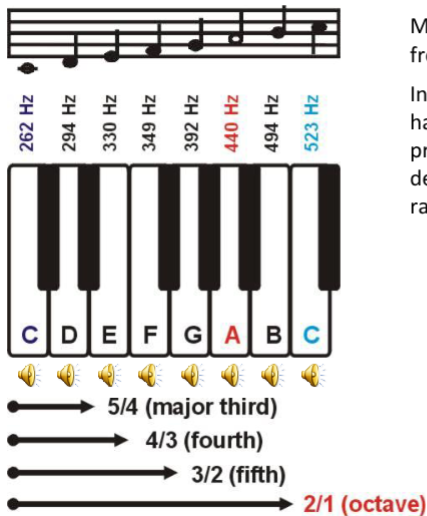
Musical pitch relates to specific frequencies
In Western classical music, harmony is defined through progression of intervals, each defined by their own frequency ratios
What is an ultrasound?
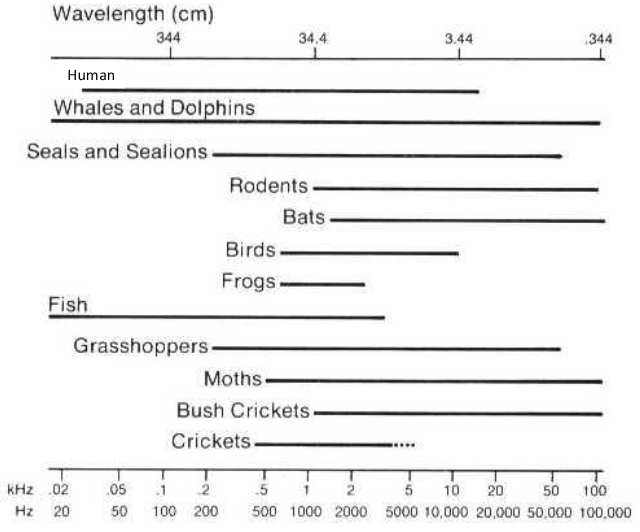
Frequencies above 20 kHz
Not audible to humans
Dogs can hear up to 40 kHz sounds (dog whistles!
What is an infrasound?
Frequencies below 20 Hz
Not audible to humans, but can cause dizziness etc
Elephants can hear sounds as low as 15 Hz
Whales communicate with infrasounds
Sensitivity in animals
How do we known where each sound is coming from in an auditory scene?
From 2 1D sensors (ears) → localise sounds + identify several objects concurrently
Pinnae = ridges on ears channel sound differently depending on where it comes from
Useful for computing elevation (vertical) of sound source
Inter-aural processing = signals are combined to find the angluar location (horizontal) of the sound source
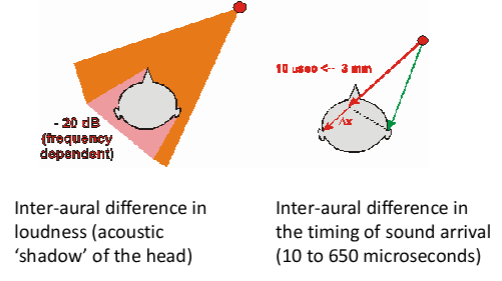
How does sound localisation work?
Sound arriving at the ear closer to the sound source is louder than the sound in the farther ear → because listener’s head partially blocks sound energy
Loudness difference decreases as the sound source moves from a position directly to one side (max difference) to straight ahead (no difference)
Timing → sound waves arrive a little sooner at the near ear than at the far ear
Timing difference can be as brief as a few ms BUT together with the intensity difference it’s sufficient to allow people with hearing to perceive the location of a sound
Ambiguous location → turn head → changes relative intensity + timing of sound waves arriving in their ears + collects better info about the likely source of the sound
Visual orienting = behavioural response to move the eyes towards a target that might signal a potential prey or predator
What is multisensory integration?
Perceptual representation of events from more than one sensory modality
Expect synchrony/integration (e.g. bad dubbing, beat to come from a drum)
Ventriloquist effect (Howard + Templeton, 1966) → ‘throw’ their voice by minimising the movements of their own mouth + accentuating the movements of the dummy, leading to the compelling impression that the dummy is talking
Achieved by neurons in the brain that receive input from more than one sensory modality (Stein + Meredith, 1993) → sensitive to the source of the signals in terms of location and timing, as in the case of beating a drum
When multisensory neurons receive synchronised activity from the visual + auditory channels, they produce an enhanced response that represents the combined activity of the different senses (Stein, 1989) → when they are not synchronised, the multisensory neurons are not activated
What is the cocktail party effect?
Cherry (1953) → following 1 of 2 concurrent messages is much better + less effortful if these messages are presented to separate ears than if they’re both presented to a single ear
Separation of sound sources in space can be facilitated through high-level effects (language, familiarity, attention) + sensory fusion (visual signals)