Week 2: Motivation
 Call Kai
 Learn
Learn Practice Test
 Spaced Repetition
 Match
Match Flashcards
 Knowt Play
1/24

There's no tags or description
Looks like no tags are added yet.
Name | Mastery | Learn | Test | Matching | Spaced | Call with Kai |
|---|
No analytics yet
Send a link to your students to track their progress
25 Terms
What is motivation according to Sage (1977)?
The direction and intensity of one's effort.
What are the different approaches to motivation?
Person centred view (trait)
Participant motivation
Situational factors (state)
Participant and situation interaction
What does the bounded rationality perspective suggest about motivation?
Money will not always motivate people to perform their best; humans don't always act rationally.
What is the focus of Self-Determination Theory (SDT)? (Deci and Ryan, 1985, 2000)
Self-Determination Theory (SDT), developed by Deci and Ryan
Proposes that motivation is driven by an innate need for growth and the fulfillment of three basic psychological needs: autonomy (control over actions), competence (mastery), and relatedness (connection).
It distinguishes between intrinsic motivation (internal interest) and extrinsic motivation (external rewards/pressure)
→ supporting these three needs fosters higher-quality, autonomous motivation
What are the three basic psychological needs in SDT?
Autonomy, competence, and relatedness.
What does autonomy refer to in the context of SDT?
The need to feel in control of one's own behaviours and goals.
How is competence defined in SDT?
The need to gain mastery of tasks and learn different skills.
What does relatedness mean in SDT?
The need to experience a sense of belonging and attachment to others.
What occurs when people experience all 3 psychological needs according to the SDT?
They become more self-determined and intrinsically motivated
The higher the level, the higher the intrinsic motivated
What is the difference between intrinsic and extrinsic motivation?
Intrinsic motivation is driven by enjoyment or the desire to learn, while extrinsic motivation is driven by rewards.
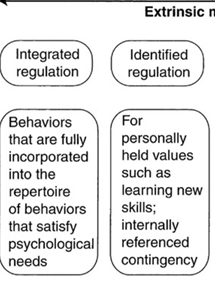
What are the ideal points on the autonomy continuum according to SDT?
Integrated regulation and identified regulation.
What does Achievement Goal Theory focus on? (Nicholls, 1989)
• Understanding the role of competence or ability
• A theory of motivation that focuses on differences in how individuals evaluate competence and define success and failure.
What is task-mastery orientation?
Taking pride in progressive improvement of knowledge and ability relative to past performances.
Self-referenced
Focus on improving ability rather than current ability
Process orientation (one step at a time)
Conductive maintaining high perceptions competence/ability
What characterises ego orientation?
Intent on demonstrating superiority over others, motivated by social comparison.
Other referenced perceptions of competence
Current ability is important
Superior to others
Equal with less effort
Outcome orientation
Not conductive maintaining perceptions high competence/ability
When losing, they tend to remove all effort
What are some dispositional individual differences in achievement?
Goal orientations considered independent (orthogonal - both exist) – combination of high, moderated, low (Nicholls, 1984)
• Individual differences in orientations result of socialisation of task or ego involvement in home or experiences in achievement (i.e. classroom) (Nicholls, 1989)
• Adoption of task and ego goals for specific activity involve both individual goal orientations and situation cues
What are some environmental factors involved in achievement?
• Motivational Climate (Ames, 1992) - situational factor
• Mastery (Task-involving) Climate – focused on individual improvement, effort and cooperative learning
• Performance (Ego-involving) Climate – highlighted by competition, outperforming others, viewing mistakes as failures and achieving success with minimal effort: looking for cues which reinforce our ego-orientation, over time we tend to pick up more performance cues
What is the concept of motivational climate?
The environment's values regarding winning versus improvement.
What are the two types of motivational climates identified by Ames (1992)?
Mastery (task-involving) climate and performance (ego-involving) climate.
What does the TARGET framework stand for in achievement structures? (Epstein, 1989)
Tasks, Authority, Recognition, Grouping, Evaluation, Time.
What is attribution theory?
The theory that explains specific causes used to explain outcomes or behaviours.
What are the four attributions identified in attribution theory?
Ability, effort, task difficulty, and luck.
What is the locus of causality in attribution theory?
The distinction between internal factors (ability, effort) and external factors (task difficulty, luck).
How do high achievers attribute success and failure?
Attribute success to internal factors
Failure is attributed to external factors
Approach behaviours: persistence, strive to achieve
What behaviours are associated with low achievers?
Attribute success to external factors
Attribute failure to internal factors
Avoidance behaviour: avoiding failure
What are the three theoretical approaches to motivation?
Self-Determination Theory, Achievement Goal Theory, and Attribution Theory.