Development of Aggression
 Call Kai
 Learn
Learn Practice Test
 Spaced Repetition
 Match
Match Flashcards
 Knowt Play
1/18

There's no tags or description
Looks like no tags are added yet.
Name | Mastery | Learn | Test | Matching | Spaced | Call with Kai |
|---|
No analytics yet
Send a link to your students to track their progress
19 Terms
Attachment Styles
secure and insecure
Insecure Attachments
ambivalent, avoidant, disorganized
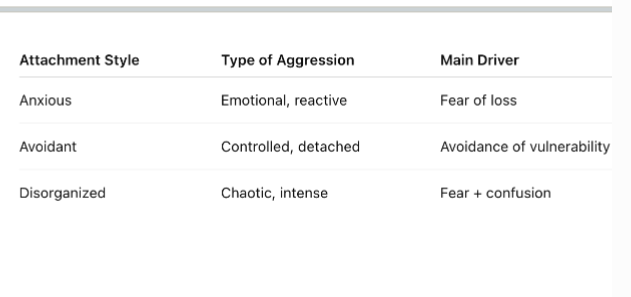
Ambivalent Attachment
anxious attachment
- fear of abandonment, need for reassurance
- tantrums, overreacting emotionally, misinterpretation of social cues, mistrust in close relationships
Avoidant Attachment
distrust of others and avoids intimacy
- bullying, short tempered, instrumental aggression in childhood, lack of remorse
Disorganized Attachment
mix of acnious and avoidant
- struggles with trust, emotional regulation, and stable relationships
- linked to stress and risk for self-directed harm
Stable Traits Emerge
aggression can emerge in all insecure styles
- a child leanrs that caregivers are unreliable, rejecting, or frightening
Bandura’s Bobo Doll Study
children’s aggression increased and included new aggressive acts not shown by the model
- boys were more aggressive
- children who saw a calm adult or mot adult showed no aggressive imitation
- girls showed more physical when seeing male and more verbal when seeing female
Child Maltreatment
verbal and emotional, sexual, physical maltreatment, neglect
- gender differences unclear
Child Neglect Rate and Percentage
377,742 victims and 70-75% of cases
- 25% of abused children are emotionally abused
- 61% are neglected and 38% are physically neglected
Child Physical Abuse Rate and Percentage
62,685 and 15-20% of cases
- 58% of abused children are physicially abused
Child Sexual Abuse Rate and Percentage
44,355 and 10-12% of cases
- 25% of abused children are sexually abused
Victim Characteristics
lifelong victimization, revictimization, stepchildren at increased risk
- no effect of craniofacial malformation
Physical Maltreatment
tissue damage is necessary for reporting standards
- intention of perpetrator determines whether or not it classifies as abuse
- ex. hitting, fist hitting, part of body outside spanking
Sexual Maltreatment
unknown rates due to failure to report
- 30% of females and 16% of males
- age of onset is 6
- stepparents and nonbiological partners of parents; male perpetrators dominate reports
Behavioral Charactersistics of Abused Children
avoidant attachment and less compliant with instructors in schools
- physical abuse yields more aggression in schol
Characteristics of Sexually Abused Children
withdrawl, altered school performance, change in appearance and weight, sexual behavior
Psychological Outcomes
suicidal ideation, altered gray and white matter, psychiatric diagnoses
ELA Outcomes
gray and white matter reductions
- gray matter in PFC, hippocampus, OFC
- white matter in corpus callosum
Connectivity Issues
connectivity between DMN and amyglada reduced