Materials Exam #2: Study Guide
 Call Kai
 Learn
Learn Practice Test
 Spaced Repetition
 Match
Match Flashcards
 Knowt Play
1/60

There's no tags or description
Looks like no tags are added yet.
Name | Mastery | Learn | Test | Matching | Spaced | Call with Kai |
|---|
No analytics yet
Send a link to your students to track their progress
61 Terms
What is the primary concern with alkali-silica reaction (ASR) in concrete?
a) Loss of workability
b) Surface discoloration
c) Expansion and cracking
d) Decreased permeability
c) Expansion and cracking
Which property is NOT a characteristic of hardened concrete?
a) Strength
b) Workability
c) Durability
d) Shrinkage
b) Workability
Which of the following aggregates is most suitable for high-strength concrete? The main factor influencing freeze-thaw durability of concrete is:
a) High water-to-cement ratio
b) Use of air entrainment
c) Use of silica fume
d) Increased cement content
b) Use of air entrainment
Rutting in asphalt pavements is primarily caused by:
a) Poor drainage
b) Freeze-thaw cycles
c) Repetitive heavy loading
d) Low ambient temperatures
c) Repetitive heavy loading
Which of the following is NOT a common distress in asphalt pavements?
a) Efflorescence
b) Delamination
c) Fatigue cracking
d) Bleeding
a) Efflorescence
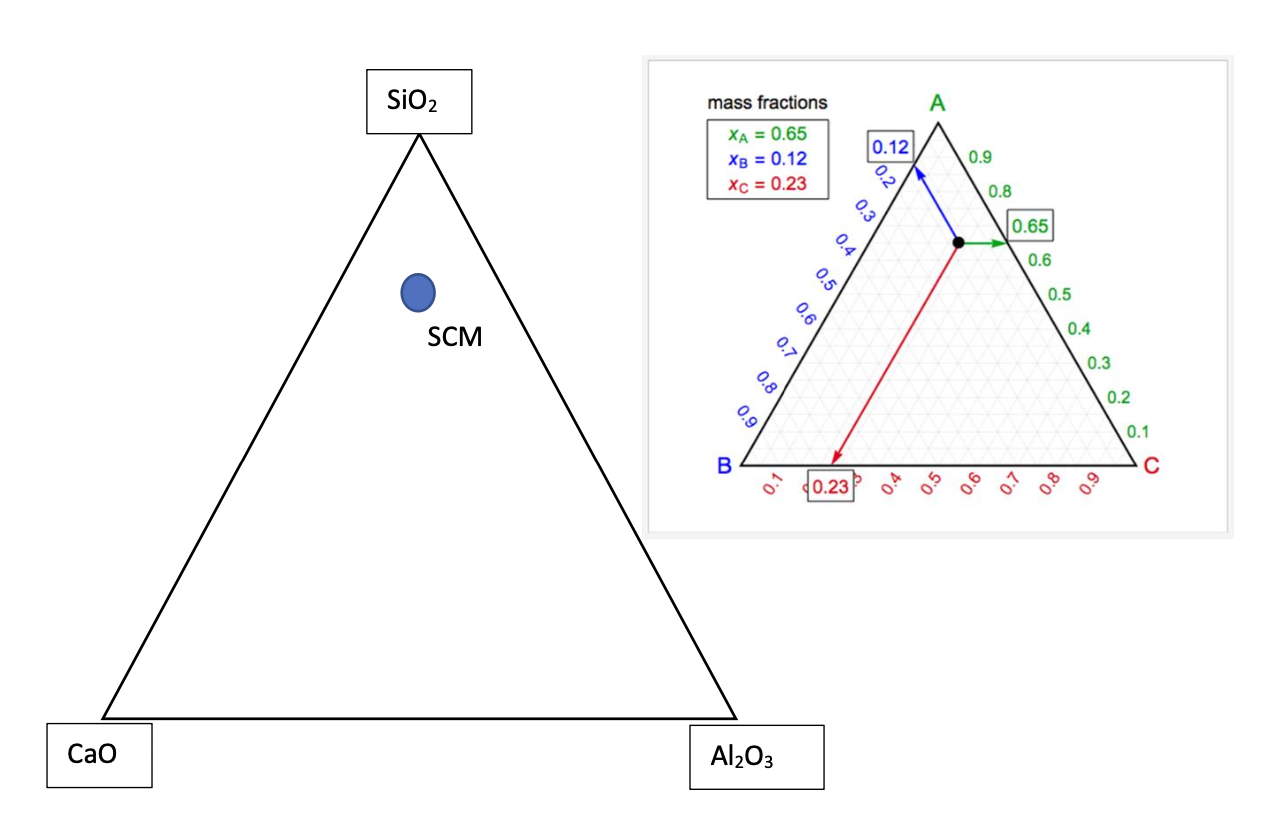
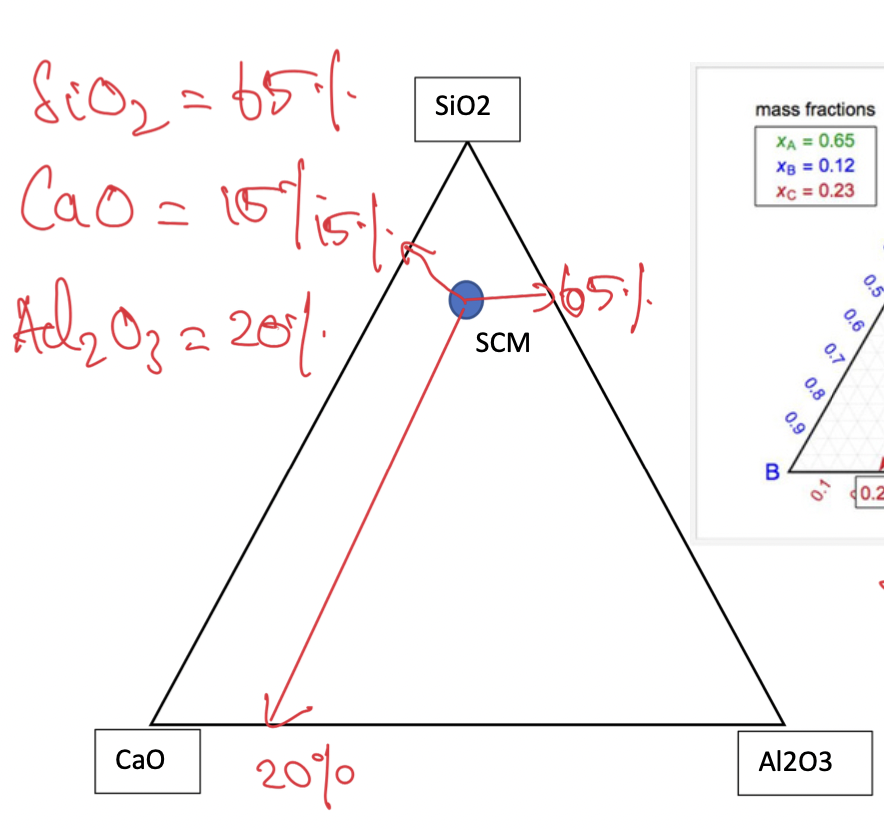
The chemical composition of an SCM is represented in the ternary diagram below. Using the chart provided, what are the approximate quantities of SiO2, CaO and Al2O3?
Show your answer by drawing appropriate lines in the ternary diagram above. (10 points)
If you were to take a pozzolanic SCM in a test tube, add sufficient water and observe it after 2 hours will you notice it any setting? Explain your answer. (5 points)
High concentration of SiO2 shows that this is a polylamic SCM it is unlikely to notice any setting
“Steel starts off in a passive state in concrete” Explain this statement. Briefly describe the two phenomena that disrupt the passivity and their mechanisms.
Highly alkaline conditions in concrete lead to the formation of a stable passive layer around the rebar
This is disrupted by:
1) carbonation - reduces the pH and destabilizes the passive layer
2) chloride - reacts and disrupts the passive layer, induces corrosion
Answer the following questions on splitting tensile strength.
Provide a sketch to describe the splitting tensile strength test and indicate the directions in which the loads are being applied.
Derive the formula used to calculate the tensile strength from the maximum tensile load at which the specimen breaks.
In this tensile strength test, no tensile forces are applied on the specimen. What makes it a “tensile test”?
State True or False: Tensile strength is typically between 50 to 75% of the compressive strength of concrete.
On the slides
stress= load / (cross-section area) = 2P / (Pi)(L)(D)
The compressive force applied in the vertical direction generates tensile force in the horizontal direction
False
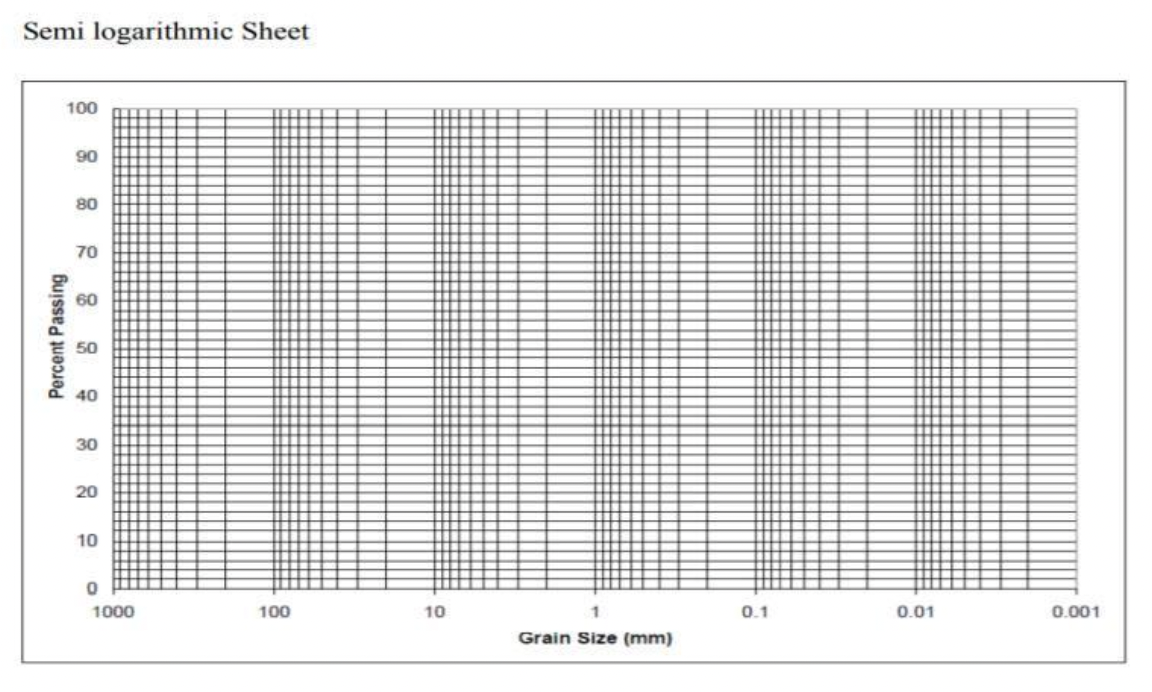
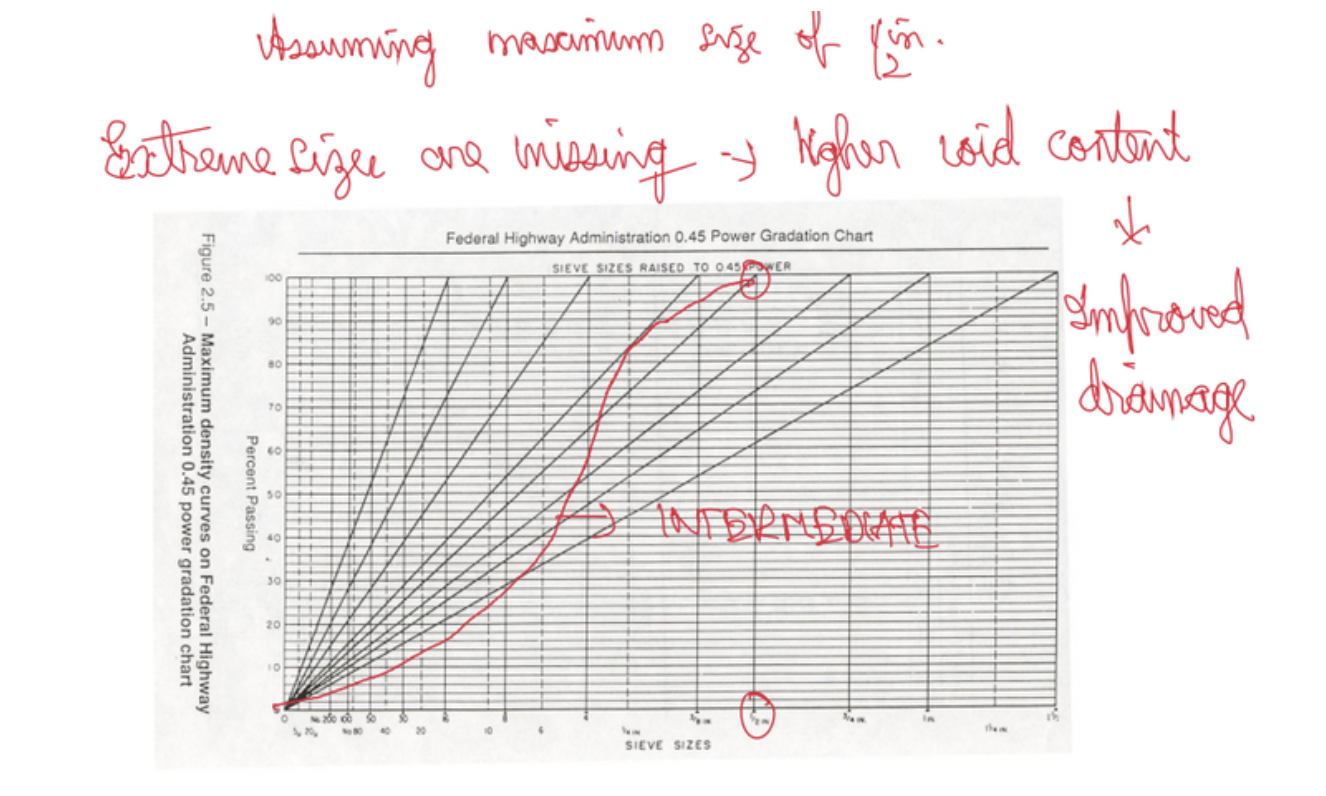
Describe the percent passing vs sieve size for an open-graded HMA concrete. Compare it with 0.45 power chart line. Explain how this contributes to an increase in the drainage capacity of the pavement.
Intermediate
extreme sizes are missing —→ has a high void content —→ which leads to improved drainage
assuming maximum size is 1/2”
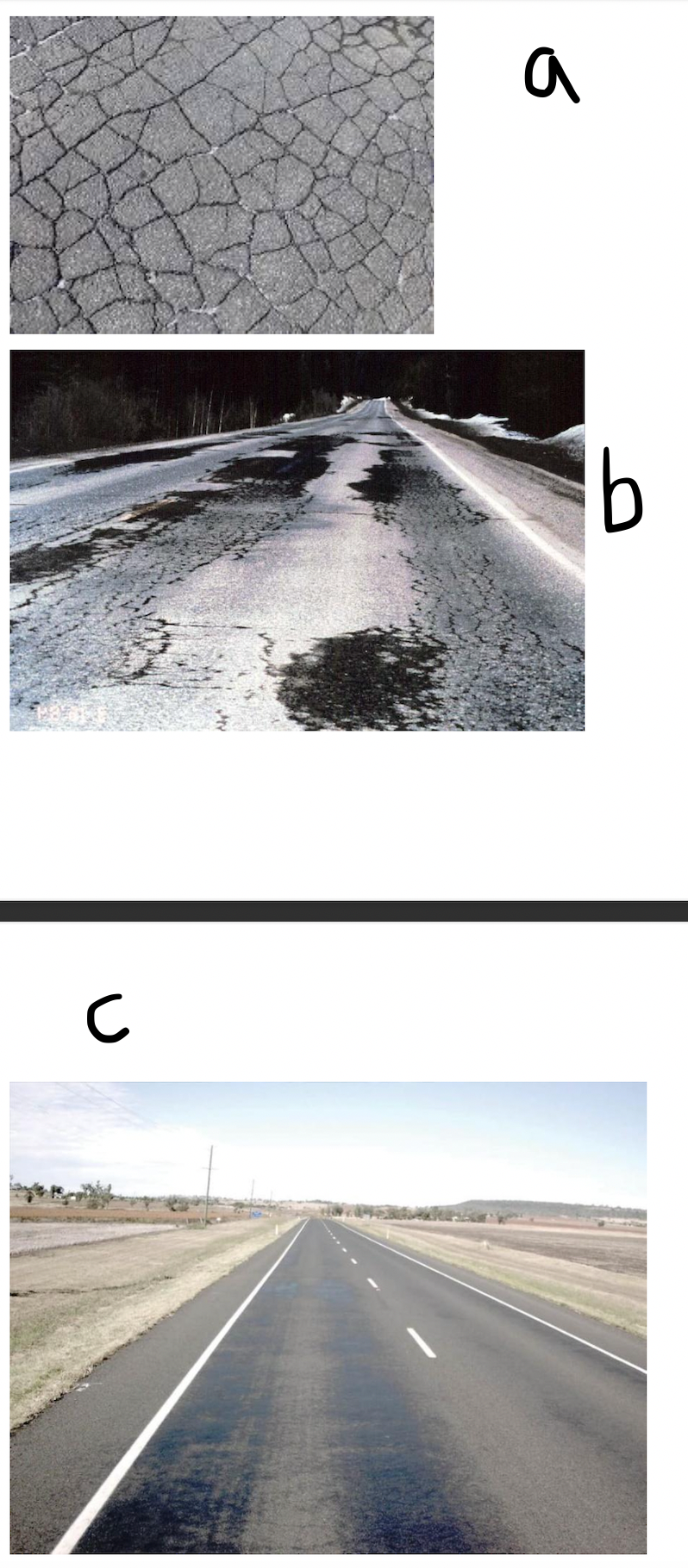
Identify the following pavement distresses. Mention the likely cause and suggest one remedial measure for each.
a. blocking and cracking
Issue: environmental/thermal, or asphalt binder becomes to stiff
Fix: Pick the right performance grade of asphalt cement
b. fatigue/cracking
Issue: heavy traffic loads
Fix: improve load carrying capacity of the pavement
c. bleeding/flushing
Issue: traffic/loading, to much binder, not enough voids
Fix: pick the optimal asphalt binder content
Which property of asphalt contributes to its usage in low-temperature placements?
Low viscosity due to additives like solvents or emulsifying agents
What key characteristic distinguishes Stone Matrix Asphalt (SMA) from traditional Dense-Graded Hot Mix Asphalt (HMA) in terms of its gradation curve?
SMA features a steeper incline in its gradation curve, indicating a more narrow distribution.
Which environmental factor contributes to pavement distress by decreasing soil stiffness and asphalt concrete strength?
Increase in water content
What factor is least likely to contribute to the formation of potholes?
A road surface with deep HMA layer over 100 mm (4 inches)
Which type of pavement failure is primarily related to thermal and moisture changes in the underlying slab rather than load impacts?
Reflection Cracking
What is the primary cause of stripping in asphalt pavements as depicted in the slide images and descriptions?
High relative humidity and rain events
What is the primary factor for selecting the appropriate asphalt binder for a pavement project?
Expected temperature extremes
Which feature of AASHTO M 320 standards is directly influenced by changes in test temperature according to the specified process?
Spec Requirement Remaining Constant
What is the primary benefit of using the Rolling Thin Film Oven (RTFO) test over traditional thin film oven methods for aging asphalt binders?
It achieves the same degree of aging in a shorter amount of time.
Which of the following best describes the primary purpose of using the Pressure Aging Vessel (PAV) in the aging process of asphalt binders?
To simulate the long-term effects of high air pressure and temperature on asphalt binders, mimicking 5 to 10 years of HMA pavement service
Dicalcium Silicate C2S or Belite
Role: The "Long-Term Strength" provider.
Characteristics: It hydrates much more slowly than C3S. It contributes very little to strength in the first week but is responsible for the strength gain that happens from day 7 to day 28 and beyond.
Tricalcium Silicate C3S or Alite
Role: The "Early Strength" provider.
Characteristics: It hydrates and hardens rapidly. It is responsible for the initial set and the high strength gained within the first 7 days.
Tricalcium Aluminate C3A
Role: The "Heat and Setting" regulator.
Characteristics: This is the most reactive compound. It hydrates instantly and releases a large amount of heat. While it contributes very little to actual structural strength, it controls the initial "flash set.”
Tetracalcium Aluminoferrite (C4AF or Ferrite)
Role: The "Flux" and "Color" provider.
Characteristics: It acts as a flux during production, lowering the temperature required in the kiln to form the other compounds. It contributes almost nothing to strength
Cement Hydration Process (Stages)
Initial Hydrolysis (Rapid heat, first few minutes)
Dormant Period (Window of workability for placement)
Acceleration (Initial/Final set, rapid strength gain)
Deceleration (Rate slows as hydration products build up)
Steady State (Slow, long-term strength development)
In the PG Binder system (e.g., PG 64-22), what does the first number represent and the second number
Maximum 7-day pavement design temperature
Minimum pavement temperature that the binder stays ductile
Which of the following is not a benefit of SCM’s
increase in required concrete curing time
A sieve aggregate is characterized as open-graded aggregate if it is missing aggregate in the very fine and very coarse fraction but has even distribution of aggregate in the mid sized range.
False
In general, air entrained concrete is stronger than non air entrained concrete of the same water to cementitious materials ratio
False
Using cement chemistry notation what are two of the four main raw compounds in portland cement
C3S
C3A
Using Cement chemistry notation what is the hydrated cement phase mainly responsible for strength and durability in concrete _____
C-S-H
Name two of any other hydrated phases using either the cement chemistry notation or just using their names ____
CH, C4ASH12
Which of the following is not a primary raw material used in cement manufacture
sand
The primary role of gypsum in cement manufacture is to
control the setting time of cement
Which of the following aggregates is most suitable for high-strength concrete
angular aggregate
The chemical compound responsible for the initial setting of cement is
Tricalcium aluminate (C3A)
The water cement ration primarily effects
workability and strength
Role of aggregates in concrete:
Aggregates provide bulk, reduce shrinkage, and enhance the strength and durability of concrete.
Shape and texture influence workability and bonding.
Angular aggregates improve strength, while rounded aggregates enhance workability.
Cement Manufacture Process
- Raw material extraction (limestone, clay, gypsum)
- Crushing and mixing
- Heating in a kiln (clinker formation through calcination)
- Cooling and grinding clinker with gypsum to produce cement
Water-Cement Ratio Significance:
A lower water-cement ratio increases concrete strength and durability but reduces workability. Excess water weakens concrete and increases porosity.
Main Chemical Compounds in Portland Cement:
C3S
C2S
C3A
C4AF
C3S
Provides early strength
C2S
Contributes to long-term strength
C3A
Affects setting time
C4AF
Contributes to color
What is Class F Fly Ash and its role in concrete?
Class F Fly Ash is a pozzolanic Supplementary Cementitious Material (SCM) that reacts with Calcium Hydroxide (CH) to form additional C-S-H gel, reducing permeability and increasing long-term durability.
What is the function of Silica Fume in concrete?
Silica Fume is an extremely fine SCM that significantly reduces concrete permeability and increases high early strength by refining the pore structure.
What is Air Entrainment in concrete?
Air Entrainment involves the use of microscopic bubbles to provide relief chambers for the internal pressure of freezing water, preventing freeze-thaw damage.
What does the Slump Test measure?
The Slump Test measures the workability and consistency of fresh concrete, indicating how easily the mix can be placed and consolidated.
What is Alkali-Silica Reaction (ASR)?
ASR is a durability issue where reactive silica in aggregate reacts with alkalis in cement to form an expansive gel that causes internal cracking.
What does Chloride Permeability refer to in concrete?
Chloride Permeability refers to the ease with which chloride ions penetrate concrete; it is the primary factor in the corrosion of steel reinforcement.
What is Gmm (Rice Density)?
Gmm is the theoretical maximum specific gravity of an asphalt mixture calculated at zero air voids.
What does VMA (Voids in Mineral Aggregate) measure?
VMA measures the total volume of inter-granular void space between aggregate particles that must accommodate both air and effective binder.
What does Grade Bumping entail in asphalt binder selection?
Grade Bumping is the practice of selecting a higher High-Temperature PG binder (e.g., PG 70 instead of 64) for slow-moving or heavy standing loads to prevent rutting.
What is the purpose of PAV (Pressure Aging Vessel) in asphalt testing?
PAV is an asphalt aging simulation that uses high pressure and heat for 20 hours to mimic 7-10 years of in-service environmental oxidation.
What does RTFO (Rolling Thin Film Oven) simulate in asphalt aging?
RTFO simulates the short-term oxidation and hardening that occurs during plant mixing and construction.
What is Stripping in the context of asphalt distress?
Stripping is a moisture-induced distress where the bond between the asphalt binder and the aggregate is broken, often leading to raveling.
What is the function of the Superpave Gyratory Compactor (SGC)?
The SGC is a device used in mix design to simulate the field compaction of asphalt through a combination of vertical pressure and gyratory kneading.
What does Fineness Modulus (FM) indicate?
FM is an index of the coarseness or fineness of an aggregate, calculated from the cumulative percentages retained on standard sieves.
What are SCM (Supplementary Cementitious Materials)?
SCMs are materials like fly ash, slag, or silica fume used to replace a portion of Portland cement to improve durability or sustainability.