Chapter 8-9 - Growth
 Call Kai
 Learn
Learn Practice Test
 Spaced Repetition
 Match
Match Flashcards
 Knowt Play
1/36

There's no tags or description
Looks like no tags are added yet.
Name | Mastery | Learn | Test | Matching | Spaced | Call with Kai |
|---|
No analytics yet
Send a link to your students to track their progress
37 Terms
Absolute population size
total number of all animals or total biomass
Closed population
population that remains unchanged during the study period (migration, mortality, and recruitment negligible)
Relative population size
estimates based on data assumed to be correlated with absolute abundance size
often called an index of abundance
(ex. number of cougar tracks)
Relative population estimates are easier and less expensive to obtain, BUT it only works if…
the metric is proportional to absolute abundance
N = qU
(U = relative abundance)
(N = absolute abundance)
(q = a scalar)
Mark-recapture theory
the principle that the proportion of marked individuals in a second sample (R/M2) equals the original marked proportion of the total population (M1/N)
CPUE
a relative index of population abundance developed from fishery-dependent observations
U = C/f
Catchability coefficient (q)
the proportion of the population captured by a standard unit of fishing effort, relating CPUE to true population size
Describe what environmental factors (both biotic and abiotic) might affect CPUE.
Abiotic - water temperature, salinity, oxygen levels, weather/climate, habitat structure, currents/tides
All of the above effect animal density, how they behave, and how effective fishing gear will be. For example, strong currents and tides will influence how fish move and might create CPUE peaks.
Biotic - prey availability, predators, population size, migrations or spawning, disease
All of the above will also affect density and behavior. For example, prey availability might increase or decrease CPUE, dependent on how well-fed and willing fish are to take bait.
Explain when/why electrofishing may be used to estimate fish population.
very quick and efficient for rapid testing
works in shallow, low salinity habitats (streams, lakes, etc.)
good for understanding current fish stock, predators, and forage availability
Explain when/why various distance methods (such as line transects or visual surveys) may be used to estimate fish population.
good for long term monitoring of large areas and collecting absolute density without the need for physical capture
works best in clear waters for reef fish or large pelagic species
Explain when/why mark-recapture may be used to estimate fish population.
for when we need true population estimates/models and not just an index
when fish are hard to count directly
when CPUE is unreliable
good for tracking movement and life cycles
Principle of Parsimony / “Ockham’s razor”
the most acceptable explanation of an occurrence, phenomenon, or event is the simplest, involving the fewest entities, assumptions, or changes
Variables VS Parameters (in models)
Variables - entities that can be defined and associated to observations from nature
Parameters - help define the relationships between variables
Life history
major events relating to an organism’s growth, development, reproduction, and survival
Life history strategy
timing and nature of life history events, averaged across all the individuals of a species or population
Why do we study life history?
To understand and model population dynamics
To develop quantitative relationships for factors such as: growth, fecundity, weight/length, gender balance, natural mortality, etc.
Growth is the combination of…
anabolism (A) and catabolism (C)
for growth to occur, the biomass added by anabolism must exceed that lost by catabolism (A > C)
Anabolism is a function of the _____ of an animal (ie. area), while catabolism is a function of the _____ of an animal.
surface (S)
volume (V)
How do we age fish?
Otoliths
Spines
Vertebrae
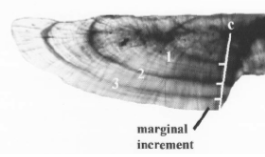
Marginal increment analysis
measure from last annulus to edge
Fecundity
the number of fertilized eggs produced by a mature female
True or False: Fish have higher fecundity compared to other species.
True
Fecundity in fish tends to _____ (increase/decrease) with length.
increase
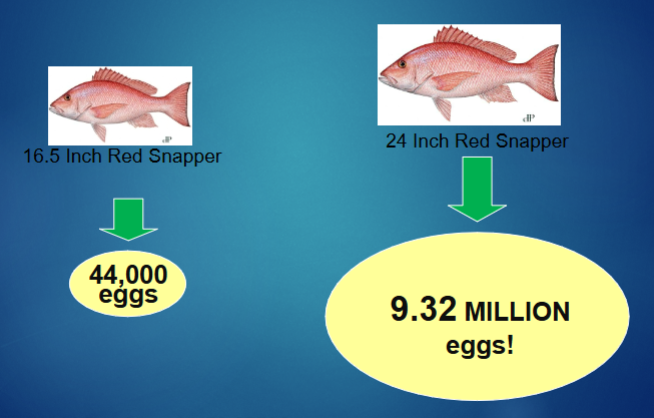
Total spawners / total fecundity
fish that release one batch of eggs per breeding season
Batch spawners / batch fecundity
release multiple batches of eggs in one season
Compensatory density dependence
decrease in recruits per spawner as spawning stock increases (i.e. can be due to limited shared resources)
Depensatory density dependence
increase in recruits per spawner as spawning stock increases (i.e. can be due to compensating for predation)
Allee / Founders effect
decreased reproductive success at low population densities
Sequential hermaphroditism
the ability to switch genders
Protogynous hermaphrodites
female → male
ex. groupers
Protandric hermaphrodites
male → female
ex. snooks
What are the two most commonly used stock-recruitment relationships?
Beverton and Holt
Ricker
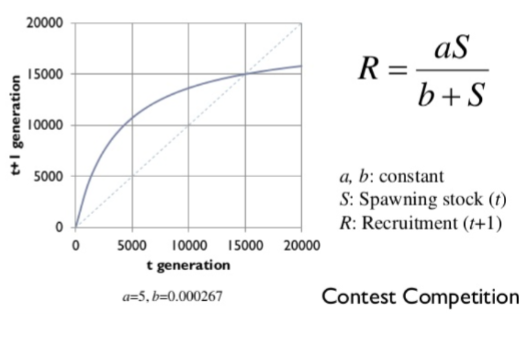
Beverton and Holt (stock recruitment)
incorporates density-dependent survival rates reflecting intracohort competition for resources
predicts that recruitment saturates at high stock levels
contest competition
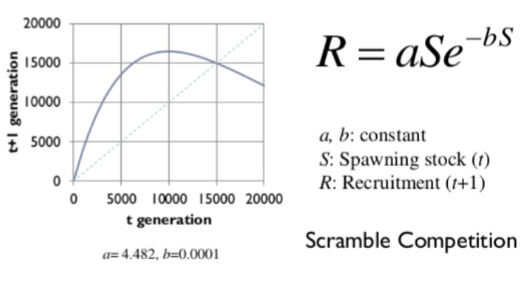
Ricker (stock recruitment)
density dependence mortality term for eggs and juvenile fish relates to total stock size rather than cohort size
predicts that recruitment declines at high stock levels
scramble competition
Spawning stock biomass
a measure of the reproductive productivity of the mature population (optimal measurement is number of eggs spawned) – can be estimated from average fecundity
Growth overfishing VS recruitment overfishing
Growth - stock is fished so hard that most individuals are caught at a relatively small size – classic yield-per-recruit problem of balancing stock loss against stock gains from growth (both individual animal growth and population growth)
Recruitment - occurs when a stock is fished so hard that the stock size is reduced below the level at which it can produce enough new recruits to replace those dying
Spawning potential ratio (SPR)
the impact that fishing has on the ability of each recruit to contribute to spawning
compares the spawning ability of a stock in the fished condition to the stock’s spawning ability in the unfished condition