Gene inactivation
 Call Kai
 Learn
Learn Practice Test
 Spaced Repetition
 Match
Match Flashcards
 Knowt Play
1/77

There's no tags or description
Looks like no tags are added yet.
Name | Mastery | Learn | Test | Matching | Spaced | Call with Kai |
|---|
No analytics yet
Send a link to your students to track their progress
78 Terms
Insertional mutagenesis
Gene silencing
Gene editing
Drie hoofdstrategieën om plantgenen te inactiveren
screen many lines for a phenotype of interest, afterwards determine which gene was mutated.
forward genetics
retrieve a line in which your gene of interest is mutated and determine phenotype
reverse genetics
T-DNA from Agrobacterium inserts (rather) randomly in genome
When within a gene, this likely disrupts it
principe T-DNA tagging
T-DNA
Transposon
TILLING
drie manieren voor insertional mutagenesis
co-suppression
RNAi
artificial microRNAs
methodes van gene silencing
Collections of mapped T-DNA insertions
Hundreds of thousands plants with a T-DNA locus, for which flanking regions have been determined
resultaat T-DNA tagging
PCR-based methods are used to identify flanking regions
Doel TAIL-PCR
Thermal asymmetric interlaced PCR
afkorting TAIL-PCR
LB-primers
specifieke, geneste primers die binden in de gekende T-DNA-sequentie
Arbitrary degenerate primers
minder specifieke primers die op verschillende plaatsen in het onbekende flankerende genomische DNA kunnen binden
De LB-primers hebben een hogere Tm; de degenerate primers een lagere Tm
twee soorten primers voor TAIL-PCR
Nested primers: e.g. LB1, LB2 and LB3, primers that lie progressively deeper inside the T-DNA, each nested within the previous one, increasing specificity with each PCR round.
nested primers in context van TAIL-PCR
Round 1: LB1 binds strong, more amplification of the places where LB1 is located
2nd round: PCR product of first round as template, and LB2 used, bit deeper into the T-DNA
(optional 3th round)
De verschillende PCR rondes bij TAIL-PCR
Transposons (jumping genes) are mobile DNA elements
transposons
Source of mutations in plants and humans, but rare: when ending up in GOI
transposons als mutatiebron
when a transposon ‘jumps’ into a gene, you see which effect this gene has. you can determine where this gene is located, by located the known transposon with PCR
principe transposon-tagging
If transposition occurs in the germline, you get a stable insertion of the transposon
when do you have stable insertion of a transposon?
gusA has only a weak minimal promoter. Only when the T-DNA inserts close to an enhancer can that enhancer activate this promoter.
Those enhancers are tissue-specific, so the GUS expression pattern reveals where a tissue-specific enhancer is located.
principe enhancer trap
EMS (ethyl methanesolufonate)
chemical mutagen used for TILLING
EMS adds an ethyl group to guanine base (G) in DNA, forming O-6-ethylguanine.
working EMS
O-6-ethylguanine “mispairs” with thymine (T) during replication instead of cytosine.
This mispairing leads to G:C → A:T transition mutations after DNA replication
gevolg vorming O-6-ethylguanine bij TILLING
Typically EMS mutagenesis introduces about 1 SNP per 7 Mb (can vary by species and conditions).
aantal SNPs door EMS mutagenesis
Targeting Induced Local Lesions IN Genomes
afkorting TILLING
Er is geen transformatie nodig, waardoor TILLING bij veel plantensoorten toepasbaar is
De verkregen mutanten worden doorgaans niet als GMO beschouwd
TILLING kan zwakke allelen opleveren
dus geen volledige knock-out, maar een gedeeltelijk veranderde eiwitfunctie
Principe:
TILLING is breed toepasbaar en laat toe om naast knock-outs ook subtielere functieveranderingen te vinden.
voordelen TILLING
High background mutation load (barley: 10.000 mutations estimated when 1/500 kb)
Backcrossing needed to eliminate the background mutations
nadelen TILLING
Dubbelstrengig RNA (dsRNA) wordt door Dicer geknipt tot siRNA’s van ongeveer 21–24 nucleotiden
De siRNA’s worden opgenomen in het RISC-complex met een Argonaute-eiwit
RISC gebruikt het siRNA om complementair mRNA te herkennen en af te breken
De transcriptie verloopt dus normaal, maar het mRNA wordt gedegradeerd
Principe:
Bij PTGS wordt genexpressie geremd ná transcriptie doordat specifiek mRNA wordt afgebroken.
werking post-transcriptional gene silencing (PTGS)
Een deel van het doelgen wordt in sense- en antisense-richting in één construct geplaatst
Na transcriptie plooit het RNA tot hairpin-dsRNA
Dicer knipt dit dsRNA in siRNA’s
Deze siRNA’s leiden het RISC-complex naar complementair mRNA, dat vervolgens wordt afgebroken
Principe:
RNAi verlaagt genexpressie door gericht mRNA van een homologe sequentie af te breken
Hoe werkt RNA interference (RNAi)?
1. Transgene expressie in de plant
de plant produceert zelf dsRNA tegen een gekozen doelgen
2. Externe toediening van dsRNA
dsRNA wordt rechtstreeks op de plant gesproeid
Het doel kan een plantgen zijn, maar ook een essentieel gen van een insect of pathogeen
Principe:
RNAi kan dus intern of extern worden aangeleverd en zowel plantgenen als genen van belagers uitschakelen.
Hoe kan RNAi in planten worden toegepast?
DNA methylation of promoter:
Cytosine > methylcytosine
No more transcription
DNA methyltransferase
DNA methylation is heritable (epigenetics)
Transcriptional gene silencing (TGS)
Spontaneous silencing of transgenes during a generation
transgene silencing
when an inserted transgene silences both itself and the homologous endogenous gene (same sequence), not necessarily genes around it
co-suppression
co-suppression
first observed method to silence endogenous genes via sequence homology
Een ingebracht transgen met hoge sequentie-overeenkomst met een endogeen gen kan dsRNA/siRNA-vorming uitlokken
De siRNA’s veroorzaken PTGS
zowel het transgene als het homologe endogene mRNA wordt afgebroken
Dezelfde siRNA’s kunnen ook via RNA-directed DNA methylation DNA-methylatie sturen, waardoor TGS ontstaat
Principe:
Bij co-suppression worden zowel het transgen als het overeenkomstige endogene gen gesilenced door sequentiehomologie.
mechanisme co-suppression
Met een hoog transgene copy number
Met inverted repeats van het transgen
Deze structuren kunnen RNAi en epigenetische silencing activeren
Principe:
Daarom selecteert men bij voorkeur high-quality events met één intacte transgenkopie.
met wat wordt transgene silencing vaak gelinkt?
Need to select high-quality events with a single-copy transgene for stable expression
Selection methods: Southern blot, dPCR, …
Hoe kan je transgene silencing voorkomen?
microRNAs: Small, non-coding RNA molecules of about 21 nucleotides that play a role in the regulation of gene expression
miRNAs
Binds to complementary sequences on messenger RNA (mRNA) and inhibit protein production by:
degrading the mRNA
blocking translation.
mechanisme miRNA
artificial microRNAs
amiRNA
Een bestaande miRNA, bijvoorbeeld miRNA172a uit Arabidopsis, wordt gebruikt als backbone
De seed region wordt aangepast zodat ze complementair is aan het gewenste target-mRNA
Daardoor ontstaat een amiRNA dat specifiek dat mRNA herkent en silenced
De amiRNA kan onder controle van een gekozen promoter worden geplaatst, zodat silencing constitutief of weefselspecifiek gebeurt
Principe:
Bij amiRNA behoud je de natuurlijke miRNA-structuur, maar verander je de targetsequentie om een gekozen gen gericht te silenzen
voorbeeldmechanisme amiRNA
Clustered Regularly Interspaced Short Palindromic Repeats
afkorting CRISPR
CRIPSR associated genes
afkorting Cas
Een CRISPR-locus bevat:
cas-genen, die coderen voor CRISPR-geassocieerde eiwitten zoals nucleasen
een CRISPR-array met afwisselend repeats en spacers
De repeats zijn identieke DNA-sequenties
De spacers zijn verschillende sequenties die afkomstig zijn van eerder binnengedrongen viraal DNA en zo een genetisch geheugen van infecties vormen
Principe:
De cas-genen leveren de afweermachinerie, terwijl de spacers bepalen welk viraal DNA later herkend wordt.
Samenstelling CRISPR locus
160 kDa – 1368 aa
grootte Cas9 protein
dead Cas9: (mutations in both HNH and RuvC domains) can bind DNA but not cut it; used for gene repression (blocking transcription)
dCas9
nickase Cas9 (mutation in one nuclease domain) cuts only one DNA strand (nickase)
nCas9
crRNA bevat de variabele sequentie die complementair is aan het target-DNA en bepaalt dus de specificiteit
tracrRNA heeft een grotendeels constante sequentie en vormt de structuur die nodig is voor binding en activatie van Cas9
In bacteriën vormen crRNA + tracrRNA samen het gidscomplex voor Cas9
In het labo worden beide samengevoegd tot één single guide RNA (sgRNA)
tracrRNA en crRNA in bacteria en in het labo (in context van CRIPSR)
Protospacer adjacent motif
afkorting PAM
In target sequence, not in sgRNA
waar vind je de PAM sequence?
Streptococcus pyogenes: “NGG”
meeste gebruikte species Cas9, met de PAM sequence
Cas9 recognizes the PAM (not the sgRNA)
dsDNA unwinding: local opening of the double DNA helix after PAM recognition, allowing sgRNA to access one strand
sgRNA base pairs with the target DNA sequence (starting from the seed region)
Only with sufficient complementarity does Cas9 become fully active and induce a double-strand break
‘samenwerking’ Cas9 en sgRNA
Also works in eukaryotic cells to make DSB in genome
Wat is een belangrijke constatatie voor CRISPR/Cas9 als gene editing tool?
After splicing, exon–exon junctions are marked by EJCs, indicating where introns were removed
During normal translation, ribosomes remove these EJCs; the stop codon is typically located after the last EJC
If the stop codon is premature, the ribosome stops early and downstream EJCs remain → this is recognized and activates NMD
principe NMD
Nonsense-mediated decay
NMD
An abnormally long 3’ UTR can also trigger NMD
andere factor dat NMD kan triggeren, buiten premature stop codon
One protein: Cas9
Express multiple sgRNAs → these will form multiple RNP complexes that can target multiple loci simultaneously
voordeel van multiplexing bij CRIPSR/Cas9
Transcription Activator-Like Effector Nuclease.
TALEN
Gene editing method, discovered in plants
waarom is TALEN interessant?
Backbone (bacterial part): ori’s, KanR (for selection in E. coli)
T-DNA (plant part):
LB, RB
Selection marker
p35S::Cas9
pU6::sgRNA (you can multiplex this part)
opbouw Cas9 vector voor planten
NLS: directs Cas9 to the nucleus where the DNA is located
belang NLS voor expressie Cas9
addition of introns improves gene expression and mRNA processing in plants (since Cas9 is of bacterial origin)
intronization van Cas9
sgRNA is expressed using a polymerase III promoter (instead of Pol II), because it is a small RNA that requires precise transcription start and end
Pol III naturally transcribes small RNAs such as U6 and U3, which are therefore used as promoters for sgRNA expression
promotor voor expressie van sgRNA
A polyT sequence acts as a termination signal for Pol III, ensuring correct transcript length
stopsignaal voor expressie sgRNA
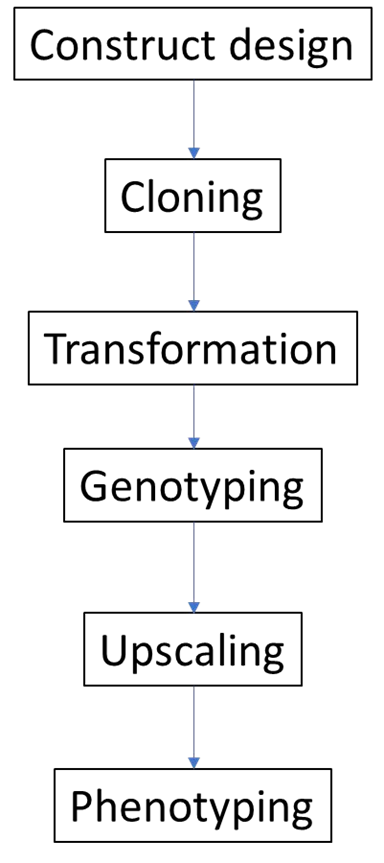
verschillende stappen voor CRISPR / Cas9 in de praktijk
Know your gene!
belangrijke eerste stap voor je aan gene editing gaat doen
Do you expect strong defects in development or even lethality? (maybe knock down better?)
Are you targeting one or more genes?
Is there gene linkage between the genes you want to knock out? Difficult to separate them via crosses?
vragen die je jezelf moet stellen als je een gen kiest voor knock out
determining the genotypes in each plant after gene editing
genotyping
Backup if one sgRNA fails
Larger deletion is easier to identify with PCR
waarom vaak twee sgRNAs per gene?
Region of the gene is important: targeting early exons (e.g. first exon) increases chance of frameshift and premature stop → stronger knock-out; targeting later regions may still allow partial protein function
waarom is de region of the GOI belangrijk voor het gRNA design?
Off-targets: similar sequences elsewhere in the genome can also be recognized and cut
→ therefore the 20 bp spacer sequence must be highly specific to minimize off-target effects
Wat zijn off-targets en hoe ga je ermee om?
Off-targets zijn vaak voorspelbaar, waardoor je planten met weinig of geen ongewenste mutaties kunt selecteren
Ze komen relatief zelden voor in vergelijking met spontane mutaties
Door meerdere generaties te (terug)kruisen kunnen ongewenste off-targetmutaties worden weggewerkt
Principe:
In plantenveredeling kan je off-targets opsporen, selecteren en via kruising uit de lijn
waarom zijn off targets niet echt een probleem bij plant breeding?
De 20 bp spacer wordt als twee complementaire oligonucleotiden ontworpen
Een Type IIS-restrictie-enzym, zoals BsaI, knipt buiten zijn herkenningsplaats en maakt specifieke sticky ends
De oligonucleotiden krijgen passende overhangs, worden geanneald en directioneel in het geopende vectorconstruct ingebracht
Daarna worden vector en insert verbonden met T4 DNA-ligase
Principe:
Alleen de spacer wordt vervangen; de rest van het CRISPR/Cas9-construct blijft hetzelfde.
cloning van target sequence voor sgRNA in CRISPR/Cas9 construct
Bringing a specific gene or trait from one genetic line into another by repeatedly backcrossing to the recipient (elite) line
introgression
Meiosis is the process of cell division that results in gametes (sperm or egg cells)
meiosis
During meiosis, crossing over takes place between two homologous chromosomes: meiotic recombination
meiotic recombination
At least 1 crossover per chromosome pair (obligate crossover)
obligate crossover
1 percent recombination = 1 centimorgan = 1 cM.
Recombination frequencies between loci are proportional to the distance between them.
> 50 cM: the markers are not paired and behave as if on other chromosomes
genetic distance
Recombination mainly at ends of chromosomes
Less so near centromeres
waar zie je vooral recombination?
A desired gene is introduced together with linked, unwanted genomic regions due to limited recombination
linkage drag
Marker-assisted backcrossing: following all chromosomes!
Conventionally you are blind to this: you can only follow traits
marker-assisted vs conventionally backcrossing