2.3 Transport across cell membranes
 Call Kai
 Learn
Learn Practice Test
 Spaced Repetition
 Match
Match Flashcards
 Knowt Play
1/41

There's no tags or description
Looks like no tags are added yet.
Name | Mastery | Learn | Test | Matching | Spaced | Call with Kai |
|---|
No analytics yet
Send a link to your students to track their progress
42 Terms
What are the two key features of the fluid-mosaic model of membrane structure?
Molecules are free to move laterally in the phospholipid bilayer.
Many components are present, including phospholipids, proteins, glycoproteins, and glycolipids.
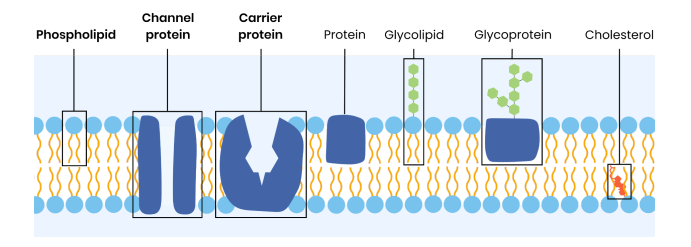
How are phospholipids arranged in a cell membrane?
Phospholipids form a bilayer with hydrophobic fatty acid tails facing inwards and hydrophilic phosphate heads facing outwards.
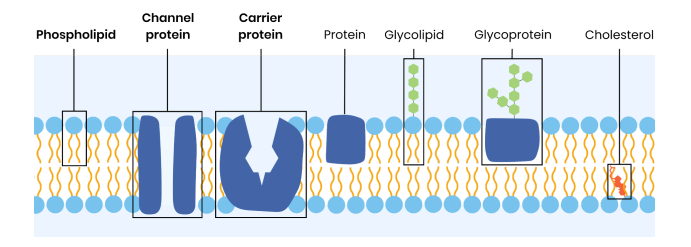
What are the two types of proteins found in cell membranes and where are they located?
Intrinsic or integral proteins span the bilayer, for example channel and carrier proteins.
Extrinsic or peripheral proteins are found on the surface of the membrane.
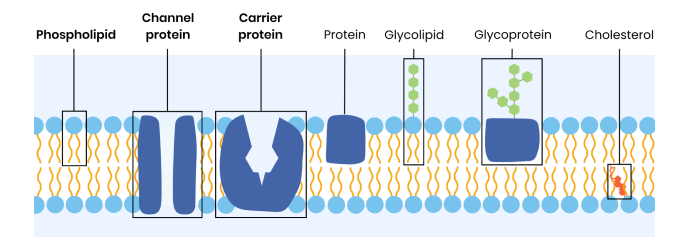
Where are glycolipids and glycoproteins found in the cell membrane?
Glycolipids are lipids with polysaccharide chains attached, found on the exterior surface.
Glycoproteins are proteins with polysaccharide chains attached, found on the exterior surface.
What is the role of cholesterol in cell membranes?
Cholesterol binds to phospholipid hydrophobic fatty acid tails.
It restricts movement of other molecules, decreasing fluidity and permeability while increasing rigidity.
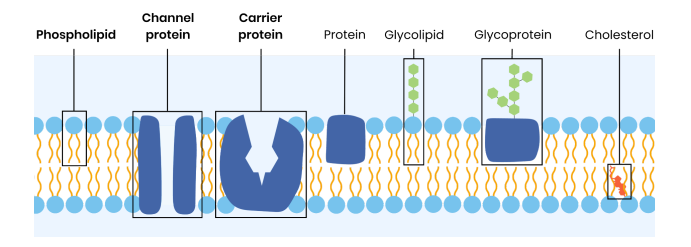
Why do phospholipids form a bilayer?
Water is present on either side of the membrane.
Hydrophobic fatty acid tails are repelled from water, so they point away from water towards the interior.
Hydrophilic phosphate heads are attracted to water, so they point towards the water.
How does the fluidity of the phospholipid bilayer aid membrane function?
Fluidity enables the membrane to bend for vesicle formation or phagocytosis.
How do glycoproteins and glycolipids contribute to membrane function?
Glycoproteins and glycolipids are found on the exterior surface of the bilayer.
They act as receptors for cell signalling and antigens for cell recognition.
Which types of substances move across membranes by simple diffusion?
Lipid-soluble or non-polar substances, for example oxygen and steroid hormones.
Very small substances.
Describe the direction and energy requirements of simple diffusion.
Substances move from an area of higher concentration to lower concentration, down a concentration gradient.
Passive process that does not require energy from ATP or respiration, only kinetic energy of the substances.
How do substances cross the membrane during simple diffusion?
Across the phospholipid bilayer.
Which substances are restricted by the phospholipid bilayer?
Water-soluble or polar substances, for example sodium ions and glucose.
Larger substances.
Why does the phospholipid bilayer restrict these substances?
Due to the hydrophobic fatty acid tails in the interior of the bilayer.
Which types of substances move across membranes by facilitated diffusion?
Water-soluble, polar, charged, or slightly larger substances, for example glucose and amino acids.
Describe the direction and energy requirements of facilitated diffusion.
Substances move from an area of higher concentration to lower concentration, down a concentration gradient.
Passive process that does not require energy from ATP or respiration, only kinetic energy of the substances.
How do substances cross the membrane during facilitated diffusion?
Through specific channel or carrier proteins.
What determines which substances move through carrier and channel proteins?
The shape or charge of the protein determines which substances move.
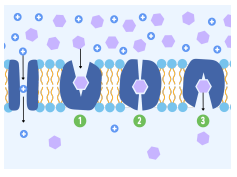
Describe the function of channel proteins in facilitated diffusion.
Channel proteins facilitate the diffusion of water-soluble or polar substances through a hydrophilic pore filled with water.
They may be gated and can open or close.
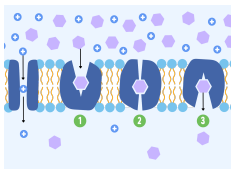
Describe the function of carrier proteins in facilitated diffusion.
Carrier proteins facilitate the diffusion of slightly larger substances.
A complementary substance attaches to the binding site, causing the protein to change shape and release the substance on the side of the membrane with a lower concentration.
Which substance moves across membranes by osmosis?
Water diffuses or moves.
Describe the direction of water movement during osmosis.
Water moves from an area of high water potential to low water potential, down a water potential gradient.
Describe the pathway and energy requirements of osmosis.
Through a partially permeable membrane, which is the phospholipid bilayer.
Passive process that does not require energy from ATP or respiration, only kinetic energy of the substances.
What is water potential and what is the value for pure distilled water?
Water potential is a measure of how likely water molecules are to move out of a solution.
Pure distilled water has the maximum possible water potential of 0 kPa.
How does increasing solute concentration affect water potential?
Increasing solute concentration decreases water potential.
Describe the direction and requirements of active transport.
Substances move from an area of lower concentration to higher concentration, against a concentration gradient.
Requires energy from the hydrolysis of ATP and specific carrier proteins.
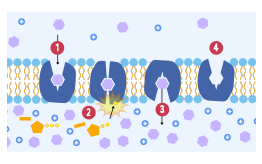
What is the first step in active transport by a carrier protein?
A complementary substance attaches to the binding site of a specific carrier protein.
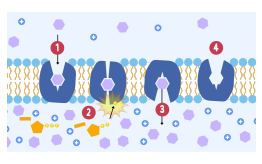
What is the second step in active transport by a carrier protein?
ATP binds and is hydrolysed into ADP and inorganic phosphate, releasing energy.
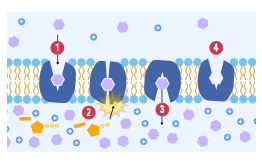
What is the third step in active transport by a carrier protein?
The carrier protein changes shape, releasing the substance on the side of the membrane with a higher concentration.
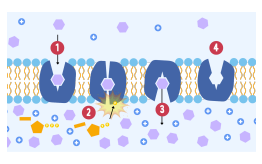
What is the fourth step in active transport by a carrier protein?
Inorganic phosphate is released, causing the protein to return to its original shape.
What is co-transport?
Two different substances bind to and move simultaneously via a co-transporter protein, which is a type of carrier protein.
Movement of one substance against its concentration gradient is often coupled with movement of another down its concentration gradient.
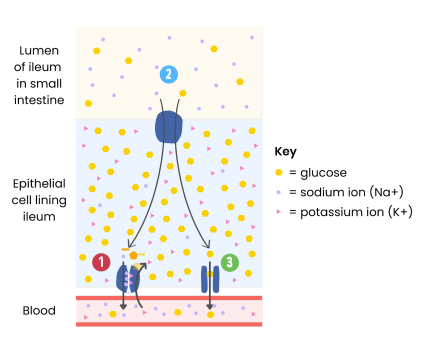
In the example of sodium and glucose absorption, what establishes the sodium concentration gradient?
Sodium ions are actively transported from epithelial cells lining the ileum to the blood by the sodium-potassium pump, establishing a higher sodium ion concentration in the lumen than in the epithelial cell.
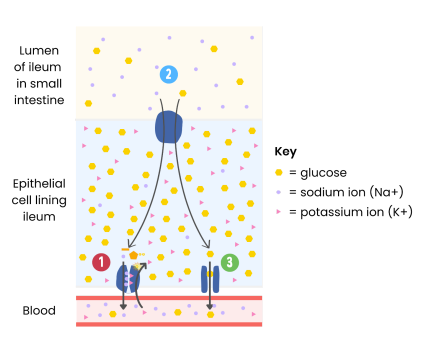
How do sodium ions and glucose enter the epithelial cell?
Sodium ions enter the epithelial cell down their concentration gradient, carrying glucose against its concentration gradient via a co-transporter protein.
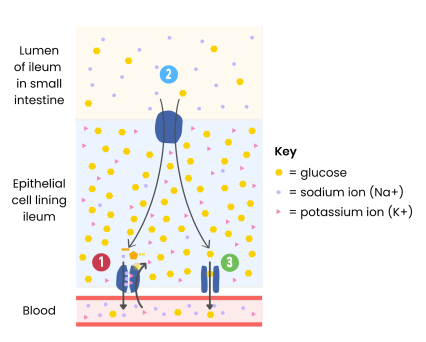
How does glucose move from the epithelial cell into the blood?
Glucose moves down its concentration gradient into the blood via facilitated diffusion.
What is another name for this process and why?
Indirect or secondary active transport, as it is reliant on a concentration gradient established by active transport.
How does increasing surface area of a membrane affect the rate of movement?
Increasing surface area increases the rate of movement.
How does increasing the number of channel or carrier proteins affect the rate of movement?
Increasing the number of channel and carrier proteins increases the rate of facilitated diffusion and active transport.
How does increasing the concentration gradient affect the rate of simple diffusion?
Increasing the concentration gradient increases the rate of simple diffusion.
How does increasing the concentration gradient affect the rate of facilitated diffusion?
Increasing the concentration gradient increases the rate of facilitated diffusion until the number of channel or carrier proteins becomes a limiting factor, as all are in use or saturated.
How does increasing the water potential gradient affect the rate of osmosis?
Increasing the water potential gradient increases the rate of osmosis.
How do some specialised cells increase the rate of transport across their membranes? Give an example.
Microvilli or folded cell-surface membranes provide a large surface area.
For example, the epithelial cells lining the ileum have microvilli.
How else do specialised cells increase the rate of transport?
They have more channel and carrier proteins to increase the rate of facilitated diffusion or active transport.
Why do specialised cells involved in active transport have a large number of mitochondria?
To make more ATP by respiration to release energy by ATP hydrolysis for active transport.