Econ hw 7
 Call Kai
 Learn
Learn Practice Test
 Spaced Repetition
 Match
Match Flashcards
 Knowt Play
1/19

There's no tags or description
Looks like no tags are added yet.
Name | Mastery | Learn | Test | Matching | Spaced | Call with Kai |
|---|
No analytics yet
Send a link to your students to track their progress
20 Terms
You are the manager of a firm that produces output in two plants. The demand for your firm's product is P = 78 −
15Q, where . The marginal costs associated with producing in the two plants are and
. How much output should be produced in plant 1 in order to maximize profits?
1
You are the manager of a firm that produces output in two plants. The demand for your firm's product is P = 78 −
15Q, where . The marginal costs associated with producing in the two plants are and
. What price should be charged in order to maximize revenues?
$39
You are the manager of a firm that sells its product in a competitive market at a price of $50. Your firm's cost
function is . The profit-maximizing output for your firm is
5
You are the manager of a firm that sells its product in a competitive market at a price of $50. Your firm's cost
function is . Your firm's maximum profits are
$85
You are the manager of a firm that produces output in two plants. The demand for your firm's product is P = 120 −
6Q, where . The marginal costs associated with producing in the two plants are and
. What price should be charged to maximize profits?
$66
You are the manager of a firm that produces output in two plants. The demand for your firm's product is P = 120 −
6Q, where . The marginal costs associated with producing in the two plants are and
. What price should be charged in order to maximize revenues?
$60
You are the manager of a firm that sells its product in a competitive market at a price of $40. Your firm's cost
function is . The profit-maximizing output for your firm is
5
You are the manager of a monopoly that faces a demand curve described by P = 63 − 5Q. Your costs are C = 10 +
3Q. The revenue-maximizing output is
6.3
Which of the following is an example of a monopoly?
local utility industry in a small town
Suppose that initially the price is $50 in a perfectly competitive market. Firms are making zero economic profits.
Then the market demand shrinks permanently, some firms leave the industry, and the industry returns to a long-run
equilibrium. What will be the new equilibrium price, assuming cost conditions in the industry remain constant?
$50
A monopoly has produced a product with a patent for the last few years. The patent is going to expire. What will
likely happen to the demand for the patent-holder's product when the patent runs out?
Demand will decline.
A monopoly has produced a product with a patent for the last few years. The patent is going to expire. What will
happen after the patent expires?
Some firms will enter the industry.
A firm can produce two products with the cost function . The firm
enjoys
cost complementarity and economies of scope.
You are the manager of a firm that produces output in two plants. The demand for your firm's product is P = 20 − Q,
where . The marginal costs associated with producing in the two plants are and
. How much output should be produced in plant 1 in order to maximize profits?
8
Suppose a monopolist knows the own price elasticity of demand for its product is −3 and that its marginal cost of
production is constant MC(Q) = 10. To maximize its profit, the monopoly price is
$15 per unit.
Consider a monopoly where the inverse demand for its product is given by P = 80 − 2Q. Total costs for this
monopolist are estimated to be . At the profit-maximizing combination of output and
price, deadweight loss is
$50.
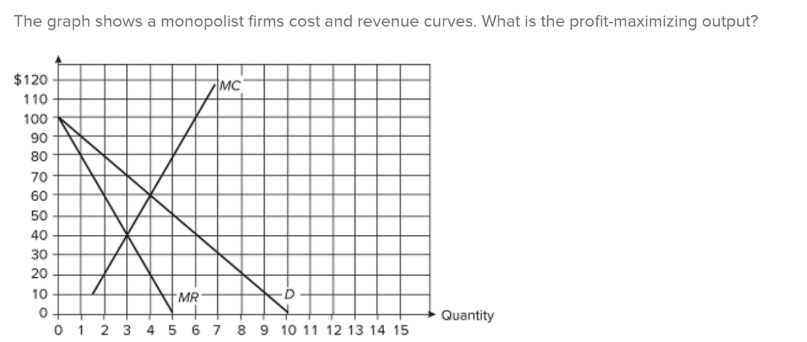
3
Suppose perfectly competitive market conditions are characterized by the following inverse demand and inverse
supply functions, respectively: P = 200 − 2Q and P = 50 + 3Q. The demand curve facing an individual firm operating
in this market is
a horizontal line at $140.
Consider a monopoly where the inverse demand for its product is given by P = 300 − 2Q. Total costs for this
monopolist are estimated to be . At the profit-maximizing combination of output and price,
deadweight loss is
revision: 11_25_2025_QC_HETS-107900
$1,250.
Consider a monopoly where the inverse demand for its product is given by P = 300 − 2Q. Total costs for this
monopolist are estimated to be . At the profit-maximizing combination of output and price,
monopoly profit is
$7,400.