Bisc 101 Nucleic Acids and DNA
 Call Kai
 Learn
Learn Practice Test
 Spaced Repetition
 Match
Match Flashcards
 Knowt Play
1/16

There's no tags or description
Looks like no tags are added yet.
Name | Mastery | Learn | Test | Matching | Spaced | Call with Kai |
|---|
No analytics yet
Send a link to your students to track their progress
17 Terms
Deoxyribonucleic acid (DNA)
-stores genetic information and is replicated using proteins.
-polymers of nucleotide monomers
RNA world hypothesis
-Proposes that there was a stage in the evolution of life when RNA both stored the genetic information and catalyzed its own replication.
Nucleic Acid
Polymers made of Nucleotides
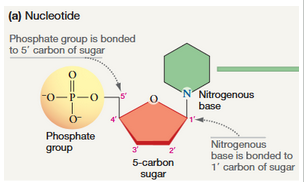
Nucleotide
-monomers of Nucleic Acid
-building blocks, of DNA and RNA
(1) a phosphate group, (2) a five-carbon sugar, and (3) a nitrogenous base.
-sugar is the central component.
-5 types of bases:
Purines: adenine (A) and guanine (G)
Pyrimidines: cytosine (C), uracil (U), and thymine (T)
Ribonucleotide
-monomers of RNA
-sugar: Ribose, C 2’ is OH
-Uses Uracil
Deoxyribonucleotides
-monomers of DNA
-sugar: Deoxyribose, C2’ is Hydrogen
-Uses Thymine
Pyrimidines
cytosine (C), uracil (U), and thymine (T)
single ring structure
Purines
Adenine (A), Guanine (G)
two ring structure
Polymerization of nucleic acids
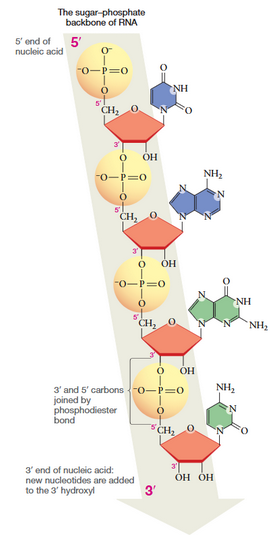
-Occurs through condensation reactions which forms a new covalent bond: a phosphodiester bond.
-Releases a molecule of water.
Phosphodiester bonds are covalent bonds
-catalyzed by enzymes. Joining of nucleotides is not spontaneous.
-Cells raise the potential energy of nucleotides before polymerization occurs.
DNA and RNA Strands Are Directional
-the sequence of nucleotides found in an RNA or DNA strand are always written in the 5′ -> 3′ direction.
-one end always has a free phosphate (5') and the other always has a free hydroxyl group. (3')
5’ outside ring, 3’ inside ring
Why Phosphates Store Energy
-Phosphates carry a negative charge.
-Linking multiple phosphates together creates a covalent bond that carries potential energy due to the repulsive forces.
-Energy is released when phosphates break off.
Antiparallel
-the two DNA strands run in opposite directions; one runs 5'→3' while the other runs 3'→5.
Base pair
-two nitrogenous bases held together by hydrogen bonds across the double helix
A-T base pair
2 hydrogen bonds
G-C base pair
3 hydrogen bond
Two grooves exist on the outside
Major groove: wider; where most proteins bind to DNA
Minor groove: narrower
What Stabilizes the Double Helix
-Hydrogen bonding between complementary base pairs.
-Bases are nonpolar and cluster in the interior.
-Van der Waals interactions between tightly stacked bases.
-DNA as a whole is water soluble because the phosphate backbone (exterior) is negatively charged and hydrophilic