week 2 developmental psych module
0.0(0)
Studied by 0 people Call Kai
 Learn
Learn Practice Test
 Spaced Repetition
 Match
Match Flashcards
 Knowt Play
Card Sorting
1/16

Earn XP
Description and Tags
Last updated 6:49 AM on 4/15/23
Name | Mastery | Learn | Test | Matching | Spaced | Call with Kai | Chat |
|---|
No analytics yet
Send a link to your students to track their progress
17 Terms
1
New cards
Development is:
Multi-directional: losses & gains at every age
• Plastic: within-person variability
• Fetal (foetal) brain is a dynamic structure
• Plastic: within-person variability
• Fetal (foetal) brain is a dynamic structure
2
New cards
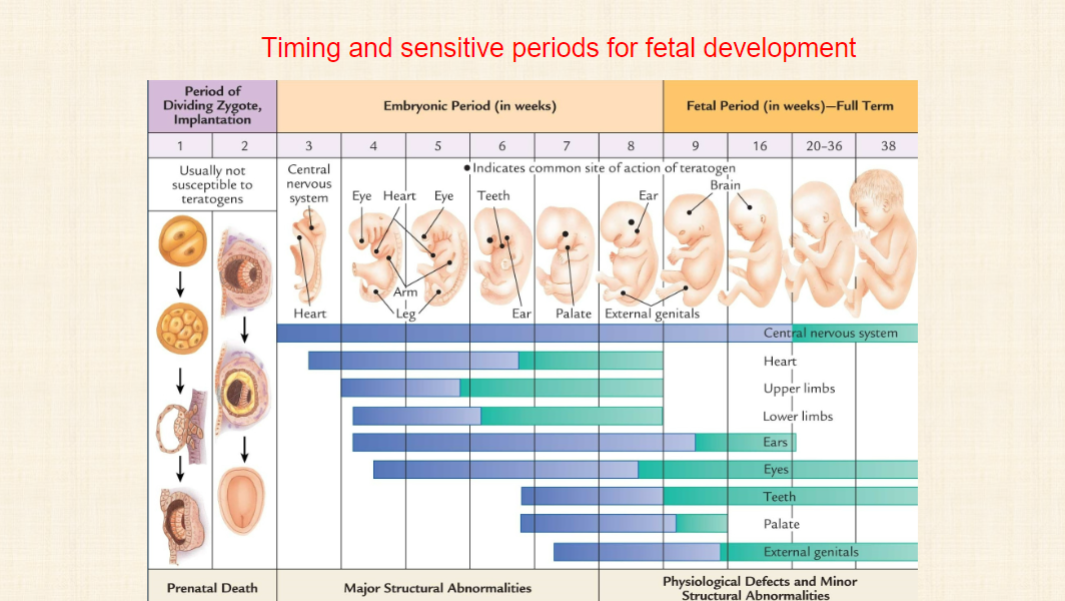
Timing and sensitive periods for fetal development
3
New cards
What are Effects of Environment \n Poverty, associated with ?
– Increased stress \n – Fewer but more hostile interactions \n – External environmental risks \n – Serious developmental risks
4
New cards
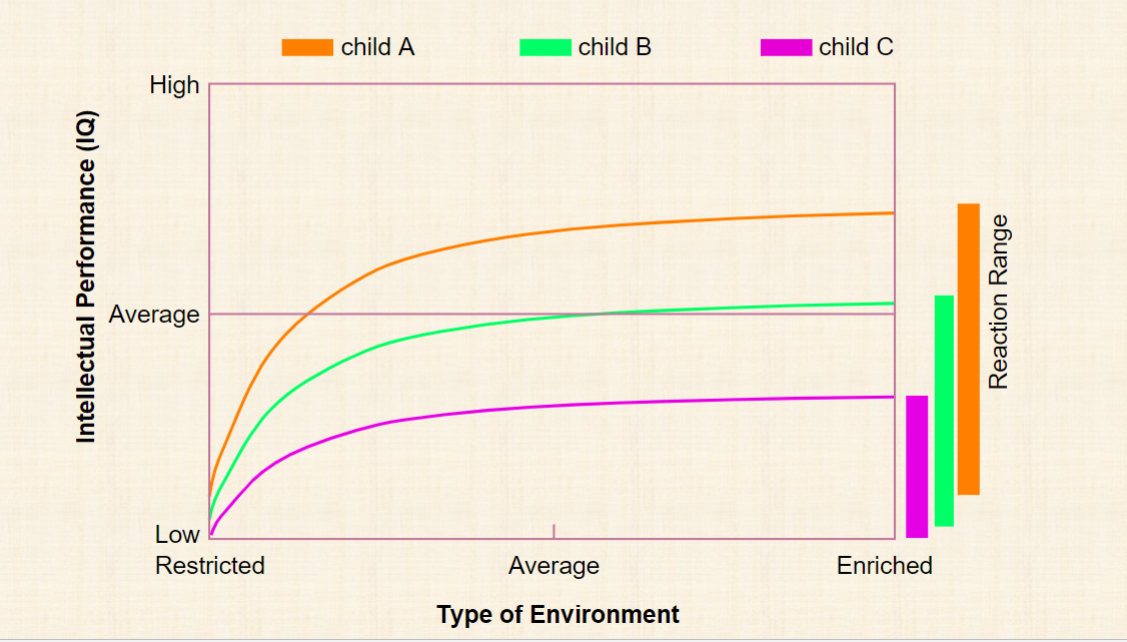
Child’s intellectual ability by environment
5
New cards
Genes don’t work alone:
• As shown, due to unique genetic \n makeup, we respond differently to \n the same environments \n • But the same genes also respond \n differently to the same environments \n when exposed at different periods of \n development
6
New cards
What are Teratogens?
harmful environmental \n agents/conditions that impair \n prenatal development and lead to \n death, birth defects, or later \n emotional, behavioural, and/or \n intellectual impairments \n • Key stages of prenatal period, harms \n fetus in different ways
7
New cards
What are some examples of teratogens ?
Prescription drugs: thalidomide, accutane \n (Vitamin A) \n Illegal drugs: marijuana, cocaine \n alcohol and tobacco \n (Pre-natal exposure to smoking alters gene \n expression, linked to ADHD) \n Environmental hazards: X-rays, pollution \n disease: Rubella, HIV/AIDS, STDs \n Parental factors: maternal malnutrition, \n stress, age; paternal age, Vitamin C \n deficiency, exposure to toxins, smoking
8
New cards
what are some teratogens Risk Factors ?
Dose: Generally larger dose over \n longer time more damage \n May be safe thresholds. \n However, for example: alcohol \n WHO recommends no known safe \n level of alcohol during pregnancy \n Australian NHMRC Guidelines- \n safest = no alcohol during pregnancy \n or breastfeeding.
9
New cards
What are some teratogen risk factors ?
\n Heredity e.g., alcohol \n dehydrogenase gene \n • Interaction effects e.g., alcohol + \n marijuana, no safe thresholds \n • Timing sensitive and critical periods \n See Fig 3.2 \n • Also environmental interactions (e.g. \n low SES, smoking, & developmental \n delays, Perera et al., 2006)
10
New cards
Australian NHMRC Guidelines re: alcohol and pregnancy
“A ‘no-effect’ level has not been established, and limitations in the available evidence make it impossible to set a ‘safe’ or ‘no-risk’ drinking level for women to avoid harm to their unborn children, although the risks to the fetus from low-level drinking (such as 1 or 2 drinks per week) during pregnancy are likely to be low. A conservative, public health approach has therefore been taken in recommending that ‘not drinking alcohol is the safest option’ for pregnant women and women planning a pregnancy.”
11
New cards
Result from exposure to alcohol (again a \n teratogen)
• 1 – 3 per day: ARND (Alcohol-related \n Neurodevelopmental Disorder) or Fetal \n Alcohol Effects \n • > 3 per day or binging (5+) in early \n pregnancy: Fetal Alcohol Syndrome
12
New cards
Expression of FAS depends on:
– Timing of alcohol consumption relative \n to the stage of fetal development \n • Incl. exposure prior to pregnancy, incl. by \n father \n • Most vulnerable between 3 – 6 weeks \n – Dose and frequency of consumption \n – Socio-behavioural risk factors (maternal \n age/duration of drinking, low SES, race, \n genetic differences, polydrug use) \n (O’Leary 2004)
13
New cards
Infant Brain Development
• At birth \n – birth: 25% adult brain weight \n • 2 years: 80% \n – Increases due to dendrite growth and \n myelination
14
New cards
Determinants of brain \n development
Maturation + Stimulation \n • Deprivation studies \n e.g., Rozenweig’s (1984) rat experiments \n e.g. Human deprivation studies (Beckett et al., \n 2006)
15
New cards
What is face perception ?
preference for mother’s face and the still face experiment
16
New cards
What is depth perception ?
Ability to judge distance of objects • Tied to motor development, esp. crawling –the Visual Cliff
17
New cards
Toddler imitation :
• Depends on motor and cognitive \n skills necessary to carry out the \n action to be imitated. \n • @ 15 months, children this age are \n usually mobile and have some hand- \n eye coordination. \n • “Serve and return” (video, Kingston \n & his dad)