Diagnostics
 Call Kai
 Learn
Learn Practice Test
 Spaced Repetition
 Match
Match Flashcards
 Knowt Play
1/60

Earn XP
Description and Tags
Year 1 - Semester 2
Name | Mastery | Learn | Test | Matching | Spaced | Call with Kai |
|---|
No analytics yet
Send a link to your students to track their progress
61 Terms
Process to diagnose a disease
identify animal species
identify the body system primarily affected
identify main symptoms of the disease
identify which microorganism is causing the disease
aseptic technique
any method used to sterilise and maintain the sterility of an object or location
What is the main concern when collecting specimens from a patient?
contamination
What are the main principles of sample collection?
specimen must be obtained aseptically from a site that is representative of the disease process, sufficient quantity of material is collected, speciments are collected prior to treatment to maximise pathogen recovery, if cultures are not immediately initiated after collection then specimens must be refrigerated
What must blood cultures NOT contain?
EDTA
Why must blood cultures not contain EDTA?
it is a chelating agent which inhibits the growth of microorganisms, so would prevent a representative culture from forming
What information should be included on a sample submission form?
case history, required tests and sample type
What are the 2 types of swabs?
wet and dry
features of wet swabs
have a transport medium so can transport microorganisms to a lab without desiccation occuring
features of dry swabs
no transport medium so used to transport samples to be tested immediately
function of transport mediums
to prevent microorganisms from dying in transit for a certain time period, suitable for specific microorganisms
What is the ideal temperature for short term storage of microorganisms?
4 degrees
What is the ideal temperature for long term storage of microorganisms?
-80 degrees or below
What are the 2 main methods to identify an unknown pathogen in a specimen?
culture based and non-culture based
What are the non-culture based methods to identify an unknown pathogen in a specimen?
microscope examination, molecular methods, antigen-antibody reactions, point of care tests
What are the 3 ways to directly observe clinical material under a microscope?
make a swab smear, make an aspirate smear, make a tissue impression smear
advantages of direct microscopic observation of a specimen
cost effective, rapid, provides immediate information on presence of bacteria and fungi and the number of organisms present, allows presumptive identification of bacteria using morphological characteristics and gram-staining, provides information on the host cellular response
What are some examples of microorganisms which cannot be observed under a microscope using gram stain?
mycobacterium spp. and leptospira interrogans
How are myobacterium spp. viewed under a microscope?
using Ziehl-Neelsen stain
How are leptospira interrogans observed under a microscope?
dark field microscopy
How are fungal specimens prepared for observation under a microscope?
10% KOH is added to act as a clearing agent, then blue Parker ink is added which is taken up by the fungal spores, making them appear blue-violet
How are viral specimens viewed under a microscope?
H&E stain is used, cannot always see viral particles under a light microscope but can see the effect of the particles on host tissue, can use an electron microscope
What are the aims of bacterial culture?
to isolate the organism in pure culture, to identify the isolate, to enable antimicrobial susceptibility testing
What are the types of media used to culture bacteria?
enrichment, differential, selective
enrichment media
general purpose media supplemented by blood or other special nutrients to encourage the growth of fastidious organisms
differential media
media that allows scientists to distinguish between different groups of bacteria on the basis of their biological characteristics
selective media
media which favour the growth of particular microorganisms and inhibit the growth of others
How can bacteria be isolated in culture?
use of specific media, enrichment and selection protocols, different incubation conditions
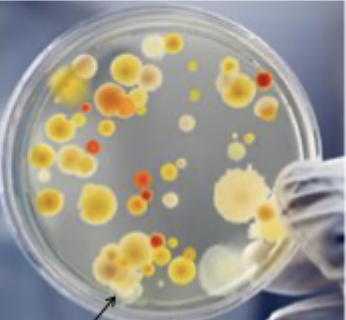
Does this show mixed or pure bacterial growth?
mixed
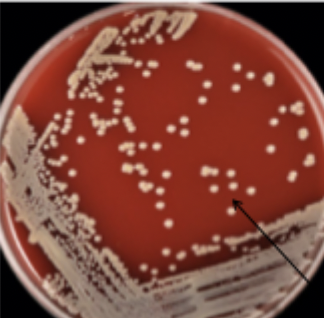
Does this show mixed or pure growth?
pure
phenotypic traits of bacteria used for identification in cultures
oxygen requirements, culture characteristics, staining properties, microscopic morphology, biochemical reactions, MALDI-TOF
What are some examples of biochemical reactions used to identify bacteria from a culture?
catalase, oxidase, urease
What is the effect of beta-haemolytic bacteria on blood agar?
they secrete enzymes/toxins that lyse the erythrocytes in the agar which produces zones of haemolysis
What is a qualitative method for antimicrobial susceptibility testing?
incubation using disc diffusion of antimicrobial agents on an isolated culture
What are the quantitative methods for antimicrobial susceptibility testing?
MIC and E-test
What are the 3 categories of microorganism response to antimicrobial susceptibility testing?
susceptible, resistant, intermediate
antimicrobial susceptible microorganism
a microorganism which is inhibited by a concentration of the anitmicrobial agent that can be attained in blood with the normally recommended dose (suggests infection by this microorganism can be treated with this antimicrobial)
antimicrobial resistant microorganism
a microorganism which is resistant to the concentration of the antimicrobial agent that can be attained with normally recommended doses
antimicrobial intermediate
a buffer zone to avoid misinterpretation of susceptibility testing results which suggests that treatment is possible if infection is in the body sites where the antimicrobial is concentrated
Why can viruses be difficult to culture in a lab?
they are obligate intracellular organisms, specialist labs are required, bacterial growth can occur, not all viruses grow in cell culture, labour intensive process
Which mediums can viruses be preserved in?
tissue cell cultures, embryonated eggs, experimental animals
cytopathic effects
structural and morphological changes in host cells caused by viral invasion, often leading to cell damage or death
examples of cytopathic effects
rounding of cells, fusion, inclusion bodies
How are viruses identified from cultures?
cytopathic effects, morphological characteristics, viral haemagglutination
viral haemagglutination
some virus particles have haemagglutinin particles on their surfaces which bind to red blood cells and cause agglutination
What specimens are taken from a patient for fungal culture?
plucked hairs from lesions, toothbrush, skin scrapings, exudates, biopsies
How is the growth of most bacteria inhibited when culturing fungi?
low pH is used
How are fungal cultures identified?
macroscopic and microscopic morphology
What are some tests that can be used to identify fungal infection?
at-home dermatophyte culture plates, UV fluorescence which identifies fluorescent metabolites produced by some fungi, lab culture
What can detecting a host immune response to an infection indicate?
ongoing infection, past exposure to the pathogen, maternally derived antibodies, vaccination
delayed hypersensitivity reaction
exposure to a pathogen causes a delayed but large immune response which shows that the animal has been exposed to the pathogen before, used to diagnose bovine tuberculosis
How are antigen-antibody reactions used to identify pathogens?
serological tests detect presence of antibodies for a specific pathogen and delayed hypersensitivity reaction tests
advantages of using PCR to identify pathogens
very sensitive, detects microorganisms that are non-viable, uncultivable or slow growing, faster results than culture methods
limitations of using PCR to identify pathogens
reaction is susceptible to inhibitors, contamination and experimental conditions, cannot differentiate between live and dead organisms
What are some examples of microorganisms that are detected using PCR?
mycoplasmas, mycobacteria, spirochaetes, viruses
How are rapid molecular diagnostics performed?
single-step, cartridge-based molecular test devices which target pathogens implicated in clinical syndromes
point of care testing
clinical laboratory testing which is conducted close to the side of the patient where care or treatment is provided, this testing gives rapid results which can improve clinical/economic outcomes
analytic sensitivity of a diagnostic test
the lowest amount a test can detect defined at 95% Cl
analytic specificity of a diagnostic test
the ability of a test to not react with other substances other than the analyte of interest
clinical sensitivity of a diagnostic test
the ability of a test to correctly designate an individual with disease as a positive (true positive)
clinical specificity of a diagnostic test
the ability of a test to correctly designate an individual who does not have a disease as negative to the test (true negative)