1.2.7 Price Mechanism
 Call Kai
 Learn
Learn Practice Test
 Spaced Repetition
 Match
Match Flashcards
 Knowt Play
1/49

There's no tags or description
Looks like no tags are added yet.
Name | Mastery | Learn | Test | Matching | Spaced | Call with Kai |
|---|
No analytics yet
Send a link to your students to track their progress
50 Terms
What is the price mechanism?
The process by which prices adjust due to changes in demand and supply to allocate scarce resources in a market economy.
Define Supply
The willingness and ability of producers to supply to a market at every given price level at a given period of time
What economic system relies on the price mechanism?
A free market economy.
What are the three key functions of the price mechanism?
Signalling, incentives, and rationing.
Prices as signals (definition)
Prices provide information to consumers and producers about relative scarcity and changing market conditions.
What does a rise in price signal to producers?
That demand has increased or supply has fallen, making production more profitable.
What does a fall in price signal to consumers?
That a good is less scarce or demand has fallen, encouraging increased consumption.
Prices as incentives (definition)
Prices motivate consumers and producers to change their behaviour.
How do high prices act as an incentive for firms?
They encourage firms to increase supply to earn higher profits.
How do low prices act as an incentive for consumers?
They encourage consumers to buy more of a good.
Prices as a rationing device (definition)
Prices allocate scarce resources by limiting demand to those willing and able to pay.
How does the price mechanism ration scarce resources?
By excluding consumers who are unwilling or unable to pay the market price.
What is market equilibrium?
The price at which quantity demanded equals quantity supplied.
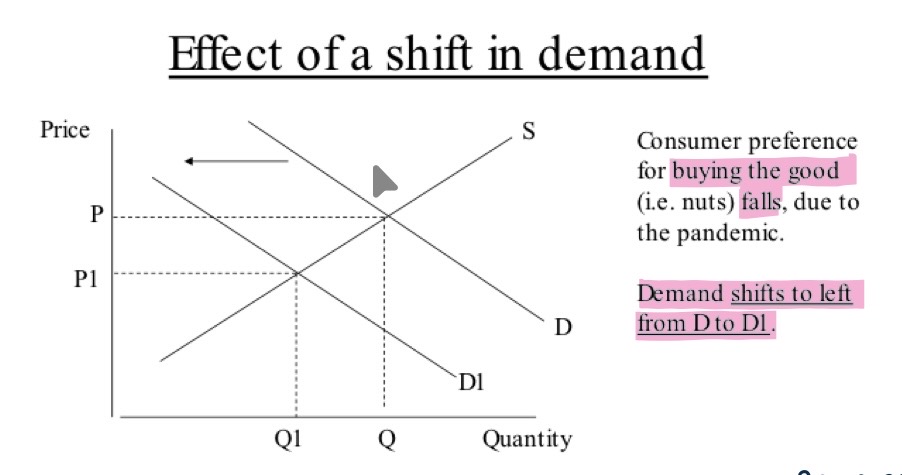
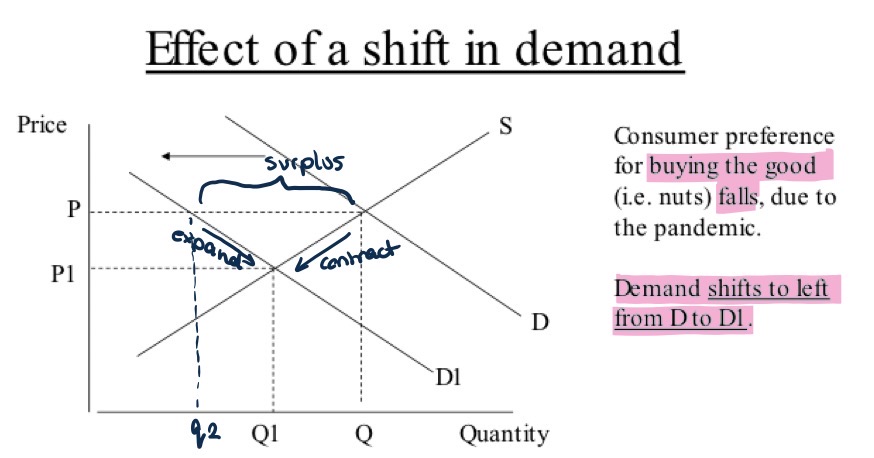
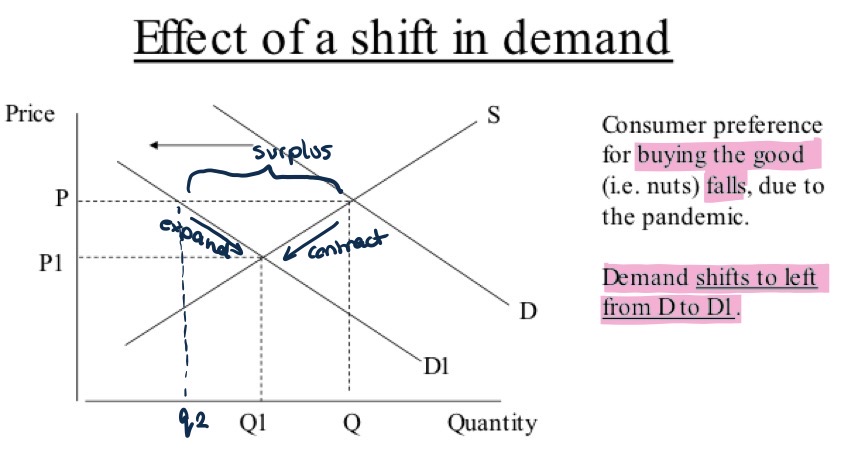
Explain the market mechanism if consumer preference for buying the good (i.e nuts) falls, due to the pandemic. Leading to a left (inwards) shift in the demand curve. Show this on a graph
At the original price P there is a surplus in demand
This will send a signal to producers to supply less, as there will be reduced incentive to make them, as profit will be lowered.
As production is reduced and prices start to fall, less rationing by consumers will take place, as more can no afford the price..
The expansion of demand and contraction of supply will continue until new equilibrium is established at P1Q1.
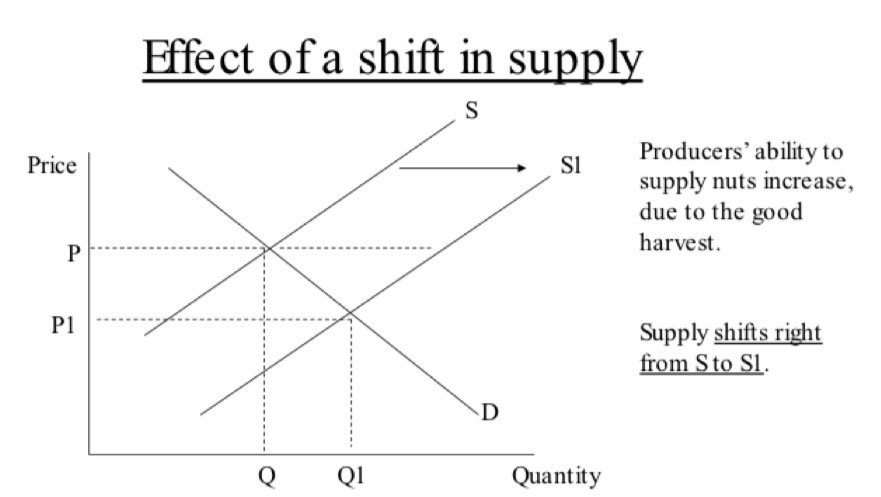
What effect will the price mechanism have if producers’ ability to supply nuts increase, due to the good harvest - Show this on a graph
As the original price P there is a surplus in supply
This ill send a signal to producers to supply less, as there will be reduced incentive to make them, as profits will be lowered
As price falls, less rationing by consumers will take place, as more can now afford the price.
The expansion of demand and contraction of supply will continue until new equilibrium established at P1Q1.
What happens at equilibrium?
The market clears with no excess demand or excess supply.
Define excess demand
When quantity demanded is greater than quantity supplied at a given price.
What causes excess demand?
A price set below the equilibrium level.
How does the price mechanism respond to excess demand?
Prices rise as consumers compete for limited supply.
Define excess supply
When quantity supplied is greater than quantity demanded at a given price.
What causes excess supply?
A price set above the equilibrium level.
How does the price mechanism respond to excess supply?
Prices fall as firms try to sell surplus stock.
How does the price mechanism help allocate resources efficiently?
Resources move towards markets where demand and prices are higher.
One advantage of the price mechanism
It is responsive to changes in consumer preferences.
Another advantage of the price mechanism
It has low administrative costs as no government planning is required.
Why does the price mechanism encourage efficiency?
Firms must reduce costs and innovate to remain competitive.
One limitation of the price mechanism
It can lead to market failure.
How do externalities cause market failure in the price mechanism?
Prices fail to reflect social costs or benefits.
Why may the price mechanism lead to inequality?
Allocation is based on income rather than need.
Why may prices fail to adjust quickly?
Due to time lags, poor information, or price rigidity.
Give an example of the price mechanism in action
Higher house prices encourage more housebuilding.
Why are diagrams important when explaining the price mechanism?
They help show excess demand, excess supply, and equilibrium price changes clearly.
What are the three functions of the price mechanism?
Signalling, incentives, and rationing.
What is meant by prices as signals?
Prices communicate information about changes in demand, supply, and relative scarcity.
How do prices signal increased scarcity?
Rising prices indicate demand has increased or supply has decreased.
How do prices signal reduced scarcity?
Falling prices indicate demand has decreased or supply has increased.
How do consumers respond to price signals?
They reduce consumption when prices rise and increase consumption when prices fall.
How do producers respond to price signals?
They increase supply when prices rise and reduce supply when prices fall.
What is meant by prices as incentives?
Prices encourage consumers and producers to change their behaviour.
How do higher prices act as incentives for producers?
They encourage firms to increase output to maximise profit.
How do lower prices act as incentives for consumers?
They encourage consumers to increase quantity demanded.
Why do incentives help reallocate resources?
Resources move towards more profitable uses where demand is higher.
What is meant by prices as a rationing device?
Prices allocate scarce goods and services to those willing and able to pay.
Why is rationing necessary in economics?
Because resources are scarce and wants are unlimited.
How does the price mechanism prevent shortages?
Higher prices reduce demand and increase supply.
What is a drawback of rationing by price?
It may lead to inequality as poorer consumers are excluded.
Which function of the price mechanism links most closely to equity issues?
Rationing.
Which function of the price mechanism links most closely to efficiency?
Signalling and incentives.
Which function of the price mechanism links most closely to market clearing?
Rationing through price adjustment.
How can the three functions work together?
Signals identify scarcity, incentives change behaviour, and rationing allocates resources.