Linearity, superposition, Thevenin Equivalent
 Call Kai
 Learn
Learn Practice Test
 Spaced Repetition
 Match
Match Flashcards
 Knowt Play
1/16

There's no tags or description
Looks like no tags are added yet.
Name | Mastery | Learn | Test | Matching | Spaced | Call with Kai | Chat |
|---|
No analytics yet
Send a link to your students to track their progress
17 Terms
Linearity theorem
For any circuit containing resistors and independent voltage or current sources,
every node voltage and branch current is a linear funtion of the source values and has the form sigma aiUi where Ui are the source values and ai are constants.
Using Linearity theorem
Use variables instead of fixed values for independent v and I sources:
1) Label all nodes
2) KCL equations
3) Solve for node voltage
effect voltage given by…
(a1 x cause_1) + (a2 x cause_2)…
proportionality
multiplying cause and effect by same factor

superposition
find effects produced by two causes seperately and add them together to find the effect of both
combining linearity and superposition
gives linearity property
zero-value voltage source
zero volts between terminals for any current
equivalent to a short circuit
if u have voltage source with fixed Vs value, regard it as =0 or replace with wire
zero-value current source
no current flowing between terminals
equivalent to open circuit or broken wire
Superposition
find the effect of each source on its own by setting other sources to zero, then sum.
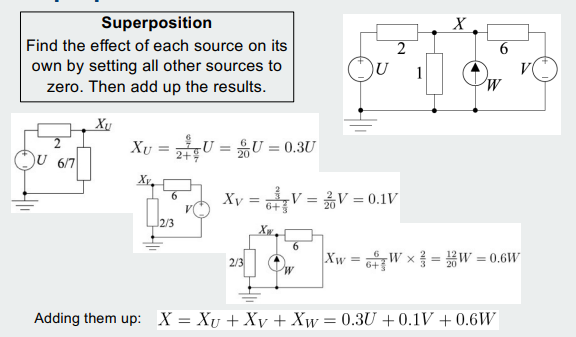
superposition steps
1) consider source U and zero V and W
2) Zero V means replacing it with a wire, zero W means removing W
3) resistor 1 II 6 = 6/7, Xu = 0.3U
voltage divider circuit
voltage x R interest/R total
Equivalent networks
Relationship between V and I being exactly the same in shaded region
Thévenin theorem
two-terminal network consisting of resistors, fixed voltage sources
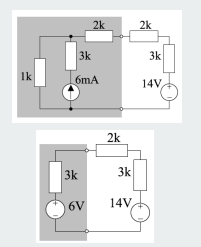
Thevenin equivalent circuit
voltage and current in unshaded part of circuit is same in both circuits
new components are called equivalent resistance, RTh and equivalent voltage VTh
Useful way to simplify complicated circuit, if we dont wanna know about V and I in shaded part
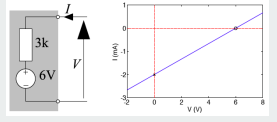
Thevenin circuit properties
V = RthI + Vth
open circuit voltage: I = 0, Voc = Vth
short circuit current: V = 0, Isc = -Vth/Rth
thevenin resistance: slope of characteristics is dI/dV = 1/Rth
Thevenin: in any two-terminal circuit …
the three quantities will have same values
If we can work out two of them, we can work out thevenin equivalent
Determining thevenin values
V = Rth*I + Vth
1) open circuit output