Conservation, Presentation and Care of Artworks - Unit 4 AM&E
 View linked note
 Call Kai
 Learn
Learn Practice Test
 Spaced Repetition
 Match
Match Flashcards
 Knowt Play
1/41

Earn XP
Description and Tags
Vocabulary flashcards covering key terms related to conservation, presentation, and care of artworks as taught in the unit.
Name | Mastery | Learn | Test | Matching | Spaced | Call with Kai |
|---|
No analytics yet
Send a link to your students to track their progress
42 Terms
Conservation
The practices to protect artworks from deterioration and preserve their condition across display, storage, handling, and transport.
Presentation
The practical and aesthetic arrangement of artworks in exhibition spaces to communicate ideas and support the artist's intentions.
Care
Ongoing practices to maintain artworks, including environmental control, handling protocols, storage, and monitoring.
Environmental considerations
Strategies to protect artworks on display and in storage, including lighting, temperature, humidity, and material stability.
Exhibition furniture
Furniture used in display (plinths, vitrines) to support and present artworks.
Invigilation
Supervision during exhibitions to safeguard works and monitor conditions.
Handling
Procedures for moving and manipulating artworks safely to avoid damage.
Transport
Safe movement of artworks between spaces, often with specialized packing.
Storage
Controlled conditions for keeping artworks when not on display.
Condition reporting
Documentation of an artwork's condition at a given time to monitor changes.
Material stability
How different materials respond to environmental factors and aging.
Lighting levels
The intensity and quality of light affecting artworks during display and storage.
Temperature
Heat levels and fluctuations affecting artworks; museums aim for stable ranges.
Relative Humidity (RH)
Moisture level in air; target ranges and limits to prevent damage.
Vermin
Pests (mice, insects) that damage organic materials; require monitoring and control.
Security
Measures to protect artworks from theft, damage, and vandalism.
Site-specific/public art
Artworks created outside traditional galleries; often temporary, raising conservation questions.
Artist’s intention
The goals and meanings the artist aims to convey; guides display and care decisions.
Cultural protocols
Ethical guidelines for display, storage, and handling of culturally sensitive works.
Exhibition space
The physical environment where artworks are shown (gallery, museum, outdoor, site-specific).
Curation
Process of selecting, organizing, and presenting artworks in an exhibition.
Backing board
Support placed behind fabric-supported works to maintain planarity during transport.
Solander Box
pH-neutral, light-safe container for storage and transport of artworks.
Glassine
Acid-free interleaf for short-term storage/packing; not suitable in humid conditions and can adhere if varnished.
Kraft paper
Low-acidity packing paper; strong and absorbent; use caution if varnish isn’t dry and avoid direct contact with tacky surfaces.
Tyvek
Durable interleaf material for long-term storage and transport of artworks.
Mylar
Clear polyester interleaf; silicone-release type safe for direct contact with art; avoid for pastel/charcoal.
Polyethylene film
Moisture barrier film used for packing; sealed micro-climates can reduce moisture but risk condensation if not properly sealed.
Bubble wrap
Cushioning material; should not contact artwork surfaces directly—use an interleaf.
Ethafoam/Volara
Lightweight cushioning foam; moisture barrier; used for long-term storage with appropriate interleaving.
PU foam
Polyurethane foam cushioning; suitable for short-term transport when used with interleaf barriers.
Environmental monitoring
Tracking RH and temperature to maintain stable conditions in galleries.
Data loggers
Devices that continuously record environmental conditions over time.
Sight lines
Lines of sight in an exhibition space that influence placement and audience movement.
Exhibition design
Planning how artworks are presented, including layout, lighting, and interpretive elements.
Ethical considerations
Moral responsibilities in displaying and caring for artworks, including culturally sensitive works.
Site-specific considerations
Factors unique to works created for specific spaces or contexts that affect display and conservation.
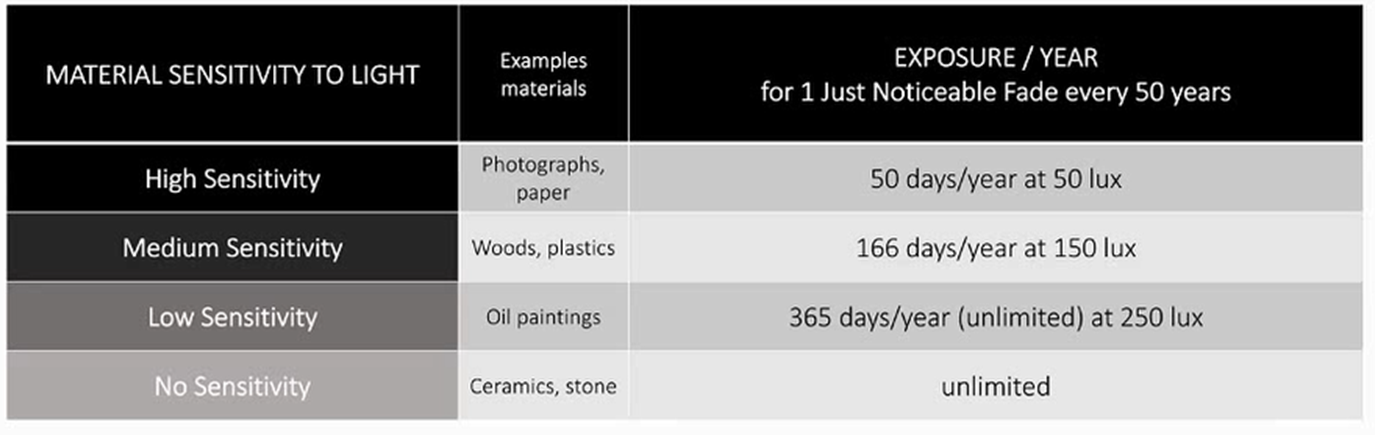
material sensitivity to light
what is the ideal temp range for artworks in a gallery
20ºC – 24ºC. No more than 4 degree change in 24 hours.

what is the ideal humidity level for artworks in a gallery
relative humidity is 50% ± 5%.

why do galleries have to stay in the temp range
Excessive heat can not only lead to decreased RH, it can also accelerate chemical reactions and physical change that lead to degradation of the artworks.

Rapid changes in temperature or relative humidity can cause sudden movement in materials (expansion and contraction),
