Constitutional Law
 Call Kai
 Learn
Learn Practice Test
 Spaced Repetition
 Match
Match Flashcards
 Knowt Play
1/113

There's no tags or description
Looks like no tags are added yet.
Name | Mastery | Learn | Test | Matching | Spaced | Call with Kai |
|---|
No analytics yet
Send a link to your students to track their progress
114 Terms
Youngstown Sheet & Tube Co v Sawyer
Facts: during korean war, preisdent wanted to take ocntrol of the steel mills and keep them running during a workers strike
Main rule: president should not be doing lawmaking and should not act in opposition to congress.
Black: Pres can seize steel mills if authorized by (1) the constitution or (2) a statute
Jackson: the categories. (1) congress approves, (2) congress is silent, (3) congress disapproves
Frankfurter: history route, “has congress authorized this before?”
Vinson: President can do it in an emergency (especially if it involves foreign affairs)
Dames & Moore v Regan
Facts: pres suspends all US pending claims against iran
Rule: The president has the power to suspend claims by US citizens against foreign gov
(there is no obvious constituional authority and no statute directtly on point.)
Zivotofsky v Kerry
Facts: congress passed a law that peolpe born in jerusalem could list Israel as their birthplace even though the pres refused to recognize any nation as sovereign over Israel
Rule: The law infringes on the presidents power to recognize foreign states
PS: this case is where the congress and president disagree (cat 3) but the president wins because it is an exclusive power.
Hamdi v Rumsfeld
Facts: US citizen was detained as an enemy combatant for fighting with the taliban
Rule: The president has the power to detain enemy combatant captured on the battlefield who are US Citizens
PS: there was two conflicting statutes the AUMF and the Non-detention Act
US v Curtiss Wright (is always right)
Facts: a joint resolution of congress and a proclamation issued by pres banned US weapons manufacturers from aiding with side of the war.
Rule: The president has broad power over foreign affairs.
Hamdan v Rumsfeld
Facts: prisoner was scheduled for a hearing on conspiracy charges before a military comission and petitioned for hebeas corpus
Rule:The president does not have the power to authroize trias by military comission
(the exclusive power wasnt in the constitution)
What cases are about Immunity?
Trump v US
Nixon v Fitzgerald
Clinton v Jones
What cases are about Privilege
US v Nixon
What are important factors in support for immunity?
we dont want the pres to be distrac ted from his duties
implied by the separation o fpowers
no big deal
the pres is very important
Factors against presidential immunity?
makes the president a king
Trump v US
Facts: pres trump was indicited on several counts relating to the Jan 6th insurrection
Rule:
Former presidents do have absolute immunity from federal criminal prosecution for their official acts while in office
Presumption immunity: for all offical acts
Absolute Immunity: for offical acts+ exclusive power
What is a presidential offfical act?
anything with an offical flavor
Nixon v Fitzgerald
Facts: Civil suit against pres nixon for wrongful termination
Rule: The president is immune from civil liability for his official acts
The president cannot be sued for their official acts
Clinton v Jones
Facts: President Clinton wanted to postpone a civil suit until after he left office
Rule: The president can be sued for his unofficial acts while in office.
court uses a balancing test that results in a bright line rule
US v Nixon
Facts: pres nixon refused to turn over tape recordings and docs which were subpoenaed during watergate investigation
Rule: Balancing test to determing the presidents privacy interest v interest in disclousre
Can you sue a president for unofficial acts?
YES! (clinton v jones)
Can you sue a president for official acts?
NO! (fitzgerald)
Can you prosecute for officials acts?
NOOOO!! (trump (ew))
How do you determine whats privilege?
a balancing test
presidents interest v interest in disclosure
What is Article 1
the legislative powers shall be vested in a congress which consist of a senate and house of reps.
bicameralism and presentment art 1 § 7
appointments clause art 2 § 2
INS v Chadha
Facts: house passed a resolution overrding the Attorney general decision to allow chadha to remain in the US
Rule: for an act of congress to have the force of law, it must go through art 1 § 7 process (must pass through both houses and be presented to the president)
What is Article 1 § 7?
bicameralism: must go through both houses
presentment: must be presented to the president
Clinton v New York
Facts: Congress passed a statute providing that for future spending matter the president can cancel certainitems in a spending bill and accept others.
Rule: Congress cannot pass a statute that changes the art 1 § 7 process for passing laws
This statute does comply with the Chadha rule.
Whitman v American Trucking Association
Facts: congress passed a statute requiring the EPA to make air quality standards
Rule: Congress can task an executive branch to make rules as long as its an intelligible principal
intelligible principal: unclear; more than just “do whatever you think is best”
Gorsuch in Gundy
(dissent)
gorsuch thinks delegation is scary because it seems like a workaround of the seperations of powers and the art 1 § 7 lawmaking procedure.
Trump v Hawaii
Facts: congress passed a statyte saying the president could exclude non-citizens from the US if they thought the non citizen were a threat to national security.
Rule: Congress can delegate this power to the president
(this is a case application)
what is the general rule of Delegation?
Congress is pretty free to delegate as long as they
(1) provide an intelligible principal (Whitman) AND
(2) they are clear about it — major question doctrine (West Virginia v EPA)
What cases are used for delegation?
whitman
gundy
WV v EPA
Trump v Hawaii
What is Article 2 § 2
Appointments
[The President] shall nominate, and by and with the Advice and Consent of the Senate, shall appoint Ambassadors, other public Ministers and Consuls, Judges of the Supreme Court, and all other Officers of the United States, whose Appointments are not herein otherwise provided for, and which shall be established by Law; but the Congress may by Law vest the Appointment of such inferior Officers, as they think proper, in the President alone, in the Courts of Law, or in the Heads of Departments.
What is the rule for presidents in regards to appointments in the constitution?
president gets to appoint officers with the advice and consent of the senate
What is the execptions of the rule for presidents in regards to appointments in the constitution?
congress can pass a statute that allows (1) the president, (2) the courts, or (3) the heads of departments to appoint inferior officers
what does this mean in plain terms?
the appointments clause only applies to officers (anyone can appoint employees)
what case decide what an “officer” is?
Lucia v SEC
what case determins what is an inferior officer?
morrision v olson
lucia v sec
facts: statute allows administrative law judges be appointed by SEC staff members.
first question to ask: are ALJ officers.
Rule: someone is an officer if they exercise significant authority.
TAKEAWAY: appointments clause applies ot officers not employees.
Morrison v Olson
Facts: congress passed a statute which provided fo ran independant counsel, appointed by the jjudicial branch to investigate and prosecute crimes by certain government officials
Rule: an appointment is valid when it is determined that the officer is not a superior officer.
gives us elements to determine superior officers:
(1) limited duties;
(2) subject to removal by a higher executive official;
(3) authority is limited in jurisdiction;
(4) limited tenure
who can appoint superior officers?
the president & the advice and consent of the senate (default rule)
who can appoint inferior officers?
use the default rule OR the president, courts, or head of departments with statutory authority
who can appoint employees?
ANYONE
Removal (from what the constitution tells us)
impeachment (thats it, ik crazy)
Bowsher v Synar
Facts: a balanced budget law passed by congress required conclusions about the budget to be made by the comptroller general who was removable by congress.
Rule: Congress does not have the power to remove executive officers.
Myers v US
Facts: postaster was removed without the advice and consent of the senate contrary to wha tthe statute provided which required the advice and consent of the senate
Rule: Congress cannot require the president to receive the senates advice and consent to remove an executive officer
TAKEAWAY: requiring the senates advice and consent to remove an executive officers impermissibly limits the pres power.
Humohrey’s executor v US
facts: pres roosevelt fired humphrey (FTC commissioner) because of his policy positions. the FTC act only allowed a president to remove a commissioner for “inefficiency, neglect of duty, or malfeasance in office”
Rule: for-cause limitations on the president’s removal of board/agencies is permissible
Selia Law v CFPB
Facts: seila law argues that the consumer finacial protection bureau was unconstitutional because it is an independant agency headed by a single director who exercises substantial executive power but can be removed by the president only for cause
Rule: congress cannot place a for cuase limit on removal of superior officers/heads of boards
What CAN congress do for removals?
(1) place a for-cause limt on inferior officers
(2) place a for-cause limit on board/agencies
What CANNOT congress do for removals
(1) remove executive officers
(2) require advice and consent of senate to remove executive officers
(3) place a for-cause limit on removal of superior officerss/head of boards
what questions should you ask when determining removal
(1) are they an executive officer
(2) what kind of removal limitation is imposed
(3) are they an inferior or superior officer
(4) are they a board member or individual
what cases are removal cases
bowsher v synar
morrision v olson (part 2)
meyers v US
humphrey’s executor v US
seila law v CFPB
what is article 3
Judicial Power
“power of the US shall be vested in ONE supreme court”
Marbury v Madison
Facts: marbury didnt get his comission. marbury wants his commission
Takeaway: the supreme court gets to say what the law is (JUDICIAL REVIEW)
Marbury question 1: is marbury entitled to his comission?
yes, under art 2 § 3 commissioning officers is a duty of the president and marbury was appointed
Marbury question 2: does marbury have a remedy?
yes, the writ of mandamus could provide marbury the remedy he wants BUT he court is worried that president thomas jefferson wont listen
Marbury question 3: can the supreme court issue the writ of mandamus?
Yes, the judiciary act give SCOTUS original jurisdicition to certain kinds of cases
what is the ussye with the supreme court issue of a writ of mandamus?
the judiciary act is unconstitutional because SCOTUS doesnt have original jurisdiction over these types of cases
Martin v hunter’s leesee
Facts: virginia didnt want to follow the supreme court ruling and argued that it was unconstituional for SCOTUS to have appellate jurisdiction over state court decisions
Rule: the SCOTUS can hear appeals from state court
Cooper v Aaron
Facts: arkansas state officials challenged the application of a federal integration decision to their legisilative schemes
Rule: what teh supreme court says about the constitution is LAW and is binding on the lower courts
(differs from marbury)
what is judicial review
SCOTUS says what the law is (marbury)
Does SCOTUS have appellate jurisdiction over court decisions?
Yes (hunters lessee)
Are states bound by supreme court decision?
yes! (cooper)
Cases for art 3 powers
marbury v madison
martin v hunter leesee
cooper v aaron
what are the limits on judicial power?
(1) courts have limited jurisdiction (diversity and federal question) (art 3 § 2)
(2) congress can limit the courts jurisdiction (art 1 § 1)
(3) court can only decide cases or controversies
no advisory opinions
no political questions
parties must have standing
3 part test for standing?
MUST HAVE:
(1) injury in fact, actual, or imminent
(2) Causation
(3) repressibility
Plaintiff must show this
(Lujan)
Lujan v defenders of wildlife
Facts: defenders of wildlife have the endangered species act (ESA) interpreted to cover government agencies activites in foreign countries
Rule: there is a 3 part test to determine standing:
injury inf act, actual or imminent
causation
redressability
what was the plaintiffs argument for standing in Lujan?
(1) injury: the animals will die and we wont be able to see/study them
(2) causation: gov caused them to die by not applying the ESA overseas
(3) redressability: the court can remedy the injury caused by the animal dying by ordering the harmful project not to be funded anymore
What was the defendants argument against standing in Lujan?
(1) injury: they dont have plans to study/see the animals (speculative)
(2) causation/redressability: even if they stop funding th eprojects, the animals will die anyways
Massachusetts v EPA (D and P’s arguments)
Facts: MA and others brought suit against teh EPA for not doing its job under the clean air act by failing to regulate emission of greenhouse gasses
P side:
(1) injury: coastal erosion of the shoreline cause dby rising sea levels is an actual injury
(2) causation: risiing sea levels are caused by greenshouse gas emissions
(3) redressability: coastal erosion will be reduced if the court requires the EPA to enforce the clean air act and regulate greenhouse gas emissions
D Side:
(1) other contributing factors to the rising sea levels so we dont know if that actually casued the injury.
(2) the epa may not be able to do anything about the sea level rising because of other contributors
what are the cases for standing?
lujan v defenders of wildlife
massachusetts v EPA
What are the 2 political questions?
1) textually deostrable commitment by the constitution to another branch of government (the issue needs to be solve by a different group of people)
2) lack of judicially discoverable and manageable standards (if the court doesnt know much about the topic to draw a distinct line)
what is the difference between ripeness & mootness
Mootness: A case is moot if it was once active but the controversy has resolved, rendering it too late for judicial intervention. (TOO OLD)
Ripeness: A case is not ripe if it is premature, as the facts have not developed into a concrete, actual dispute , they have to wait till the situation actually starts (TOO PREMATURE)
What are the exceptions of mootness?
1) capable of repetition yet evading review (not enough time to have the suit before its resolved i.e. roe v wade)
2) voluntary cessation (challenges the govs conduct adn the gov stops it to avoid the suit)
if you sue for damages will standing be an issue?
NOPE — standing is only an issue for injunctions
what is enumerated powers (Federalism)
how we know what the federal government gets to do and what is left for the states
what are some examples of enumerated powers
^
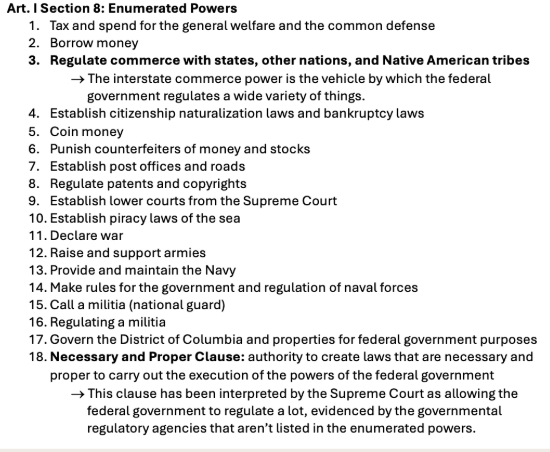
what happened in McCulloch v Maryland
Facts: federal gov created a bank of the US and a branch was opened in maryland. McCulloch worked at the maryland branch and refused to pay maryland taxes.
What was the 2 main issues in McCulloch v Maryland
1) Does the federal government have the power to create a bank?
2) If so, can a state tax a federal bank?
what was the holding of the two issues of McCulloch v Maryland?
1) even though banks arent an enumerated power it is necessary and proper for congress to carry out itsother enumerted powers
2) States cannot tax a federal bank—>the power to tax is the power to destory
what is a key takeaway for McCulloch v Maryland?
the constitution creates a hierarchy where the federal government is above the states
the necessary and proper clause alows congress to pass laws that are helpful to carry out its other enumerated powers
the court will defer to what congress says is helpful (means) as long as the ends are constituitonal
Gibbons v Ogden (facts & holding)
facts: state v federal steamboat license
Holding: congress can override state law under the supremacy clause (Art 6). If a state law conflicts with a federal law, the state law only wins if the federal is unconstitutional.
What was the federal argument for Gibbons v Ogden
Federal: the federal gov has power over interstate commerce according to art 1 § 8. steamboat navigation is under interstate commerce. So, the federal law is constitutional and should win out because of the supremacy clause.
What was the state argument for Gibbons v Ogden
the federal law is unconstitutional because steamboat navigation is not interstate commerce because it doesnt involve buying and selling stuff
J Marshall: navigation is part of interstate commerce, therefore, the federal law us constitutional and wins out over the conflciting state law
McCullah Summary
confirms that federal > states and reads the powers broadly to encompass a lot of things that aren’t on the fact of the constitution
Gibbons Summary
confims this and expands the commerce power to include buying & selling and commercial navigation
what is the Commerce Clause
congress shall have the power to regulate commerce with foreign nations, and among the several states, and with the indian tribes
Pre-New Deal Shift (commerce clause)
United States v. E.C. Knight: Congress can’t regulate sugar manufacturing
Hammer v. Dagenhart: Congress can’t regulate child labor
Champion v. Ames: Congress can regulate transportation of lottery tickets
Shreveport Rate Case: Congress can regulate local and interstate railroad rates
Carter v. Carter Coal Co.: Congress can’t regulate coal mining wages and hours
A.L.A Schechter Poultry Corp v. U.S.: Congress can’t regulate codes of fair competition in the poultry industry
The court takes a very narrow interpretation of the commerce power
New Deal Shift (commerce clause)
NLRB v Jones & Laughlin: congress CAN regulate manufacturing of steel
United states v Darby: congress CAN regulate minimum wage for lumber industry
the court is now looking at things thta have a substaintial effect on interstate commerce
Wickard v Filburn (facts, issue, holding)
facts: farmer Filburn was growing wheat for his personal use
Issue: could congress regulate the personal growth of wheat?
Holding: YES
Filburn: the wheat is literally not leaving the state and is only being used for his personal use so how would this have a substantial effect on interstate commerce
Court: when we aggregate all the farmer Filburns, it would have a substantial effect on the wheat market
heart of atlanta motel v US (facts, issue, holding)
Facts: statute forbade racial discrimination. the heart of atlanta motel refused room to black people (racist ass motherf*ckers)
Issue: can congress regulate the activity of the otel through this statute?
Holding: Yesssss
people travel through interstate commerce
aggregate all motels to get a substantial effect on interstate commerce
Katzenbach v McClung (Facts, Issue, Holding)
Facts: statute forbade racial discrimination. the McClungs owned a barbeque resturant in alabama. approximately half of the food they purchased was sold and traveled ininterstate commerce.
Issue: Can congress regulate the activitiy of the resturant through this statute
Holding: yessss
the food traveled interstate commerce
aggregate all resturants to get a substaintial effect on interstate commerce
US v Lopez (facts, issue, holding)
Facts: congress wanted to pass a statute that would regulate possession of guns around school
Issue: Can congress regulaate the possession of guns around schools?
Holding: NOPE (bruh wtf)
not really an economic activity, possession guns in certain areas
speculative effect on interstate commerce, yes you can buy and sell them but that s a long way of possessing them by schools
would make congress’s power unlimited
no deference to congress
US v Morrison (facts, issue, holding)
Facts: con gress wanted to pass the violence against women act
Issue: can congress regulate violence against women under the commerce power?
Holding: HAHA NOOOOO
not an economic activity—> violence against women isnt buy and selling stuff
speculative effect on interstate commerce
would make congresses’s commerce power unlimited
no deference to congress
Gonzales v Raich (Facts, Issue, Holding)
Facts: congress tried to regulate the personal growth of marijuana for medical purposes. state law allowed medical marijuana while the federal law made it illegal.
Issue: can congress regulate the personal growth of medical marijuana through this statute?
HOLDING: YESSS 420 un-blaze it :(
What was the states argument for Gonzalez v Raich?
no commerce is taking place because nothing is being bought or sold
too speculative effect on commerce
not economic=don’t defer to congress
this would make congress’s power limitless
DISTINGUISH: Wickard
what was the federal governments argument in Gonzalez v Raich?
both cases deal with growing goods for personal use and their impact on the market
connection to commerce is less speculative
economic=defer to congress
aggregation for substantial effect
distinguish: lopez & morrison
NFIB v Sebelius (PART1) (facts, issue, holding)
Facts: individual mandate required people to purchase health insurance
issue: can congress order peole to participate in commerce?
Holding: NOOOOOOPPPPEEEE
not buying something is not a commercial activity
not economic = no deference to congress
would give congress unlimited power
What is the governments argument for NFIB Part 1?
cases they use: wickard, raich, heart of atlanta, McClung
1) congress can regulate things with a substantial effect interstate commerce even if they are not themselves interstate commerce
2) even if the individual conduct would not gave a substainital effect we aggregate
3) this activity is economic in nature
4) the regulation is part of a larger economic regulation
5) this is a situation where we should give deference to congress
what is the state argument in NFIB Part 1?
Cases: lopez, morrision, sebulius (kinda)
1) the connection between the regulation and interstate commerce is speculative
2) this activity is not economic in nature
3) the activity is in a traditional area of state regulation
4) this would make the commerce power unlimited
5) this is a situation where we should give less deference to congress
what is the taxing power (congress)
congress shall have the power to lay and collect taxes
T/F: Congress can use taxes as a means of regulation?
FALSE
what are the elements to determine if the tax is actually a penalty?
whether:
1) imposes an exceedingly heavy burden that leaves little reasonable choice
2) hasa. scienter requirement
3) is collected by the IRS or someone else
NFIB v Sebelius (facts, issue, holding)
Facts: Individual mandate required people to buy health insurance or make a payment to the IRS with their taxes.
Issue: Could Congress do this under its taxing power?
Holding: Yes.
Main question: is this a tax or a penalty?
Exceedingly heavy burden**
No scienter requirement
Payment collected by the IRS or someone else
This is a tax because:
Payment was close to the price of getting insurance
No scienter requirement
Collected by the IRS
NFIB Scalia’s Dissent
the individual mandate created criteria for wrongfoing and imposed a monetary penalty for not following hte criteria, so this is a penalty (the staute legit calls is a penalty)