Ornithology Final

0.0(0)
Studied by 0 people
call kaiCall Kai
learnLearn
examPractice Test
spaced repetitionSpaced Repetition
heart puzzleMatch
flashcardsFlashcards
GameKnowt Play
Card Sorting

1/256

encourage image

There's no tags or description

Looks like no tags are added yet.

Last updated 7:00 PM on 5/10/26
Name
Mastery
Learn
Test
Matching
Spaced
Call with Kai

No analytics yet

Send a link to your students to track their progress

257 Terms
1
New cards
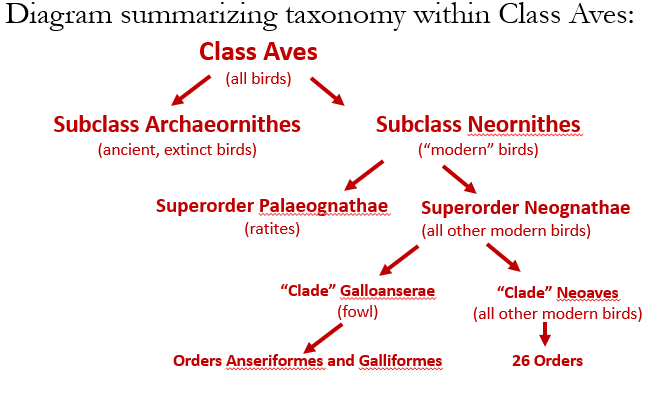
<p>Class Aves</p>

Class Aves

All birds

2
New cards
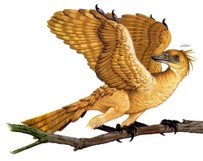
<p>Subclass Archaeornithes</p>

Subclass Archaeornithes

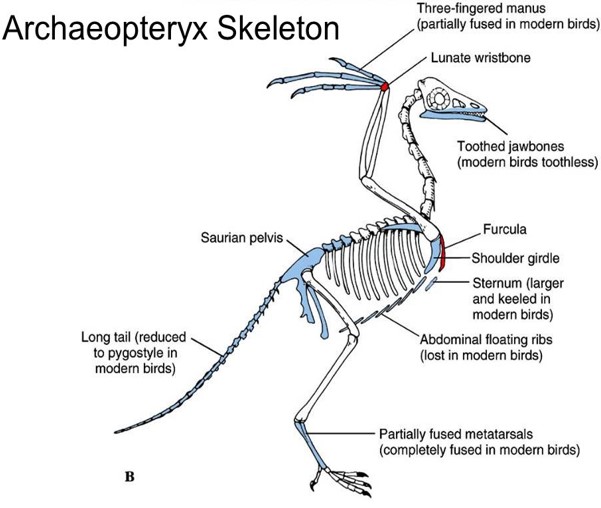
  • Extinct birds that lived in Mesozoic Era (250-65 mya); first birds ~150 mya

    • First birds had long tails with at least 13 caudal vertebrae

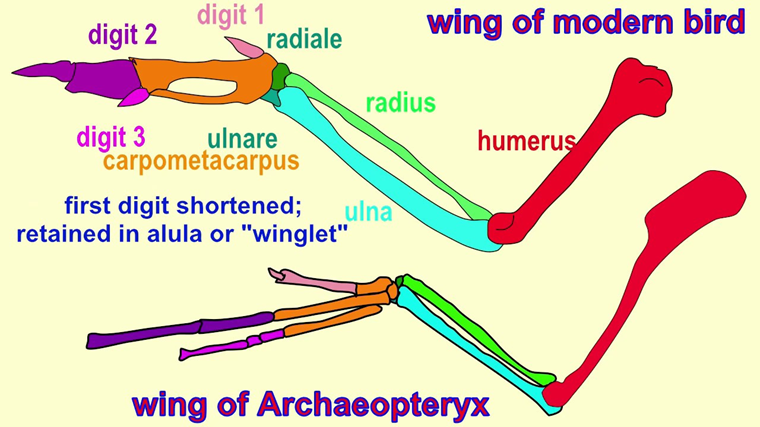
    • Metacarpals were separate and with claws and teeth in the bill

      • e.g., Achaeopteryx lithographica

3
New cards
<p>Subclass Neornithes</p>

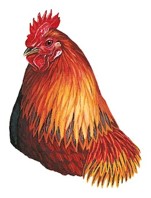
Subclass Neornithes

  • includes some extinct and all extant birds

  • tail usually ends in pygostyle

  • most without teeth in bill

  • usually a well-developed sternum

    • e.g., Gallus gallus

<ul><li><p><span>includes some extinct and all extant birds</span></p></li><li><p><span>tail usually ends in pygostyle</span></p></li><li><p><span>most without teeth in bill</span></p></li><li><p><span>usually a well-developed sternum</span></p><ul><li><p><span>e.g., <em>Gallus gallus</em></span></p></li></ul></li></ul><p></p>
4
New cards

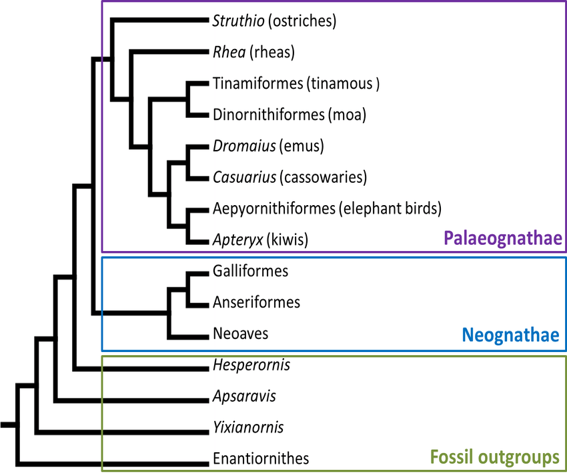
Superorder Palaeognathae (of subclass Neornithes)

  • large flightless birds (some extinct such as elephant birds and moas)

  • living ratites: ostrich, rhea, emu, kiwi, cassowary, tinamous
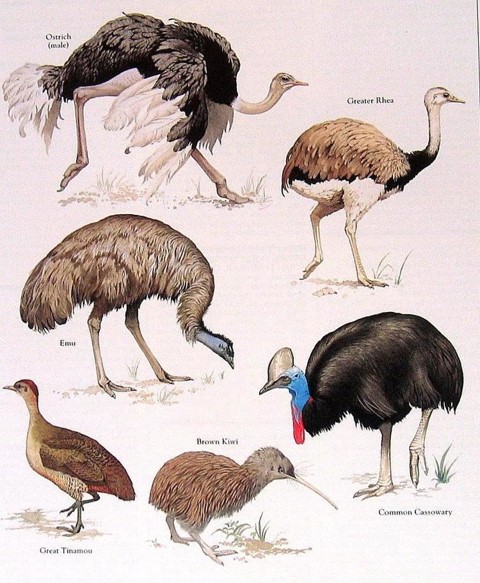
<ul><li><p><span>large flightless birds (some extinct such as elephant birds and moas)</span></p></li><li><p><span>living ratites: ostrich, rhea, emu, kiwi, cassowary, tinamous</span></p></li></ul><p></p>
5
New cards
<p><span>Superorder Neognathae (</span>of subclass Neornithes)</p>

Superorder Neognathae (of subclass Neornithes)

  • modern flying birds

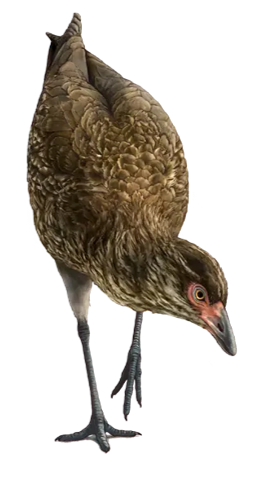
    • 1st modern bird, “wonderchicken”, evolved about 67 mya

    • Neognathae divided into two clades:

      • Galloanserae (fowl)

      • Neoaves (all other modern birds)

<ul><li><p><span>modern flying birds</span></p><ul><li><p><span>1st modern bird, “wonderchicken”, evolved about 67 mya</span></p></li><li><p><span>Neognathae divided into two clades:</span></p><ul><li><p><span>Galloanserae (fowl)</span></p></li><li><p><span>Neoaves (all other modern birds)</span></p></li></ul></li></ul></li></ul><p></p>
6
New cards
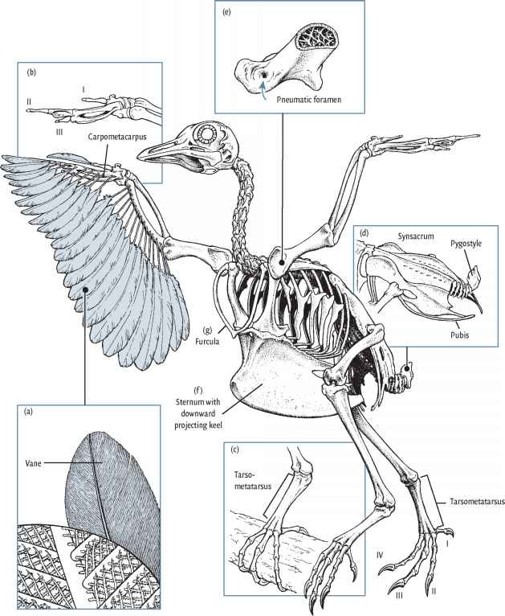
<p><span>Distinguishing features of birds</span></p>

Distinguishing features of birds

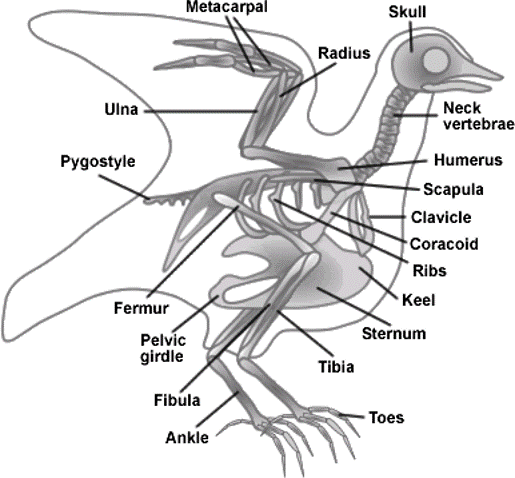
  • feathers (shared with extinct dinosaurs)

  • toothless bill (or beak)

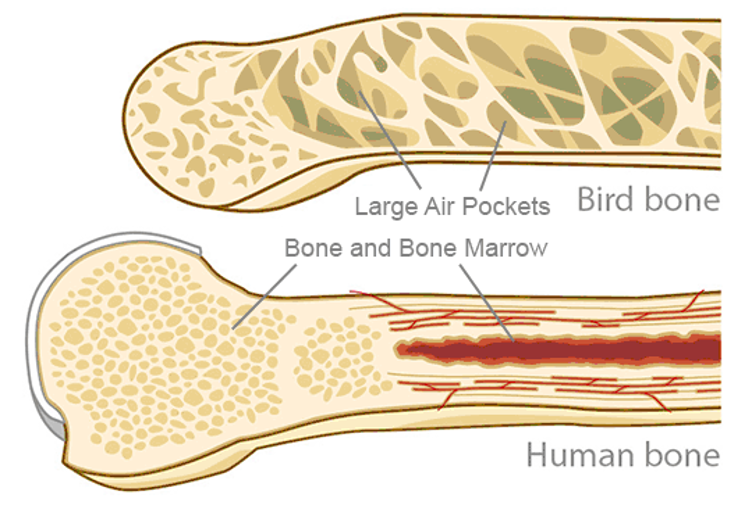
  • pneumatized bones (contain air-filled cavities)

  • fused clavicles to form furcula

  • deeply keeled sternum

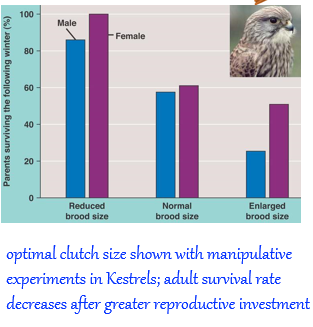
  • pygostyle (short tail bone)

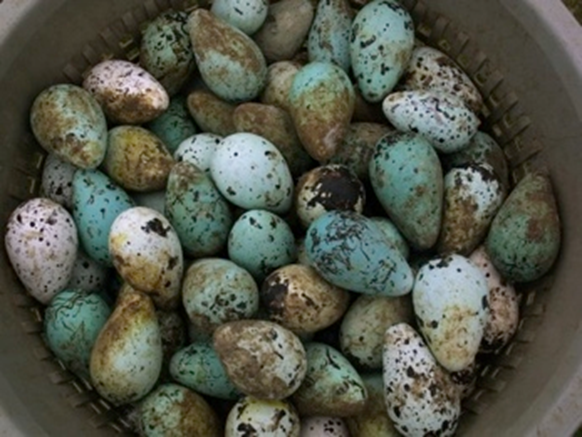
<ul><li><p><span>feathers (shared with extinct dinosaurs)</span></p></li><li><p><span>toothless bill (or beak)</span></p></li><li><p><span>pneumatized bones (contain air-filled cavities)</span></p></li><li><p><span>fused clavicles to form furcula</span></p></li><li><p><span>deeply keeled sternum</span></p></li><li><p><span>pygostyle (short tail bone)</span></p></li></ul><p></p>
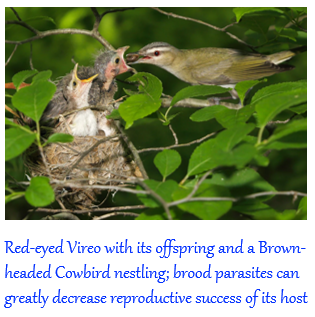
7
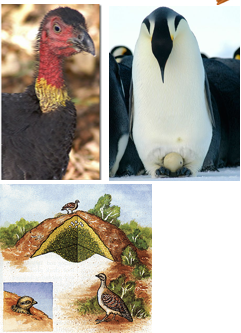
New cards

What are birds most closely related to?

  • clear evidence of bird-reptile relationship

    • e.g., the transitional fossil Archaeopteryx lithographica
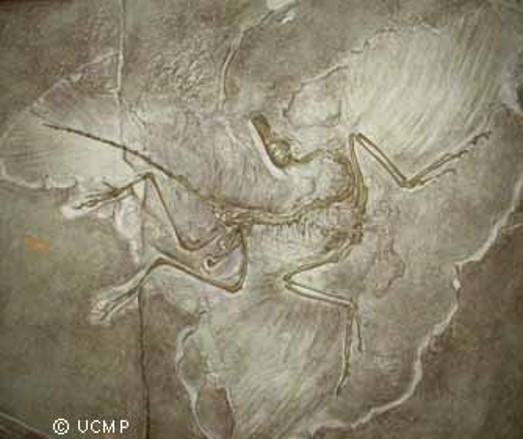
<ul><li><p><span>clear evidence of bird-reptile relationship</span></p><ul><li><p><span><em>e.g., </em>the transitional fossil<em> Archaeopteryx lithographica</em></span></p></li></ul></li></ul><p></p>
8
New cards

Reptile features of Archaeopteryx:

  • jaws with teeth

  • separate metacarpals

  • separate pelvic bones

  • 23 caudal vertebrate

  • small, flat sternum

  • rib cage lack uncinate process

  • small braincase

<ul><li><p>jaws with teeth</p></li><li><p>separate metacarpals</p></li><li><p>separate pelvic bones</p></li><li><p>23 caudal vertebrate</p></li><li><p>small, flat sternum</p></li><li><p>rib cage lack uncinate process</p></li><li><p>small braincase</p></li></ul><p></p>
9
New cards

Bird features of Archaeopteryx

  • asymmetrical feathers

  • 3 metacarpals

  • semilunate carpal (wrist)

  • clavicles fused (making a furcula)

  • 4 phalanges including backward-facing hallux
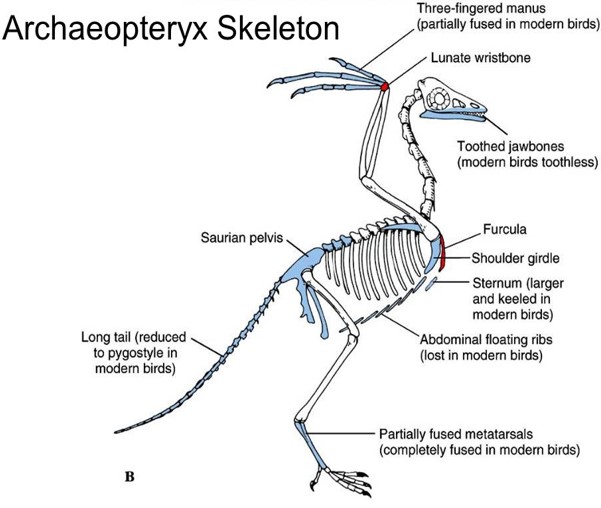
<ul><li><p>asymmetrical feathers</p></li><li><p>3 metacarpals</p></li><li><p>semilunate carpal (wrist)</p></li><li><p>clavicles fused (making a furcula)</p></li><li><p>4 phalanges including backward-facing hallux</p></li></ul><p></p>
10
New cards

Archaeopteryx has connections between birds and reptiles, but which reptiles?

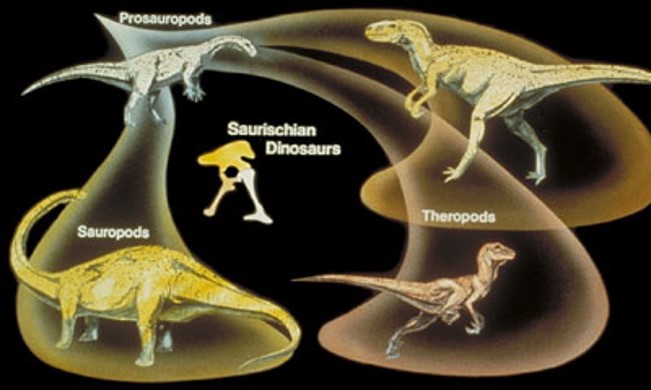
therapod ancestry
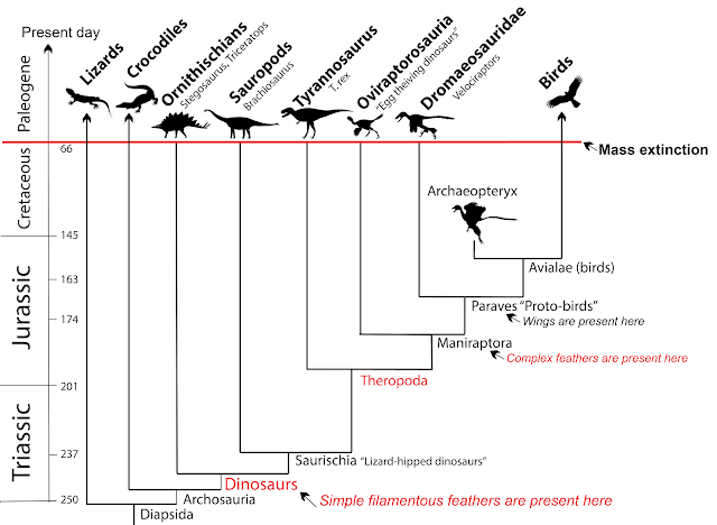
<p><span>therapod ancestry</span></p>
11
New cards
<p>Therapods (<span>saurischian dinosaur)</span></p>

Therapods (saurischian dinosaur)

  • bipedal

  • carnivores

  • hollow bones

  • small forelimbs

    • e.g., Deinonychus, Velociraptor, and Tyrannosaurs

12
New cards

Major clues to birds’ therapod ancestry

  • skeletal features

    • 3 toes (phalanges) with elongated, fused metatarsals (leg bones)

    • 3 metacarpals with 2nd digit the largest

    • half-moon shaped (semilunate) wrist bone

    • large eye socket

    • pneumatized (hollow) bones

    • long s-shaped neck

    • fused clavicles (to form a furcula)

    • backward-facing pubis (in advanced therapods)

  • non-skeletal features

    • reproductive behaviors

    • eggs laid over several days

    • eggs incubated at a nest

    • eggs with two-layered (inner is crystalline and is porous)

  • feathers

  • use of air sacs for respiration

  • similar collagen protein in connective tissue

13
New cards

Natural selection

Process in which the frequency of traits changes in a population due to differential reproductive success among individuals

14
New cards

Three conditions necessary for natural selection to act
in a population

  1. individuals in a population express variation in traits

  2. variation in traits among individuals is passed from parents to offspring (= heritability)

  3. individuals produce different numbers of offspring as a result of variation (i.e., differential reproductive success because of variation)

15
New cards

How can natural selection be tested?

  • by demonstrating that all 3 necessary conditions are met

    • e.g., beak depth in Medium Ground Finches on Daphne
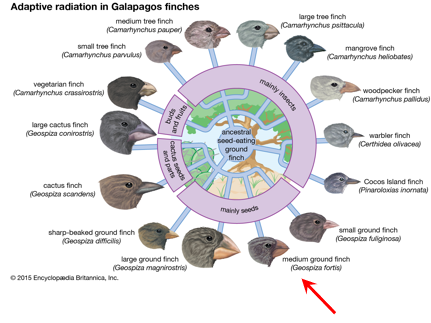
<ul><li><p>by demonstrating that all 3 necessary conditions are met</p><ul><li><p>e.g., beak depth in Medium Ground Finches on Daphne</p></li></ul></li></ul><p></p>
16
New cards
<p>Natural Selection in medium ground finches </p>

Natural Selection in medium ground finches

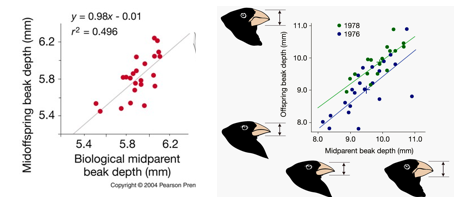
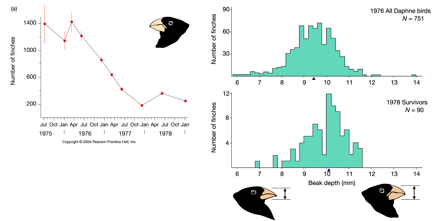
  • captured and measured individuals to show variation among individuals for beak depth

  • heritability shown as a positive association between beak depth of parents and offspring

  • cross-fostering experiments demonstrate heritability if:

    • no relationship between traits of offspring and foster parents

    • but a positive relationship between traits of offspring and  biological parents

  • observed differences in reproductive success among individuals of population associated with variation in beak depth

  • about 84% of finches died during 1977 drought

    • number of seeds greatly reduced; only large, hard seeds available during drought

    • birds surviving drought were larger and had deeper beaks on average
<ul><li><p>captured and measured individuals to show variation among individuals for beak depth</p></li><li><p>heritability shown as a positive association between beak depth of parents and offspring</p></li><li><p>cross-fostering experiments demonstrate heritability if:</p><ul><li><p style="text-align: left;">no relationship between traits of offspring and foster parents</p></li><li><p style="text-align: left;">but a positive relationship between traits of offspring and&nbsp; biological parents</p></li></ul></li><li><p style="text-align: left;">observed differences in reproductive success among individuals of population associated with variation in beak depth</p></li><li><p style="text-align: left;">about 84% of finches died during 1977 drought</p><ul><li><p>number of seeds greatly reduced; only large, hard seeds available during drought</p></li><li><p>birds surviving drought were larger and had deeper beaks on average</p></li></ul></li></ul><p></p>
17
New cards

What is the main process that produces new species?

Natural selection

18
New cards

Species

Population(s) whose members interbreed freely in nature and fail to do so with other populations

19
New cards

True species

Populations that are reproductively isolated; they fail to produce hybrids under natural conditions

20
New cards

Hybrids

Offspring of parents that are genetically dissimilar, particularly parents belonging to different species

21
New cards

Speciation

  • fundamental changes in populations

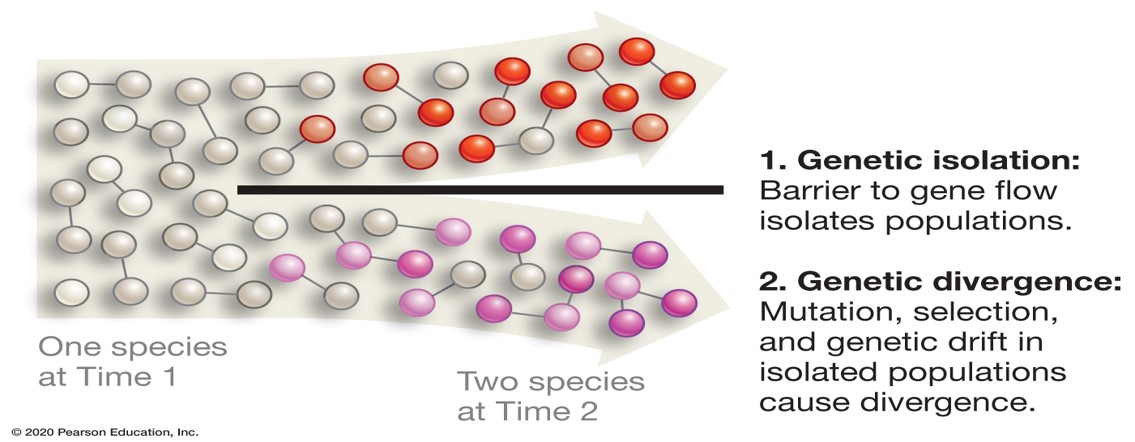
  • Speciation is a 2-step process:

    • genetic isolation: gene flow must be restricted between two populations (i.e., no exchange of alleles)

      genetic divergence: evolutionary forces act independently in the two populations

      • e.g., traits evolve in each population as adaptations to their own environment; as a side effect, these traits also prevent populations from exchanging alleles
<ul><li><p><span>fundamental changes in populations</span></p></li><li><p><span>Speciation is a 2-step process:</span></p><ul><li><p><mark data-color="yellow" style="background-color: yellow; color: inherit;">genetic isolation:</mark> gene flow must be restricted between two populations (i.e., no exchange of alleles)</p><p><mark data-color="yellow" style="background-color: yellow; color: inherit;">genetic divergence:</mark> evolutionary forces act independently in the two populations</p><ul><li><p><span>e.g., traits evolve in each population as adaptations to their own environment; <em>as a side effect</em>, these traits also prevent populations from exchanging alleles</span></p><p></p></li></ul></li></ul></li></ul><p></p>
22
New cards

Allopatric speciation

geographic barriers create genetic isolation

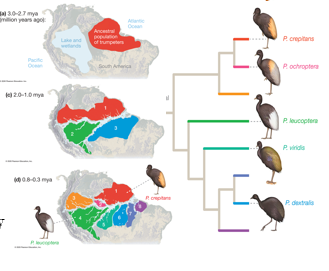
  • e.g., allopatric speciation by vicariance: trumpeters in S.A.

  • large ground birds that fly only short distances

  • phylogeny reconstructed based on DNA similarities

  • speciation events corresponded closely with geological events (e.g., formation of Andes Mountains and Amazon River)
<p><span>geographic barriers create genetic isolation</span></p><ul><li><p>e.g., allopatric speciation by vicariance: trumpeters in S.A.</p></li><li><p>large ground birds that fly only short distances</p></li><li><p>phylogeny reconstructed based on DNA similarities</p></li><li><p>speciation events corresponded closely with geological events (e.g., formation of Andes Mountains and Amazon River)</p></li></ul><p></p>
23
New cards

Allopatric speciation by dispersal

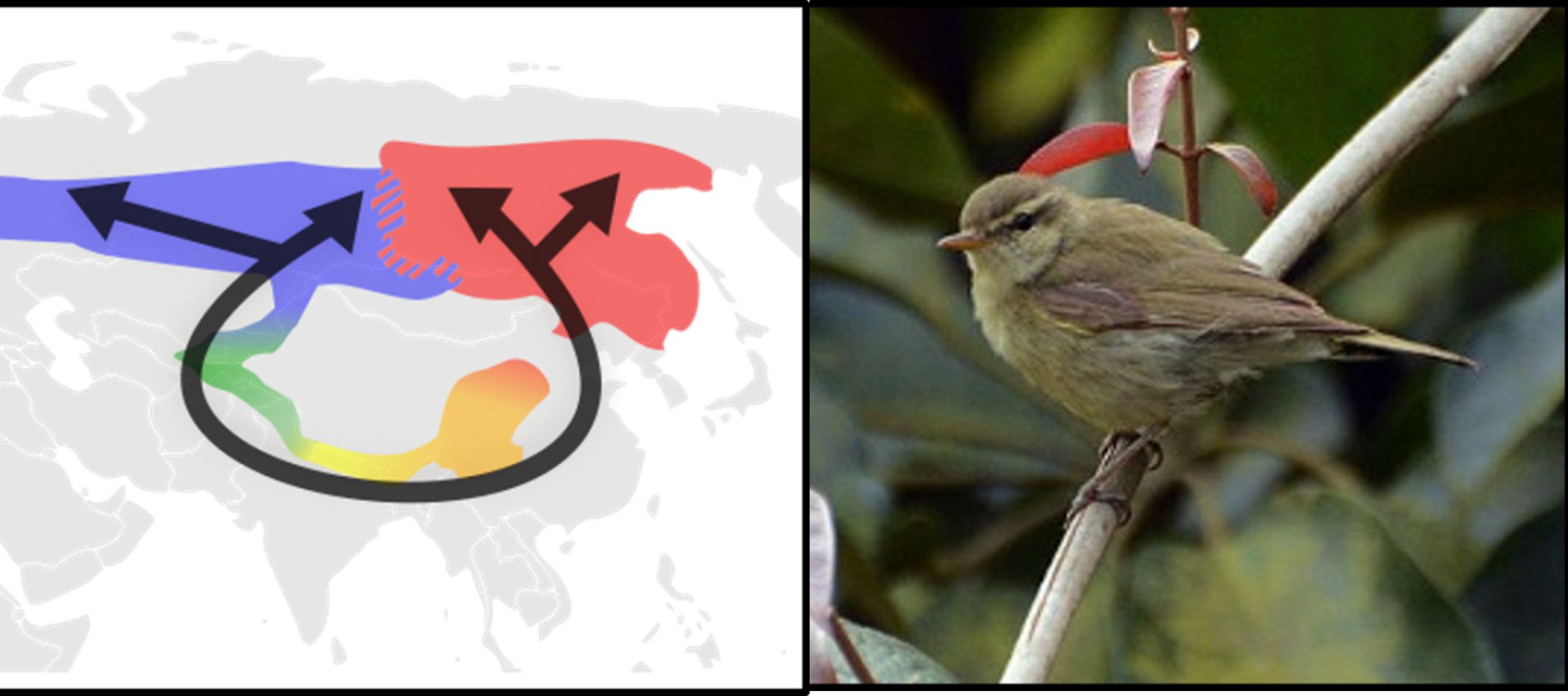
  • e.g., Eurasian Greenish Warblers

    • originated south of Tibetan Plateau; gradually expanded northeast and northwest

    • populations vary, but interbreed freely until Siberian (called a ring species)

    • Siberian populations genetically morphologically distinct; rarely interbreed
<ul><li><p>e.g., Eurasian Greenish Warblers</p><ul><li><p>originated south of Tibetan Plateau; gradually expanded northeast and northwest</p></li><li><p>populations vary, but interbreed freely until Siberian (called a ring species)</p></li><li><p>Siberian populations genetically morphologically distinct; rarely interbreed </p></li></ul></li></ul><p></p>
24
New cards

Evolution of feathers

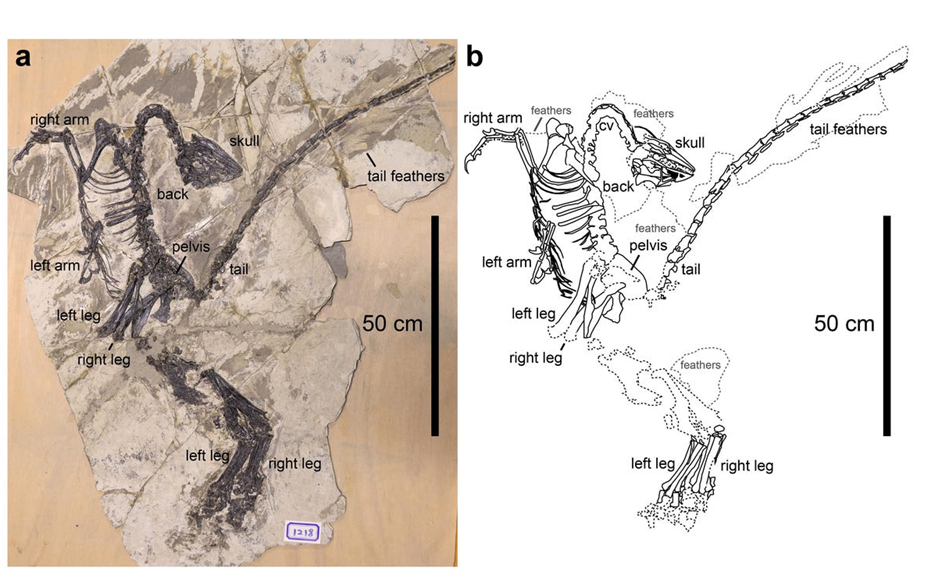
  • feathers once thought to be unique bird trait, but many therapod dinosaurs also had feathers

  • appearance of feathers in therapods suggests feathers evolved for reasons other than flight
<ul><li><p>feathers once thought to be unique bird trait, but many therapod dinosaurs also had feathers</p></li><li><p>appearance of feathers in therapods suggests feathers evolved for reasons other than flight</p></li></ul><p></p>
25
New cards

Major functions of bird feathers

  • flight

  • water proofing

  • insulation

  • communication

  • predator (cryptic plumage)

  • tactile structures (e.g., in Order Caprimulgiformes)

  • physical support (e.g., stiff feathers in woodpeckers)

26
New cards

Feather composition and structure

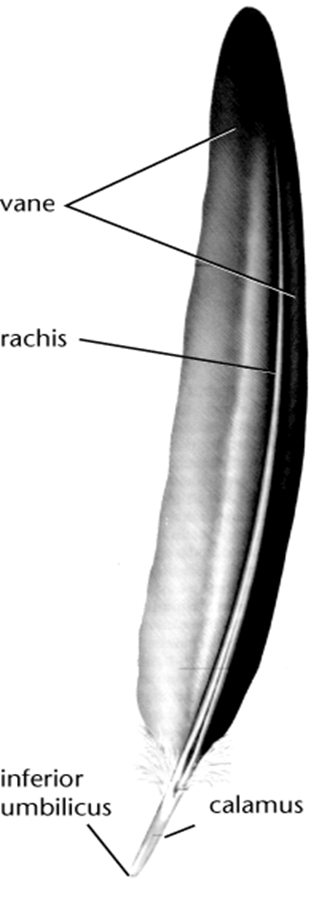
  • composed of b-keratin (similar to protein of our finger nails)

  • arise from follicles in the epidermis; inert at maturity

  • central shaft composed of:

    • quill or calamus (bare, proximal)

    • rachis (surrounded by vane, distal)

  • broad, flexible vanes on either side of rachis can be:

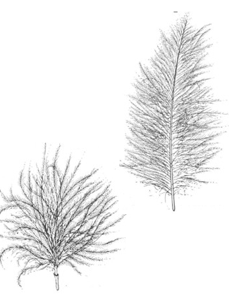
    • plumulaceous (fluffy)

    • pennaceous (stiff)

<ul><li><p>composed of b-keratin (similar to protein of our finger nails)</p></li><li><p>arise from follicles in the epidermis; inert at maturity</p></li><li><p>central shaft composed of:</p><ul><li><p>quill or calamus (bare, proximal)</p></li><li><p>rachis (surrounded by vane, distal)</p></li></ul></li><li><p>broad, flexible vanes on either side of rachis can be:</p><ul><li><p>plumulaceous (fluffy)</p></li><li><p>pennaceous (stiff)</p></li></ul></li></ul><p></p>
27
New cards

Detailed structure of vane

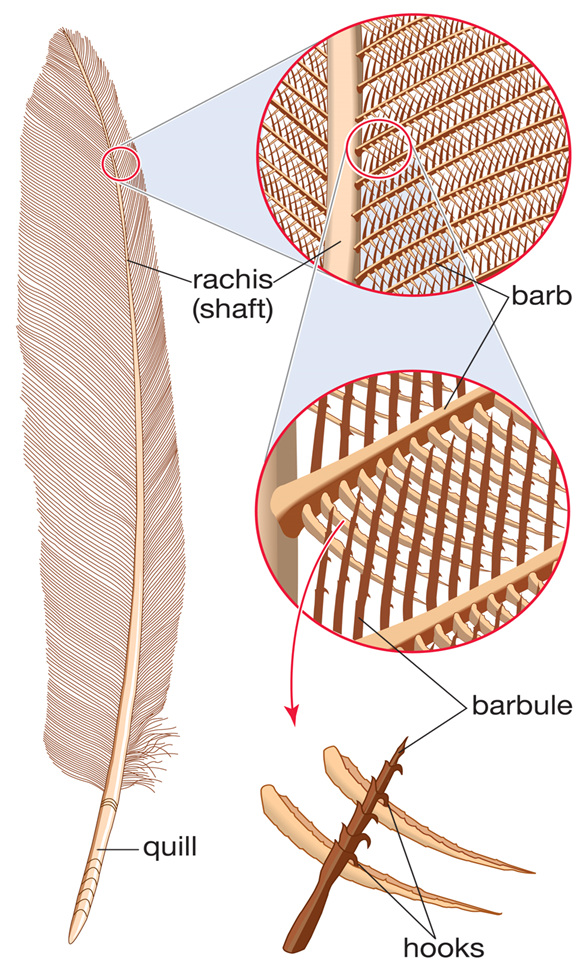
  • barbs run perpendicular to the rachis

  • each barb is composed of perpendicular barbules

  • barbules contain barbicels that interlock adjacent barbs
<ul><li><p><u>barbs</u> run perpendicular to the rachis</p></li><li><p>each barb is composed of perpendicular <u>barbules</u></p></li><li><p>barbules contain barbicels that interlock adjacent barbs</p></li></ul><p></p>
28
New cards

Major types of feathers

  • remiges

    • flight (wing) feathers: primaries, secondaries, and tertials (coverts and alula are not remiges)

  • retrices

    • tail feathers

  • contours

    • feathers that cover the outer body

    • vane has pennaceous and plumulaceous portions
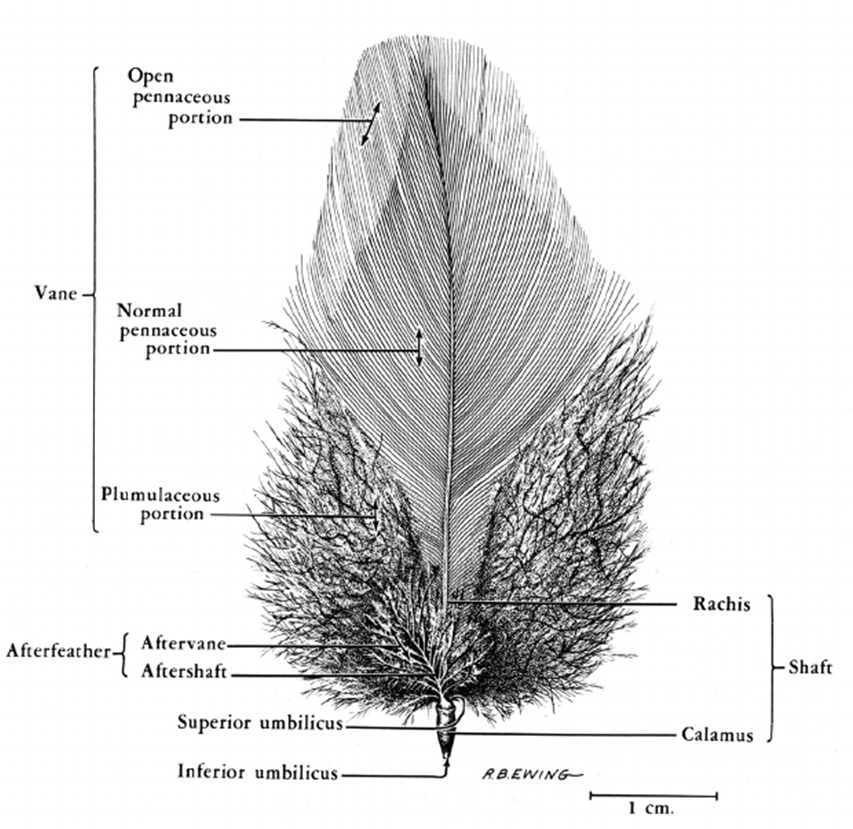
<ul><li><p>remiges</p><ul><li><p>flight (wing) feathers: <u>primaries</u>, <u>secondaries</u>, and <u>tertials</u> (coverts and alula are not remiges)</p></li></ul></li><li><p>retrices</p><ul><li><p>tail feathers</p></li></ul></li><li><p>contours</p><ul><li><p>feathers that cover the outer body</p></li><li><p>vane has pennaceous and plumulaceous portions</p></li></ul></li></ul><p></p>
29
New cards

Major types of feathers

  • bristles

    • long, hair-like sensory feathers near the mouth

  • filoplume

    • long, sensory feather of body; detect position of other feathers
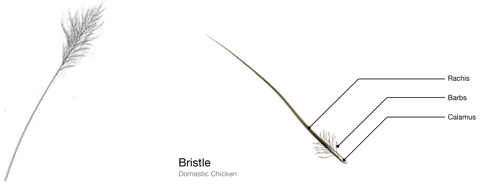
<ul><li><p>bristles</p><ul><li><p>long, hair-like sensory feathers near the mouth</p></li></ul></li><li><p>filoplume</p><ul><li><p>long, sensory feather of body; detect position of other feathers</p></li></ul></li></ul><p></p>
30
New cards

Major types of feathers

  • down

    • feathers close to the body that insulate it

    • have entirely plumulaceous vanes

    • nestlings initially covered in down feathers

  • semiplume

    • intermediate between down and contour feather

    • provides insulation and form

<ul><li><p>down</p><ul><li><p>feathers close to the body that insulate it</p></li><li><p>have entirely plumulaceous vanes</p></li><li><p>nestlings initially covered in down feathers</p></li></ul></li><li><p>semiplume</p><ul><li><p>intermediate between down and contour feather</p></li><li><p>provides insulation and form</p></li></ul></li></ul><p></p>
31
New cards
<p><span>Feather care</span></p>

Feather care

  • birds preen feathers to maintain them

    • use bills to reposition out-of-place feathers

    • pull remiges and retrices through bill to restore connections between barbicels

  • preen wax applied to feathers

    • secretions of uropygial (preengland located on rump

      • waxes (fatty acids + alcohols)

      • waterproofs feathers

      • may inhibit growth feather-degrading bacteria

32
New cards

Feather distribution

  • feathers occur in tracts separated by bare skin

    • pterylae = feather tracts

    • apteria = patches of bare skin

  • patterns of apteria differ among bird taxa

  • brood patches are specialized apteria with dense blood vessels; used for incubation
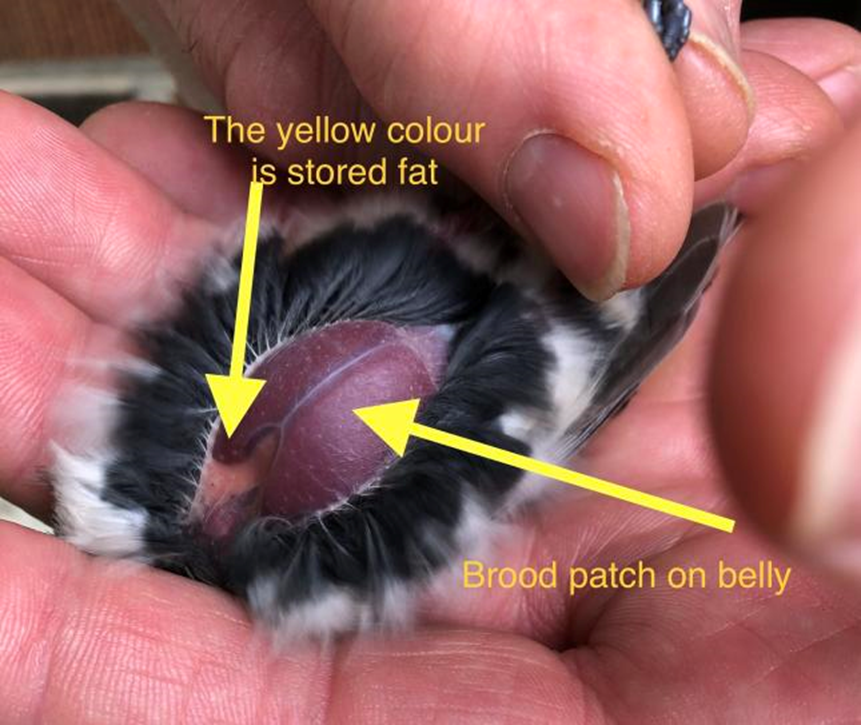
<ul><li><p>feathers occur in tracts separated by bare skin</p><ul><li><p>pterylae = feather tracts</p></li><li><p>apteria = patches of bare skin</p></li></ul></li><li><p>patterns of apteria differ among bird taxa</p></li><li><p><u>brood</u> <u>patches</u> are specialized apteria with dense blood vessels; used for incubation</p></li></ul><p></p>
33
New cards

What causes bird feathers to be so vibrant and varied?

pigments or structural features in the feathers

34
New cards

Pigments

  • found in rachis, barbs, and barbules

  • absorb certain wavelengths of light and reflect the colors we see

35
New cards

Common pigments in bird plumage

  • melanin:

    • produces black, browns, tans, red-browns, and grays

    • associated with extra deposits of keratin which strengthens feathers

    • often found at the tips of primaries (remiges), particularly in white birds (e.g., gulls)
<ul><li><p>melanin: </p><ul><li><p>produces black, browns, tans, red-browns, and grays</p></li><li><p>associated with extra deposits of keratin which strengthens feathers</p></li><li><p>often found at the tips of primaries (remiges), particularly in white birds (e.g., gulls)</p></li></ul></li></ul><p></p>
36
New cards

Common pigments in bird plumage

  • carotenoids:

    • produces bright yellow to red colors

    • birds cannot synthesize carotenoids; obtained in diet (fruits, seeds)

    • carotenoid-produced colors are often important in mate choice

    • combination of melanin and carotenoids produce olive-green color
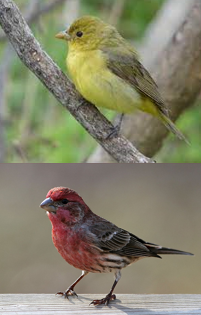
<ul><li><p>carotenoids: </p><ul><li><p>produces bright yellow to red colors</p></li><li><p>birds cannot synthesize carotenoids; obtained in diet (fruits, seeds)</p></li><li><p>carotenoid-produced colors are often important in mate choice</p></li><li><p>combination of melanin and carotenoids produce olive-green color</p></li></ul></li></ul><p></p>
37
New cards

Structural colors

  • blue and white feathers are produced as light is reflected by scattered keratin proteins and melanin layers in the feathers

  • different arrangements of keratin causes reflection of different wavelengths of light

38
New cards

Iridescence

describes metallic blues, greens, reds, and golds

  • different layers of keratin and melanin reflect different wavelengths of light; color we see depends on angle of light
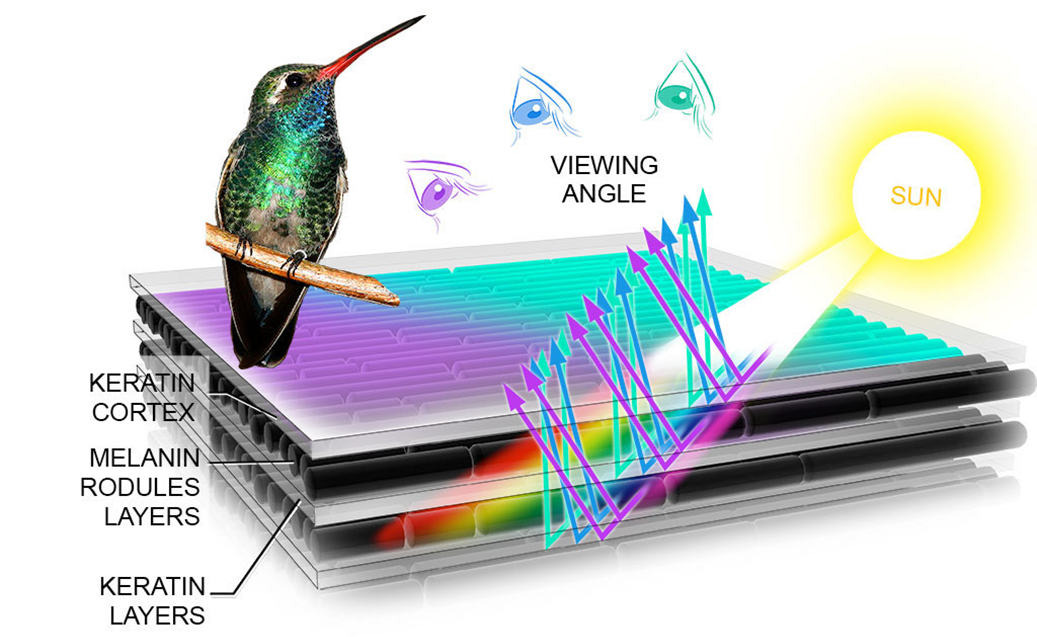
<p><span>describes metallic blues, greens, reds, and golds</span></p><ul><li><p><span>different layers of keratin and melanin reflect different wavelengths of light; color we see depends on angle of light</span></p></li></ul><p></p>
39
New cards

Feather molting

  • Because of physical wear, feathers must be replaced periodically

  • molting: process of shedding and replacing feathers

    • frequency and extent of molts depends on life history (e.g., migratory or resident)

    • most N. American birds molt twice per year

      • flight and body feathers in late summer (into basic or winter plumage)

      • some body feathers in early spring (into alternate or breeding plumage)

40
New cards

Typical feather-molting pattern for NA songbirds

Natal down (june) —-prejuvenile molt—> Juvenile plumage (july-august) ——1st prebasic molt (incomplete)——> basic plumage (august-march) ——-prealternate molt—→ alternate plumage (may-august) ——prebasic molt (complete; all flight feathers are replaced)——> basic plumage (september-march)
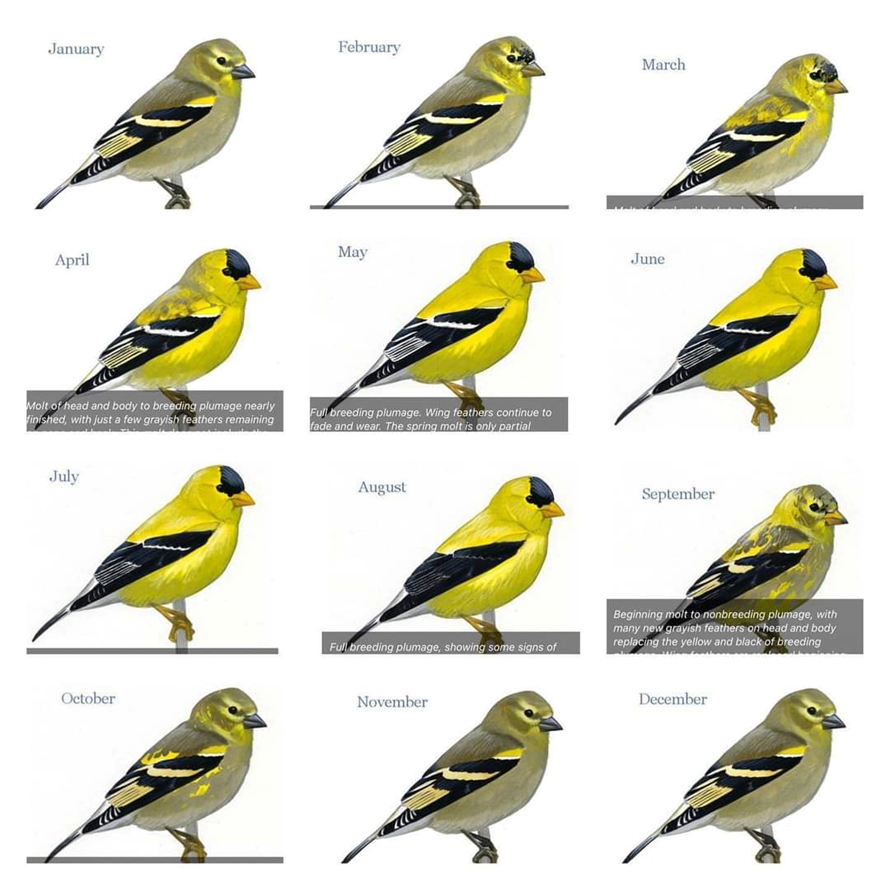
<p>Natal down (june) —-prejuvenile molt—&gt; Juvenile plumage (july-august) ——1<sup>st</sup> prebasic molt (incomplete)——&gt; basic plumage (august-march) ——-prealternate molt—→ alternate plumage (may-august) ——prebasic molt (complete; all flight feathers are replaced)——&gt; basic plumage (september-march)</p>
41
New cards

Four forces of flight

  • lift (upward)

  • thrust (forward)

  • weight (downward)

  • drag (backward)

    • to maintain level flight, birds must maintain all forces in balance
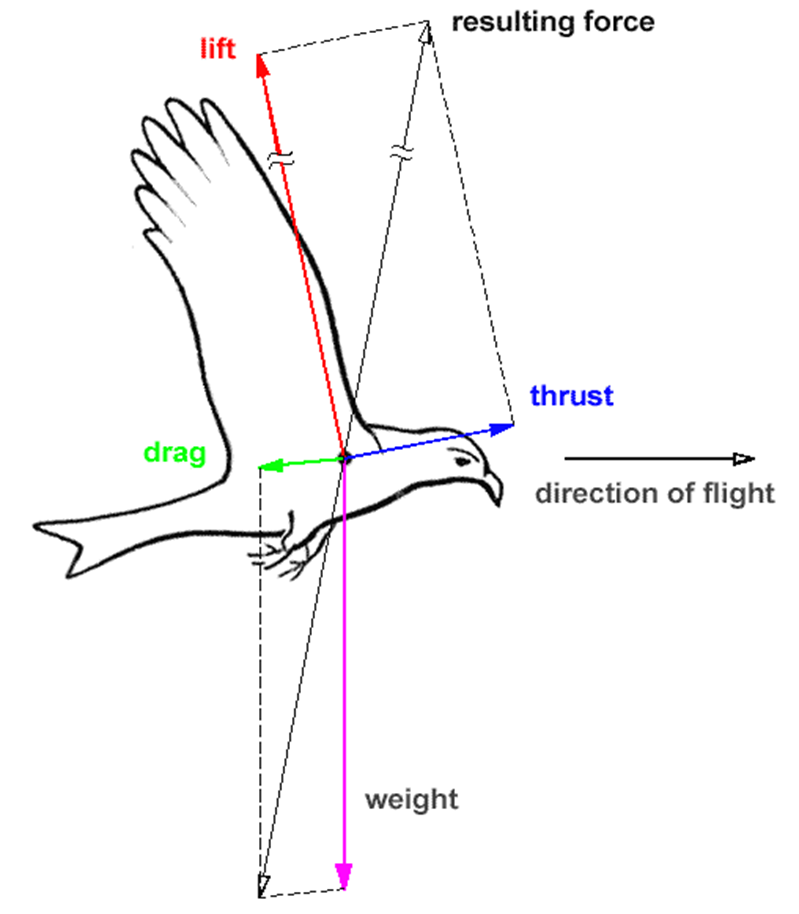
<ul><li><p>lift (upward)</p></li><li><p>thrust (forward)</p></li><li><p>weight (downward)</p></li><li><p>drag (backward)</p><ul><li><p>to maintain level flight, birds must maintain all forces in balance</p></li></ul></li></ul><p></p>
42
New cards

Airfoil

  • Wings act as airfoils to produce lift

  • airfoil = shape that produces a laminar (parallel) flow of air across its surface

    • differences in air pressure above and below the wing (or any airfoil) produce lift

      • air moves faster above the wing than below

      • faster-moving air creates less pressure; difference in pressure above and below wing is lift
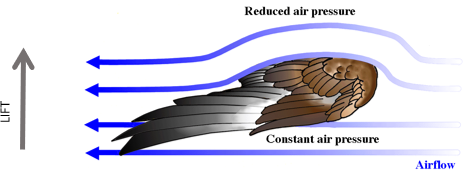
<ul><li><p>Wings act as airfoils to produce lift</p></li><li><p><u>airfoil</u> = shape that produces a laminar (parallel) flow of air across its surface</p><ul><li><p>differences in air pressure above and below the wing (or any airfoil) produce lift</p><ul><li><p>air moves faster above the wing than below</p></li><li><p>faster-moving air creates less pressure; difference in pressure above and below wing is lift</p></li></ul></li></ul></li></ul><p></p>
43
New cards
<p>Lift </p>

Lift

  • Lift is produced by wings

    • but birds do not need to “flap” to create lift

      • wing shape (i.e., airfoil) is sufficient if air moves fast enough across the wing surfaces (more air speed, more lift)

      • for birds to stay aloft, force of lift > weight

      • birds evolved many weight-reducing adaptations:

        • hollow (pneumatized) bones; sometimes with internal “struts”

        • fused bones (e.g., metacarpals)

        • lightweight, stiff wing feathers

        • lightweight, toothless bill

      • movement of air along surface of wing causes lift

      • changing angle of attack alters the amount of lift
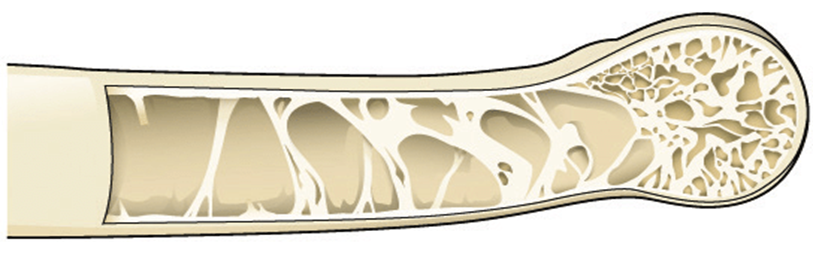
<ul><li><p>Lift is produced by wings</p><ul><li><p>but birds do not need to “flap” to create lift</p><ul><li><p>wing shape (i.e., airfoil) is sufficient if air moves fast enough across the wing surfaces (more air speed, more lift)</p></li><li><p>for birds to stay aloft, force of lift &gt; weight</p></li><li><p>birds evolved many weight-reducing adaptations:</p><ul><li><p>hollow (pneumatized) bones; sometimes with internal “struts”</p></li><li><p>fused bones (e.g., metacarpals)</p></li><li><p>lightweight, stiff wing feathers</p></li><li><p>lightweight, toothless bill</p></li></ul></li><li><p>movement of air along surface of wing causes lift</p></li><li><p>changing angle of attack alters the amount of lift</p></li></ul></li></ul></li></ul><p></p>
44
New cards

Lift

  • Lift is produced by wings

  • if trailing edge of wing is pointed down (large angle of attack), air does not move along entire wing surface

    • air swirls at the back of wing, causing more drag and loss of lift (aerial stall)

    • to perch, birds adjust wing angle to create an aerial stall

  • wing shape also influences lift (high aspect ratio wings produce more lift)
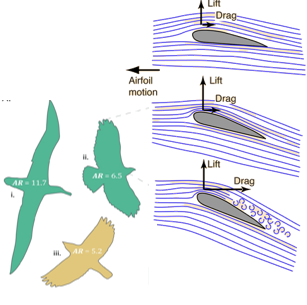
<ul><li><p>Lift is produced by wings </p></li><li><p>if trailing edge of wing is pointed down (large angle of attack), air does not move along entire wing surface</p><ul><li><p>air swirls at the back of wing, causing more drag and loss of lift (aerial stall)</p></li><li><p>to perch, birds adjust wing angle to create an aerial stall</p></li></ul></li><li><p>wing shape also influences lift (high aspect ratio wings produce more lift)</p></li></ul><p></p>
45
New cards

Forward motion requires thrust

  • as front of wing oriented slightly downward (low angle of attack), lift is converted to thrust (without flapping)

  • thrust also generated by flapping

  • flapping involves:

    • up-down motion by secondaries

    • twisting motion by primaries

    • folding of wing on the upstroke to reduce drag
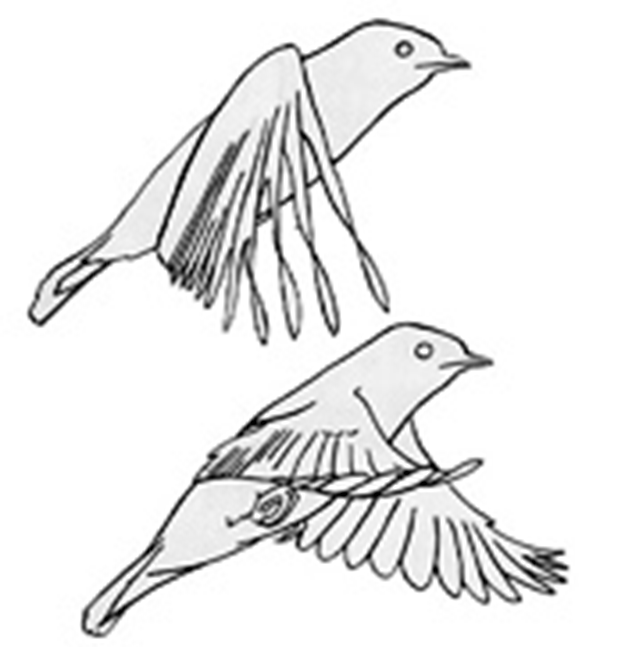
<ul><li><p>as front of wing oriented slightly downward (low angle of attack), lift is converted to thrust (without flapping)</p></li><li><p>thrust also generated by flapping</p></li><li><p>flapping involves:</p><ul><li><p>up-down motion by secondaries</p></li><li><p>twisting motion by primaries</p></li><li><p>folding of wing on the upstroke to reduce drag</p></li></ul></li></ul><p></p>
46
New cards

Flight adaptations

  • airfoil-shaped wings

  • lightweight skeleton

  • coracoid bone that supports shoulder

  • enlarged sternum with deep keel for attachment of muscles

  • furcula that acts as a spring for wing beat

  • efficient respiratory system to supply O2 to muscles
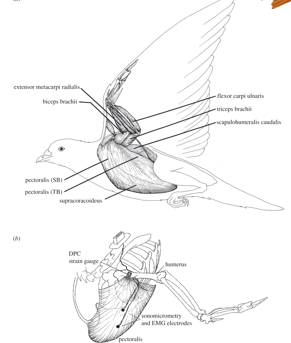
<p></p><ul><li><p>airfoil-shaped wings</p></li><li><p>lightweight skeleton</p></li><li><p>coracoid bone that supports shoulder</p></li><li><p>enlarged sternum with deep keel for attachment of muscles</p></li><li><p>furcula that acts as a spring for wing beat</p></li><li><p>efficient respiratory system to supply O2 to muscles</p></li></ul><p></p>
47
New cards

Key musculoskeletal structures

  • bones:

    • furcula: acts as strut connecting shoulders

    • coracoid: connects sternum to shoulder

    • humerus: upper bone in wing; connects to coracoid and scapula

    • sternum: where breast muscles attach

  • muscles:

    • attached to sternum and humerus by tendons

      • pectoralis (major): contracts to pull wing

      • supracoracoides: contracts to lift wings
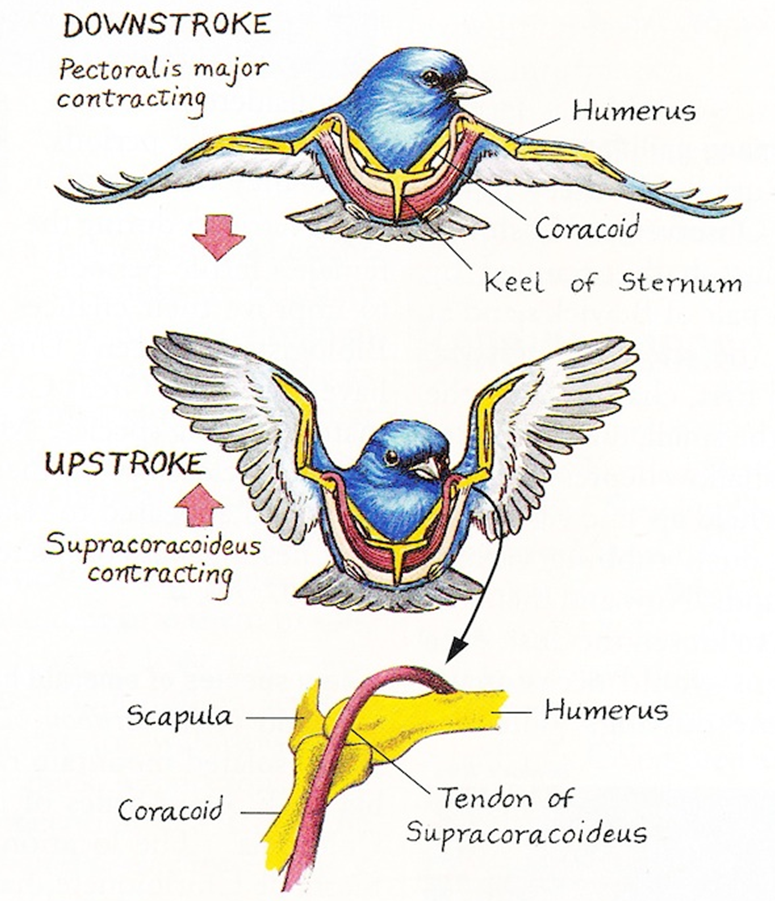
<ul><li><p>bones: </p><ul><li><p><u>furcula</u>: acts as strut connecting shoulders</p></li><li><p><u>coracoid</u>: connects sternum to shoulder</p></li><li><p><u>humerus</u>: upper bone in wing; connects to coracoid and scapula</p></li><li><p><u>sternum</u>: where breast muscles attach</p></li></ul></li><li><p>muscles:</p><ul><li><p>attached to sternum and humerus by tendons</p><ul><li><p><u>pectoralis (major)</u>: contracts to pull wing</p></li><li><p><u>supracoracoides</u>: contracts to lift wings</p></li></ul></li></ul></li></ul><p></p>
48
New cards
<p>Avian respiratory system</p>

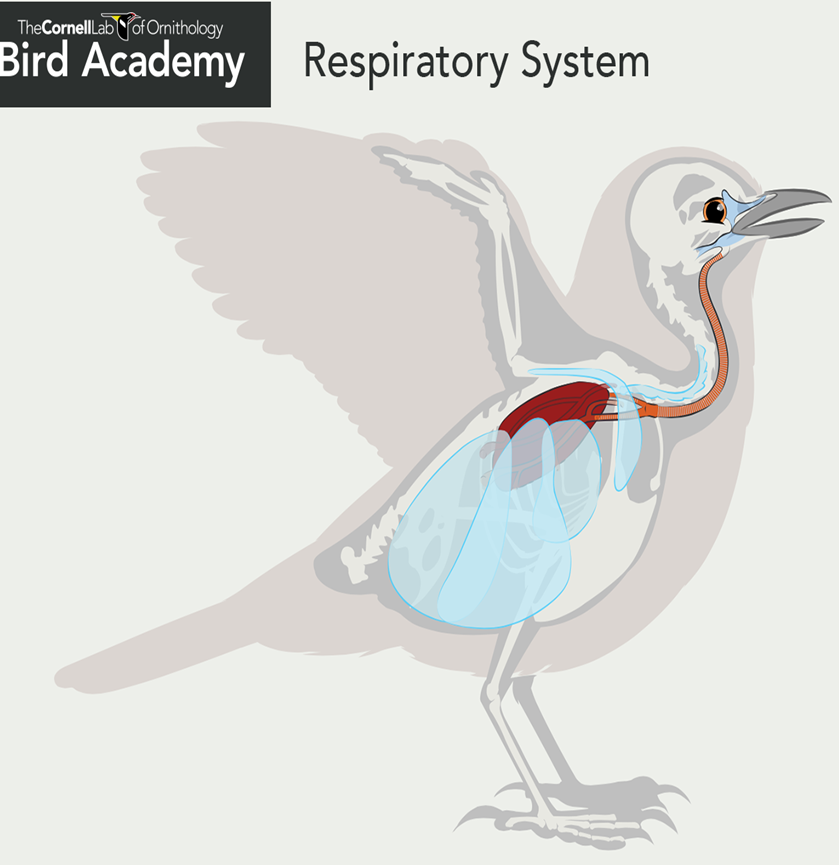
Avian respiratory system

  • flight is energetically expensive

  • O2 needed to convert food into ATP for muscle contraction

  • birds have higher metabolism, higher body temps, and faster heart rates than other terrestrial vertebrates

  • birds also have most efficient respiratory system
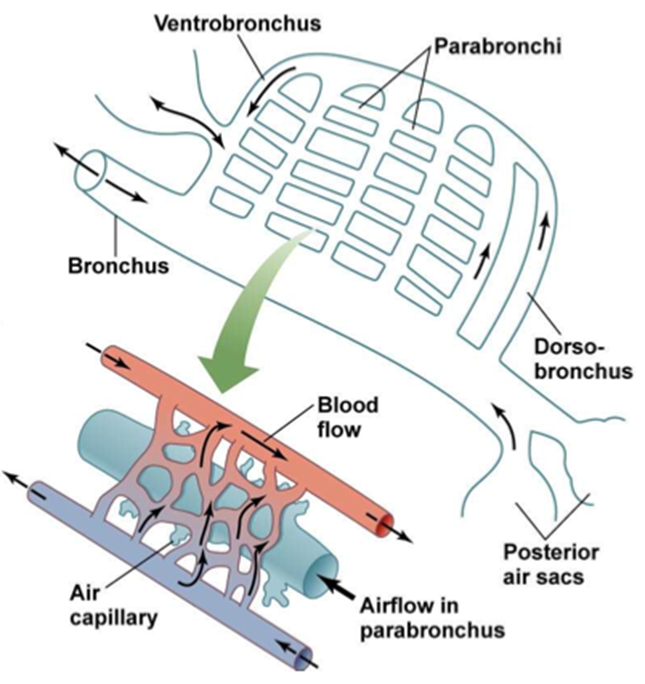
49
New cards
<p>Lungs</p>

Lungs

  • small, but with large internal surface area

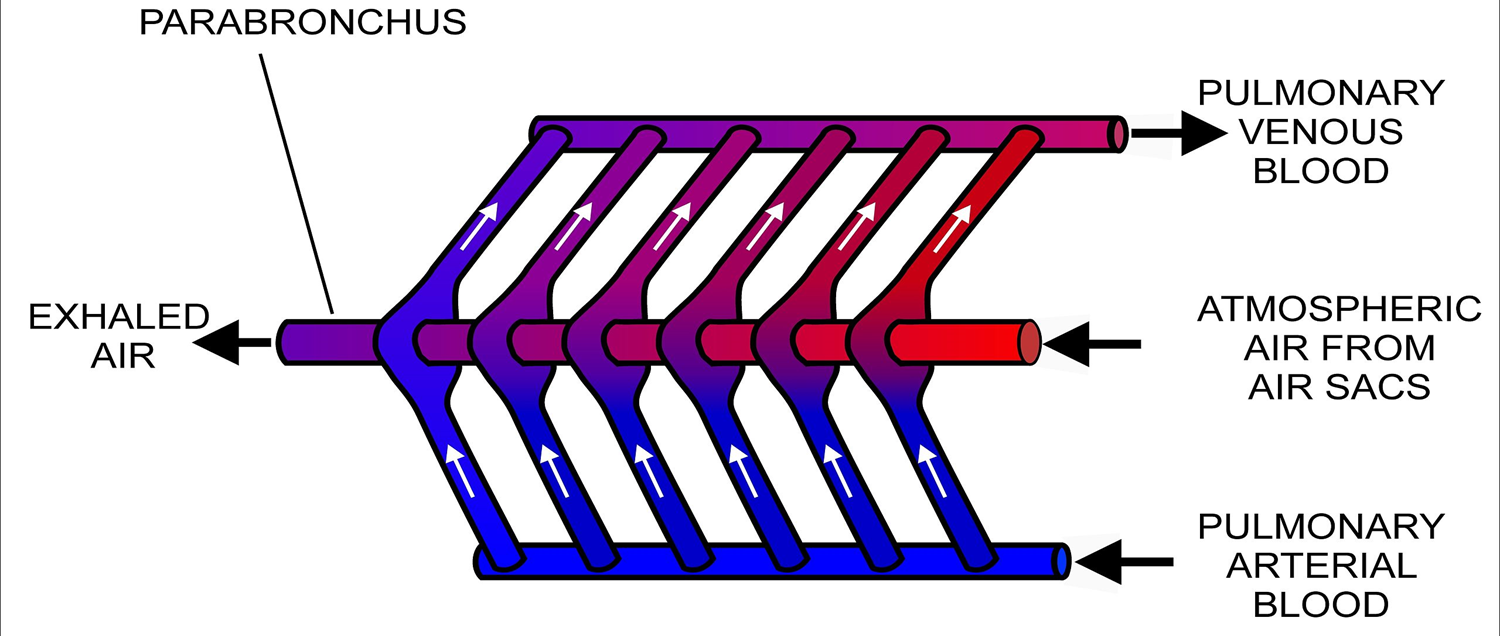
  • network of tiny tubes (parabronchi), each has many capillaries for gas exchange

  • direction of air is perpendicular to flow of blood in capillaries –> crosscurrent gas exchange
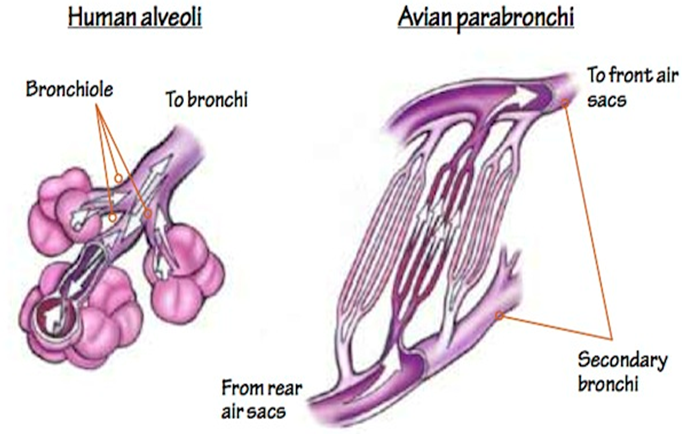
<ul><li><p>small, but with large internal surface area </p></li><li><p>network of tiny tubes (parabronchi), each has many capillaries for gas exchange</p></li><li><p>direction of air is perpendicular to flow of blood in capillaries –&gt; <u>crosscurrent gas exchange</u></p></li></ul><p></p>
50
New cards
<p>Cross-current gas exchange</p>

Cross-current gas exchange

maintains a favorable concentration gradient of O2 across entire parabronchus

51
New cards

Air sacs

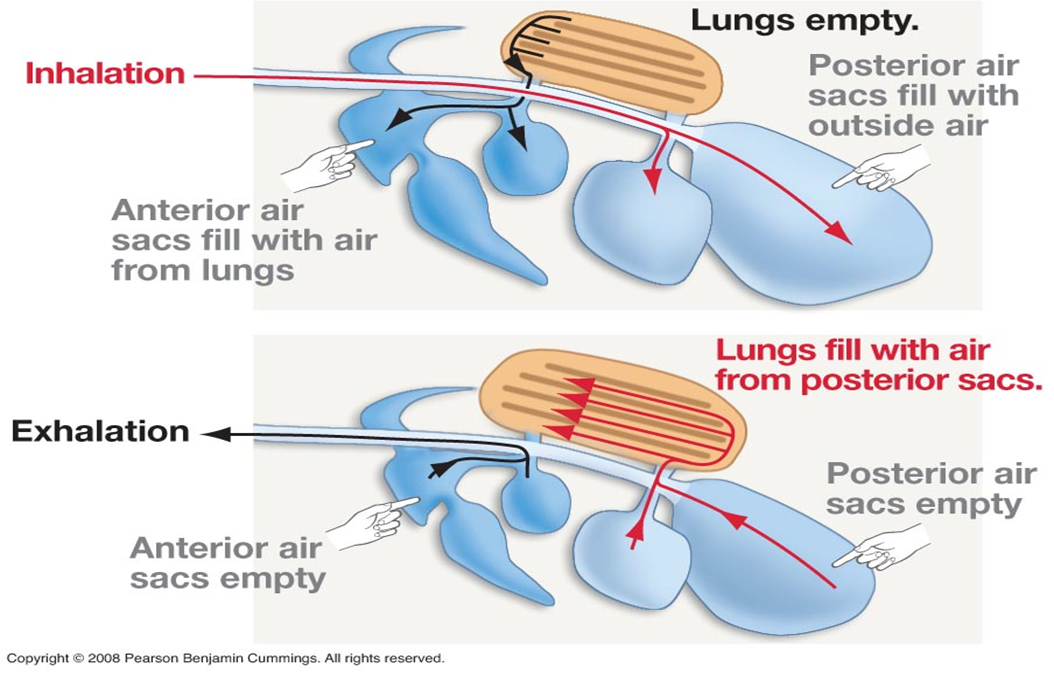
1-way flow of air occurs because of anterior and posterior air sacs
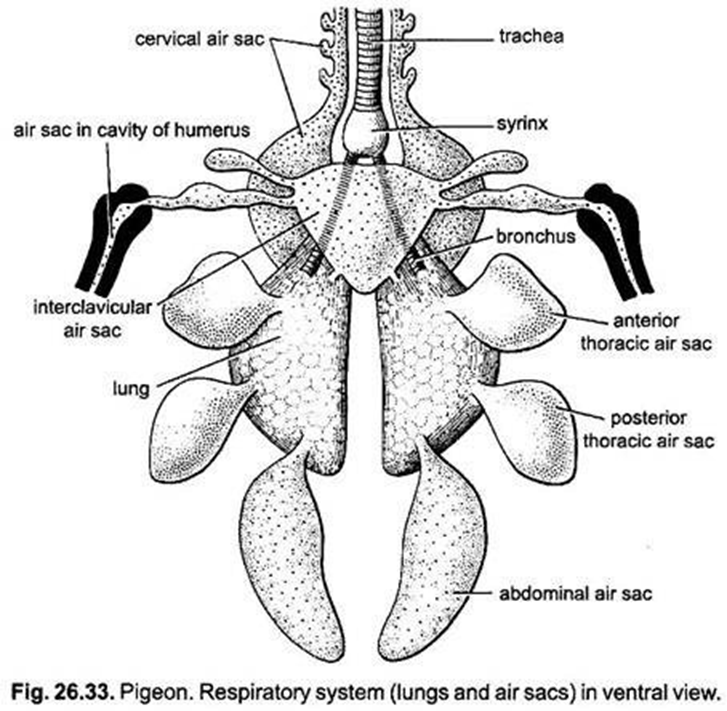
<p><span>1-way flow of air occurs because of anterior and posterior air sacs</span></p>
52
New cards

Movement of air in avian respiratory system

  • complete cycle of respiration:

    • 1st inhale: air goes into posterior air sacs

    • 1st exhale: air into parabronchi for gas exchange

    • 2nd inhale: air moves into anterior air sacs

    • 2nd exhale: air moves out of bird

<ul><li><p>complete cycle of respiration:</p><ul><li><p>1st inhale: air goes into posterior air sacs</p></li><li><p>1st exhale: air into parabronchi for gas exchange</p></li><li><p>2nd inhale: air moves into anterior air sacs</p></li><li><p>2nd exhale: air moves out of bird</p></li></ul></li></ul><p></p>
53
New cards

Major adaptations of avian respiratory system

  • movement of air between air sacs and lungs (1-way)

  • cross-current gas (O2 and CO2) exchange in the lungs

54
New cards

Migration

  • regular seasonal movement between breeding and wintering regions

    • most temperate birds migrate

    • most birds that breed in this region are Neotropical migrants

    • distance of migration varies within and among species

    • migration can be obligate or facultative

55
New cards

Types of migration

  • partial migration = some individuals of population migrate, others are resident year round

  • differential migration = different sex-age classes of population migrate different distances

  • altitudinal migration = migrate up and down mountains

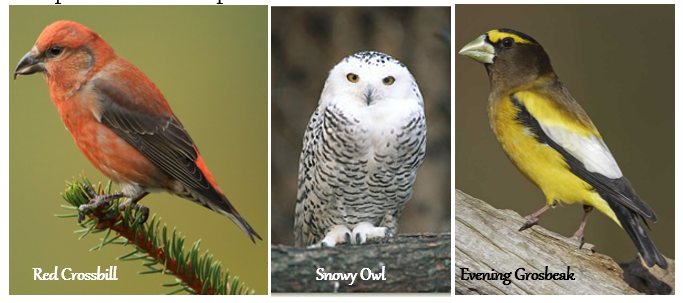
  • irruptions = migration only in some years; respond to unpredictable resources                                    

56
New cards

Species w/ irruptive movements

knowt flashcard image
57
New cards

Timing of migration

  • “internal rhythms” govern timing of migration

    • zugunruhe: migratory restlessness, the preparation for migration

      • increased activity near dusk; normal sleep pattern changes; increased feeding

      • ultimately controlled by changes in daylength, but immediate weather conditions influence exact timing of movement

58
New cards

Timing of migration pt.2

  • migratory fattening is part of zugunruhe

    • fat is major fuel for migrants because it provides the most energy per gram

      • long-distance migrants: 30-50% of total body weight (tbw) in fat

      • short-distance migrants: 10-25% of tbw in fat

      • non-migratory: 3-5% tbw in fat; except in winter when they store 10-15%, enough to survive 1-2 days

59
New cards

Terms to describe movements during migration

  • orientation: flight in proper compass direction

  • navigation: knowing where you are and how to get to a specific geographic location

  • generally, orientation is genetically determined, but navigation involves some learning

    • e.g., experiments with displaced juvenile vs. adult migratory European Starlings

60
New cards

Perdeck’s (1958) classic experiment

  • displaced 11,000 starlings during migration (C to R1, R2 and R3)

  • most young starlings (black circles) oriented in direction (and for same distance) as they normally would have, but ended up in an incorrect wintering location

  • most adults (yellow) navigated to correct wintering sites
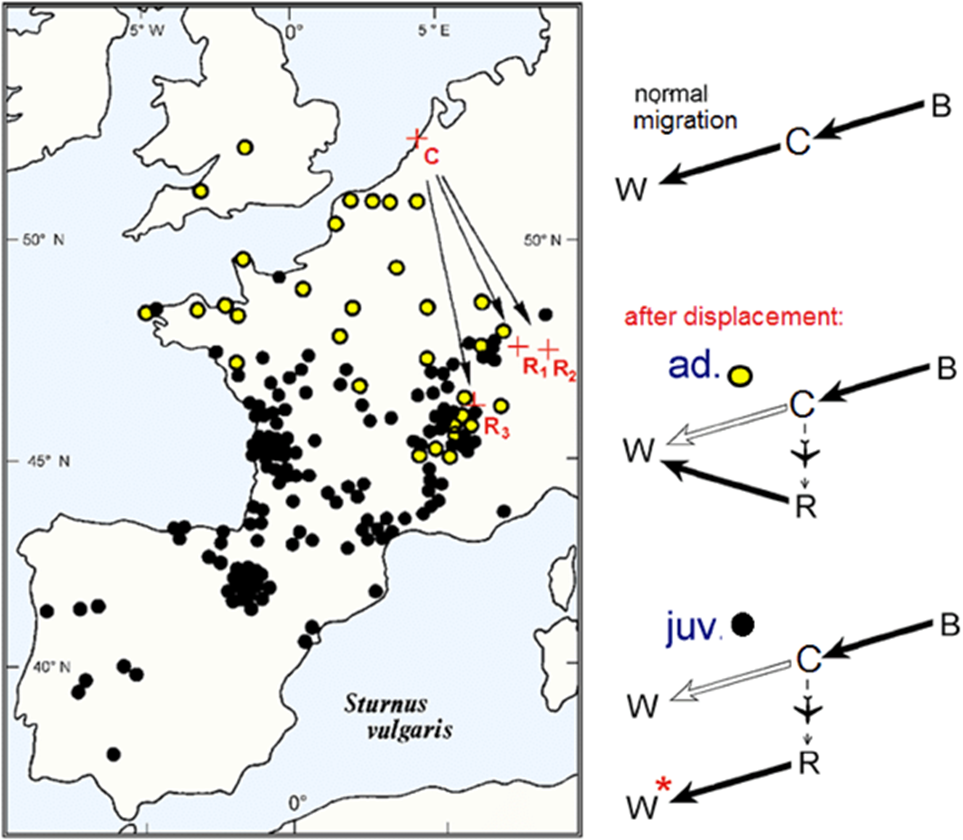
<ul><li><p>displaced 11,000 starlings during migration (C to R1, R2 and R3)</p></li><li><p>most young starlings (black circles) oriented in direction (and for same distance) as they normally would have, but ended up in an incorrect wintering location</p></li><li><p>most adults (yellow) navigated to correct wintering sites</p></li></ul><p></p>
61
New cards

Orientation cues

  • visual cues

    • diurnal migrants may use landmarks (e.g., rivers, coasts)

      • likely cue used by Orders Anseriformes, some Apodiformes, Gruiformes, Accipitriformes, Falconiformes

        • e.g., whooping cranes learn landmarks during migration; follow older birds initially

      • but ... visually impaired pigeons can still navigate; suggests other cues are used by most other birds
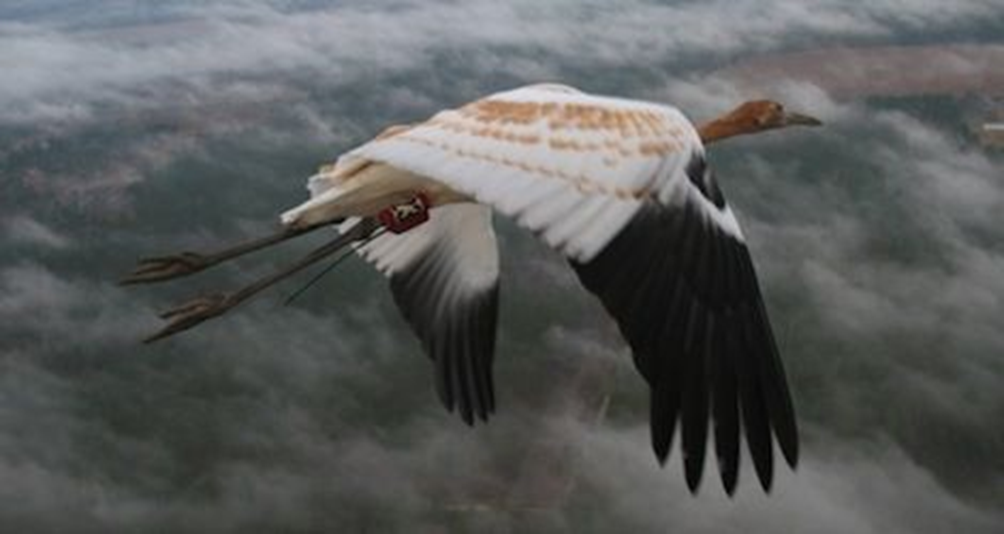
<ul><li><p>visual cues</p><ul><li><p>diurnal migrants may use landmarks (e.g., rivers, coasts)</p><ul><li><p>likely cue used by Orders Anseriformes, some Apodiformes, Gruiformes, Accipitriformes, Falconiformes</p><ul><li><p>e.g., whooping cranes learn landmarks during migration; follow older birds initially</p></li></ul></li><li><p><span>but ... visually impaired pigeons can still navigate; suggests other cues are used by most other birds</span></p></li></ul></li></ul></li></ul><p></p>
62
New cards

Orientation cues

  • olfactory cues

    • follow concentration gradients of odors

      • used by seabirds (e.g., Procellariiformes) to locate nest sites and food

        • e.g., petrels with severed olfactory nerves could not find nest site
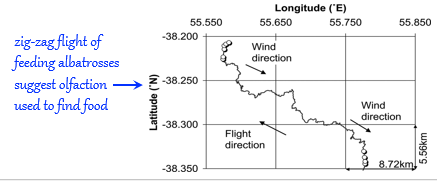
<ul><li><p>olfactory cues</p><ul><li><p>follow concentration gradients of odors</p><ul><li><p>used by seabirds (e.g., Procellariiformes) to locate nest sites and food </p><ul><li><p>e.g., petrels with severed olfactory nerves could not find nest site </p></li></ul></li></ul></li></ul></li></ul><p></p>
63
New cards

Orientation cues

  • time-compensated sun compass

    • position of sun in sky indicates compass direction

      • requires that birds compensate for changing position of sun (changes ~ 15o per hour during the day

      • shifting bird’s internal clock (making it “think” it’s a different time) causes incorrect orientation
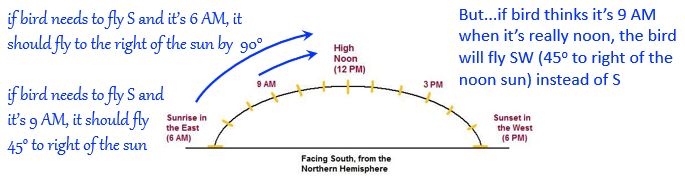
<ul><li><p>time-compensated sun compass</p><ul><li><p>position of sun in sky indicates compass direction</p><ul><li><p>requires that birds compensate for changing position of sun (changes ~ 15o per hour during the day</p></li><li><p>shifting bird’s internal clock (making it “think” it’s a different time) causes incorrect orientation</p></li></ul></li></ul></li></ul><p></p>
64
New cards
<p>Orientation cues</p>

Orientation cues

  • Celestial cues

    • use rotation of stars around Polaris to orient

    • cue used by nocturnal migrants (e.g., migratory songbirds)

      • e.g., Emlen (1967)

        • young indigo buntings placed in Emlen funnels and moved to planetarium after 1 of 3 rearing conditions:

          • no view of night sky

          • view of correct night sky (with rotation around Polaris)

          • view of incorrect night sky (rotation around Betelgeus in Orion constellation)
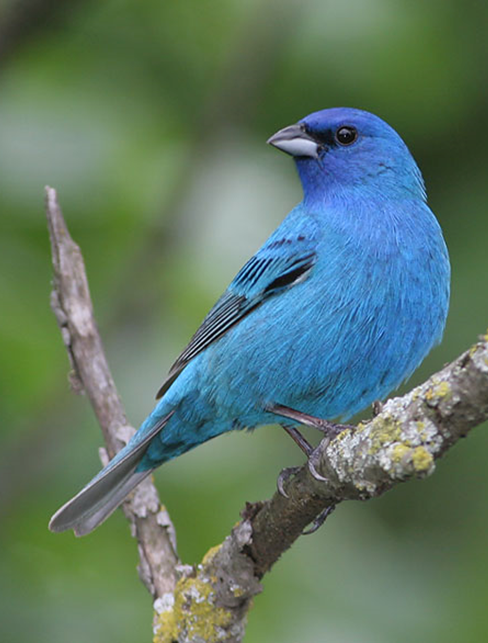
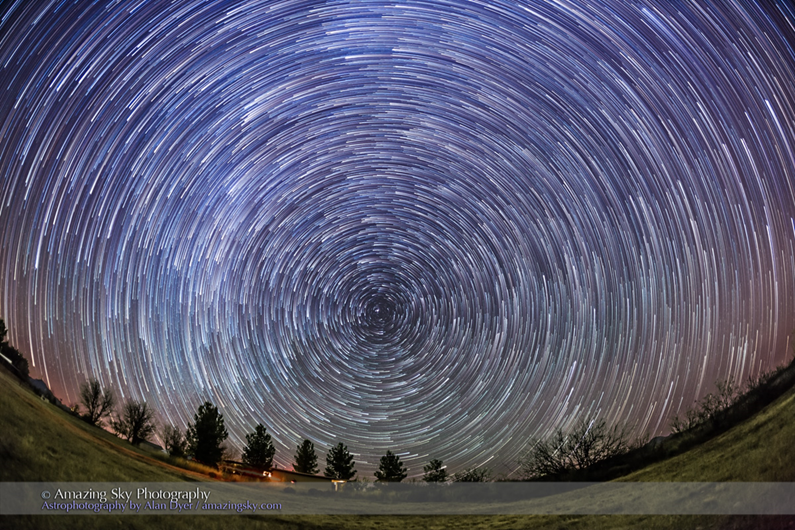
<ul><li><p>Celestial cues </p><ul><li><p>use rotation of stars around Polaris to orient</p></li><li><p>cue used by nocturnal migrants (e.g., migratory songbirds)</p><ul><li><p>e.g., Emlen (1967)</p><ul><li><p>young indigo buntings placed in Emlen funnels and moved to planetarium after 1 of 3 rearing conditions:</p><ul><li><p>no view of night sky</p></li><li><p>view of correct night sky (with rotation around Polaris)</p></li><li><p>view of incorrect night sky (rotation around Betelgeus in Orion constellation)</p></li></ul></li></ul></li></ul></li></ul></li></ul><p></p>
65
New cards

Results of Emlen (1967)

  • Indigo Buntings (INBUs) with no view of night sky showed no orientation; moved in random directions

  • INBUs with view of simulated night sky oriented properly; flew opposite Polaris (during fall migration)

  • INBUs with view of incorrect night sky oriented incorrectly; flew opposite Betelgeuse
66
New cards
<p>Orientation cues</p>

Orientation cues

  • Geomagnetic cues

    • birds use Earth’s magnetic field

      • flow of liquid iron in Earth's core creates electric currents, which in turn creates the magnetic field

      • stronger magnetic “pull” at poles than toward the equator

      • cryptochrome 4 protein (cry4) is molecule that is sensitive to blue light and allows birds to “see” the magnetic field

      • cry4 proteins may produce a geomagnetic “filter” (top panel of figure) over a bird’s field of view (bottom panel)
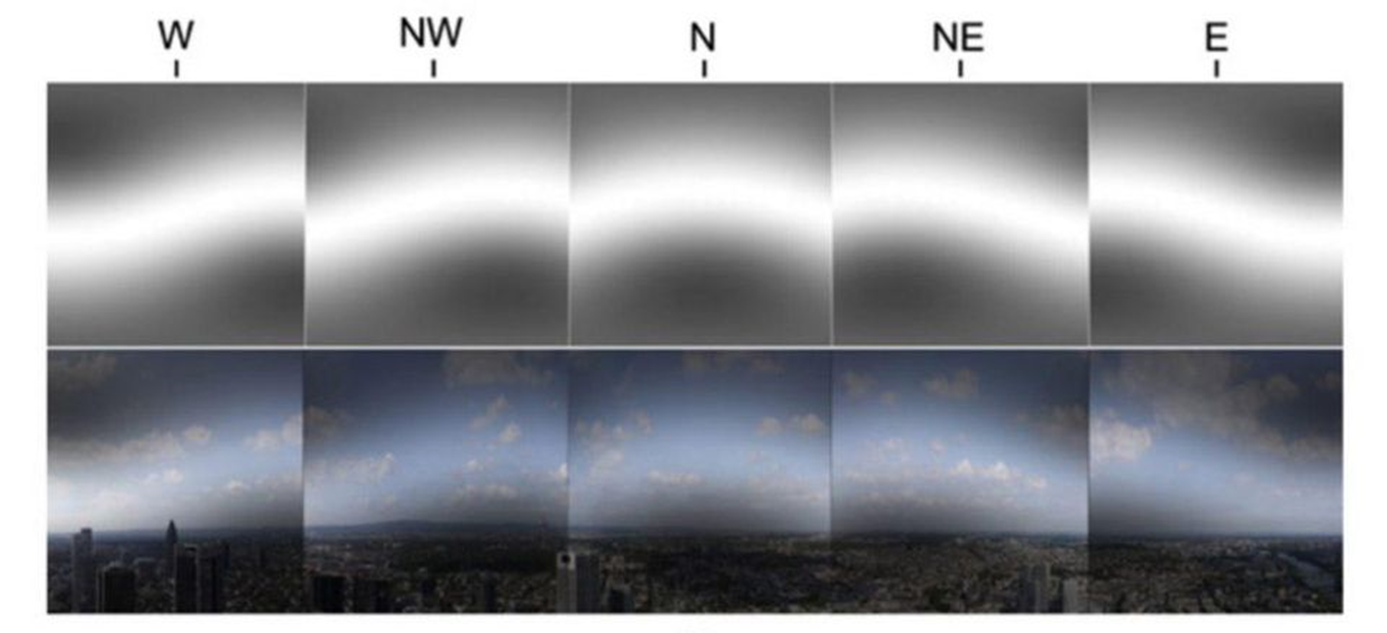
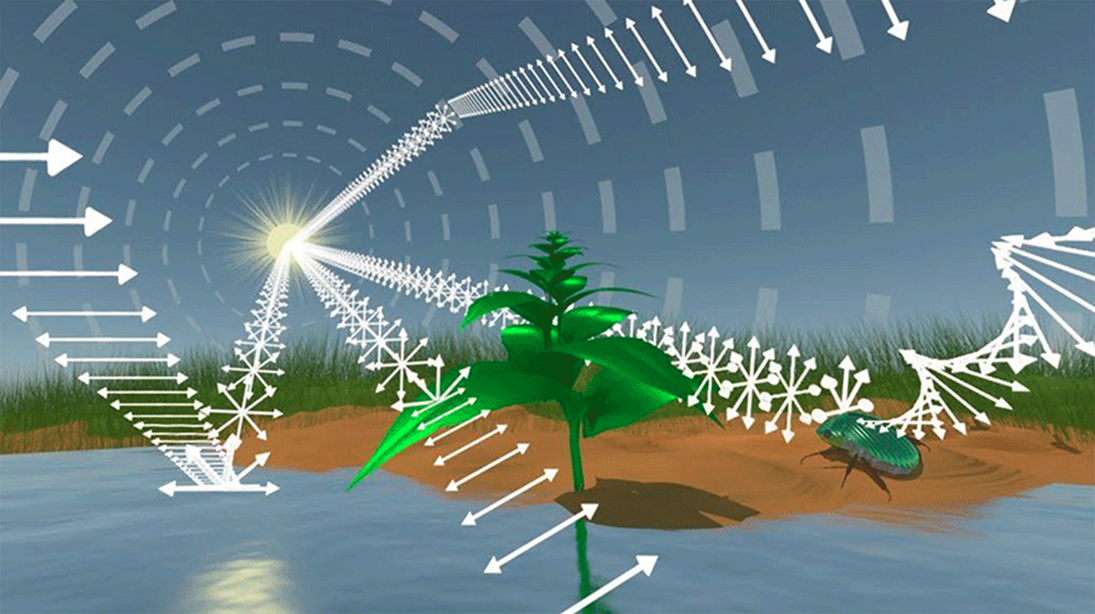
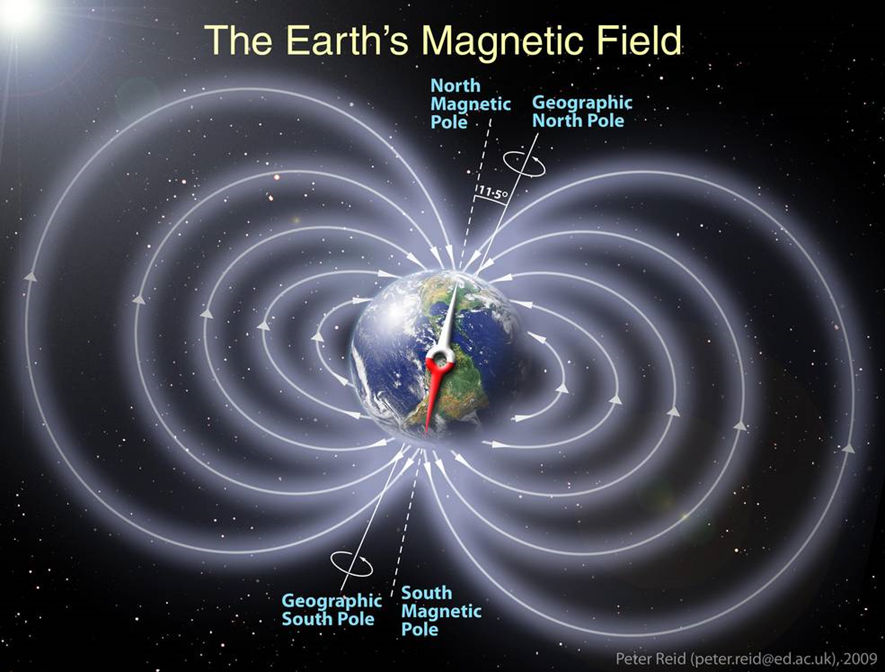
<ul><li><p>Geomagnetic cues </p><ul><li><p>birds use Earth’s magnetic field</p><ul><li><p>flow of liquid iron in Earth's core creates electric currents, which in turn creates the magnetic field</p></li><li><p>stronger magnetic “pull” at poles than toward the equator</p></li><li><p>cryptochrome 4 protein (cry4) is molecule that is sensitive to blue light and allows birds to “see” the magnetic field</p></li><li><p>cry4 proteins may produce a geomagnetic “filter” (top panel of figure) over a bird’s field of view (bottom panel)</p></li></ul></li></ul></li></ul><p></p>
67
New cards
<p>Orientation cues</p>

Orientation cues

  • Polarized light cues

    • pattern of polarized light at sunset used to set N-S compass

      • polarized light travels in one plane; caused by reflection off surfaces and scattering by atmosphere

      • direct sunlight is unpolarized

  • How migrating birds appear to use polarized light

    • maximum polarization occurs in a band 90° from the sun

      • at noon, maximum polarization is a band around the horizon (A)

      • at dusk and dawn, maximum polarization is band defined by the North-Zenith-South plane (B)

  • nocturnal migrants start migration shortly after sunset and end at dawn

    • Muheim et al. (2006) suggest birds calibrate their magnetic compass based on averaged polarized light patterns at sunset and sunrise

      • when sparrows exposed to artificial polarized light in East-West arc

      • birds recalibrated their North-South axis based on the artificial polarized light
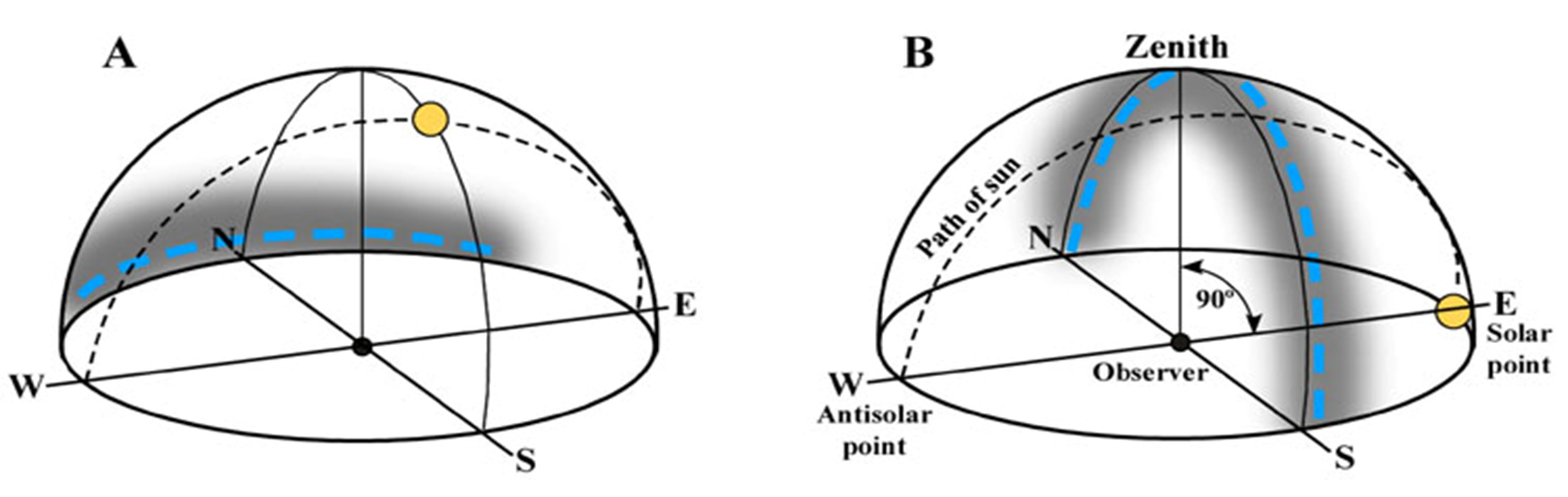
<ul><li><p>Polarized light cues</p><ul><li><p>pattern of polarized light at sunset used to set N-S compass</p><ul><li><p>polarized light travels in one plane; caused by reflection off surfaces and scattering by atmosphere</p></li><li><p>direct sunlight is unpolarized</p></li></ul></li></ul></li><li><p>How migrating birds appear to use polarized light</p><ul><li><p>maximum polarization occurs in a band 90° from the sun</p><ul><li><p>at noon, maximum polarization is a band around the horizon (A)</p></li><li><p>at dusk and dawn, maximum polarization is band defined by the North-Zenith-South plane (B)</p></li></ul></li></ul></li><li><p>nocturnal migrants start migration shortly after sunset and end at dawn</p><ul><li><p>Muheim et al. (2006) suggest birds calibrate their magnetic compass based on averaged polarized light patterns at sunset and sunrise</p><ul><li><p>when sparrows exposed to artificial polarized light in East-West arc</p></li><li><p>birds recalibrated their North-South axis based on the artificial polarized light</p></li></ul></li></ul></li></ul><p></p><p></p>
68
New cards

Orientation and navigation in birds, what’s learned, what’s innate?

  • genetically controlled:

    • zugunruhe

    • pace and duration of migration

    • ability to use geomagnetic compass and polarized light to orient

  • learned

    • how to use solar compass, celestial compass, olfactory cues, and possibly visual landmarks (learned during initial migration)

      • if pigeons wear magnets on first homing flight (altering their sense of geomagnetic field), they are unable to navigate correctly thereafter

69
New cards

Sex determination

  • sex is determined genetically

    • males are homogametic (ZZ)

    • females are heterogametic (ZW)

  • sex-specific development of song is associated with Z-linked gene in songbirds

    • singing controlled by high vocal center (HVC)

    • HVC is larger in male brains; occurs early in development

    • HVC development caused by z-linked gene for receptor of neurotransmitter (called brain-derived neurotrophic factor, BDNF)
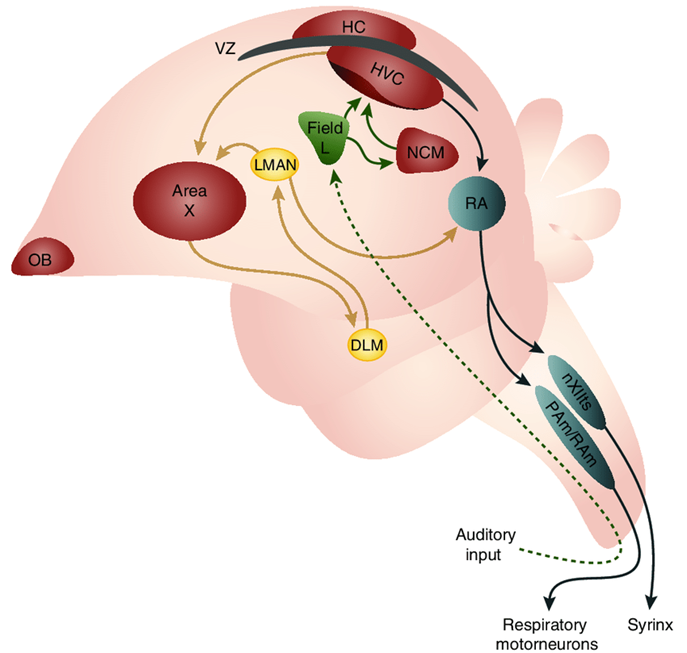
<ul><li><p>sex is determined genetically</p><ul><li><p>males are homogametic (ZZ)</p></li><li><p>females are heterogametic (ZW)</p></li></ul></li><li><p>sex-specific development of song is associated with Z-linked gene in songbirds</p><ul><li><p>singing controlled by high vocal center (HVC) </p></li><li><p>HVC is larger in male brains; occurs early in development</p></li><li><p>HVC development caused by z-linked gene for receptor of neurotransmitter (called brain-derived neurotrophic factor, BDNF)</p></li></ul></li></ul><p></p>
70
New cards

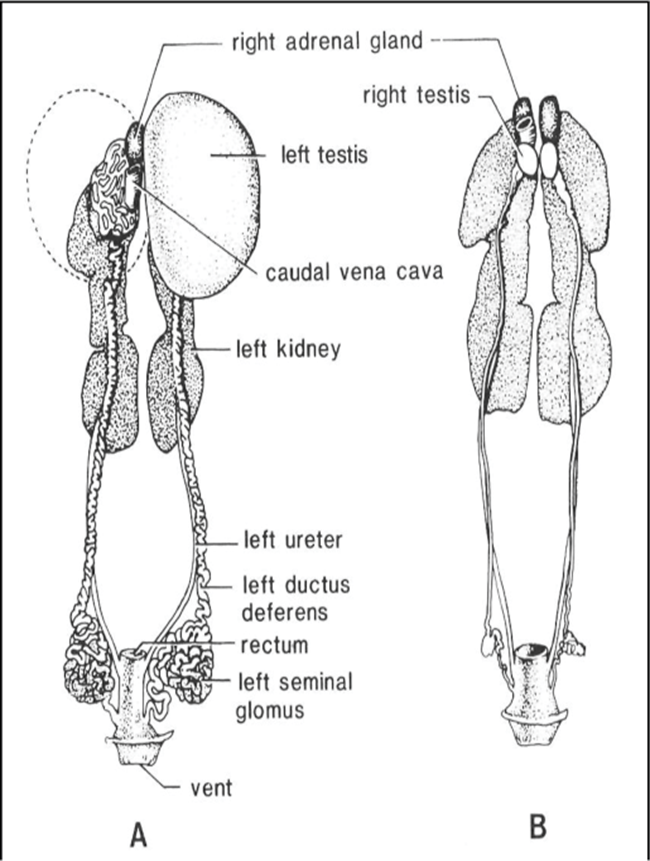
Male reproductive system

  • paired testes; shrink after breeding

  • no true external genitalia in most species; males have swollen cloacal protuberance

    • copulation occurs with cloacal (vent) contact
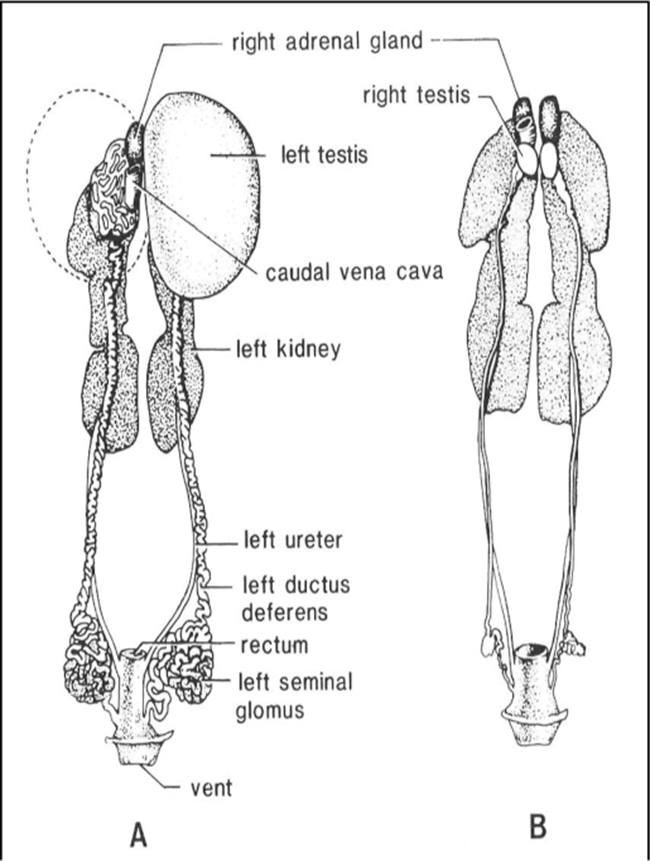
<ul><li><p>paired testes; shrink after breeding</p></li><li><p>no true external genitalia in most species; males have swollen cloacal protuberance</p><ul><li><p>copulation occurs with cloacal (vent) contact</p></li></ul></li></ul><p></p>
71
New cards

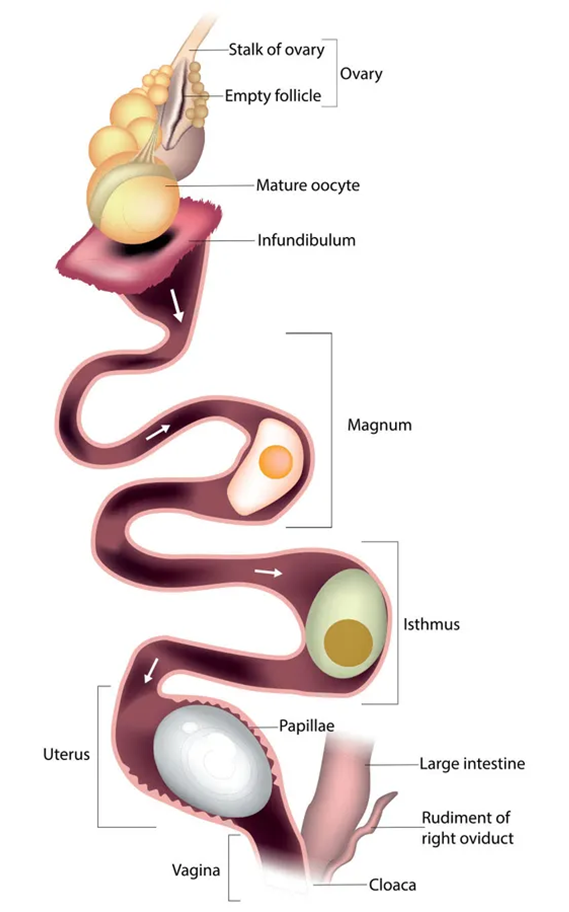
Female reproductive system

  • single (left) ovary, except raptors

  • ovary larger in breeding season than in non-breeding season
<ul><li><p>single (left) ovary, except raptors</p></li><li><p>ovary larger in breeding season than in non-breeding season</p></li></ul><p></p>
72
New cards
<p>Egg structure</p>

Egg structure

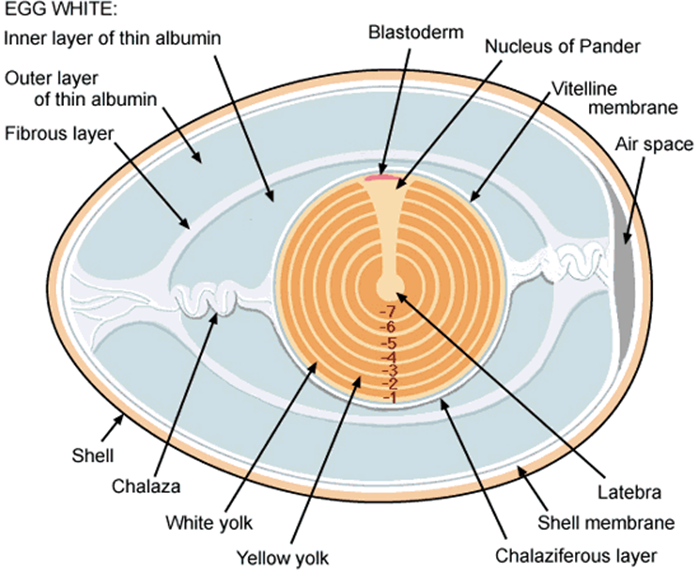
  • eggs develop in 24 hours; 1 egg/day

  • embryo develops on top of yolk

  • yolk is rich in fat, protein, and other nutrients

  • albumen: water supply, shock absorber, prevents rapid cooling of egg when not being incubated

  • 3-layed shell:

    • hard outer layer is calcium carbonate embedded in a collagen lattice

    • 2 inner membranes to which shell adheres
<ul><li><p>eggs develop in 24 hours; 1 egg/day</p></li><li><p>embryo develops on top of yolk</p></li><li><p><u>yolk</u> is rich in fat, protein, and other nutrients</p></li><li><p><u>albumen</u>: water supply, shock absorber, prevents rapid cooling of egg when not being incubated</p></li><li><p><span>3-layed <u>shell</u>:</span></p><ul><li><p>hard outer layer is calcium carbonate embedded in a collagen lattice</p></li><li><p>2 inner membranes to which shell adheres</p></li></ul></li></ul><p></p>
73
New cards

Egg extraembryonic membranes

  • amnion: surrounds embryo; holds amniotic fluid in which embryo sits

  • chorion: surrounds embryo and yolk; functions in gas exchange

  • allantois: sac growing from embryo that fuses with chorion for gas exchange and stores uric acid (waste) produced by the embryo

  • yolk sac: vascularize membrane around yolk; aids in absorption of nutrients from yolk
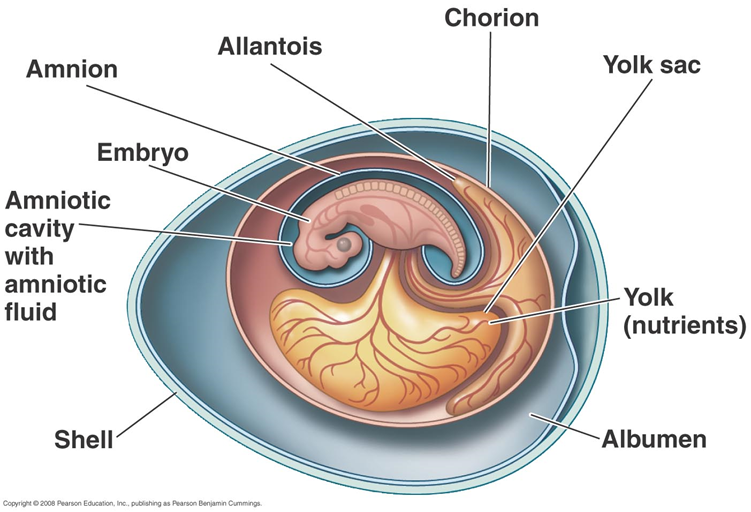
<ul><li><p><u>amnion</u>: surrounds embryo; holds amniotic fluid in which embryo sits</p></li><li><p><u>chorion</u>: surrounds embryo and yolk; functions in gas exchange</p></li><li><p><u>allantois</u>: sac growing from embryo that fuses with chorion for gas exchange and stores uric acid (waste) produced by the embryo</p></li><li><p><u>yolk sac</u>: vascularize membrane around yolk; aids in absorption of nutrients from yolk </p></li></ul><p></p>
74
New cards

Egg laying

  • egg-laying interval constrained:

    • time required to produce the egg (about 24 hours)

    • need to reduce weight for flight

  • can adjust egg size and number

    • increase volume of eggs when mated with low-quality male

    • clutch sizes vary between and within species

    • clutch size should maximize lifetime reproductive success
<ul><li><p>egg-laying interval constrained:</p><ul><li><p>time required to produce the egg (about 24 hours)</p></li><li><p>need to reduce weight for flight</p></li></ul></li><li><p>can adjust egg size and number </p><ul><li><p>increase volume of eggs when mated with low-quality male</p></li><li><p>clutch sizes vary between and within species</p></li><li><p>clutch size should maximize lifetime reproductive success</p></li></ul></li></ul><p></p>
75
New cards

Egg coloration

  • primary explanation for many egg colors and patterns:

    • camouflage

      • generally, nests in cavities have white eggs, whereas open nests are cryptically patterned

      • but... too many exceptions to be the only explanation

    • other explanations for many egg colors and patterns:

      • signal of female quality (e.g., Pied Flycatcher egg brightness associated with immunocompetence)
<ul><li><p>primary explanation for many egg colors and patterns:</p><ul><li><p>camouflage</p><ul><li><p>generally, nests in cavities have white eggs, whereas open nests are cryptically patterned</p></li><li><p>but... too many exceptions to be the only explanation</p></li></ul></li><li><p>other explanations for many egg colors and patterns:</p><ul><li><p>signal of female quality (e.g., Pied Flycatcher egg brightness associated with immunocompetence)</p></li></ul></li></ul></li></ul><p></p>
76
New cards

Brood parasitism

  • within species (e.g., egg dumping in ducks) or between species (e.g., cowbirds and cuckoos laying in “host” nests)

    • egg dumping: deposit 1-2 eggs into conspecific nests as “insurance”

    • obligate brood parasitism: lay eggs in nests of other species and leave the young to be raised by “host”
<ul><li><p>within species (e.g., egg dumping in ducks) or between species (e.g., cowbirds and cuckoos laying in “host” nests)</p><ul><li><p><u>egg dumping</u>: deposit 1-2 eggs into conspecific nests as “insurance” </p></li><li><p><u>obligate brood parasitism</u>: lay eggs in nests of other species and leave the young to be raised by “host”</p></li></ul></li></ul><p></p>
77
New cards

Egg development

  • incubation

    • optimal temp: 37-38o C (100o F)

    • too hot is lethal, too cold slows development

    • in most species, only female incubates; heat transferred through brood patch

      • male penguins place eggs on feet to keep eggs warm

      • megapodes (e.g., brush turkeys) use heat produced by decomposition of organic matter
<ul><li><p>incubation</p><ul><li><p>optimal temp: 37-38o C (100o F)</p></li><li><p>too hot is lethal, too cold slows development</p></li><li><p>in most species, only female incubates; heat transferred through brood patch</p><ul><li><p>male penguins place eggs on feet to keep eggs warm</p></li><li><p>megapodes (e.g., brush turkeys) use heat produced by decomposition of organic matter</p></li></ul></li></ul></li></ul><p></p>
78
New cards

Precocial Hatchlings

  • young leave nest after hatching; can feed themselves

    • e.g., Anseriformes, Galliformes, Charadriiformes
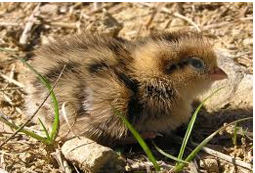
<ul><li><p>young leave nest after hatching; can feed themselves</p><ul><li><p>e.g., Anseriformes, Galliformes, Charadriiformes</p></li></ul></li></ul><p></p>
79
New cards

Altricial hatchlings

  • young naked, blind, helpless; require much parental care

    • e.g., Passeriformes, Falconiformes, Piciformes, Apodiformes
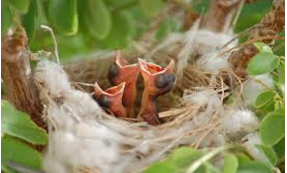
<ul><li><p>young naked, blind, helpless; require much parental care</p><ul><li><p>e.g., Passeriformes, Falconiformes, Piciformes, Apodiformes</p></li></ul></li></ul><p></p>
80
New cards

Why have altricial hatchlings?

  • precocial development is primitive; altricial evolved independently in several taxa

  • altricial may be associated with learning:

    • precocial: large brains at hatching, but adult has relatively small brain

    • altricial: much post-hatch brain development; adults proportionately large brains
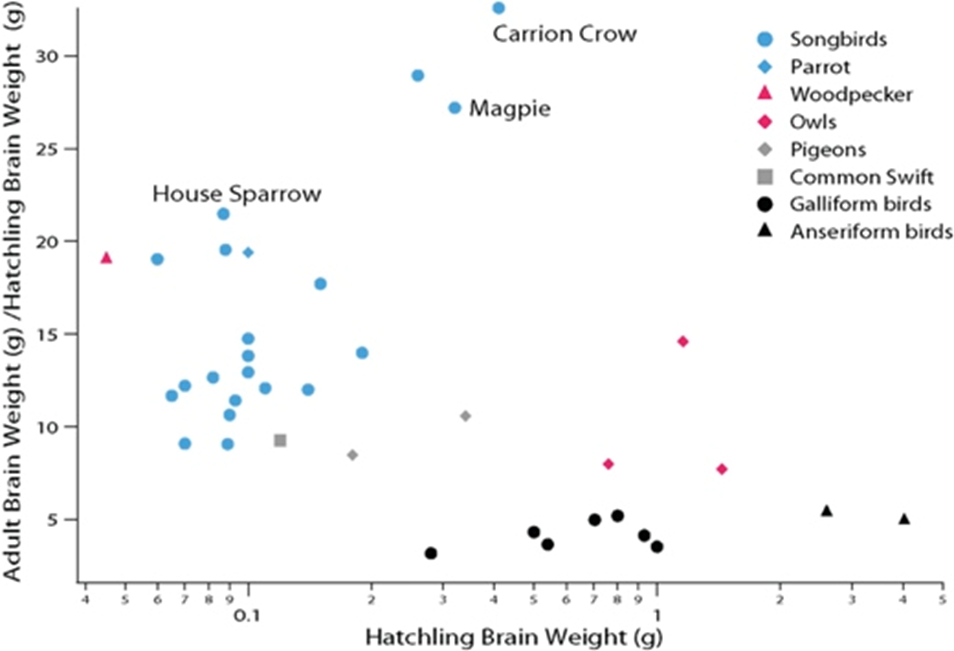
<ul><li><p>precocial development is primitive; altricial evolved independently in several taxa</p></li><li><p>altricial may be associated with learning:</p><ul><li><p><u>precocial</u>: large brains at hatching, but adult has relatively small brain</p></li><li><p><u>altricial</u>: much post-hatch brain development; adults proportionately large brains</p></li></ul></li></ul><p></p>
81
New cards
<p>Mating systems (monogomy)</p>

Mating systems (monogomy)

  • Monogamy (92% species)

    • 1 male socially bonded to 1 female; often defend territory

    • long pair bond; 1 season to lifetime

    • “divorce” more likely if reproductive failure occurs

      • parental care is shared (unevenly; females incubate and feed nestlings more frequently)

    • male and female reproductive success is similar

  • monogamy occurs when it’s the best strategy for both sexes

    • monogamy expected whenever...

      • males improve survival of young (e.g., gull parents take turns foraging and protecting young )

      • males (or females) cannot defend resources to attract multiple mates
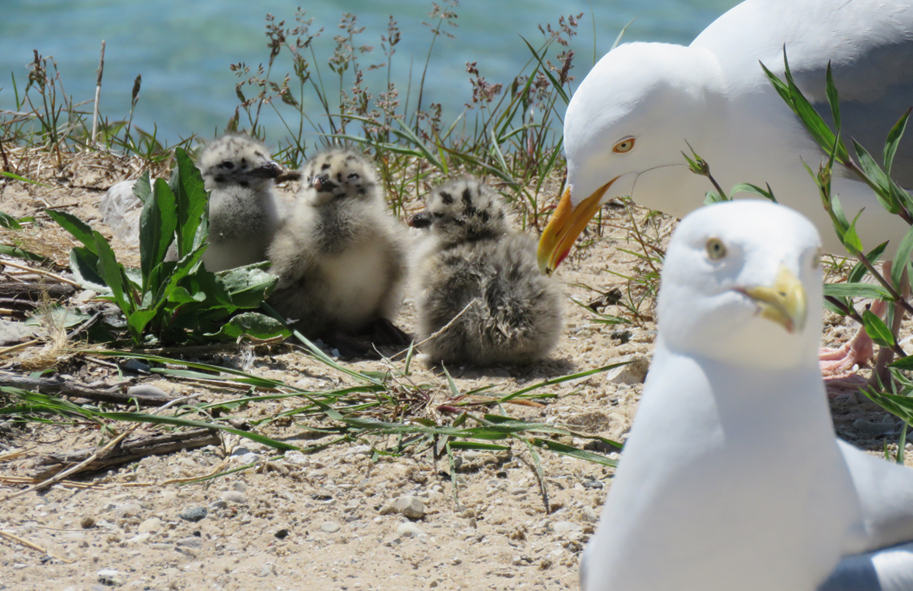
<ul><li><p>Monogamy (92% species)</p><ul><li><p>1 male socially bonded to 1 female; often defend territory</p></li><li><p>long pair bond; 1 season to lifetime</p></li><li><p>“divorce” more likely if reproductive failure occurs</p><ul><li><p>parental care is shared (unevenly; females incubate and feed nestlings more frequently)</p></li></ul></li><li><p>male and female reproductive success is similar</p></li></ul></li><li><p>monogamy occurs when it’s the best strategy for both sexes</p><ul><li><p>monogamy expected whenever...</p><ul><li><p>males improve survival of young (e.g., gull parents take turns foraging and protecting young )</p></li><li><p>males (or females) cannot defend resources to attract multiple mates</p></li></ul></li></ul></li></ul><p></p><p></p>
82
New cards

Extrapair copulations

  • monogamy is not “strict”

    • social monogamy ≠ genetic monogamy

    • extrapair copulations (EPCs) occur

      • 85% of monogamous bird species

      • 5-50% offspring from EPC

      • benefits of EPCs

        • males: higher reproductive success

        • females: benefit: better quality genes or access to better/more resources

      • males try to prevent EPCs with mate guarding and frequent copulations
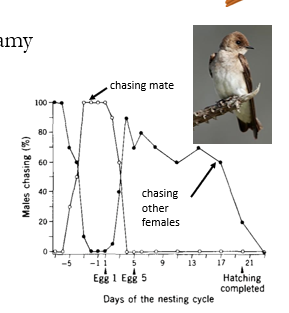
<ul><li><p>monogamy is not “strict”</p><ul><li><p>social monogamy ≠ genetic monogamy </p></li><li><p>extrapair copulations (EPCs) occur</p><ul><li><p>85% of monogamous bird species</p></li><li><p>5-50% offspring from EPC</p></li><li><p>benefits of EPCs</p><ul><li><p><u>males</u>: higher reproductive success</p></li><li><p><u>females</u>:  benefit: better quality genes or access to better/more resources</p></li></ul></li><li><p>males try to prevent EPCs with mate guarding and frequent copulations</p></li></ul></li></ul></li></ul><p></p>
83
New cards

Mating systems (polygyny)

  • polygyny is uncommon (3% of species)

    • 1 male mated to >1 female; pair bonds may or may not occur

    • usually occurs in habitats with high variation in territory quality

      • e.g., 13 of 14 N.A. songbirds that are polygynous nest in grasslands or marshes (e.g., Red-winged Blackbirds)

  • potential of polygyny increases as resources become clumped and economically defensible

    • good territories attracts multiple females, poor territories attracts only single female mate

    • males often provide less parental care to clutches of “secondary” females
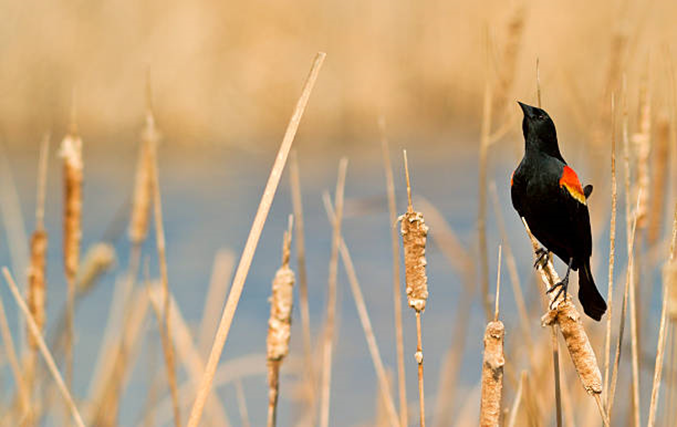
<ul><li><p>polygyny is uncommon (3% of species)</p><ul><li><p>1 male mated to &gt;1 female; pair bonds may or may not occur</p></li><li><p>usually occurs in habitats with high variation in territory quality</p><ul><li><p>e.g., 13 of 14 N.A. songbirds that are polygynous nest in grasslands or marshes (e.g., Red-winged Blackbirds)</p></li></ul></li></ul></li><li><p>potential of polygyny increases as resources become clumped and economically defensible</p><ul><li><p>good territories attracts multiple females, poor territories attracts only single female mate</p></li><li><p>males often provide less parental care to clutches of “secondary” females</p></li></ul></li></ul><p></p>
84
New cards

Mating systems (polyandry)

  • polyandry is extremely rare (1% of species)

    • 1 female mated to > 1 male; no extended pair bond

    • usually involves sex role reversal; males incubates and cares for young

    • primarily in Gruiformes and Charadriiformes

    • evolution of polyandry is difficult to explain (i.e., females have higher reproductive success, but what about males?)
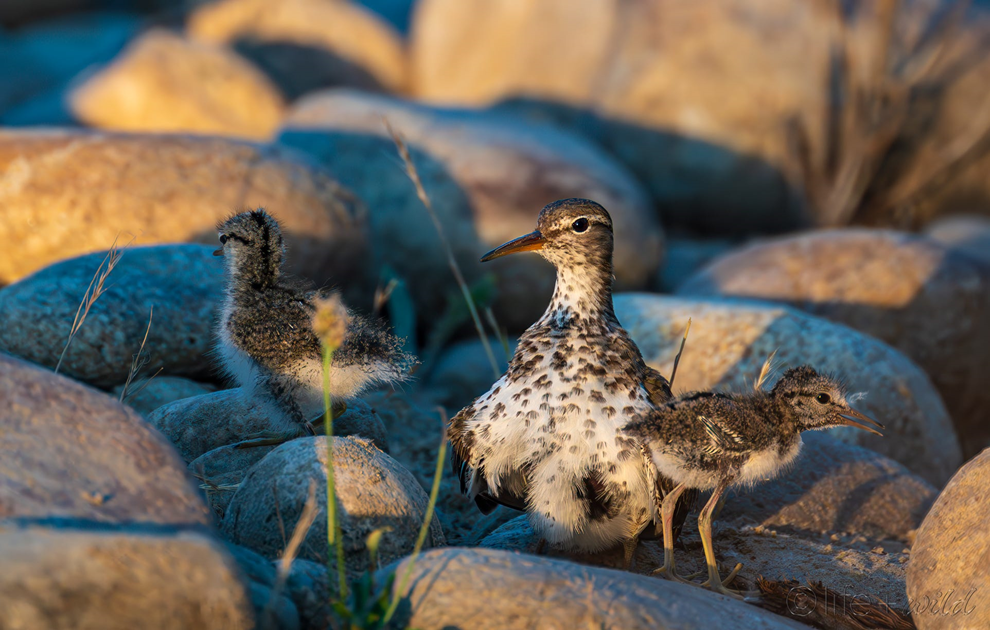
<ul><li><p>polyandry is extremely rare (1% of species)</p><ul><li><p>1 female mated to &gt; 1 male; no extended pair bond</p></li><li><p>usually involves sex role reversal; males incubates and cares for young</p></li><li><p>primarily in Gruiformes and Charadriiformes</p></li><li><p>evolution of polyandry is difficult to explain (i.e., females have higher reproductive success, but what about males?)</p></li></ul></li></ul><p></p>
85
New cards

Mating systems (polygynandry)

  • polygynandry is extremely rare (1% of species)

    • both sexes have multiple mates; short-term pair bonds form

      • e.g., Bicknell’s Thrush

        • females hold small, non-overlapping nesting territories

        • males and female mate with multiple partners

        • 2-4 males feed at a female’s nest (some males feed at multiple nests); but just 1 female per nest

        • high-quality territories have more fledglings, but fewer males feeding
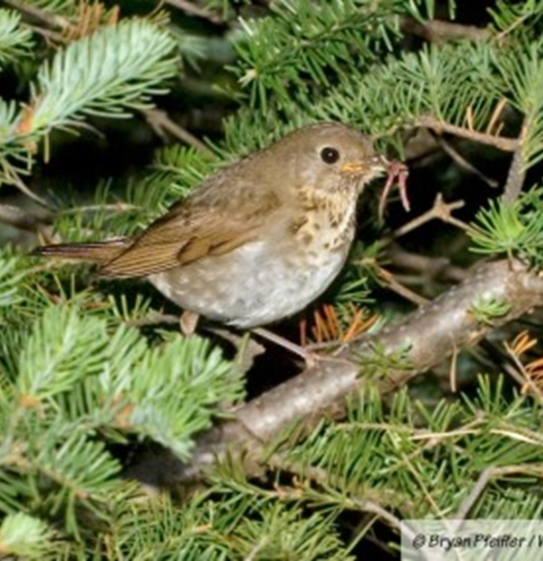
<ul><li><p>polygynandry is extremely rare (1% of species)</p><ul><li><p>both sexes have multiple mates; short-term pair bonds form</p><ul><li><p>e.g., Bicknell’s Thrush</p><ul><li><p>females hold small, non-overlapping nesting territories</p></li><li><p>males and female mate with multiple partners</p></li><li><p>2-4 males feed at a female’s nest (some males feed at multiple nests); but just 1 female per nest</p></li><li><p>high-quality territories have more fledglings, but fewer males feeding</p></li></ul></li></ul></li></ul></li></ul><p></p><p></p>
86
New cards

Mating systems (promiscuity)

  • promiscuity is infrequent (6% of species)

    • both sexes have multiple mates; no pair bonds

    • usually only the female provides parental care

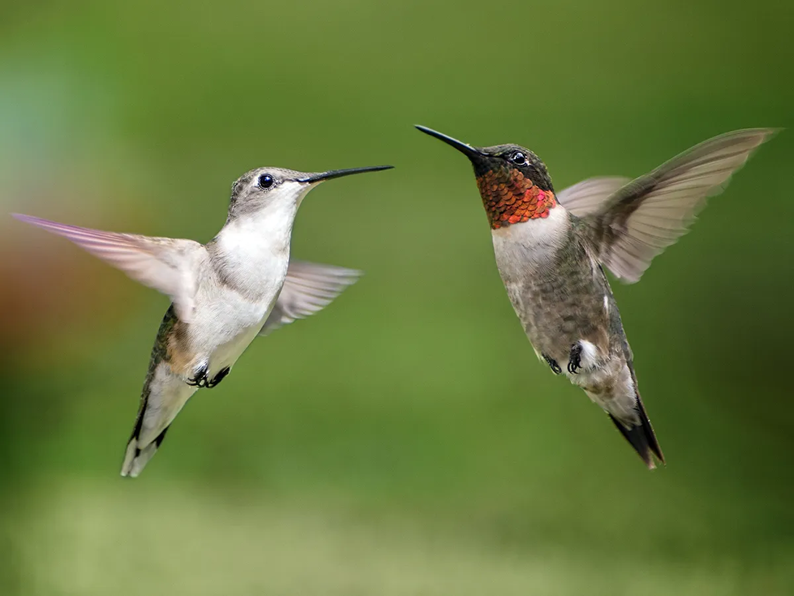
      • e.g., Ruby-throated Hummingbirds

<ul><li><p>promiscuity is infrequent (6% of species)</p><ul><li><p>both sexes have multiple mates; no pair bonds</p></li><li><p>usually only the female provides parental care</p><ul><li><p>e.g., Ruby-throated Hummingbirds</p></li></ul></li></ul></li></ul><p></p>
87
New cards

Leks

  • lek (mating sites and displays; not a mating system)

    • lek = aggregation of males that engage in competitive displays and courtship rituals that female observe

      • either a polygynous or promiscuity mating system; no pair bond formed

      • males display to females at traditional sites

      • lek site has no resources; females get sperm only

      • lek has many males (usually with elaborate traits)

      • male reproductive success is variable; less than 10% of males obtain more than 80% of the matings!

      • females provide all the parental care

88
New cards

Exploded leks

few males display in several leks separated by relatively short distances (e.g., American Woodcock)

89
New cards

Cooperative leks

groups of males display to attract females, but only dominant male mates (e.g., manakins)

90
New cards

Sexual selection

  • birds are anisogamous

    • anisogamy = production of different-sized gametes by males and females (i.e., tiny sperm and large eggs)

    • operational sex ratio = number of males and females available for mating at a given time

    • anisogamy and operational sex ratio cause males and females to maximize reproductive success differently
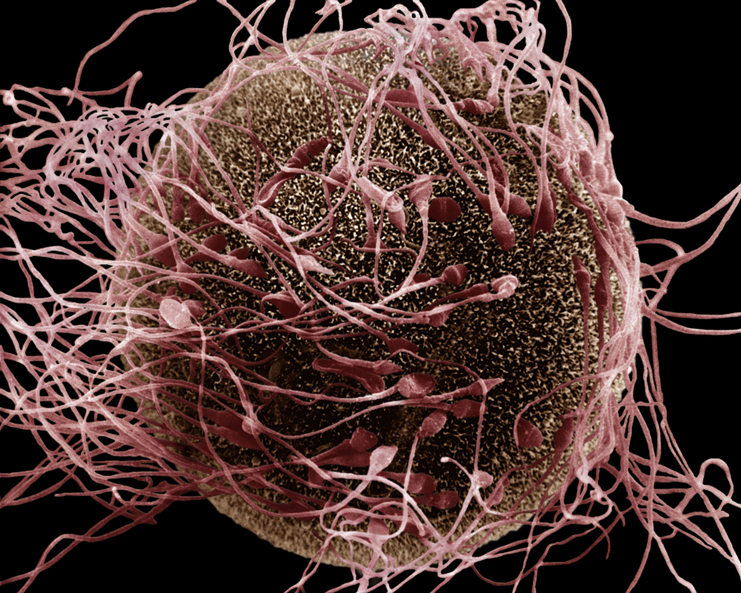
<ul><li><p>birds are anisogamous</p><ul><li><p><u>anisogamy</u> = production of different-sized gametes by males and females (i.e., tiny sperm and large eggs)</p></li><li><p><u>operational sex ratio</u> = number of males and females available for mating at a given time</p></li><li><p>anisogamy and operational sex ratio cause males and females to maximize reproductive success differently</p></li></ul></li></ul><p></p>
91
New cards

Fundamental asymmetry of the sexes (female)

  • females (usually):

    • produce few, large, energetically expensive eggs

    • usually provide considerable parental care

    • so... female reproductive success is limited by the number of eggs she can produced and raise successfully

    • natural selection should favor female traits that enhance the quality of offspring (i.e., improve offspring survival and reproduction)

      • females must invest carefully in each of her relatively few eggs

92
New cards

Fundamental asymmetry of the sexes (male)

  • males (usually):

    • produce numerous, energetically inexpensive sperm

    • typically spend less time with eggs and offspring

    • male reproductive success is limited by number of mates

    • natural selection should favor male traits that improve the chance of producing many offspring

93
New cards

Sexual selection

  • a special case of natural selection: sexual selection

    • sexual selection: natural selection acting on traits involved in obtaining mates

      • fundamental asymmetry of sex predicts:

        • members of rarer sex (in breeding season) that provide more parental care are “choosy” about mates

          • usually females

        • members of more abundant sex (in breeding season) that provides less parental care typically compete for mates

          • usually males

        • sexual selection produces sexual dimorphism

          • sexual dimorphism: differences in morphology of sexes

          • e.g., sexual dimorphism in Wood Ducks and Scarlet Tanagers
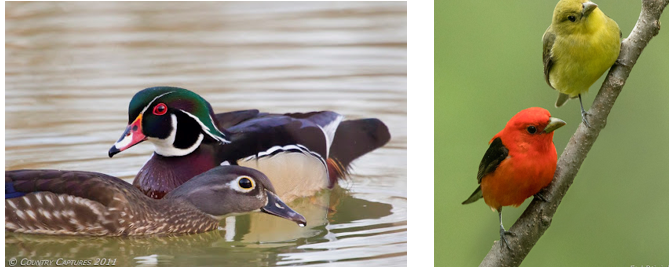
<ul><li><p>a special case of natural selection: sexual selection</p><ul><li><p><u>sexual selection</u>: natural selection acting on traits involved in obtaining mates</p><ul><li><p>fundamental asymmetry of sex predicts:</p><ul><li><p>members of rarer sex (in breeding season) that provide more parental care are “choosy” about mates</p><ul><li><p>usually females</p></li></ul></li><li><p>members of more abundant sex (in breeding season) that provides less parental care typically compete for mates</p><ul><li><p>usually males</p></li></ul></li><li><p>sexual selection produces sexual dimorphism</p><ul><li><p><u>sexual dimorphism</u>: differences in morphology of sexes </p></li><li><p>e.g., <span>sexual dimorphism in Wood Ducks and Scarlet Tanagers</span></p></li></ul></li></ul></li></ul></li></ul></li></ul><p></p>
94
New cards

Intrasexual selection

selection for traits that enhance within-sex mating interactions; (usually) male competition for mates

95
New cards

Intersexual selection

selection for traits that improve between-sex mating interactions; (usually) female choice of mates

96
New cards

How do males compete for mates?

  • mating displays (e.g., lekking sage grouse)

  • defend territories for breeding and foraging; involves chases, singing, and sometimes fights
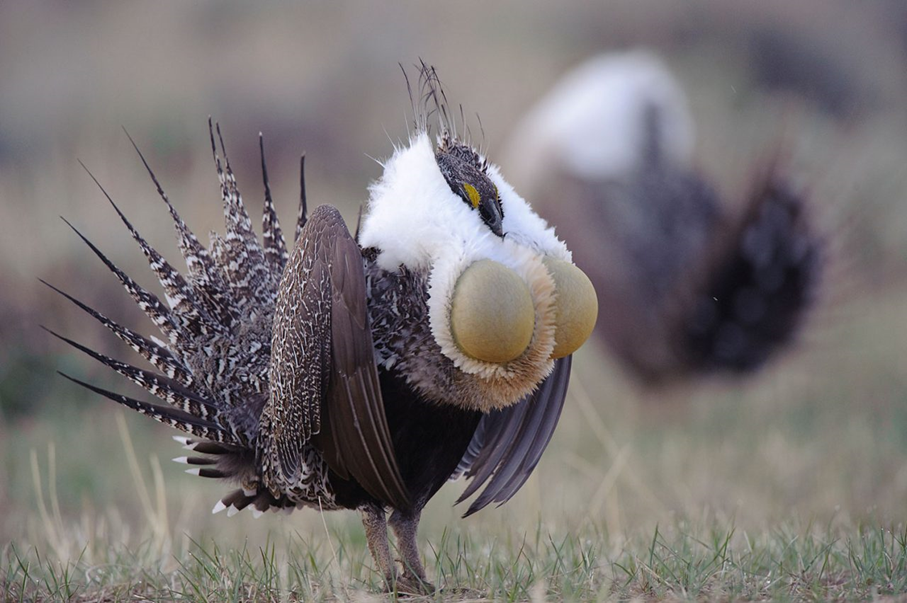
<ul><li><p>mating displays (e.g., lekking sage grouse) </p></li><li><p>defend territories for breeding and foraging; involves chases, singing, and sometimes fights </p></li></ul><p></p>
97
New cards

What is the female basis of choice in mates?

  • resources provided by males, such as nest sites and food

  • genetic benefits: males with ‘good’ genes that enhance offspring survival or reproductive success
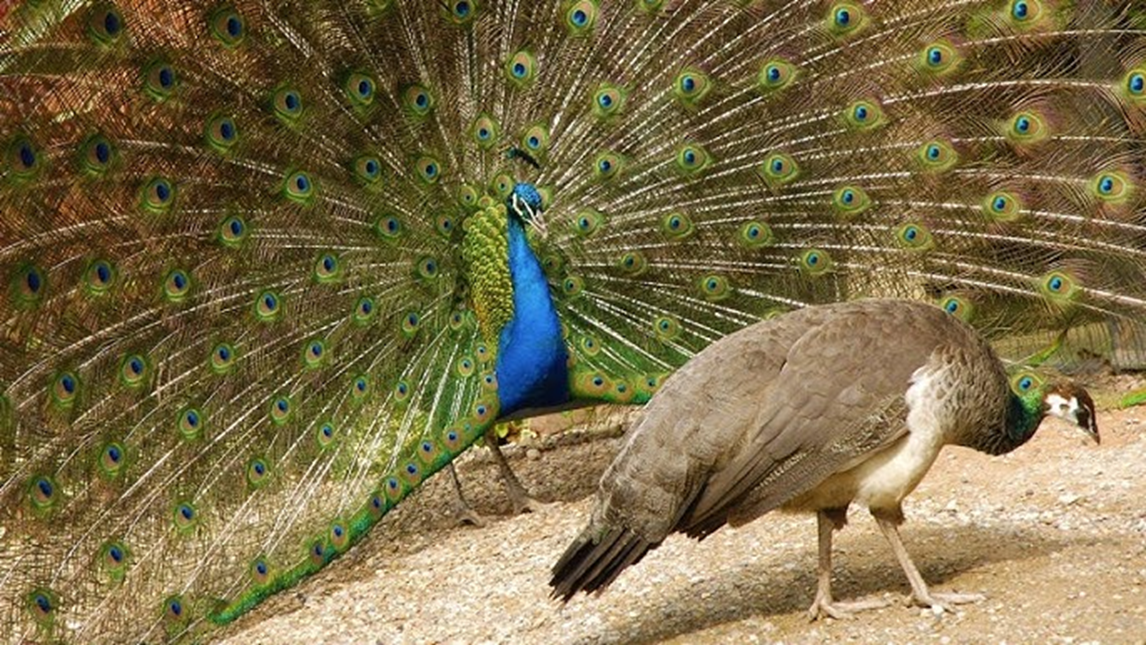
<ul><li><p>resources provided by males, such as nest sites and food</p></li><li><p>genetic benefits: males with ‘good’ genes that enhance offspring survival or reproductive success</p></li></ul><p></p>
98
New cards
<p><span>Resources provided by males</span></p>

Resources provided by males

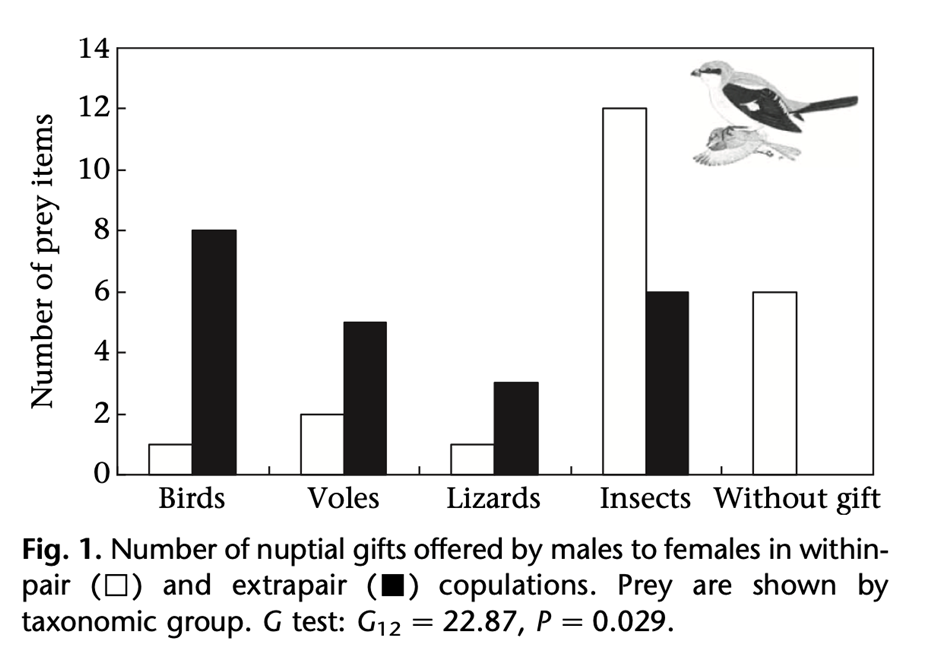
  • food (i.e., “nuptial gifts”)

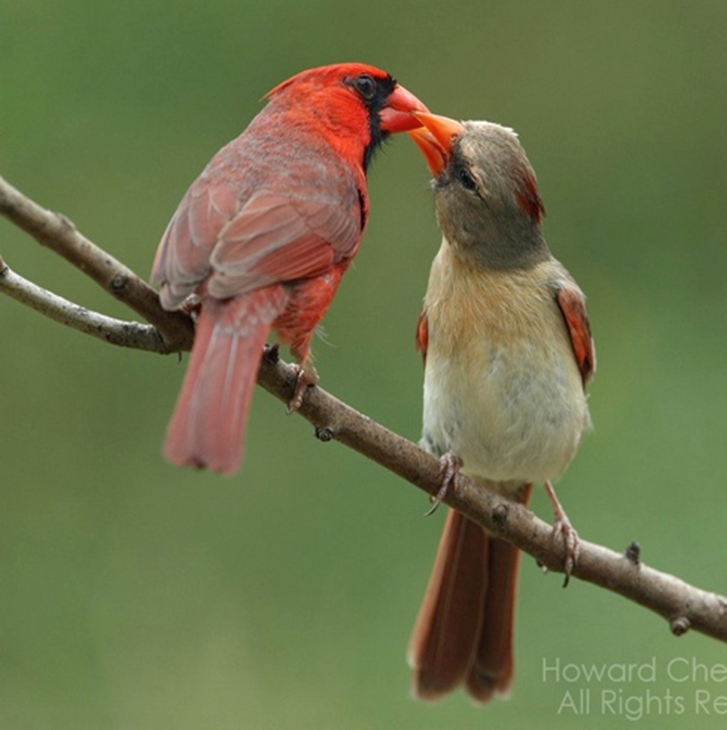
    • e.g., female Arctic Terns are more likely to pair with males with high-quality nuptial gifts

    • e.g., Great Grey Shrikes

      • male with larger caches preferred by females

      • males more likely to obtain EPCs if offer largest prey items to female

  • territories with nesting sites

    • e.g., nest sites in territories of Red-winged Blackbirds

      • females selected males with nest sites overhanging water (an indicator of territory quality)

      • females selected males with best territories, even if already mated

    • polygyny threshold model: polygynous mating is costly to females; cost of polygyny accepted if compensated by a superior territory or male

  • parental care

    • e.g., female Sedge Warblers select males with large song repertoires as social mates

      • repertoire size positively associated with with male parental care and chick weight
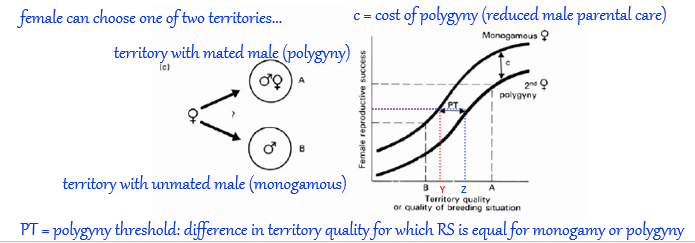
<ul><li><p>food (i.e., “nuptial gifts”) </p><ul><li><p>e.g., female Arctic Terns are more likely to pair with males with high-quality nuptial gifts</p></li><li><p>e.g., Great Grey Shrikes</p><ul><li><p>male with larger caches preferred by females</p></li><li><p>males more likely to obtain EPCs if offer largest prey items to female</p></li></ul></li></ul></li><li><p>territories with nesting sites</p><ul><li><p>e.g., nest sites in territories of Red-winged Blackbirds</p><ul><li><p>females selected males with nest sites overhanging water (an indicator of territory quality)</p></li><li><p>females selected males with best territories, even if already mated</p></li></ul></li><li><p><u>polygyny threshold model</u>: polygynous mating is costly to females;  cost of polygyny accepted if compensated by a superior territory or male</p></li></ul></li><li><p>parental care </p><ul><li><p>e.g., female Sedge Warblers select males with large song repertoires as social mates</p><ul><li><p>repertoire size positively associated with with male parental care and chick weight</p></li></ul></li></ul></li></ul><p></p><p></p><p></p><p></p>
99
New cards

Genetic benefits to females

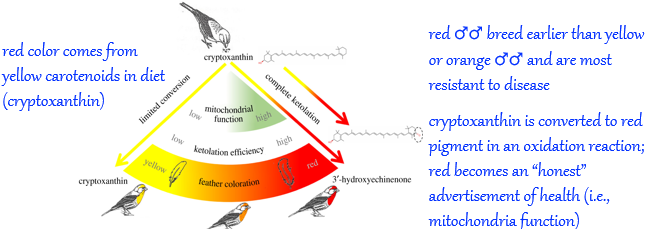
  • condition-dependent traits: “honest” advertisement of male performance or genetic quality

    • e.g., red color in male house finches

  • male songs as condition-dependent traits

    • e.g., swamp sparrow produce trills as part of song

      • trills involve sound at multiple frequencies with rapid vocal tract movements

      • vocal performance: upper limit to trade-off between trill rate and frequency

      • ︎ solicited more to ︎ with high vocal performance

<ul><li><p><u>condition-dependent traits</u>: “honest” advertisement of male performance or genetic quality</p><ul><li><p>e.g., red color in male house finches</p></li></ul></li><li><p>male songs as condition-dependent traits</p><ul><li><p>e.g., swamp sparrow produce trills as part of song</p><ul><li><p>trills involve sound at multiple frequencies with rapid vocal tract movements</p></li><li><p>vocal performance: upper limit to trade-off between trill rate and frequency </p></li><li><p><span data-name="female" data-type="emoji">♀</span>︎<span data-name="female" data-type="emoji">♀</span>︎ solicited more to <span data-name="male" data-type="emoji">♂</span>︎<span data-name="male" data-type="emoji">♂</span>︎ with high vocal performance</p></li></ul></li></ul></li></ul><p></p>
100
New cards
<p>Handicap hypothesis</p>

Handicap hypothesis

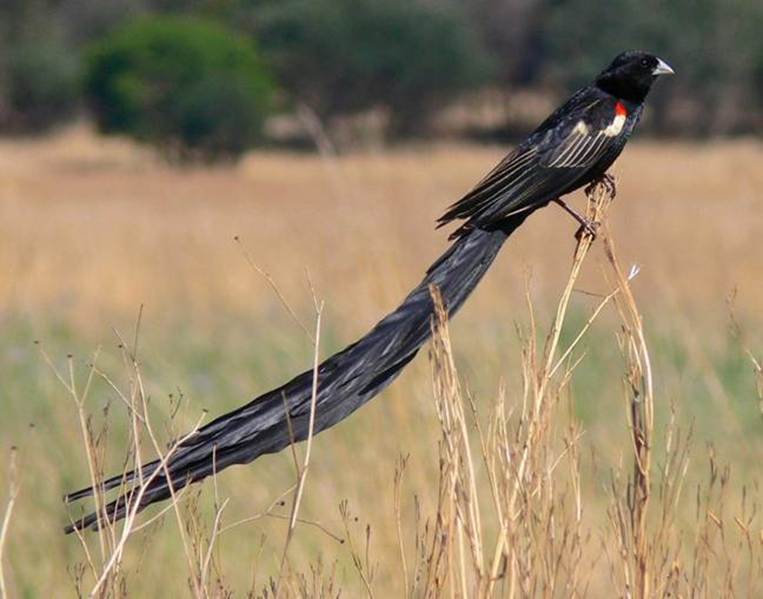
  • elaborate traits are survival burden; males’ ability to survive is reliable signal of “good genes” (e.g., Long-tailed Widowbirds)

    • experimental evidence that females prefer long tails in Long-tailed Widowbirds

      • males with elongated tails had more mates
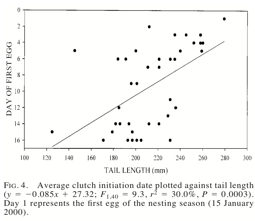
<ul><li><p>elaborate traits are survival burden; males’ ability to survive is reliable signal of “good genes” (e.g., Long-tailed Widowbirds)</p><ul><li><p>experimental evidence that females prefer long tails in Long-tailed Widowbirds</p><ul><li><p>males with elongated tails had more mates</p></li></ul></li></ul></li></ul><p></p>