Spectroscopy (exam 3)
 Call Kai
 Learn
Learn Practice Test
 Spaced Repetition
 Match
Match Flashcards
 Knowt Play
1/44

Earn XP
Description and Tags
Learning outcomes
Name | Mastery | Learn | Test | Matching | Spaced | Call with Kai |
|---|
No analytics yet
Send a link to your students to track their progress
45 Terms
The particle characteristics of electromagnetic radiation is associated with
the emission and absorption of energy that causes breaking/ionization (X-rays), excitation (UV rays), vibration (IR rays) and rotation (Microwaves) of electrons.
The particle characteristics of electromagnetic radiation is associated with (eqns)
E=hv = (hc)/lamda = hc(wavenumber) where h=6.626 x 10⁻³⁴ Js
The wave characteristics of electromagnetic radiation is associated with
the frequency and wavelength of electrons that causes the diffraction, refraction and reflection of light
The wave characteristics of electromagnetic radiation is associated with (eqns)
v*lamda=c where the speed of light is c/n(value of refractive index) in any medium that is not a vacuum
Acronym for remembering ER order
Gay Xylophones United Very Interestingly, Maybe Rationally
Gamma Rays frequency (Hz) and wavelength (m)
1020 and 10-11
X-Rays frequency (Hz) and wavelength (m)
1018 and 10-10 - 9
UV Rays frequency (Hz) and wavelength (m)
1016 and 10-8 - 7
Visible Rays frequency (Hz) and wavelength (m)
1015 and 10-6
IR Rays frequency (Hz) and wavelength (m)
1014-12 and 10-6-3
Microwaves frequency (Hz) and wavelength (m)
1011-10 and 10-3-1
Radiowaves frequency (Hz) and wavelength (m)
109 and 10-1
Violet wavelength
~400nm
Blue wavelength
~475-500nm
Green wavelength
~510-550nm
Yellow wavelength
~560-590nm
Orange wavelength
~600-650nm
Red wavelength
~650-800nm
Beer’s Law
A=BCE
What does the molar absorptivity vary with for a molecule?
Wavelength of light, solvent, temperature and molecular structure.
Molar absorptivity indicates
a substance’s ability/strength to absorb light
What wavelength in a compounds abs spectrum is best to choose if doing a study of the compounds concentration in various solutions?
Lamda max is the point in the spectrum at which there is the highest sensitivity, best signal:noise and beer’s law is best followed
Under what circumstances does Beer’s Law fail?
At high analyte concentrations there is electrostatic interactions between molecules; when using polychromatic radiation, there is large bandwidth and varying E values; when there is an non-homogenous mixture, light can scatter to disrupt absorption readings; dissociation/association with solvent can cause disruption; simple instrument error with stray light can all contribute to beer law limitations.
Describe the sources of error which dominate spectrophotometric measurements at low and high abs?
Absorption is preferred between 0.4 to 0.9 as this is the range in which instruments technically work the best. Lower than 0.4 leads to P approaching P0 which requires higher instrument sensitivity to observe. Higher than 0.9 leads to very small P which stray light can then directly compete with, increasing error in calculations/absorption measurements.
Describe what happens when a molecule absorbs light?
Depending on the wavelength of light it has absorbed, it undergoes a molecular movement specific to that region of light as energy is captured as a photon to excite electrons from a low-energy state into an higher-energy state.
Discuss the difference between electronic excited states, vibrational excited states, and rotational excited states?
Each excited state is established due to a molecule absorbing a different radiation of light (different amounts of energy was absorbed and emitted) causing different molecular motions.
Know how to use a calibration curve generated USING LINEAR REGRESSION on your calculator to determine an unk conc from its abs?
Set concentration as x and absorbance as y and solve
What is the difference between a Singlet and Triplet excited state?
Singlet states (S) have paired electrons (0 total spin) and decay quickly via fluorescence, while triplet states (T) have parallel unpaired electrons (present spin) and decay slowly through phosphorescence, making them longer-lived.
Be able to duplicate and discuss all the processes on “Jablonski” energy diagram.
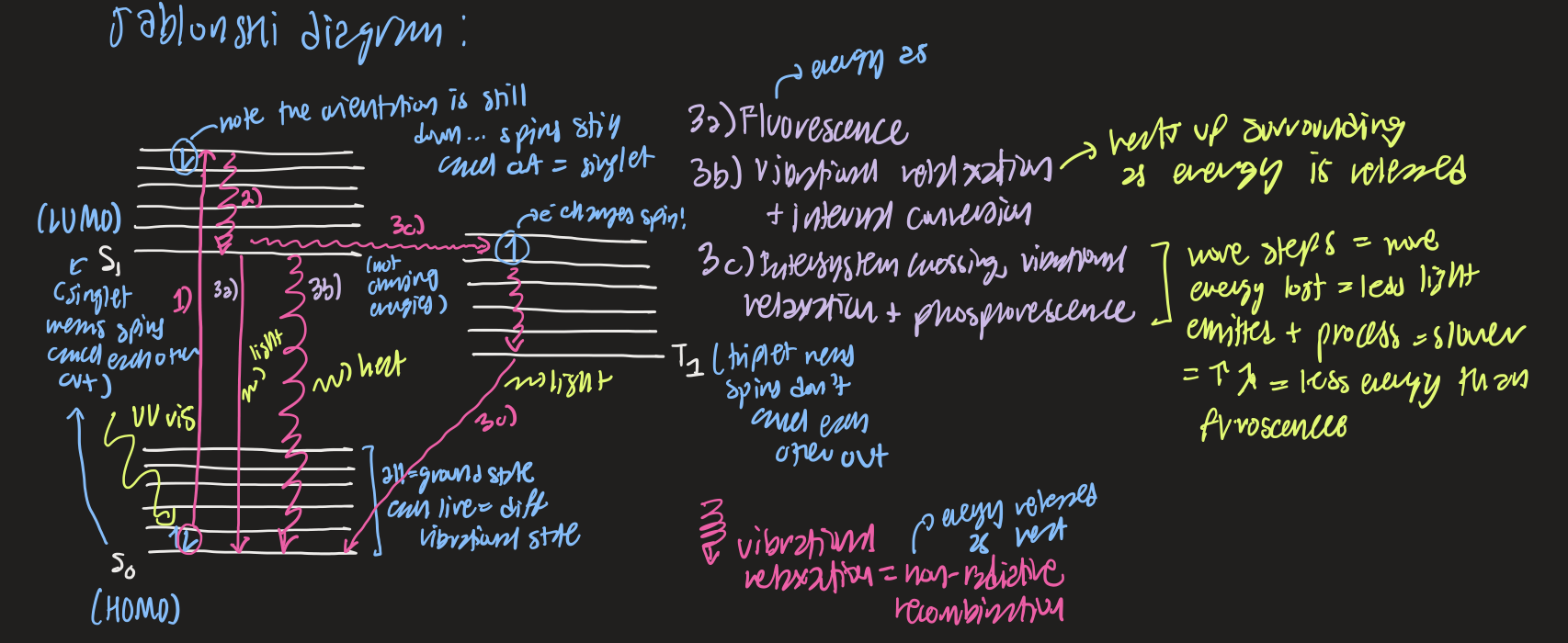
What is radiationless decay and how does it happen (vibrational relaxation)?
It is the rapid dissipation of energy as heat instead of emission as light. It usually happens via internal conversion or intersystem crossing. Vibrational relaxation drives this by transferring excess energy to surroundings.
What are the difference between Fluorescence and Phosphorescence practically?
Fluorescence is immediate emission upon excitation and dependent on the light source being present. Phosphorescence is long-lasting emission that remains even long after the light source is lost. It is a delayed emission
What does Luminescence mean?
It is a form of light emission by a substance resulting from external stimuli, such as excitation by light, a emission of light by a substance that has not been heated, as in fluorescence and phosphorescence.
What are the difference between Fluorescence and Phosphorescence in energy levels?
Fluorescence involves the rapid emission of electrons from singlet to singlet states (S1→S0) using internal conversion while phosphorescence involves delayed emission of electrons from triplet to singlet states (T1→S0) using intersystem crossing. Phosphorescence is lower energy and longer wavelenght.
What are the difference between Fluorescence and Phosphorescence (real life examples)?
Fluorescence can be used in immediate techniques like highlighters, bioimaging and fluorescent microscopy while Phosphorescence is used for exit signs, glow in the dark bracelets, and things like specialized senors
What are the differences between the absorption and the emission spectra for a compound?
Absorption spectra show dark lines on a bright background representing absorbed light (lower to higher energy transition), while emission spectra show bright lines on a dark background representing released light (higher to lower energy transition). Emission spectra is often used to identify compounds
Be able to draw the instrumental layout for both an absorption spectrophotometer and for an emission spectrophotometer? What are the similarities and critical differences?
Why are emission spectrophotometric techniques generally more sensitive than absorbance techniques?
Emissions are often at lower energies and higher wavelengths than absorptions so they can often be compared to blanks as standards while makes analysis easier as it it easier to detect little signal versus no signal. Absorptions spectra techniques are less sensitive as it is trying to compare lots of signal with slightly less leading to higher signal:noise especially with low concentration samples
Discuss the major difference between how absorbance techniques and fluorescence techniques depend on source intensity.
How do absorbance techniques and fluorescence techniques depend on concentration of sample and path length.
What is a disadvantage of fluorescence techniques?
Calibration curves using absorbance and fluorescence techniques.
Standard addition problems using absorbance and fluorescence techniques.
Internal standards problems using absorbance and fluorescence techniques.
Energy states are “quantized” meaning they
are discrete, not continuous.
How can you increase the efficiency of spectroscopy (if absorbance is the problem/too high/low)
Dilute solution of use longer path (b)