H5 Hiscock- The first land plants and their closest living relatives + The Rise of Vascular Plants
 Call Kai
 Learn
Learn Practice Test
 Spaced Repetition
 Match
Match Flashcards
 Knowt Play
1/8

There's no tags or description
Looks like no tags are added yet.
Name | Mastery | Learn | Test | Matching | Spaced | Call with Kai |
|---|
No analytics yet
Send a link to your students to track their progress
9 Terms
what did land plants evolve from? what major change did this involve?
in the ordovican period, land plants/embryophytes evolved from the charophyte green algae, likely the zygnematales order (not charales or coleochaetales)
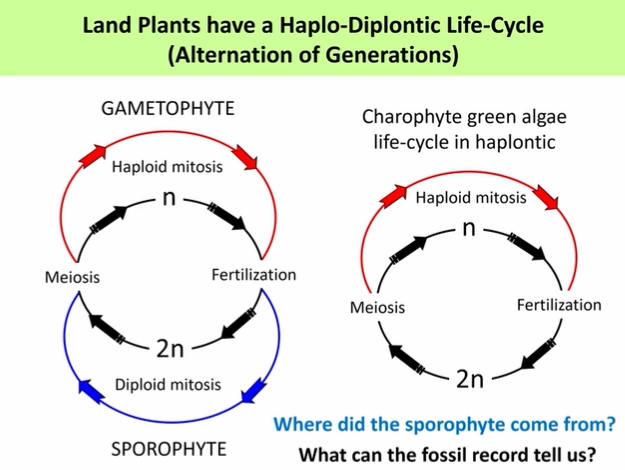
green algae have a haplontic life cycle (no diploid vegetative body)- haploid body grows through mitosis, fertilises to produce a short diploid stage, which immediately divides by meiosis to produce the haploid body
land plants evolved a haplo-diplontic life cycle (alternation of generations)
the haploid gametophyte produces gametes by mitosis
these get fertilised to produce the diploid sporophyte embryo
this undergoes meiosis to produce the spores (haploid gametophyte)
this was beneficial because diploidy allows the masking of deleterious mutations (greater risk due to UV exposure) + the diploid sporophyte can produce many spores for dispersal
this sporophyte generation was introduced into the haplontic life cycle by the retention and mitosis of the diploid stage into a sporophyte that could produce spores by meiosis
this produced the bryophytes (earliest land plants, mosses, hornworts and liverworts), where the gametophyte is dominant
eventually the sporophyte became the dominant stage due to the selective advantage (safer to have two copies)
there are no gametophyte fossils (including all bryophytes), only sporophytes eg. Cooksonia (an early tracheophyte)
what are the evolutionary trends in early tracheophytes?
from the first land plants:
increased size of sporophyte- rhizoids colonised the surrounding area allowing the sporophyte to become an independent, dominant life stage
reduction in size of gametophyte
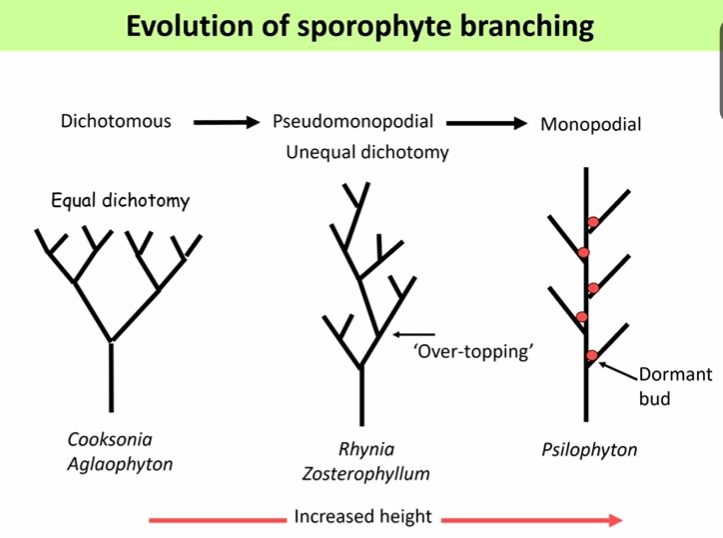
increased branching of sporophytes- bryophytes have unbranched sporangia, early tracheophytes have many branched sporangia (dichotomous → pseudomonopodial (over-topping) → monopodial (dormant buds) = increased height = spores can reach more turbulent air)
increased vascular complexity + strengthening of tracheids (= increased height)
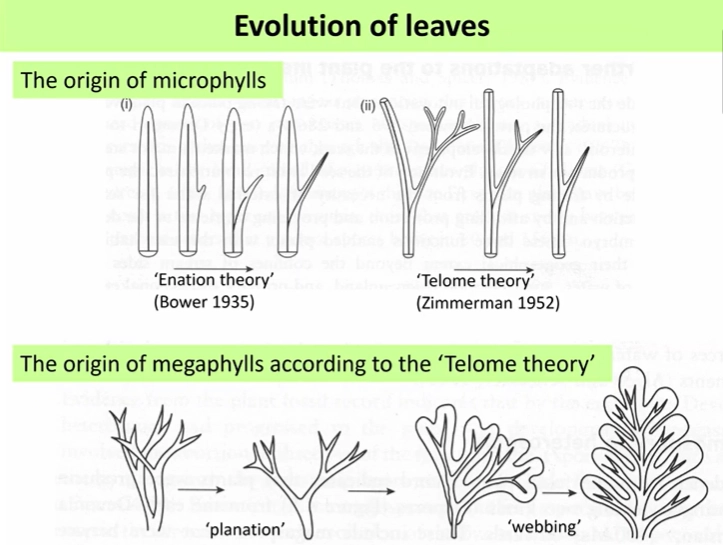
evolution of leaves- microphylls + macrophylls by the telome theory, selective advantage due to drop in atmospheric CO2 through the devonian period
evolution of roots- homorhizic (leaves and roots off same horizontal shoot) → allorhizic (distinct tap root and arial shoot) in the devonian period
evolution of symbiosis with mycorrhizal fungi (not in mosses)
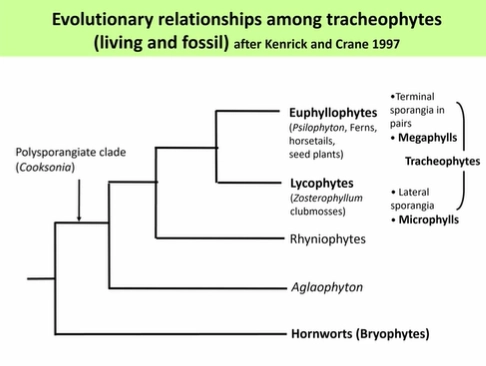
in the early devonian period: bryophytes → early tracheophytes (eg. Cooksonia → Aglaophyton in rhynie cherts → rhyniophytes → Psilophyton)
what are the two lineages of leaves?
these emerged in the mid-late devonian period
microphylls of the lycophytes- small, scale-like, stem-hugging leaves with no stem (petiole)
megaphylls of the euphyllophytes (most modern vascular plants)- larger leaves with a petiole and branched vascular strands
it is widely accepted that the megaphylls evolved by the telome theory (zimmerman), where the dichotomous branches began overtopping, and the inferior branches arranged into a 2d arrangement (planation), then webbed by intercalary mitosis and fused to create a leaf
microphylls are also thought to have developed by the reduction of branching, but a competing theory is that they came from enations straight off the stem (bower)
what is the phylogenetic tree of early land plants? what developments came with each transition?
land plants developed from algae into a stomatophyte ancestor (haplontic → haplo-diplontic life cycle)
divergence from bryophytes to early tracheophytes eg. Cooksonia (dominant, branched sporophyte)
divergence from Aglaophyton (development of vascular systems, unequal dichotomy of branching)
divergence from rhyniophytes (monopodial branching, sterile vegetative structures)
divergence from Psilophyton (evolution of roots and leaves)
divergence between euphyllophytes and lycophytes (megaphylls vs microphylls)
what are tracheids?
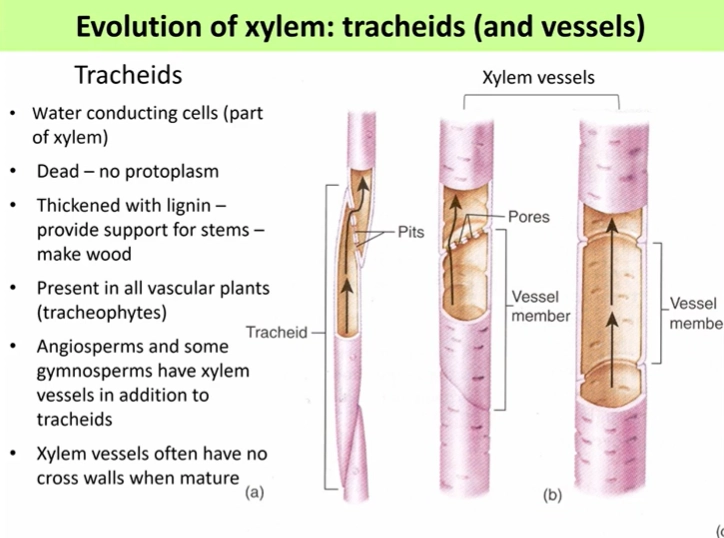
trachieds are part of the dead xylem tissue
they are present in all tracheophytes (vascular plants), but angiosperms and some gymnosperms have additional xylem vessels
tracheids are tapered cells, where water can only pass from cell to cell through pits, which has a lot of resistance force
some xylem vessels have pores, but most have lost the connecting walls to become a continuous tube, which is more efficient
describe the dominant tracheophytes of carboniferous rainforests- how and why did these traits develop?
microphylls (lycophytes):
club mosses- have strobili structures containing many sporangia on sporophylls
tree lycophytes eg. lepidodendron- siphonostele, cambium produces xylem in consecutive rings
macrophylls (early euphyllophytes, mostly ferns):
polypodiopsida/true ferns- sporangia aggregated into sori on the undersides of leaves, which eject the spores when they fill with water + dehydrate
tree ferns- no secondary thickening, protostele, large leaves produced at the crown, while the old lower leaves die and leave behind highly lignified residues that get covered in a dense mesh of adventitious roots
tree horsetails eg. calamites- siphonostele, secondary xylem is packed in radial columns with the inner area made of silicon
progymnosperms eg. archaeopteris- eustele, similar to extant gymnosperms but not seed-producing
these are mostly still homosporous, but heterospory (eg. selaginella lycophyte + some progymnosperms) and the first seed plants are emerging
in the carboniferous period, the sporophyte size increased dramatically, with increased monopodial branching and leaf size, secondary thickening, and advanced vascular systems, to produce trees- this is because of:
increased competition for space and light
decreasing CO2 levels
more effective spore dispersal- allows for avoidance of inbreeding
how did more complex vascular systems evolve in the carboniferous period?
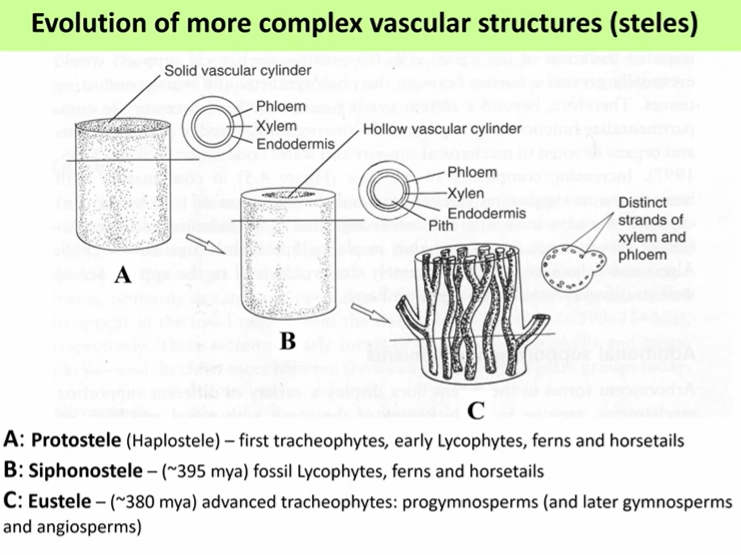
stele- vascular system arrangement
protostele → siphonostele → eustele
the cambium allows for secondary thickening
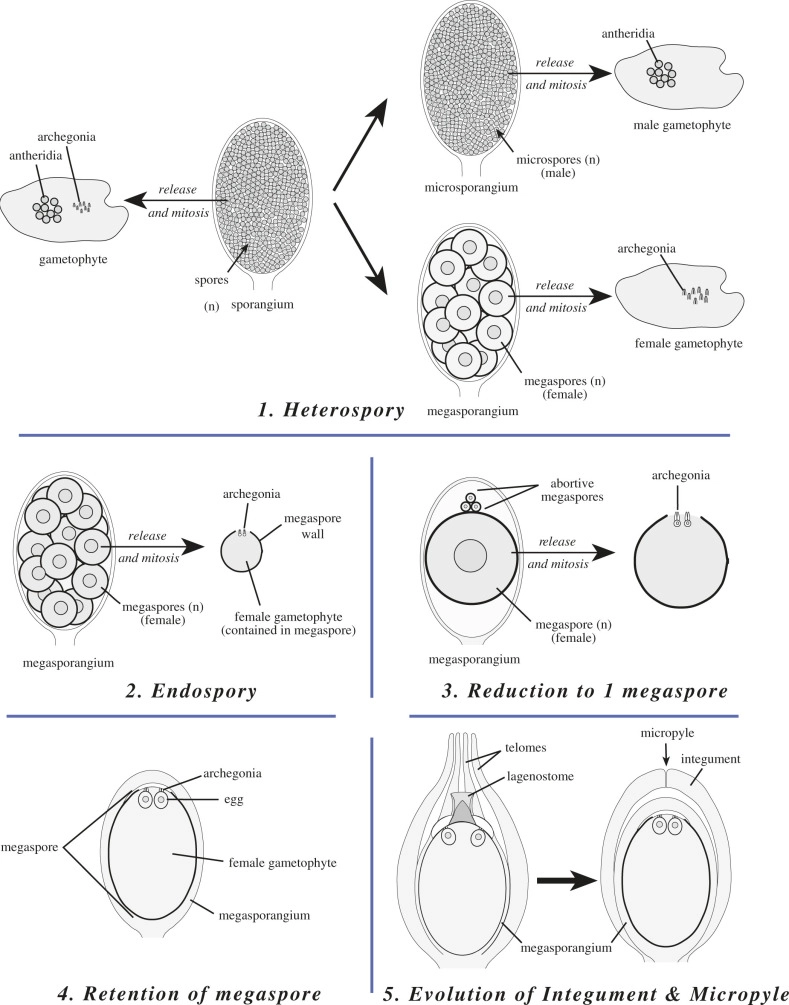
why did heterospory evolve?
in heterospory, one large megaspore germinates into the female gametophyte (producing eggs), and a smaller microspore germinates into the male gametophyte (producing sperm)
this means the eggs and sperm are produced in different gametangia
this evolved at least 4 times, because it has multiple advantages:
resource allocation- more nutrients can be given to fewer, bigger egg cells
heterosis- drastically reduced chance of self-fertilisation + more outbreeding, because the gametophytes are unisexual and the spores can be aerodynamically sorted by the microspores being lighter
protection- endosporic development is safer than germination outside the spore walls
how did early seed plants evolve from homosporous progymnosperms?
in the permian period
heterospory- the homosporous progymnosperm switched to have separate micro and megasporangia
endospory- the female gametophyte germinates within the megaspore wall
reduction to 1 megaspore- the megaspore mother cell produces just 3 abortive and 1 functional megaspore
retention of the megaspore- megagametophyte germinates inside the megasporangium/nucellus (water facilitates catching of microspore/pollen and sperm movement)
evolution of integument and micropyle- stems fusing around the megasporangium to encase it in the integument
this produced a heterosporous progymnosperm with seeds (still a naked ovule though)