PS 370: Learning after Exam 2
 Call Kai
 Learn
Learn Practice Test
 Spaced Repetition
 Match
Match Flashcards
 Knowt Play
1/28

There's no tags or description
Looks like no tags are added yet.
Name | Mastery | Learn | Test | Matching | Spaced | Call with Kai |
|---|
No analytics yet
Send a link to your students to track their progress
29 Terms
What is stimulus?
Anything detectable through the senses
Light, tone, touch, food, odor
What is Response?
A detectable, measurable behavior
Types of Learning
Associative
Observational/ Non associative
Define Associative learning
a type of learning where an individual forms connections between two stimuli or between a stimulus and a response, allowing them to predict future events based on past experiences
Types of Associative learning
Classical conditioning:
Operant conditioning
Classical conditioning
A neutral stimulus is associated with a meaningful stimulus, eventually causing the neutral stimulus to evoke a similar response as the meaningful one
Generally, a nonconscious association
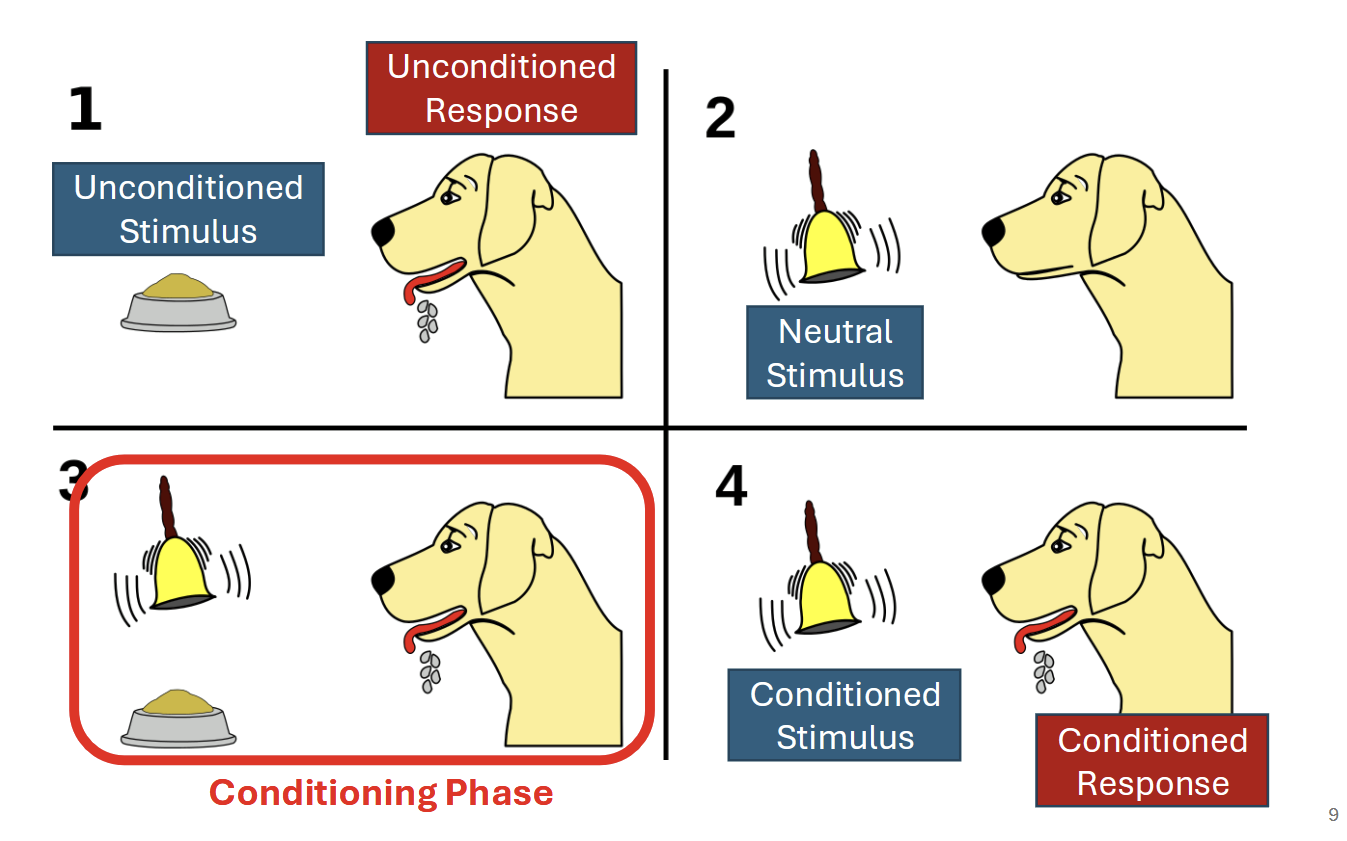
Classical conditioning: Hebb rule
synapses active around the same time that postsynaptic neuron fires are strengthened over time
Define US, UR,CS,CR
Unconditioned stimulus (US): a stimulus that produces a response without prior learning
Unconditioned response (UR): an unlearned reaction that is automatically elicited by the US
Conditioned stimulus (CS): a neutral stimulus that eventually elicits a conditioned response after being paired with the US
Conditioned response (CR): the learned response to the conditioned stimulus that occurs after CS-US pairing (will be identical behaviorally to UR
Operant conditioning
The consequences of a behavior change the probability of the behavior’s occurrence
More consciously aware
what is the operant?
behaviour perfomed
Operant conditioning: The Law of Effect
behaviors followed by pleasant outcomes are strengthened and behaviors followed by unpleasant outcomes are weakened
Operant conditioning: Reinforcement
a stimulus following a behavior increases the probability that the behavior will occur again
Operant conditioning: Punishment
a stimulus following a behavior decreases the probability that the behavior will occur again
Positive
• Introducing a stimulus
• Negative
• Removing a stimulus
What is the biological basis of short-term memory?
primarily characterized by the temporary, persistent firing of neurons in specific brain regions, notably the prefrontal cortex (PFC)
What is the biological basis of long-term memory
structural changes to neurons: strengthening synaptic connections between neurons, known as long-term potentiation (LTP), involving new protein synthesis, gene expression, and structural changes like new dendritic spines
Habituation seen in aplysia
Repeated stimulation results in
• Reduced Ca++ activity
• Reduced glutamate release
physical embodiment of Hebb’s rule
Long-Term Potentiation (LTP)
What is the Long-Term Potentiation (LTP/ memory)?
long-term ↑ in the magnitude of excitability of a particular neuronal synapse caused by repeated high-frequency activity of that input
changes seen due to memory/ LTP
↑ neurotransmitters (NT)
• ↑ receptors
• ↑ # synapses
Sensory memory
large capacity
lasts up to 1 to 2 seconds
easy to forget
Short term memory
A few seconds to a minute
What you are actively thinking about
small capacity
Getting info in and out is easy
not stable
Long term memory
Days, months, years
Your knowledge(not what you are thinking)
enormous capacity
Getting info in and out is hard
fairly stable
Sensory memory to short term
attention
short term memory to long term memory
rehearsal
Neural plasticity requires
LTP and LTD ( long term depression)
effects of long term depression
Weakens synaptic activity, decreases receptors, and reduces dendritic spines and connections between neurons
• Caused by influx of Ca++ at small, slow pace; activates a different
protein process
Short term memory vs working memory
STM isjust the storage of information for a short time, working memory is both the storage and manipulation of memory to help solve a problem