Biometrics and Mechanics of Skeletal Muscle Function and Adaptation
 Call Kai
 Learn
Learn Practice Test
 Spaced Repetition
 Match
Match Flashcards
 Knowt Play
1/77

There's no tags or description
Looks like no tags are added yet.
Name | Mastery | Learn | Test | Matching | Spaced | Call with Kai |
|---|
No analytics yet
Send a link to your students to track their progress
78 Terms
What percentage of body weight do muscles make up?
40-50%
What are the primary functions of skeletal muscle?
Locomotion, maintenance of posture, respiration, communication, constriction of organs and vessels, and thermogenesis.
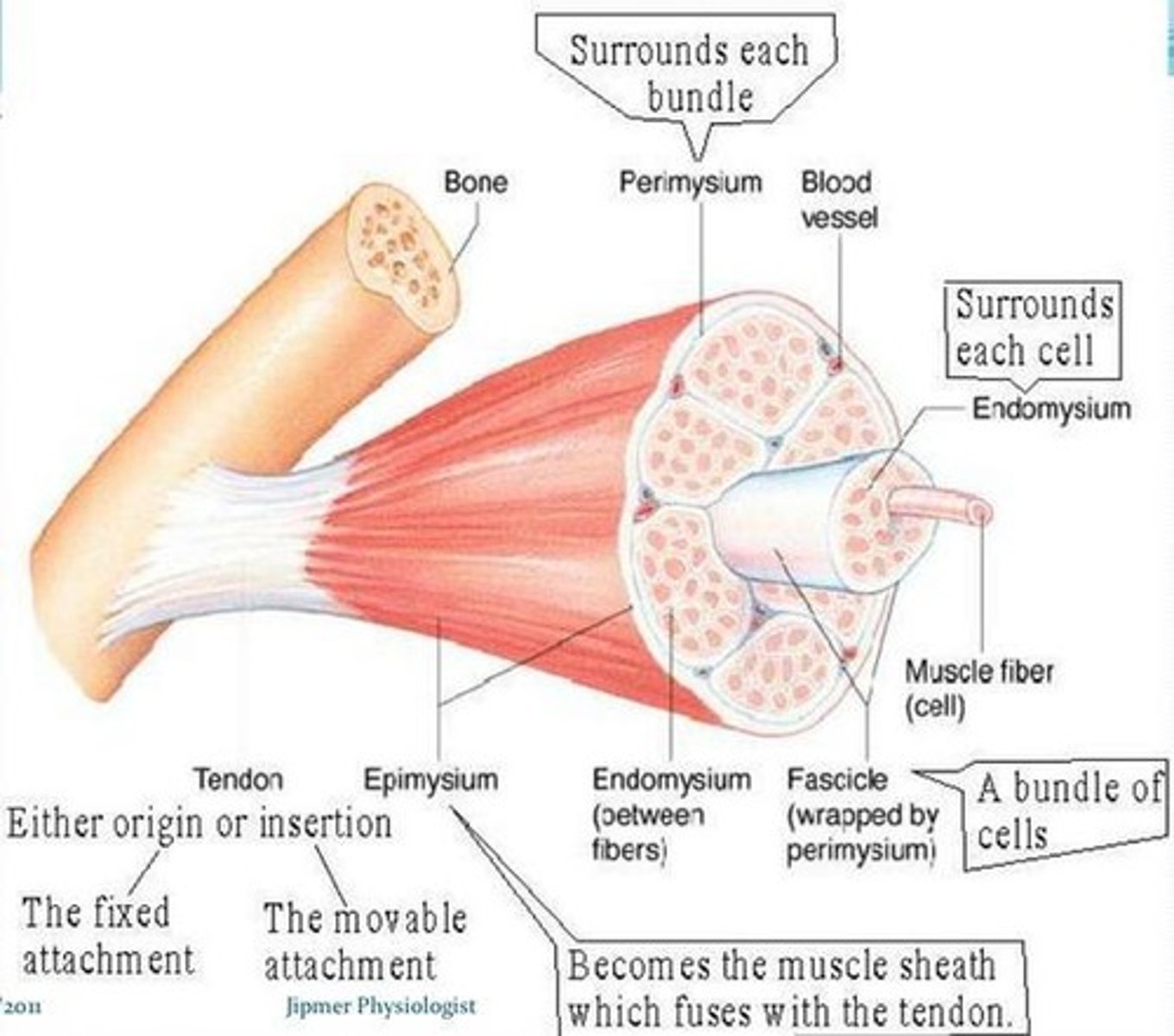
What surrounds individual muscle fibers?
Endomysium
What surrounds bundles of muscle fibers?
Perimysium
What surrounds the entire muscle?
Epimysium
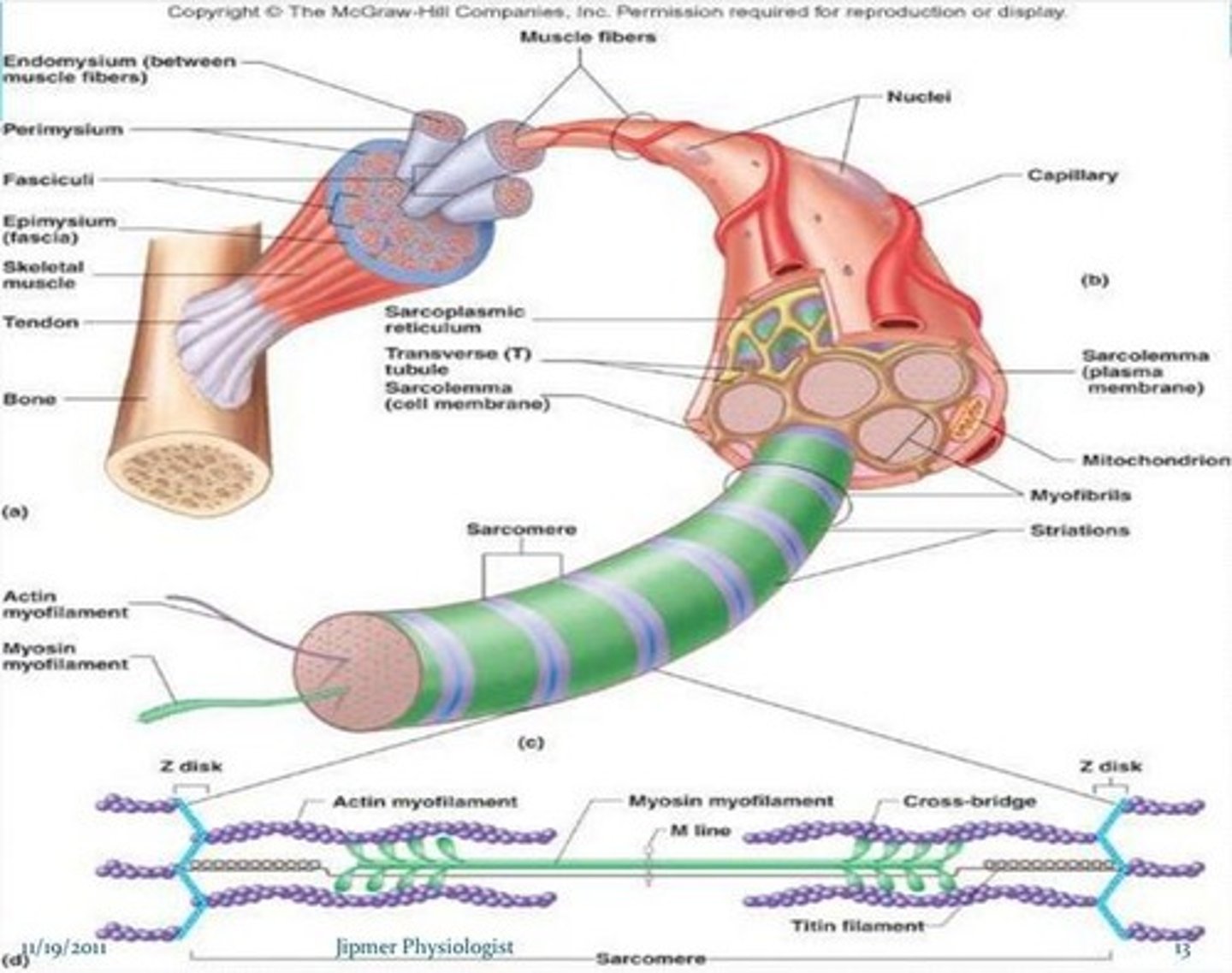
What is the smallest contractile unit of skeletal muscle?
The muscle fiber or myofibre
What is the function of the sarcolemma?
It is the cell membrane that surrounds the sarcoplasm.
What are myofibrils?
Cylindrical structures within the muscle fiber that are bundles of protein filaments.
What are the two types of myofilaments?
Actin filaments and myosin filaments.
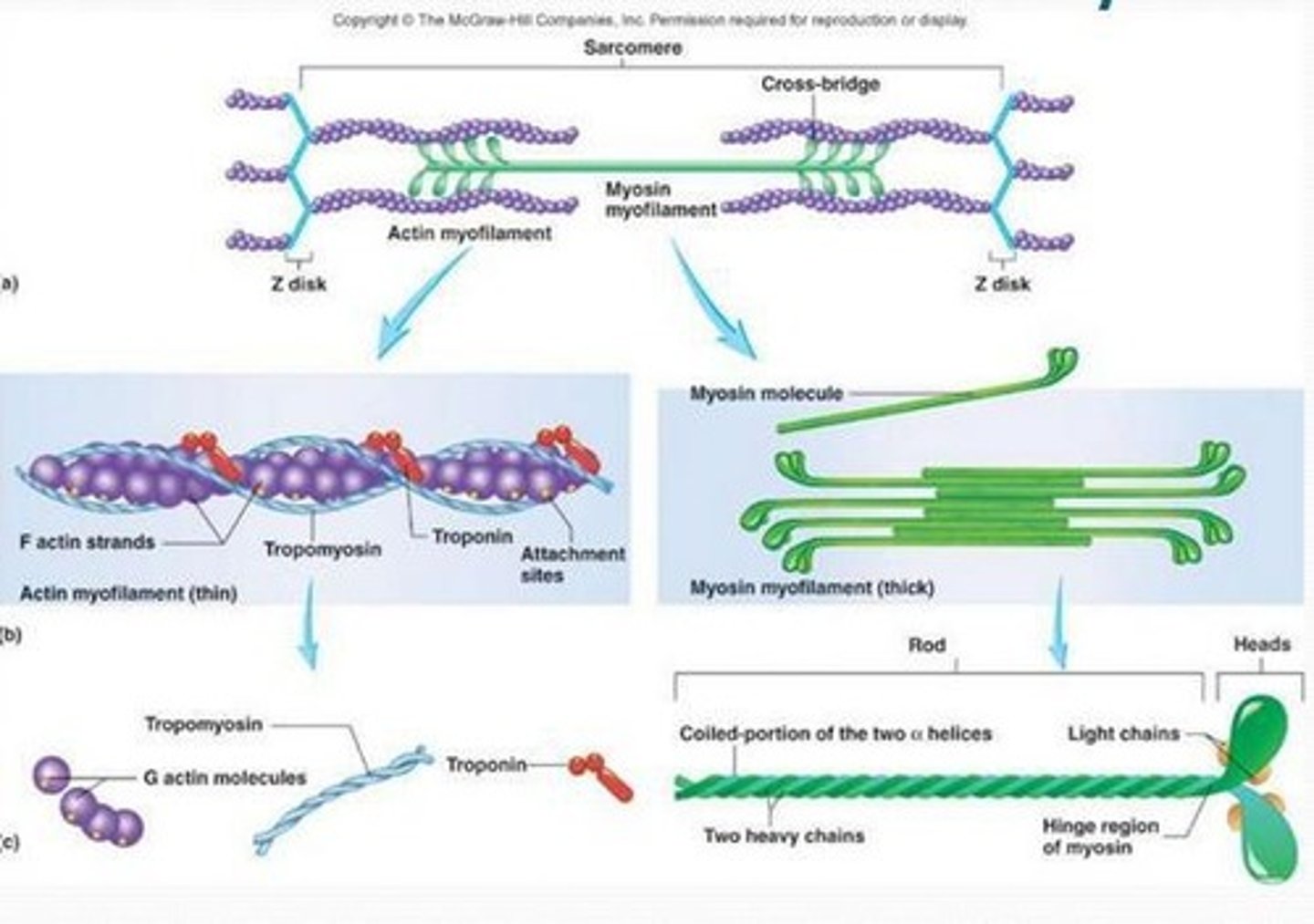
What is the sliding filament theory?
It states that muscle contraction occurs through the movement of actin and myosin filaments past one another.
What role do calcium ions play in muscle contraction?
They turn the contractile system on and off.
What is a twitch in muscle activity?
The mechanical response of a muscle to a single stimulus of its motor nerve.
What is the latency period in muscle contraction?
The interval before tension in the muscle begins to rise after stimulation.
What is summation in muscle contraction?
The cumulative effect of a number of stimuli applied to a muscle.
What is tetanic contraction?
When maximal tension is maintained due to rapid stimulation of the muscle.
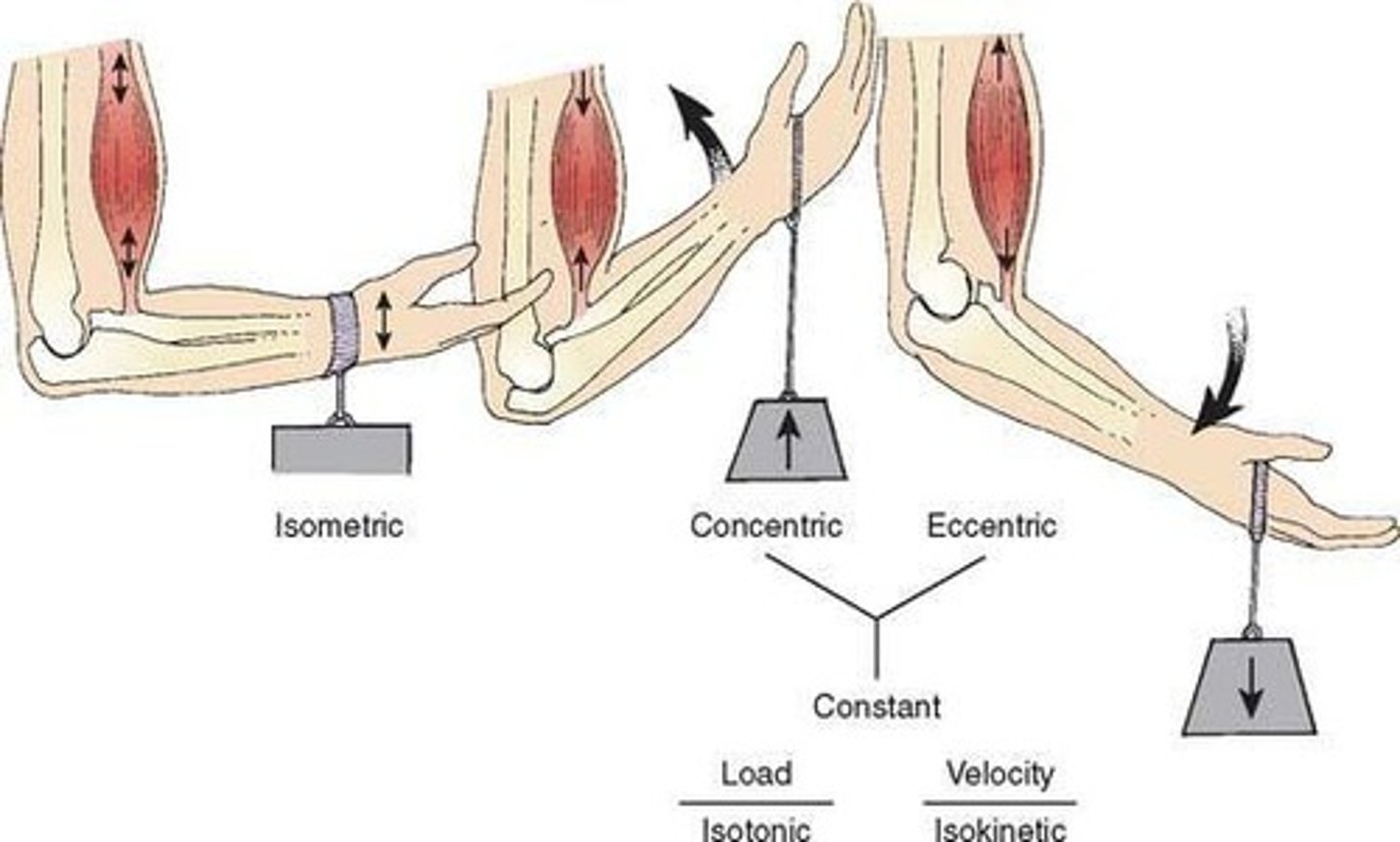
What is concentric contraction?
When a muscle shortens during contraction, causing movement of a joint.
What is eccentric contraction?
When a muscle lengthens while resisting the movement of an object.
What is the role of elastic components in muscle?
They store energy during stretching and release it during relaxation.
What is the function of tropomyosin in muscle contraction?
It regulates the making and breaking of contacts between actin and myosin.
What are the contractile proteins in muscle?
Actin and myosin.
What is the function of myoglobin in muscle fibers?
It binds oxygen and is abundant in the sarcoplasm.
What is the role of attachment proteins in muscle?
They help anchor myofibrils to the sarcolemma.
What happens during the contraction time of a muscle?
The tension in the muscle rises to its maximum.
What is the relaxation time in muscle contraction?
The time from maximum tension to zero tension.
What is the significance of the sarcomere?
It is the repeating functional unit of a myofibril responsible for muscle contraction.
What is peristalsis?
The constriction of the intestinal tract that aids in digestion.
What is vasoconstriction?
The constriction of blood vessels and pupils.
What is isometric contraction?
A type of muscle contraction where the muscle contracts to overcome resistance but does not change length, e.g., pushing against a wall.
What characterizes isokinetic contraction?
In isokinetic contraction, the velocity of the joint is kept constant while the muscle length changes at a constant rate.
Define iso-inertial contraction.
Iso-inertial contraction occurs when the resistance against which the muscle contracts remains constant, allowing for both isometric and concentric contractions.
What happens during isometric contraction when torque is less than resistance?
The muscle length does not change and contracts isometrically.
What is the length-tension relationship in muscles?
The force generated in a muscle depends on its length at the time of contraction, with maximal tension produced at the resting or slack stage.
How does the load-velocity relationship affect muscle contraction?
The velocity of concentric contraction decreases as the external load increases; at maximum load, the velocity is zero and the muscle contracts isometrically.
Explain the force-time relationship in muscle contraction.
The force produced by a muscle is proportional to the contraction time; longer contraction times lead to greater tension up to a maximum.
What is the effect of stretching on muscle function?
Stretching increases muscle flexibility, maintains joint motion, and allows the musculotendinous unit to store more energy.
What role do intrafusal muscle spindles play during stretching?
They respond to increases in muscle length, contributing to muscle contraction reflexes.
How do golgi tendon organs respond to muscle tension?
They respond to increased muscle tension, enhancing muscle relaxation.
What is the difference between primary and secondary muscle spindles?
Primary spindles respond to changes in the rate of muscle lengthening, while secondary spindles respond to actual changes in muscle length.
What happens during slow stretching of a muscle?
Slow stretching bypasses the effects of primary and secondary spindles, activating the golgi effect to promote muscle relaxation and lengthening.
How does temperature affect muscle contraction?
Increased muscle temperature raises conduction velocity and enzymatic activity, enhancing muscle contraction efficiency.
What is the impact of contraction time on muscle force production?
Longer contraction times allow for greater force production, as tension from contractile elements is transmitted through elastic components.
What occurs when the external load is equal to the maximum force of contraction?
The velocity of shortening is zero, and the muscle contracts isometrically.
What is the significance of maximal tension in muscle contraction?
Maximal tension is achieved when the muscle is at its optimal length, allowing for the greatest potential for shortening.
What happens to muscle contraction when the load is decreased?
The muscle will contract concentrically as the external load decreases.
What is the relationship between eccentric contraction and external load?
The velocity of eccentric contraction increases with an increase in external load.
What is the role of the musculotendinous unit during lifting?
It contracts isometrically to overcome inertia at the extremes of movement and concentrically during the middle of motion.
What is the effect of slow stretching on muscle spindles?
It inhibits the effects of primary and secondary spindles, promoting relaxation and lengthening of the muscle.
What is the relationship between muscle temperature and contraction frequency?
Higher muscle temperatures increase the frequency of stimulation, enhancing muscle force production.
What is the maximum time required for tendon tension to reach its peak?
Tendon tension reaches maximum only if the muscle contraction lasts long enough, typically around 300 milliseconds.
How does the length of a muscle affect its tension production?
If a muscle is stimulated to contract at its resting length, it produces maximal tension due to optimal overlap of actin and myosin filaments.
What happens to muscle contraction when the torque produced is less than the resistance?
The muscle contracts isometrically without changing length.
What is the significance of the sarcolemma in muscle contraction?
The sarcolemma's conduction velocity affects the frequency of stimulation and the overall force produced by the muscle.
What enhances the elasticity of collagen in muscles and tendons?
Increased temperature and the contractile ability of the muscle and tendon.
How can an increase in temperature be generated physiologically?
Through increased blood flow due to activity demand and heat released from muscle contraction and sliding friction.
What is fatigue in muscle contraction?
Fatigue occurs when the rate of ATP supply is outstripped by the rate of ATP breakdown during repetitive twitch responses.
What happens to muscle twitch responses when ATP levels drop?
The twitch responses decrease slowly to zero when no ATP is available.
What are the three sources of ATP in muscle?
Creatine phosphate, oxidative phosphorylation in mitochondria, and substrate phosphorylation during anaerobic glycolysis.
Which source of ATP provides the most rapid formation in muscle cells?
Creatine phosphate.
What happens to ATP production during intense exercise?
ATP breakdown may outpace replacement by oxidative phosphorylation, leading to increased reliance on anaerobic glycolysis.
What are the three types of muscle fibers?
Type I (slow twitch oxidative), Type II A (fast twitch oxidative glycolytic), and Type II B (fast twitch glycolytic).
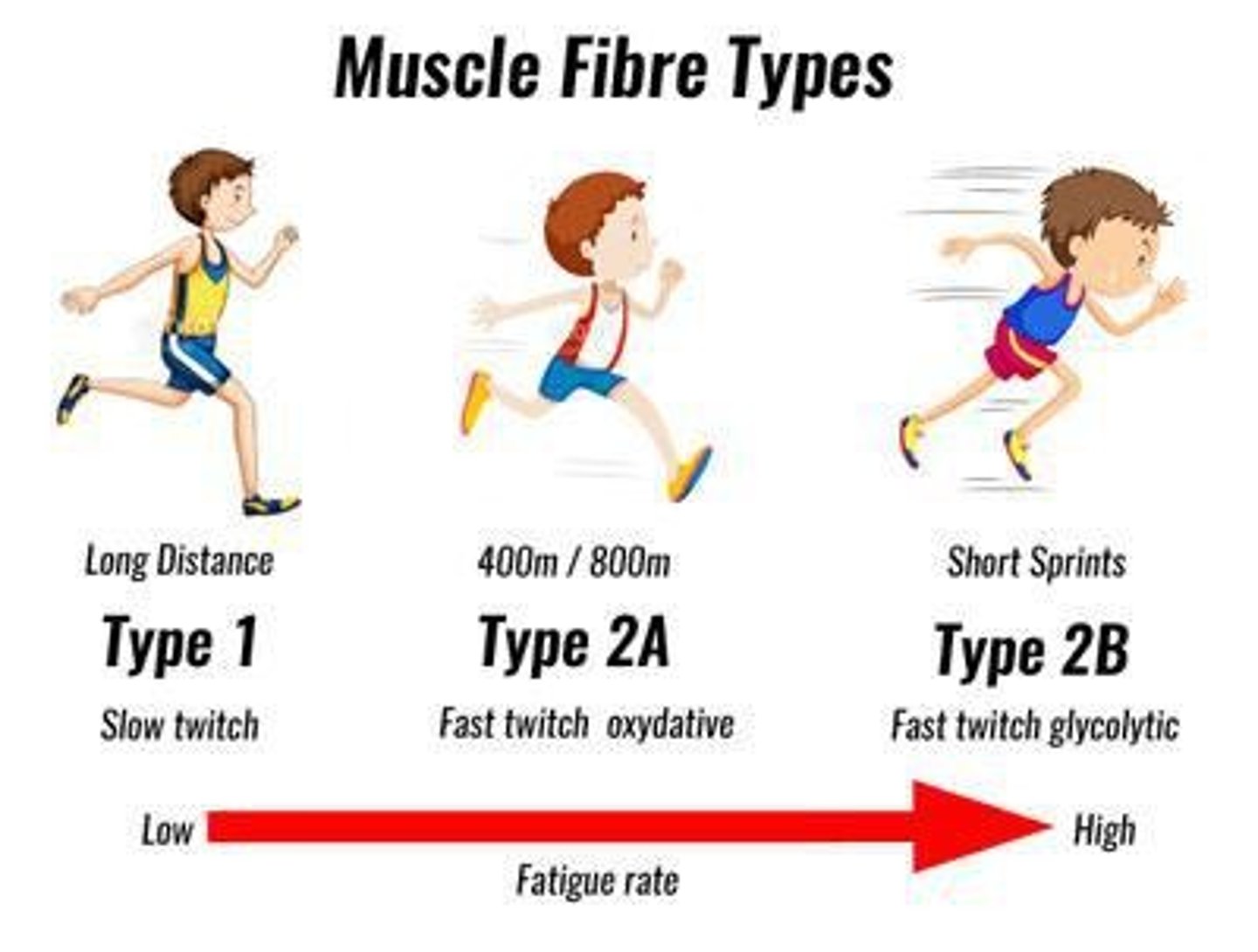
What characterizes Type I muscle fibers?
They have slow contraction times, high mitochondria content, and are suited for low intensity, prolonged work.
What is the primary energy source for Type II A muscle fibers?
They are adapted to both aerobic and anaerobic work.
What is the primary function of Type II B muscle fibers?
They are primarily for anaerobic activity and produce powerful contractions for short periods.
How does muscle fiber composition depend on function?
It depends on the muscle's function and genetic factors.
What effect does immobilization have on muscle fibers?
Type I fibers atrophy with immobilization, leading to decreased strength and oxidative enzyme activity.
What can help prevent muscle atrophy after immobilization?
Early movement and electrical stimulation of the muscle.
What effect does physical training have on muscle fibers?
It increases the cross-sectional area of all muscle fibers and may change the relative percentage of different fiber types.
What happens to Type II fibers in sprinters after immobilization?
They experience a loss of Type II fibers.
What happens to Type I fibers in long-distance runners after immobilization?
They experience a loss of Type I fibers.
What is the role of oxidative phosphorylation in muscle activity?
It supplies ATP at slower rates during the contraction cycle compared to creatine phosphate.
What is the end product of anaerobic glycolysis?
Lactic acid.
How does blood flow affect muscle performance during exercise?
Inadequate delivery of oxygen can limit ATP replacement by oxidative phosphorylation during intense exercise.
What is the relationship between muscle fiber type and athletic performance?
Sprinters typically have more Type II fibers, while long-distance runners have more Type I fibers.
What is the significance of myoglobin content in muscle fibers?
It indicates the fiber's capacity for aerobic metabolism; Type I fibers have high myoglobin content.
What is the rate of fatigue for Type I muscle fibers?
They have a slow rate of fatigue.
What is the rate of fatigue for Type II B muscle fibers?
They have a fast rate of fatigue.
What is the effect of isometric exercises on muscle atrophy?
Isometric exercises alone cannot adequately reverse muscle atrophy during immobilization.
What happens to the cross-sectional area of muscle fibers with physical training?
It increases, contributing to greater muscle bulk.