T6 Lewis- Agroecology: growing food sustainably
 Call Kai
 Learn
Learn Practice Test
 Spaced Repetition
 Match
Match Flashcards
 Knowt Play
1/3

There's no tags or description
Looks like no tags are added yet.
Name | Mastery | Learn | Test | Matching | Spaced | Call with Kai |
|---|
No analytics yet
Send a link to your students to track their progress
4 Terms
why is agroecology important?
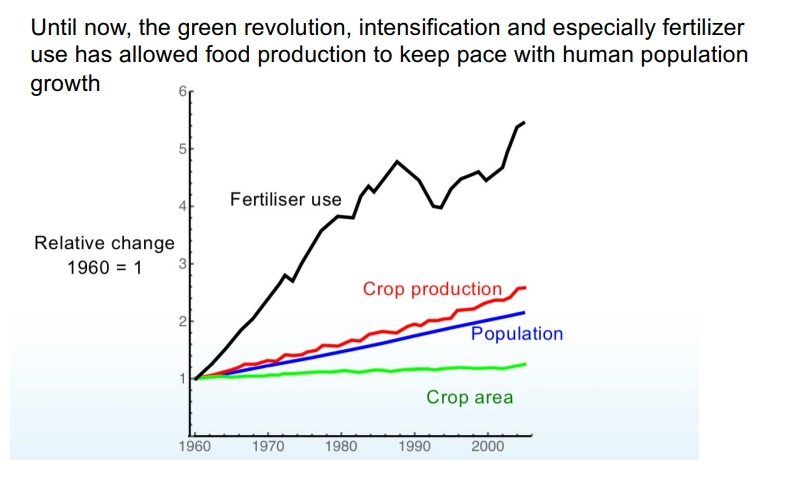
agriculture covers over a third of the ice-free terrestrial earth surface (including cropland and pastures)
agroecology needs to be considered to:
tackle the problems of food security with exponentially increasing populations (and specific food demands, eg. meat, with wealthier populations)
until now, this has been met by intensification (particularly by inorganic fertilisers, pesticides, hedgerow removal and monoculture), funded by subsidies
make yields more sustainable, by preserving ecosystem services and heterogeneity
reduce the impact of agriculture on existing biodiversity (damaged by intensive farming methods, fragmentation + land conversion, particularly in the tropics and in soil organisms)
how does agricultural intensification affect soils?
increasing input of fertilisers and disturbances (eg. tilling) has led to bacteria-dominated soil foodwebs
these are more ‘leaky’ (less nutrient efficient), have high carbon emissions and are more dependent on repeated agricultural inputs
healthy soils from low input management have more dominance of fungi, earthworms and microarthropods
these are more efficient with nutrient cycling, produce fewer C emissions and are more self-sufficient
what are the potential solutions to tackle food security while maintaining biodiversity?
organic farming, which uses crop rotation, green manure, compost and biological pest control and legally restricts inorganic fertilisers and pesticides
agroforestry, primarily in the tropics, which integrates trees into crop systems (existing or planted) to improve biodiversity and better connect rainforest fragments
agri-environment schemes, which incentivise wildlife-friendly farming and the delivery of public goods (eg. clean air + water, biodiversity + protection from hazards) eg. countryside stewardship schemes
there are three levels of diversity to consider:
crop diversity by intercropping and rotation
non-crop diversity by hedgerows, seminatural habitats and soil health
soil diversity- inoculation of beneficial soil microbes, organic inputs and reducing disturbance (eg. tilling)
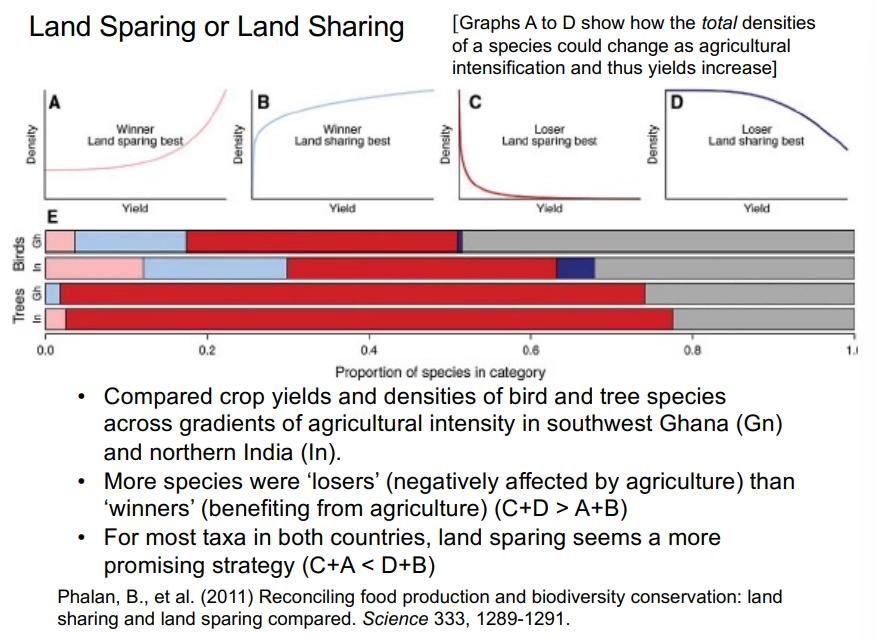
there is a land sparing vs land sharing debate:
sparing- intensively farming some land to maximise yields, while protecting other land as a reserve
sharing- farming a greater proportion of land in a wildlife-friendly way, despite lower yields per unit area
this is realistically a continuum, not a binary choice
j