Geography A-Level Coastal landscapes
 Call Kai
 Learn
 Practice Test
 Spaced Repetition
 Match
 Flashcards
 Knowt Play
1/3

Earn XP
Description and Tags
descriptors of landscapes and specific studies. Also structures on questions.
4 Terms
Concordant and Discordant coastlines.
Concordant- coasts are where bands of more-resistant and less-resistant rock run parallel to the coast.
Discordant- coasts are where the geology alternates between bands of more-resistant rock and less-resistant rocks run at right angles to the coast.
Concordant and Discordant coastline: Case study + writing
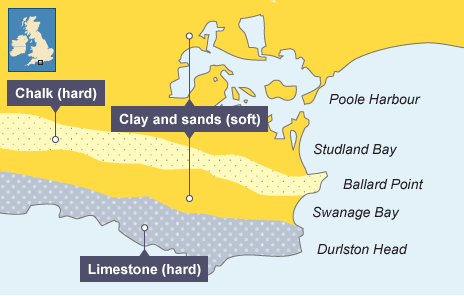
Swanage Bay + Ballard Point —> Southern England
Headlands and bays are coastal landforms created on discordant coastlines through the combined processes of differential erosion and wave refraction
Differential erosion erodes soft rock faster, creating landforms, while wave refraction shapes and intensifies headland erosion and bay deposition
As headlands and bays form, they change the way waves interact with the coast through wave refraction
Waves approaching an uneven coastline hit shallower water around the headland first , slowing and bending
This concentrates wave energy on the headland's sides and tip
Concentrated energy on headland leads to erosional like wave-cut platforms, caves, arches, stacks, and stumps
However, bending waves diverge (spread out) and weaken as they enter the bay's larger, deeper areas allowing sand and shingle to form beaches
Wave refraction changes the amount of energy reaching the shore on a small local scale

Swanage bay - made out of the soft rock clay
Studland bay - made out of the soft rock clay
Ballard point - made of the hard rock chalk
Durlston Head - made of the hard rock limestone.
Erosional Processes
Abrasion – sediment and stones are picked up by the waves and wear away at the cliff/headland
Hydraulic action – this is the shear force of the waves forcing air at high pressure into cracks in the cliff; over time, this weakens the rock and causes the joint to widen
Corrosion – weak acids in seawater dissolve the rock particles
Attrition – as rocks are moved around by the water, they knock into each other gradually becoming smaller and rounder
Wave-cut platforms
At high-energy coastlines, hydraulic action and abrasion can cause the formation of wave-cut platforms
Powerful destructive waves attack the base of the cliff at high tide
The hydraulic action and abrasion create a wave-cut notch which, over time, increases in size
This is called undercutting
Eventually, the overhang created by the undercutting collapses due to weathering and gravity
The cliff retreats, leaving a wave-cut platform that is exposed at low tide

A wave cut platform in Portugal

Diagram to show the formation of a wave cut platform
At a headland, where the rock is hard, erosion is slow and can lead to a variety of landforms
Wave refraction concentrates wave energy onto the headland and can contribute to the formation of caves, arches, stacks and stumps
Joints in the headland are susceptible to erosion by hydraulic action
Over time the joints widen, forming a cave that is enlarged by hydraulic action and abrasion
Eventually, erosion cuts through the headland forming an arch
The roof of the cave will eventually collapse due to gravity and the lack of support
This leaves a stack that will, over time, be eroded by weathering, abrasion, and hydraulic action to form a stump