BIO205 Evolution Exam 3
 Call Kai
 Learn
Learn Practice Test
 Spaced Repetition
 Match
Match Flashcards
 Knowt Play
1/161

There's no tags or description
Looks like no tags are added yet.
Name | Mastery | Learn | Test | Matching | Spaced | Call with Kai |
|---|
No analytics yet
Send a link to your students to track their progress
162 Terms
how are developmental biology and evolution related
developmental bio is the study of the processes by which an organism grows from zygote to adult
evolutionary bio is the study of changes in populations across generations
evolutionary biology
study of changes in populations across generatoins
ecolutionary changes in forms and function are rooted in corresponding changes in development
evolutionary bio addresses why changes occur
developmental bio addresses how these changes happen
evolutionary developmental bio (evo devo)
compares the developmental processes of different organisms
addresses the origin and evolution of embryonic development
how modifications of development and developmental processes lead to the production of novel features
role of developmental plasiticity in evolution
how ecology impacts development and evolution
the developmental basis of homoplasy and homology
homology
traits shared bc they were inherited from a common ancestor
homoplasy
similar features in two organisms that were not present in their most recent common ancestor (convergence)
evolved the same/similar traits separately
parallel evolution
how homoplasy results from same developmental mechanism in distinct taxa
involves closely related species who evolve similar traits from shared ancestor
are bats and wings homologous or due to convergent evolution
depends on where you start comparing (the farther in phylogeny one goes, a common ancestor can be found for both)
heliconius butterflies
example for developmental homology / homoplasy
Different Heliconius species have independently evolved similar / identical color patterns
Phenotypic homoplasy → convergent evolution
Developmental homology → same genetic mechanism used to produce same trait
generating diversity from a common genome
gene regulation — the alteration of gene expression by molecular mechanisms - enables a common genome to generate a diversity of cell types
same genes involved in development of all such features
heterochrony
change in developmental rate and timing
heterotopy
change in spatial patterning of development
some of the same regulatory genes are implicated in the generation of hair, features, and teeth
teeth, breasts, feathers, and hair all develop from the interactions between layers of skin
deep homology
cases where growth and differentiation processes are governed by genetic mechanisms that are homologous
organisms that don’t have common ancestor or same structure but share same genetic mechanisms
same genes that control different structures in different species
beyond ordinary homology
leads to similar convergence on developmental pathways over deep evolutionary time
deep homology ex: FOXP2
gene required for different organisms for different things → mutations drastically change development
req for proper brain and lung development in mammals
in humans causes limited speech
in mice- less squeaks as pups
bats can’t hear in dark — implication in echolocation
birds — harder to learning songs
homeotic genes
determine the identity of individual body segments
are transcription factors which regulate the transcription of other genes -→ important regulatory role
have a highly conserved homeobox DNA-binding domain that proteins recognize and bind to regulate gene expression
hox gene
one group of homeobox genes comprises the hox genes which include the homeotic complex of drosophila
group of transcription factor genes that regulate gene expression during development and establish body plan order
spatial colinearity
how hox genes are arranged on a chromosome and how they are expressed in embryo
gene order mirrors body order
colinearity tends to be highly conserved among taxa but not essential
cascade of gene regulation…
a cascade of gene regulation establishes the polarity and identity of individual segments of drosophila
in development, succesively smaller regions of the embryo are determined
hox mutants in drosophila
loss of function → mutant has extra set of wings (4 wings) instead of balancer organs
then another segment could develop like a more anterior segment
gain of function → activation of antennae growth when it shouldn’t (legs instead of antennas)
then a segment could appear in the wrong place if its like activation of antennae growth.
legs grlwing where antennae should be
cyclops
giant with a single eye
3 genes that influence eye formation → mutation to Shh (signaling molecular that defines midline)
determines left vs right eye etc
sheep ate wild corn lily which had cyclopamine (inhibits Shh signaling) → causing offspring to have cyclopia
hox genes in flies and mice
same hox genes in both mammals and flies
duplication event (4 more sets of hox genes in same sequence as flies)
genes for each species have different expression (how much, when, etc) that make unique
how is gene regulation achieved?
dna → transcription → RNA → translation → protein
noncoding DNA controls what proteins activate genes
cis regulatory elements (CREs)
are regions of non-coding DNA which regulate the transcription of nearby genes
includes regulatory promotoers, nearby enhancers
trans-regulatory elements (TREs)
are regions of non-coding DNA which regulate the transcription of distant genes
includes distant enhancers, insulators, etc
proteins/RNAs
transcription factor
protein that binds to a specific DNA sequence, such as CREs, thereby controlling the transcription of genetic information from DNA to messenger RNA
stickleback example
single nucleotide polymorphism that changes physiology of fish
SNP causes Wnt to not send a signal to EDA, the gene that codes for such trait
EDA is not turned since no signal from Wnt → no plat
voles
prairie voles are highly social and monogamous which montane voles
corresponds to much more expression of vasopressin receptor (V1a) in prairie
repeat expansion of enhancer of receptor associated with broad expression of V1a
adding this expansion to mice leads to broad V1a in mice
and much higher social interest
simple vs complex regulation
rhodospin vs Pax-6/eyeless
rhodospin: has much less regulation (fewer regulatory elements)
Pax-6/eyeless: several different regulatory regions though all on the same DNA strand
hairy gene example
many transcription factors are at play for this gene’s expression
synonymous substitution
does not change amino acid
less subject to selective forces, pften considered ‘neutral’
nonsynonymous substitution
changes amino acid
subject to selective forces
nonsense mutation
change to stop codon
are evolutionary changes to protein sequences (such as TFs) or DNA regulatory sequence (CREs) more important to morphological evolution?
genetic theory of morphological evolution
form evolves largely by altering the expression of functionally conserved proteins
such changes largely occur through mutations in the cis-regulatory regions of mosaically pleiotropic developmental regulatory genes and of target genes within the vast regulatory networks they control
the idea that evolutionary changes in bodyforms happen through changes in gene regulation specifically by mutations in CREs like promoters, enhancers, and nearby DNA change — CREs of mosaically pleiotropic dev regulatory genes
evo-devo and an expanding evolutionary synthesis: a genetic theory of morphological evolution
proteins that serve multiple roles or have multiple effects are called pleiotropic
most proteins that regulate development exhibit what is termed mosaic pleiotropy in that they function distinctly in different cell types, germ layers, body parts, and developmental stages
this extend of pleiotropy was a surprise as there was no particular reason to expect that the formation and patterning of such different structures would or oculd involve the same protein
pleiotropy: yellow monkeyflower
the yellow monkeyflowers lives in alpine ranges where growing season is limited
many plants fail to flower before dying
a single locus control days to flower and fecundity (seeds produced)
shorter DTF flowers have lower fecundity
but more flowers before death
this pleiotropic constraint limits shortness of flowering
homozygotes produce almost no seeds (even if quicker)
one gene affecting multiple traits with a single locus controlling fecundity (seeds produced) and days-to-flower (how long it takes for flower to flower)
Really short growing season
Trade-off!
Flower before they die → no seeds
Produce lots of seeds → don’t flower before die
Mosaic pleiotropy:
distinct function in different cell types, germ layers, body parts and developmental stages
Pleiotropic constraint:
hindering the evolution of certain traits since they are linked with another trait
pleiotropy: lectin-like low-density lipoprotein receptor
lox-1 impacts immune function and LDL binding
early in life some alleles can enhance immune function
later in life these same alleles increase risk of cardiovascular disease
androgen receptor (AR)
some alleles can confer lower risk of breast cancer
while increasing the risk of ovarian cancer
ancestral genetic complexity
morphologically disparate and long-diverged animal taxa share similar toolkits of body-building and body-patterning genes
functional equivalence of distant orthologs and paralogs
many animal toolkit proteins, despite over 1 billion years of independent evolution in different lineages, often exhibit functionally equivalent activities in vivo when substituted for one another. these observations indicate that the biochemical properties of these proteins and their interactions iwth receptors, cofactors etc, have diverged little over vast expanses of time
: substituting different genetic toolkits for distantly related species can still allow them to function the same
deep homology
The formation and differentiation of many structures such as eyes, limbs, and hearts—so morphologically divergent among different phyla that they were long thought to have evolved completely independently—are governed by similar sets of genes and some deeply conserved genetic regulatory circuits.
infrequent toolkit gene duplication
Duplications within several prominent toolkit gene families have
been surprisingly rare in the course of animal diversification relative
to duplications of other gene families. These observations indicate
that gene duplication is not a necessary ingredient for
morphological novelty, as once assumed, and there is evidence
that duplications of some toolkit genes are actually selected
against because of their effects on gene dosage-sensitive
developmental processes
heterotropy
Changes in the spatial regulation of toolkit genes and the genes
they regulate are associated with morphological divergence.
modularity of cis-regulatory elements
Large, complex, and modular cis-regulatory regions are a distinctive feature of pleiotropic toolkit loci.
vast regulatory networks
Individual regulatory proteins control scores to hundreds of target
gene CREs
a single transcription factor regulate a variety of genes, not just one
Sickle cell anemia example:
one gene affects many functions (one mutation leads to multiple phenotypes)
SNP causes polymerization of hemoglobin → blood clots, stroke, etc.
Heterozygotes are resistant to malaria!
Homozygotes getting sickle cell anemia :(
Antagonistic pleiotropy:
pleiotropy resulting in mutations that have beneficial and harmful effects
8 principles of the genetic theory of morphological evolution:
Mosaic pleiotropy: most proteins regulate multiple developmental processes
Ancestral genetic complexity: though several morphological differences, we all use same genetic toolkits
Functional equivalence of distant orthologs and paralogs: substituting different genetic toolkits for distantly related species can still allow them to function the same
Deep homology: same genetic mechanisms across species
Infrequent toolkit gene duplication: not much gene duplication events (very rare)
Heterotopy: changes where the gene is expressed
Modularity of cis-regulatory elements: each enhancer controls gene expression at a specific place and time
Vast regulatory networks: a single transcription factor regulate a variety of genes, not just one
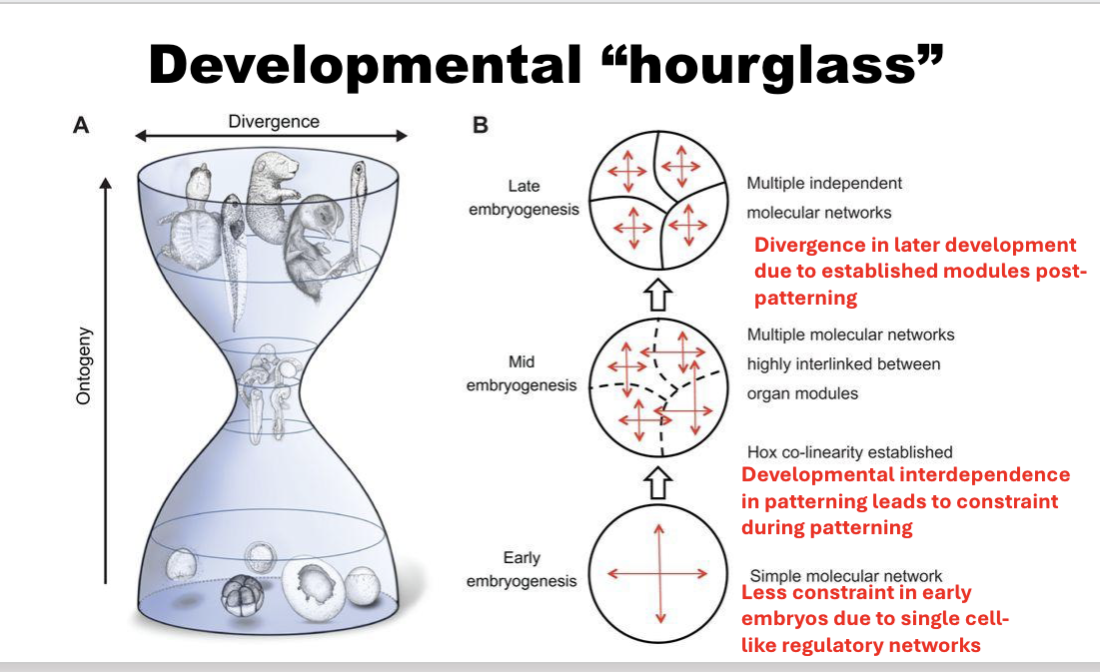
developmental hourglass
every species starts developmental very differently → converge to look very similar during mid-development → they diverge as they develop into different adult forms
a brief history of (early) life
earth formed 4.5 billion years ago
oldest known rocks are 4Gy old (limits out resolution)
earliest definitive evidence of life is 3Gy old
but life existed before this
cyanobacteria likely radiated around 2.8Gya
led to great oxygenation event
multicellular life about 1Gy ago
“hadean” period (4.5-4.0 Gya)
mostly molten rock
giant impact around 4.3 gya thought to have given rise to moon
oceans cool and atmosphere forms (mainly N2, Co2, no O2)
evidence for life: chemical traces and microfossils
C12 was found in larger concentrations than C13 → sign for life
Multicellular life in rocks and fossils dating 3.26 billion years
3 Gya
evidence of life before 3 Gya is rare and often difficult to interpret
Could be earlier
More evidence but lots to still find out (ie. cyanobacteria (2gya), multicellular eukaryotes (1gya))
properties of life
homeostasis: ability to adjust the internal environment to maintain equilibrium
structural organization: ability to maintain distinct parts and connections between them
metabolism: control of chemical reactions
growth and reproduction
response to environmental conditions and stimuli
how could the chemical building blocks of life have arisen?
miller-urey experiment
murchison meteorite
phylogenetics
how could they have gotten assembled into something iwth the minimal requirements of life?
philosophical views on origin of life
conceptual requirements
top down vs bottom up
centrality of RNA
how did pre-RNA arise?
Origin of Life
complicated by difficulty of fossil evidence
hard to see through fossil evidence and phylogenetic trees (can’t see past LUCA)
the miller-urey
foundational experiment in 1950s demonstrative that complex organic molecules could arise in conditions similar to abiotic earth
with electricity and all compounds known to have existed at time of life’s origin, 5 amino acids were found to exist
Simple molecules in right conditions can form complex, life-related molecules
H2, CH4, NH3 → assumptions
Now, we know its CO2, N2, H2O
murchison meteorite
meteorite that fell in australia in 1969
carbonaceous chondrite (high carbon)
fell from Australia in 1969 and had amino acids, complex hydrocarbons and nucleobases
Supports claim that organic compounds could have abiotic origins → could have come from space or non-living things
3 philosophical positions on the origins of life
miracle
it was an enormously improbable accident
it was an inevitable consequence of the laws of chemistry and physics, given the right conditions
requirements of life
energy source
ability to produce more complex molecules from simple building blocks in environment (catalysis)
boundary from external environment (concentration, protection)
reproduction, mutation, heredity
top-down hypothesis
start with properties of known organisms and work backward to reconstruct properties of early life
assumes first life is RNA-based
currently: nucleic acids encode proteins —> proteins required to replicate nucleic acid polymers
neither can be produced without the other
chicken meet egg
top down approach - ribonucleotides
stores genetic information and can carry out basic functions
carry energy (ATP, GTP)
are key cofactors in electron transfer (NAD, FAD) fundamental to life
are the precursors to deoxyribonucleotides
top down approach — RNA
carries information (mRNA, ncRNA, RNA viruses)
catalyzes peptide bodes (ribosomal RNA does this)
RNA using ribonucleotides
one RNA replicase, several nucleotides, and primer led to self-replication
RNA can act as an enzyme (ribozyme)
RNA and ribonucleotides play roles in many fundamental enzymes in extant life today (eg ribosomes)
RNA can form ribozymes that cleave, replicate RNA oligos, and bind cofactors regulating their own expression
focuses on reproduction, mutation, and heredity
ribozymes
all complex eukaryotes share enzymes with RNA as the catalytic units
suggests conserved feature in LUCA
early experiment showed ribozyme can catalyze joining of two fragments to form copies of itself
but requires A + B present (did not polymerize rNTPs)
so it links amino acids together and are important to the function of RNA — alows for self replication
RNA world difficulties
ribonucleotides are quite complicated (phosphate + sugar + base)
hypercycle model
model of self replicating molecules connected in a cyclic, autocatalytic manner
each member boosts replication of another
molecules won’t be supported if it doesn’t contribute to the group
division of labor
evolution of cell
separation of ‘inside’ and ‘outside’ is a fundamental component of cells
initial membranes are simple
simple fatty acids with polar heads —> bcame micelles (amphipathic, spherical structures)
simple fatty acids can flip back and forth → due to presence of water
can lead to bilayer extrusion → when many micelles are added into a membrane, it will split up after incorporation
shows how simple molecules were used/combined together to make more complicated molecules
bottom up hypothesis
redo conditions on life and see how life could have been achieved
life originated in bottom of sea (more suited for this hypothesis)
question: do we really need a self-replicating molecule to start evolution by natural selection?
no, with the hypercycle model, we can develop a network of replicators through natural selection
bottom up hypothesis: alkaline deep sea vents
satisfies conditions ofr origin of life
natural production of all kinds of molecules needed for origin of life
naturally established proton gradient by environment: water coming out of vents (less acidic) and surrounding water with dissolved Co2 (more acidic) -→ such mixing allows for proton gradient
proton gradients used by almost all organisms
atp synthesis during respiration
photosynthesis
molecular transport
bottom up approaches focus on 1-3 , top down (esp rna world) approaches focus on 4
energy source
catalysis
boundary from external environment
reproduction, mutation, and heredity
a brief history of life
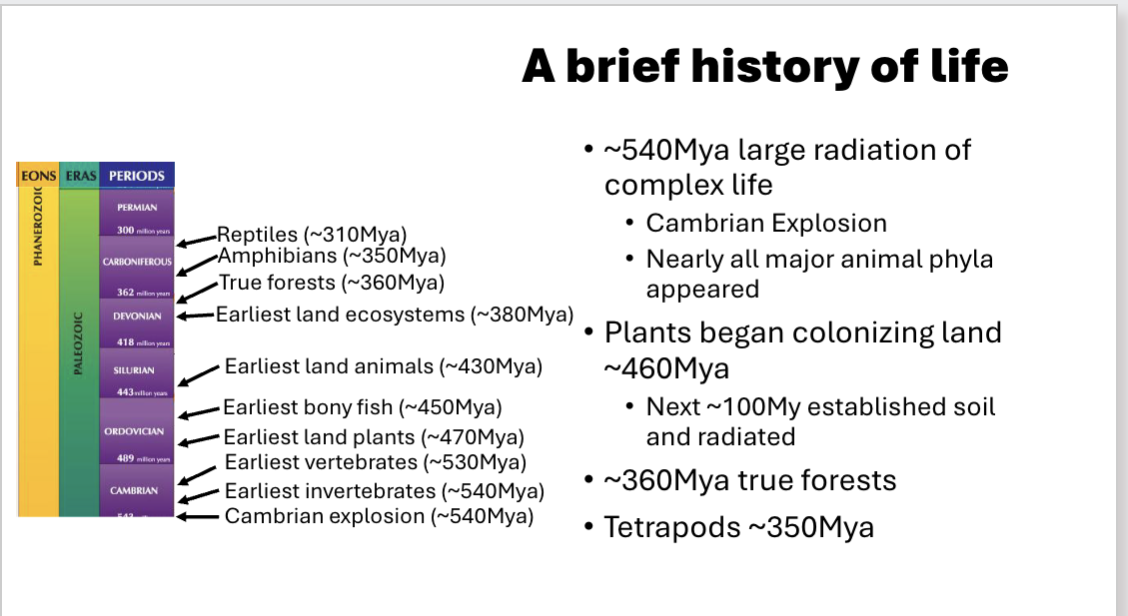
a history of life - dinosaurs and creatures
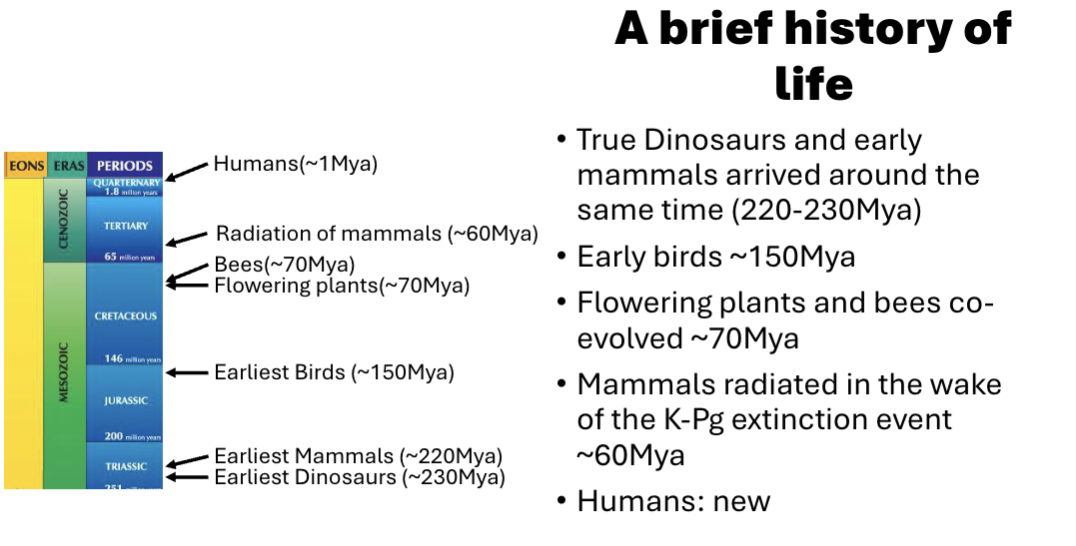
extinction paves the way
many large radiation events are preceded by large extinction events
the five best known include K-T (dinosaur killer)
almost all major geological periods have a nearby extinction evetn
humans are currently causing one of the worst (biodiversity wise)
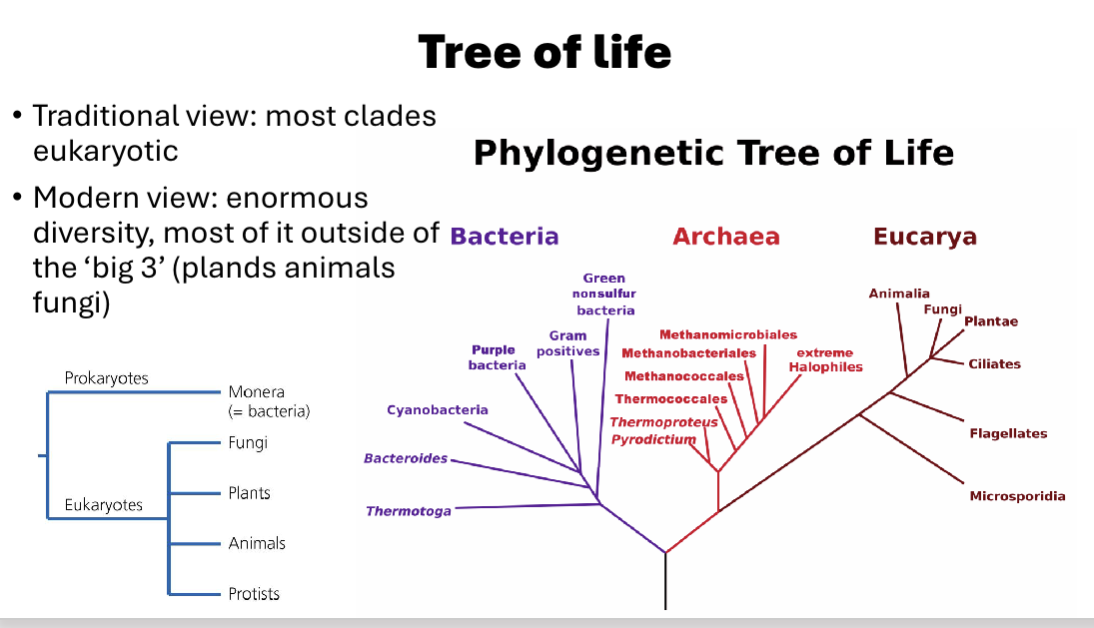
tree of life
traditional view: most clades eukaryotic
modern view: enormous diversity, most of it outside of the big 3 (plands animals fungi)
early evolution
once life began, evolution quickly started
modern DNA has enzymes that can reduce mutations but RNA does not have such correction enzymes
higher mutation rate in early evolution → since life likely started with RNA, it was fast and messy due to high mutation rate of RNA
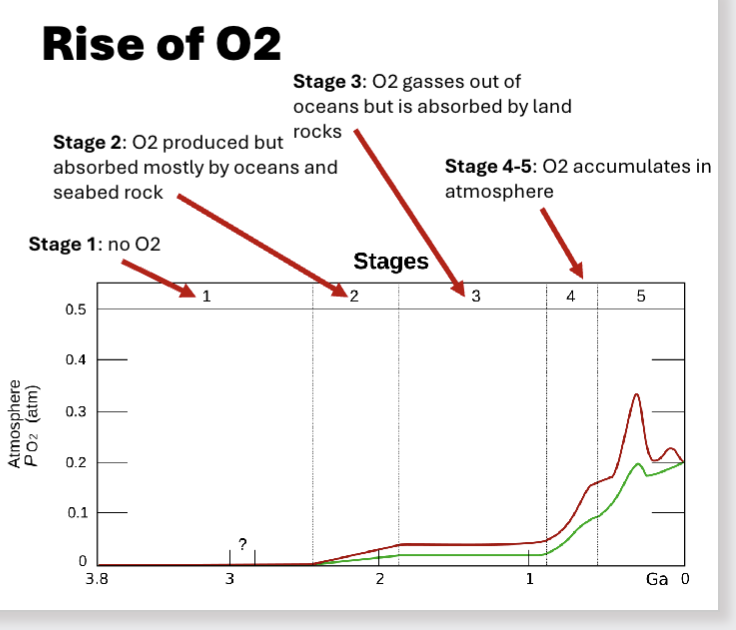
rise of o2
first organisms had simple metabolism since atmosphere was O2 free → anaerobic
all were prob chemoheterotrophs
got nutrients from organic and inorganic material
modern archaea resembles earliest life
obtaining energy from chemical reactions involving hydrogen, sulfur, and iron compounds (all abundant on early Earth)
photosynthesis
most important new metabolic process evolved gradually
organisms that lived close to ocean surface prob developed means of absorbing sunlight (UV)
once absorbed, developed methods of turning it into energy
initially used H2S as electron donor
first oxygenic photosynthesis appearing in cyanobacteria (blue-green algae)
emitted O2 and how it started using H2O instead of H2S
rise of O2
highly reactive
all initial O2 would react with rock and minerals in water
O2 would not accumulate in atmosphere until surface rock was saturated
Rocks formed banded iron formations: layers of iron rich rock that indicate that oxygen was present
rise of O2 would have created a crisis for life- O2 reacts with bonds of organic materials
surviving species avoided effects of O2 bc they lived or migrated to underground locations
many anaerobic microbes found in such locales today
around 2.4Gya “great oxygenation event”
ediacaran biota
the ediacaran period saw large diversification event
large radiation of diverse organisms mostly now extinct
vast array of body plans
organisms were replaced by modern animals during cambrian explosion
animals that dig into microbial mats may have disrupted ediacaran habitats
changes in environmental conditions
cambrian animals outcompeted them
evidence states that cambrian explosion filled niches emptied out by Ediacaran extinctions
cambrian explosion
most major animal body plans appeared very rapidly
animals with complex, distinct body plans
before most organisms were simple single or assembles of multiple cells
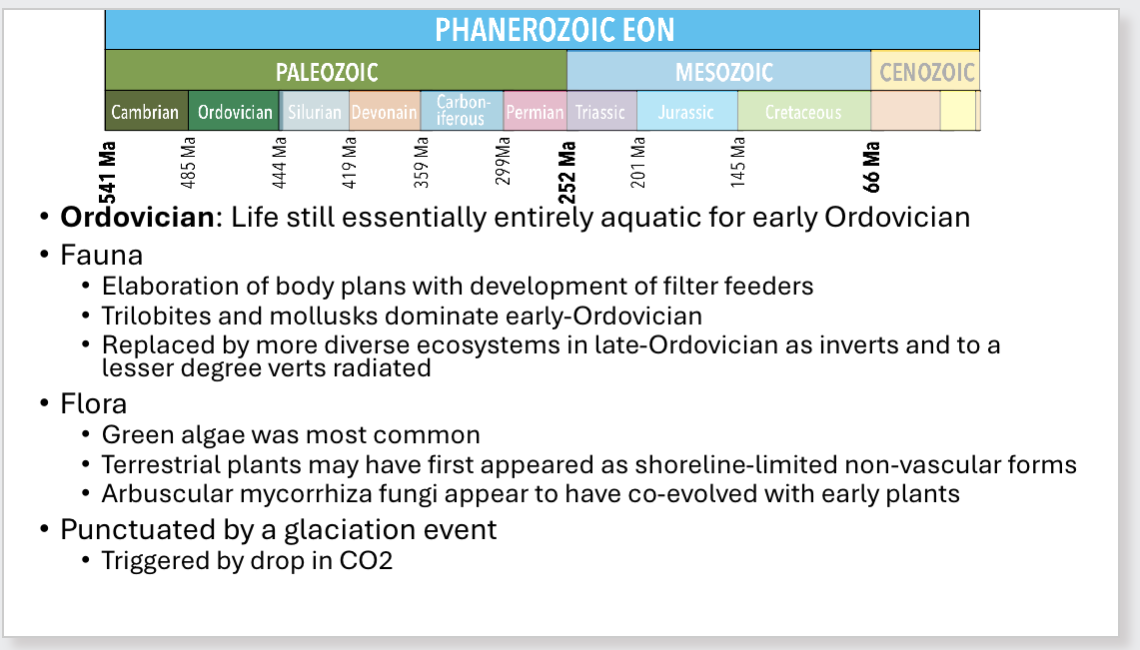
ordovician
life still essentially entirely aquatic for early ordovician
cooling event ended this period → drop in Co2
silurian
when life started to conquer land
vertebrate evolved first bony fishes
ended through Silurian-Devonian Terrestrial Revolution: transition of life from water to land
devonian
first major diversification of life on land
strong establishment of arthropods on land -→ insects and spiders
evidence of earliest tetrapods → major step toward land dwelling vertebrates
ended through series of extinction events due to land plants removing Co2, mountain building increasing rock weathering, which reduces Co2 as well
lot of reduction of Co2
carboniferous
coal bearing
huge deposits of coal that formed massive forests
Diversification of amphibians as dominant land vertebrates
First massive forests
Ended through climate shift and collapse of vast rainforests
CO2 level drops sharply → emergence of massive rain forests that sucked CO2 out
Cooling and drying due to CO2 drop → large change in climate
permian
cool dry climate favored radiation of amniotes (vs amphibians)
avoring of egg-laying vertebrates with the cool dryclimate
Permian-Triassic extinction event: triggered by massive volcanic eruptions, leading to CO2 levels skyrocketing
Ocean acidification, severe global warming, ecosystem collapse
mesozoic
dinosaur time
reptile dominance but also emergence of birds, flowering plants and early mammals
Triassic: allowed for dinosaurs to dominate
Jurassic: earliest birds and modern sharks appear
Cretaceous: flowering plants and bees radiate
Brief history of life:
simple plants → invertebrates → vertebrates
Earth formed 4.5 billion years ago
Definitive evidence of life is 3 Gy old
Cyanobacteria likely diversified 2.8 gya
Led to great oxygenation event
Multicellular appeared 1 gya
540 mya → all major animal phyla appear
460 mya → plants colonize land
360 mya → forests
350 mya → tetrapods (four limbs)
Earliest dinosaurs to humans is from 230 mya to 1 mya
extinction paves the way
many large radiation events are preceded by large extinction events
almost all major geological periods have a nearby extinction event
humans are currently causing on the worst (biodiversity wise)
Mass extinctions are always followed by major evolutionary radiations
Extinction clear out many niches
Almost every major geological boundary is near a mass extinction
extinction
all individuals in a given species have died out with no living descendants
mass extinction: widespread and rapid decrease in the biodiversity on Earth
5-20 have occurred
Initial event leads to chain of events that lead to severe environmental catastrophe
extinction events: the big 5
Late Ordovician: caused by global cooling, possibly due to volcanic ash
Late devonian: no single cause pinpointed
Permian triassic: massive volcanic eruptions in Siberia
Volcanic emissions released caused global cooling, acid rain and global warming → loss of ocean life, ecosystem damage, fungal blooming, etc
Triassic-jurassic: likely caused by another major volcanic event
70-75% of species lost
Cretaceous-paleogene: asteroid impact
Extinction events cause massive losses in biodiversity and are detectable in fossil records
pleistocene megafauna extinction
as humans evolved globally, large animals soon started to disappear
Long before modern civilization, humans had major ecological impact
How?
Hunting: hunted meat into extinction
some argue early hunter gatherer societies would not have consumed this much meat
other counter that slow generation time of large megafauna would still allow this collapse over time
Second-order predation: humans killed predators → increase in herbivores → no plants because nothing to regulate herbivores
Disruption of ecosystems by killing predators
extinction of the earth’s megafauna, unique bc of its extreme size bias toward large animals
what predicts species extinction?
geographic range
species with wider geographic range tend to have eggs in more baskets
others include species in climate extremes and specialization in habitat
Geographic range: spread out in more environments → less likely to go extinct
Climate extremes and specialization → broadly distributed, adaptable species survive better
are all extinctions bad?
Can lead to evolutionary opportunity
Major groups did not succeed because they were superior
Adaptive radiation: a process whereby an ancestral species diversifies rapidly into multiple new species/forms
End of triassic killed all dinosaurs → K-Pg (cretaceous-paleogene) blossomed with radiation of mammals
trends
how evolution is occurring
cladogenesis: a species branches into two new species
anagenesis: changes to a species over time without branching, resulting in appearance of a new species
trends: phyletic gradualism
species change historically viewed as gradual process occuring at a relatively fixed rate over time
trends: punctuated equilibrium
newer view tends to view species as keeping ‘status' quo’ until rapid evolutionary change occurs often resulting in speciation
diversity of life (metazoa)
two groups within eukaryota have produced complex multicellular organisms
archaeplastida - gave rise to plants
opisthokonta - gave rise to fungi and animals
all have a single posterior flagellum in flagellated cells
features of metazoa
multicellular
heterotrophics
obtain energy and organic molecules by ingesting other organisms
active movement
complex tissue structure
differentiated and specialized tissues
diplontic life cycle
diploid state is multicellular whereas the haploid state is (typically) gametic