Aerobic Wastewater treatment
 Call Kai
 Learn
Learn Practice Test
 Spaced Repetition
 Match
Match Flashcards
 Knowt Play
1/11

There's no tags or description
Looks like no tags are added yet.
Name | Mastery | Learn | Test | Matching | Spaced | Call with Kai |
|---|
No analytics yet
Send a link to your students to track their progress
12 Terms
Nitrogen
Too much nitrogen in water causes algae blooms → kills fish → pollutes rivers. Needs to be removed
Step 1: NITRIFICATION
An aerobic process where ammonium (NH₄⁺) is first converted to nitrite (NO₂⁻), then to nitrate (NO₃⁻) by bacteria. It consumes oxygen, which is expressed as NOD (Nitrogenous Oxygen Demand) — the amount of oxygen required to nitrify the ammonium present in the wastewater.
5% of new biomass is created
Step 2: DENITRIFICATION
Removing nitrate (NO₃⁻) by converting it into harmless nitrogen gas (N₂)
Anaerobic process — oxygen not needed
Nitrate goes through intermediates: NO₂⁻ → NO → N₂O → N₂ (released into atmosphere)
Requires organic carbon as energy source for bacteria
Called NOE (Nitrogen Oxygen Equivalent) — represents the oxygen "saved" by using nitrate instead of O₂
![<p>Too much nitrogen in water causes <strong>algae blooms</strong> → kills fish → pollutes rivers. Needs to be removed</p><p></p><p><strong>Step 1: NITRIFICATION </strong></p><p class="font-claude-response-body break-words whitespace-normal leading-[1.7]">An aerobic process where ammonium <strong>(NH₄⁺)</strong> is first converted to <strong>nitrite (NO₂⁻)</strong>, then to <strong>nitrate (NO₃⁻) </strong>by bacteria. It consumes oxygen, which is expressed as <strong>NOD (Nitrogenous Oxygen Demand)</strong> — the amount of oxygen required to nitrify the ammonium present in the wastewater.</p><p class="font-claude-response-body break-words whitespace-normal leading-[1.7]"><strong><em>5% of new biomass is created</em></strong></p><p class="font-claude-response-body break-words whitespace-normal leading-[1.7]"></p><p class="font-claude-response-body break-words whitespace-normal leading-[1.7]"><strong>Step 2: DENITRIFICATION </strong></p><p class="font-claude-response-body break-words whitespace-normal leading-[1.7]"><strong>Removing nitrate (NO₃⁻) by converting it into harmless nitrogen gas (N₂)</strong></p><ul><li><p><strong>Anaerobic process</strong> — oxygen not needed</p></li><li><p>Nitrate goes through intermediates: NO₂⁻ → NO → N₂O → <strong>N₂</strong> (released into atmosphere)</p></li><li><p>Requires <strong>organic carbon</strong> as energy source for bacteria</p></li><li><p>Called <strong>NOE (Nitrogen Oxygen Equivalent)</strong> — represents the oxygen "saved" by using nitrate instead of O₂</p></li></ul><p></p>](https://assets.knowt.com/user-attachments/3fdb22d2-7778-417d-adb4-166042036b5a.png)
Phosphorus in wastewater starts as Organic-P (bound in organic matter like food waste) and first breaks down into PO₄³⁻ (phosphate) (the dissolved form).
Two removal methods:
1. Biological — Acinetobacter bacteria absorb and store PO₄³⁻ into new biomass → removed with sludge
2. Chemical — add Fe³⁺ or Al³⁺ → reacts with PO₄³⁻ → forms solid precipitate (осадок) → removed with sludge
![<p>Phosphorus in wastewater starts as <strong>Organic-P</strong> (bound in organic matter like food waste) and first breaks down into <strong>PO₄³⁻ (phosphate)</strong> (the dissolved form).</p><p><strong>Two removal methods:</strong></p><p class="font-claude-response-body break-words whitespace-normal leading-[1.7]"><strong>1. Biological</strong> — <em>Acinetobacter</em> bacteria absorb and store PO₄³⁻ into new biomass → removed with sludge</p><p class="font-claude-response-body break-words whitespace-normal leading-[1.7]"><strong>2. Chemical</strong> — add Fe³⁺ or Al³⁺ → reacts with PO₄³⁻ → forms solid precipitate (осадок) → removed with sludge</p>](https://assets.knowt.com/user-attachments/a1ddf3c8-8d2c-461a-aaf6-b62e3844a6f4.png)
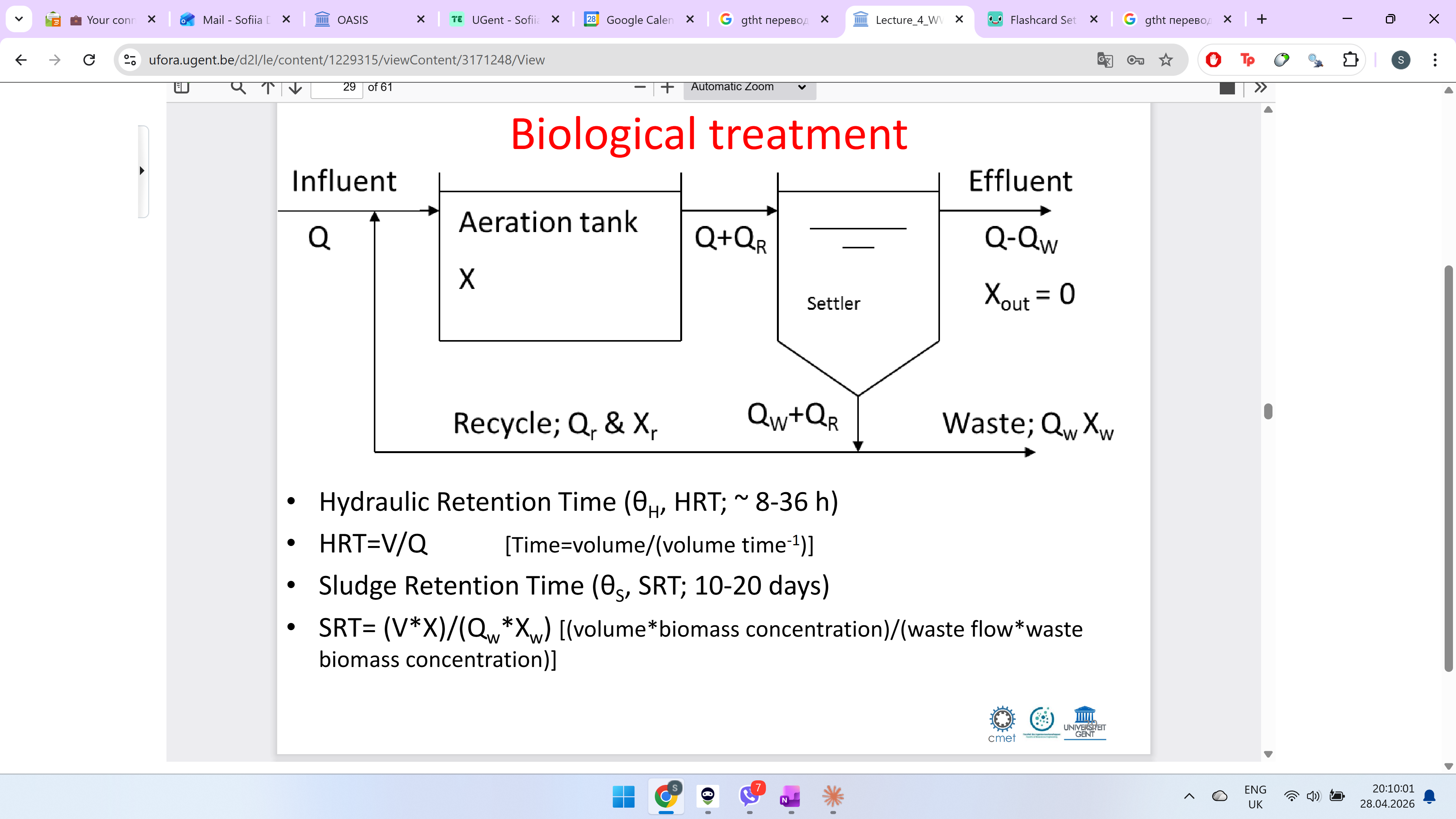
Volumetric Loading rate
Sludge Loading rate
X
Sedimented biomass concentration
Volumetric Loading Rate (Bv) — how much pollution enters per m³ of tank volume per day ~ 1 kg bCOD m⁻³ d⁻¹
Sludge Loading Rate (Bx) — how much pollution enters per kg of bacteria per day ~ 0.25 kg bCOD kgMLSS⁻¹ d⁻¹
X - Biomass concentration in aeration tank
Xr = Xw - Sedimented biomass concentration (bottom of settler)
![<p><strong>Volumetric Loading Rate (Bv)</strong> — how much pollution enters <em>per m³ of tank volume</em> per day ~ 1 kg bCOD m⁻³ d⁻¹</p><p class="font-claude-response-body break-words whitespace-normal leading-[1.7]"><strong>Sludge Loading Rate (Bx)</strong> — how much pollution enters <em>per kg of bacteria</em> per day ~ 0.25 kg bCOD kgMLSS⁻¹ d⁻¹</p><p class="font-claude-response-body break-words whitespace-normal leading-[1.7]"><strong>X - </strong>Biomass concentration in aeration tank</p><p class="font-claude-response-body break-words whitespace-normal leading-[1.7]"><strong>Xr = Xw - </strong>Sedimented biomass concentration (bottom of settler)</p>](https://assets.knowt.com/user-attachments/12e08eb1-8b7d-4e91-b719-99ea66cabd64.png)
Hydraulic Retention time (HRT)
Sludge retention time (SRT)
HRT = how long does water sit in the aeration tank, tells the volume needed given the flow = tank volume / flow of water coming
SRT = total biomass / biomass removed per day, How many days bacteria stay in the system.
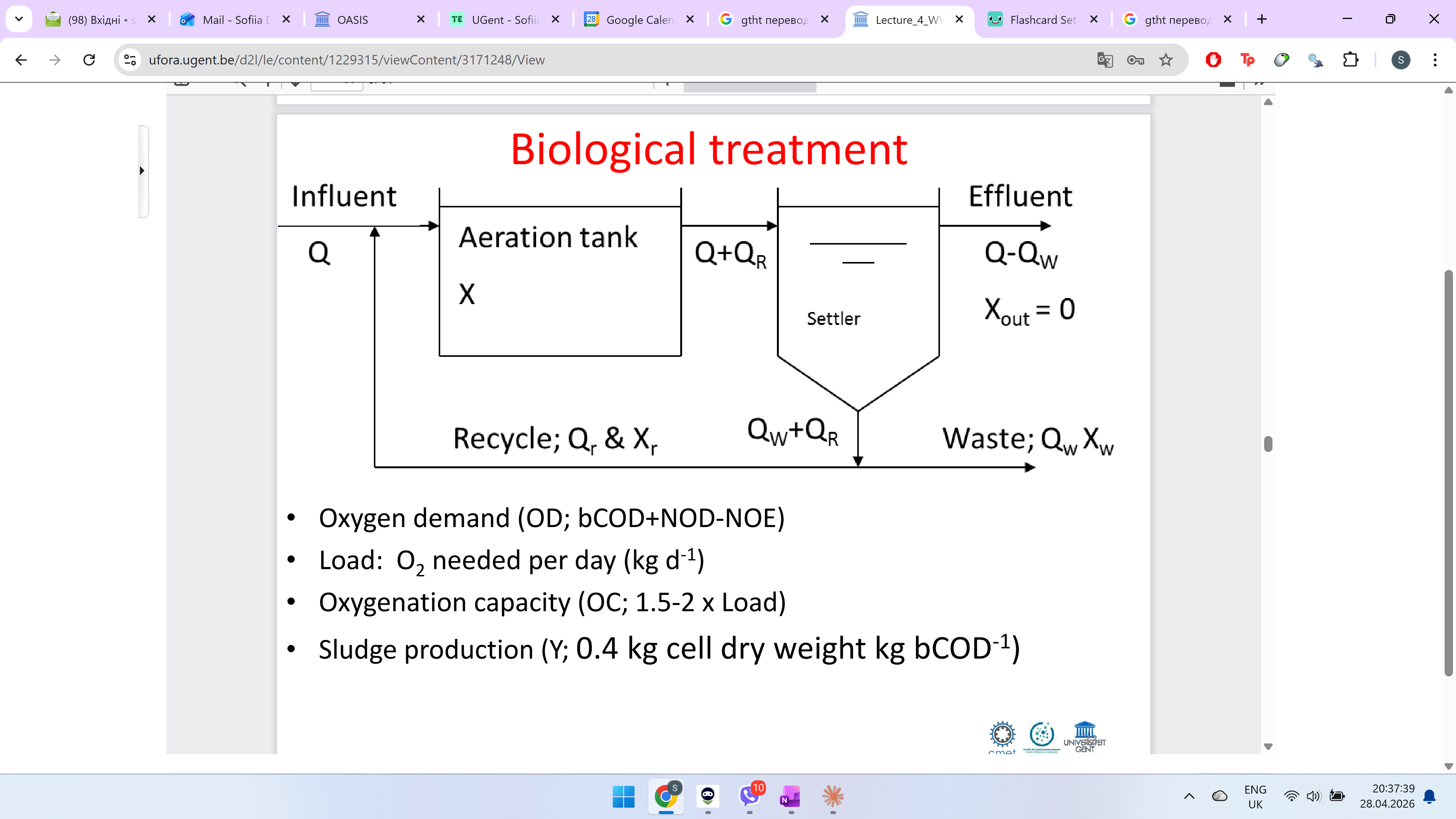
Oxygen demand
Load
Oxygen capacity
Sludge production
Oxygen demand (OD;bCOD+NOD-NOE) - total oxygen demand in aeration tank.
!NOE is subtracted because denitrifying bacteria use nitrate as their oxygen source — so you need to pump less air into the tank.
OC =what your aerators/pumps must actually deliver, always install more aeration capacity than needed
For every kg of organic pollution eaten, bacteria produce 0.4 kg of new biomass (sludge).
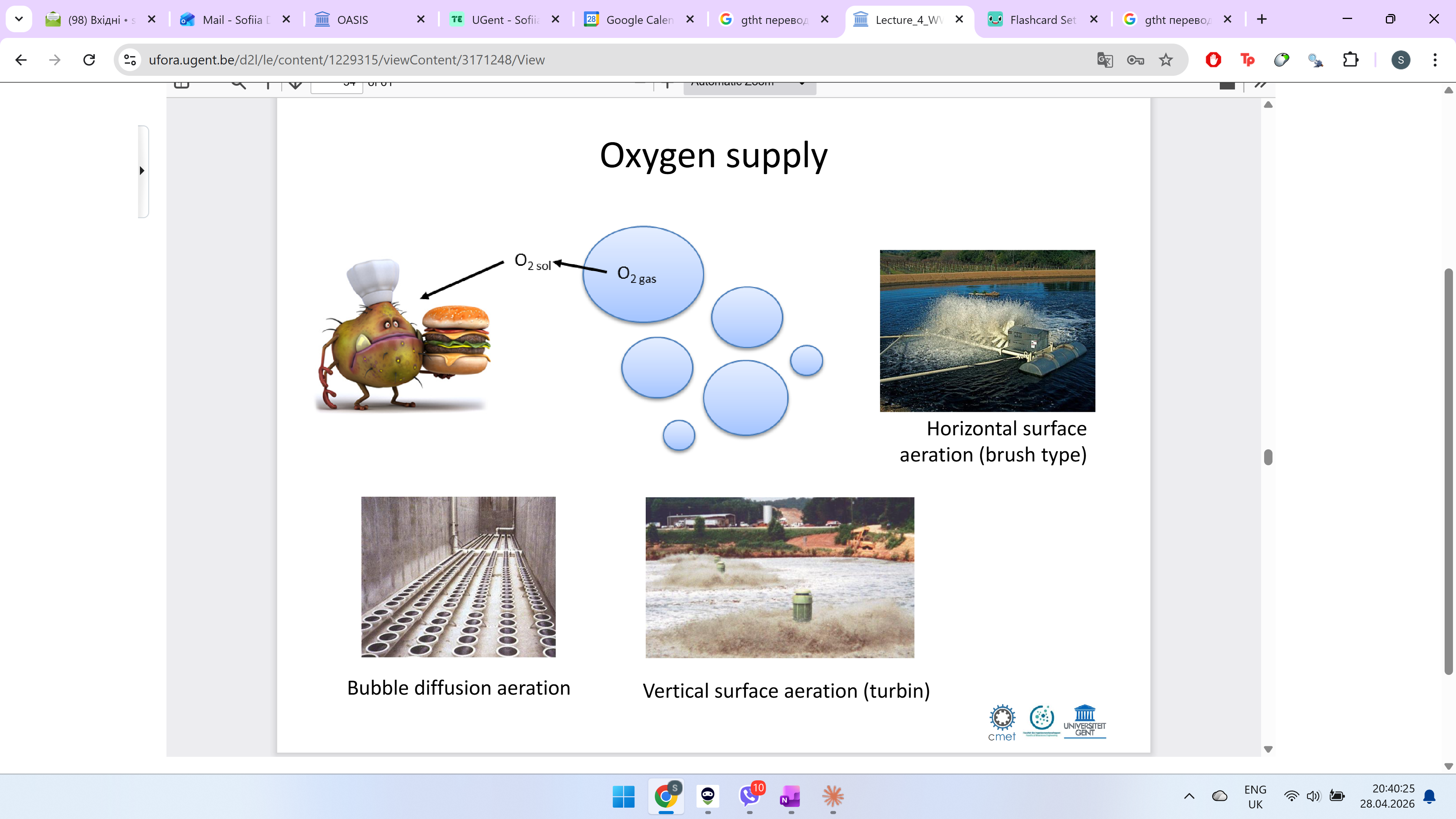
Aeration methods
Energy cost = 0.2€ per kWh
Fine bubble diffusers - the most efficient
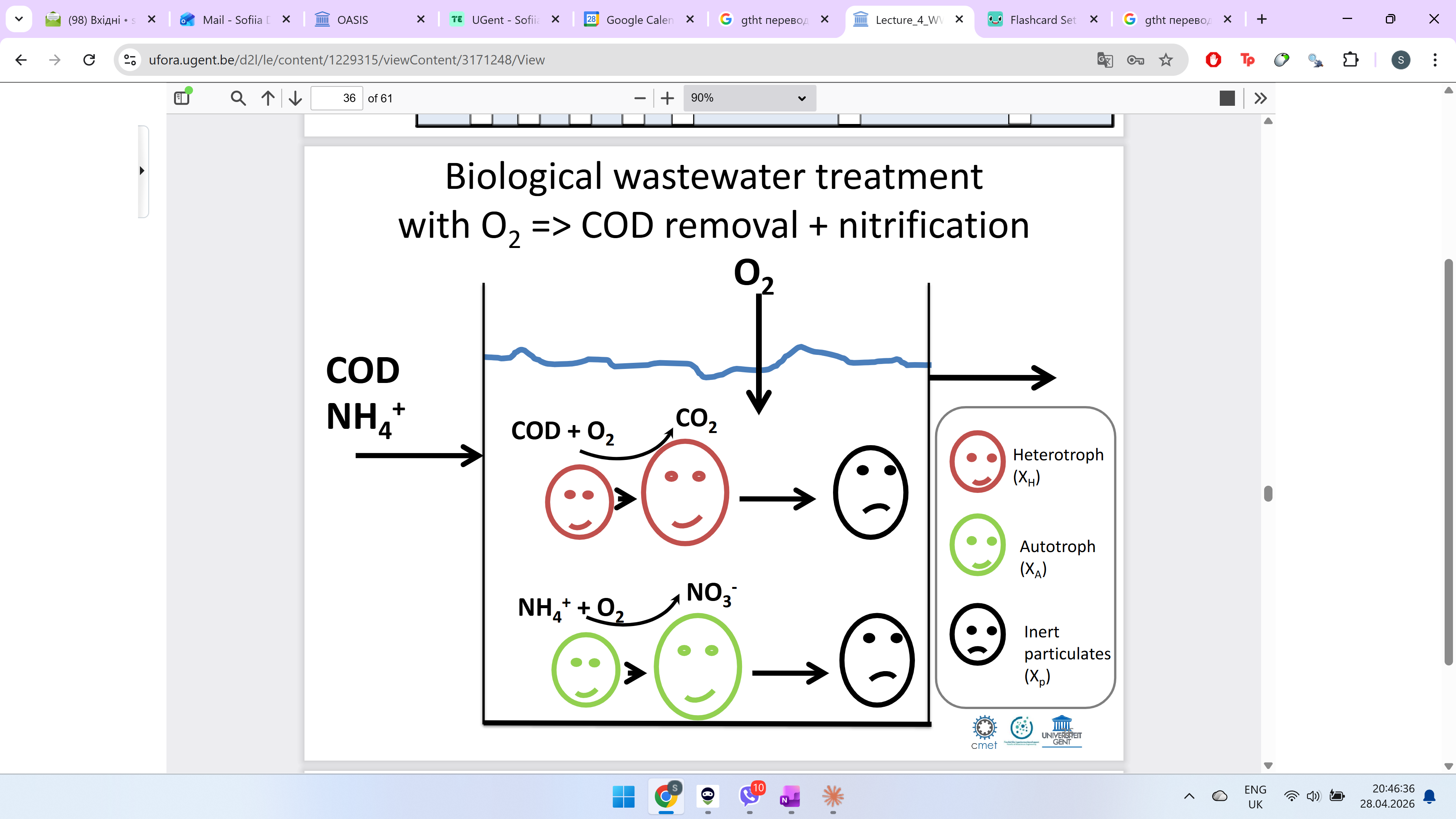
Biological wastewater treatment
with O2
COD removal + nitrification
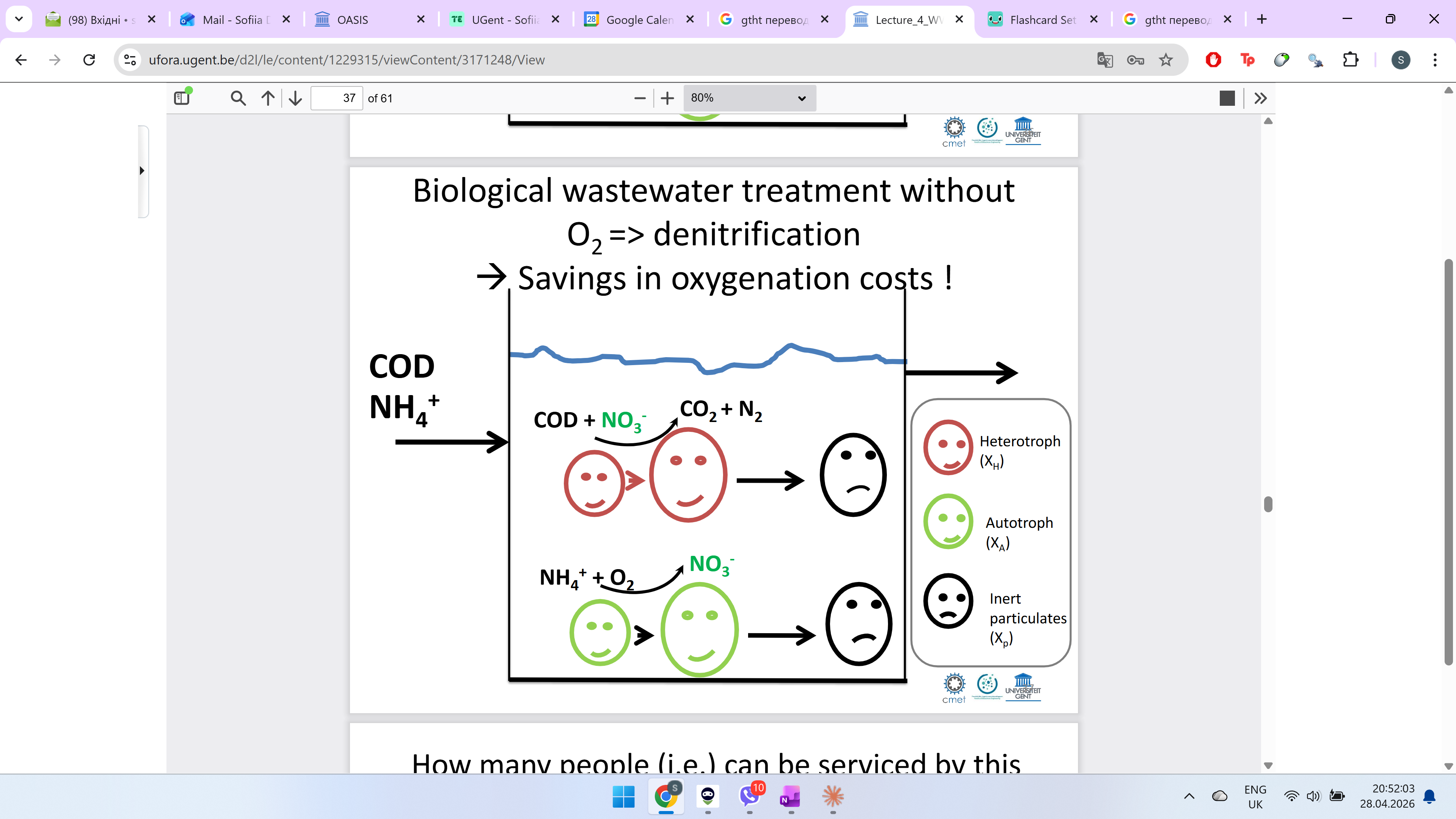
X_H - heterotroph - removes organic pollution (COD)
X_A - autotroph - nitrification (H₄ → NO₃)
X _P - inert particulates - dead matter, waste
Biological wastewater treatment without O2
- denitrification
Savings in oxygenation costs
Heterotrophs eat organic matter (COD) using O₂ or nitrate as substitute. Autotrophs eat inorganic ammonium (NH₄⁺) always requiring O₂ to produce nitrate.
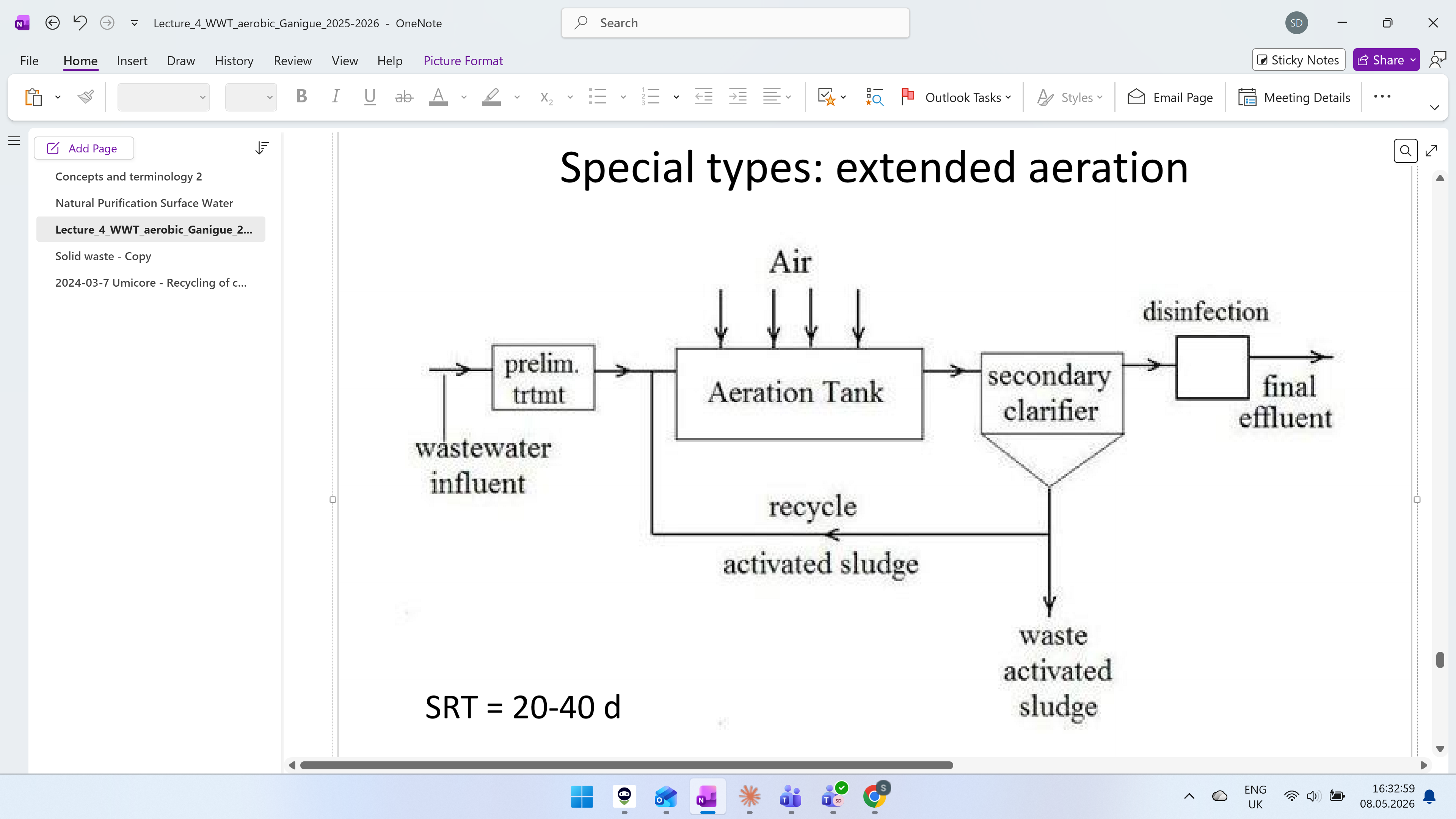
Expanded aeration
Much longer SRT 20-40 days: Microorganisms stay in the system much longer, so they consume not just the incoming organic matter but also their own cell mass → less waste in the end
Advantages:
Highly efficient BOD removal: more bacteria accumulated → higher bacteria-to-food ratio → more complete BOD removal
Limited sludge production
Disadvantages:
Suitable for small waste flows
Very low loading rate
Limited nutrient removal (N, P) - Bacteria use BOD for energy, but they only take up N and P when growing new cells. In extended aeration, bacteria are barely growing, so BOD is fully consumed but N and P pass through untreated.
Sequencing batch reactors
different processes happen in the same tank at different times
1. Fill — wastewater enters the tank
2. React — air is pumped in, bacteria break down the organic matter (like a normal aeration tank)
3. Settle — aeration stops, sludge sinks to the bottom, clean water rises to the top
4. Decant — the clean water at the top is removed through an outlet
5. Idle — tank waits until the next batch arrives, excess sludge can be wasted here
Advantages:
Potential limited CAPEX (cheaper to build)
Minimal footprint
Operating flexibility and control - You can easily adjust the cycle just by changing the timing, without building anything new.
Disadvantages:
Complexity and more labor-intensive maintenance
Potential sludge discharge during draw phase - During decanting (step 4), if the outlet is placed incorrectly or sludge hasn't fully settled, sludge can accidentally get drawn out
![<p>different processes happen in <strong>the same tank at different times</strong></p><p><strong>1. Fill</strong> — wastewater enters the tank</p><p class="font-claude-response-body break-words whitespace-normal leading-[1.7]"><strong>2. React</strong> — air is pumped in, bacteria break down the organic matter (like a normal aeration tank)</p><p class="font-claude-response-body break-words whitespace-normal leading-[1.7]"><strong>3. Settle</strong> — aeration stops, sludge sinks to the bottom, clean water rises to the top</p><p class="font-claude-response-body break-words whitespace-normal leading-[1.7]"><strong>4. Decant</strong> — the clean water at the top is removed through an outlet</p><p class="font-claude-response-body break-words whitespace-normal leading-[1.7]"><strong>5. Idle</strong> — tank waits until the next batch arrives, excess sludge can be wasted here</p><p class="font-claude-response-body break-words whitespace-normal leading-[1.7]"></p><p class="font-claude-response-body break-words whitespace-normal leading-[1.7]">Advantages:</p><ul><li><p class="font-claude-response-body break-words whitespace-normal leading-[1.7]">Potential limited CAPEX (cheaper to build)</p></li><li><p class="font-claude-response-body break-words whitespace-normal leading-[1.7]">Minimal footprint</p></li><li><p class="font-claude-response-body break-words whitespace-normal leading-[1.7]">Operating flexibility and control - You can easily <span><strong>adjust the cycle</strong></span> just by changing the timing, without building anything new.</p></li></ul><p class="font-claude-response-body break-words whitespace-normal leading-[1.7]">Disadvantages: </p><ul><li><p class="font-claude-response-body break-words whitespace-normal leading-[1.7]">Complexity and more labor-intensive maintenance </p></li><li><p class="font-claude-response-body break-words whitespace-normal leading-[1.7]">Potential sludge discharge during draw phase - During decanting (step 4), if the outlet is placed incorrectly or sludge hasn't fully settled, <strong>sludge can accidentally get drawn out</strong></p></li></ul><p></p>](https://assets.knowt.com/user-attachments/5e291595-fc33-4430-9d7e-5a5b4b5e730b.png)
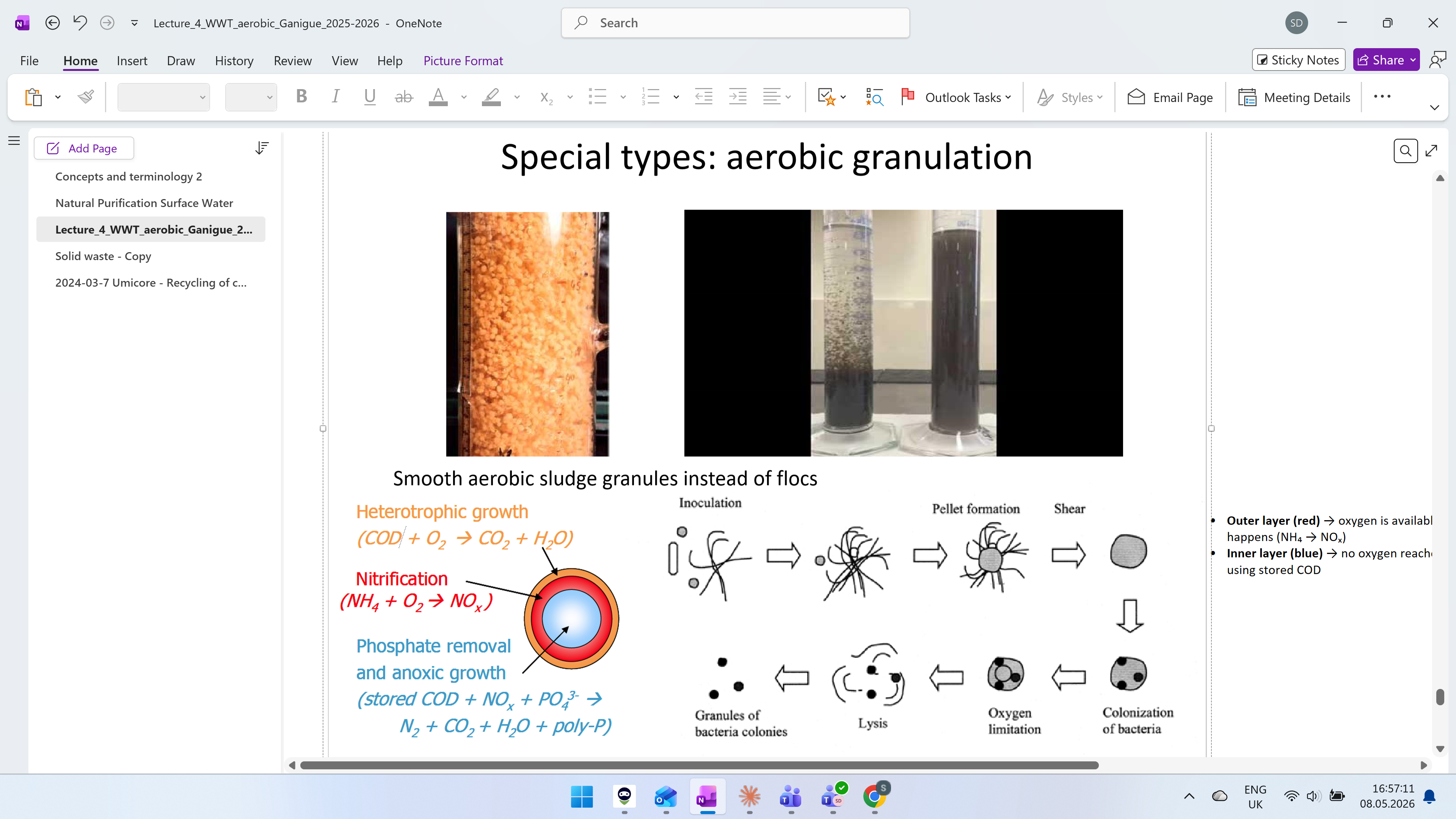
Aerobic Granulation
Instead of flocs, bacteria form granules
Outer layer (red) → oxygen is available → heterotrophic bacteria break down COD, and nitrification happens
Inner layer (blue) → no oxygen reaches here → denitrification and phosphate removal happen using stored COD
Advantages:
High settling velocity
High biomass retention - because they sink fast, bacteria stay in the tank rather than escaping with the effluent
High loads possible - granules are so packed with bacteria that a small tank can treat a lot of wastewater
Better withstands toxicants - toxic substances can only reach the outer layer, inner bacteria are protected
Disadvantage:
Technically challenging to obtain aerobic flocs - getting bacteria to form granules instead of flocs is difficult and requires very precise conditions
Membrane bio-reactors (MBR)
MBR replaces the clarifier with a membrane filter inside the aeration tank → fewer tanks, cleaner water.
Advantages
Long sludge age possible — in conventional systems, if you keep sludge too long it overflows with the water. In MBR the membrane physically holds all sludge back, so you can have a very long SRT without losing biomass → less sludge produced
Almost complete disinfection — the membrane pores are so tiny that bacteria, viruses and pathogens physically cannot pass through → very clean effluent almost without extra disinfection steps
No setling issues, high density sludge can be used — in conventional systems thick sludge settles poorly (bulking). In MBR settling doesn't matter at all since the membrane does the separation → you can have much more concentrated biomass (you can add more bacteria)
Better system robustness — conventional systems can fail if sludge stops settling properly (bulking). MBR doesn't depend on settling at all → much more stable and reliable
Limited footprint — no clarifier needed → smaller total system
Disadvantage
COST - Membranes are expensive to buy, maintain and replace. MBR costs roughly double in every category compared to conventional system
![<p>MBR replaces the clarifier with a membrane filter inside the aeration tank → fewer tanks, cleaner water.</p><p><strong>Advantages</strong> </p><ul><li><p class="font-claude-response-body break-words whitespace-normal leading-[1.7]"><strong>Long sludge age possible</strong> — in conventional systems, if you keep sludge too long it overflows with the water. In MBR the membrane physically holds all sludge back, so you can have a very long SRT without losing biomass → less sludge produced</p></li><li><p class="font-claude-response-body break-words whitespace-normal leading-[1.7]"><strong>Almost complete disinfection</strong> — the membrane pores are so tiny that bacteria, viruses and pathogens physically cannot pass through → very clean effluent almost without extra disinfection steps</p></li><li><p class="font-claude-response-body break-words whitespace-normal leading-[1.7]"><strong>No setling issues, high density sludge can be used</strong> — in conventional systems thick sludge settles poorly (bulking). In MBR settling doesn't matter at all since the membrane does the separation → you can have much more concentrated biomass (you can add more bacteria)</p></li><li><p class="font-claude-response-body break-words whitespace-normal leading-[1.7]"><strong>Better system robustness</strong> — conventional systems can fail if sludge stops settling properly (bulking). MBR doesn't depend on settling at all → much more stable and reliable</p></li><li><p class="font-claude-response-body break-words whitespace-normal leading-[1.7]"><strong>Limited footprint</strong> — no clarifier needed → smaller total system</p></li></ul><p> </p><p><strong>Disadvantage </strong></p><p class="font-claude-response-body break-words whitespace-normal leading-[1.7]"><strong>COST - </strong>Membranes are expensive to buy, maintain and replace. <strong>MBR costs roughly double</strong> in every category compared to conventional system</p>](https://assets.knowt.com/user-attachments/1618560e-3ec6-4abe-b4ba-ad1677ffcd7e.png)