GCSE Biology B5: Homeostasis
 Call Kai
 Learn
Learn Practice Test
 Spaced Repetition
 Match
Match Flashcards
 Knowt Play
1/65

There's no tags or description
Looks like no tags are added yet.
Name | Mastery | Learn | Test | Matching | Spaced | Call with Kai |
|---|
No analytics yet
Send a link to your students to track their progress
66 Terms
Homeostasis
regulation of the internal conditions of a cell or organism to maintain optimum conditions for function in response to internal and external changes
maintains optimal conditions for enzyme action and all cell functions
in the body: homeostatis controls: blood glucose conc, body temp, water levels
nervous and hormonal communication is involved in the automatic control systems which detect changes and respond to them
all control systems have:
receptors: cells that detect stimuli (changes in the environment)
coordination centres: process the information received from the receptors e.g. brain, spinal chord, pancreas
effectors: bring about responses to bring the conditions in the body back to optimum levels e.g. muscles or glands
Human Nervous System
receptor cells in the skin detect a stimulus and convert it into an electrical impulse
this electrical impulse travels along the sensory neuron
The electrical impulse gets converted to a chemical neurotransmitter to diffuse through the synapse to the sensory neurons in the central nervous system (CNS: either the brain or spinal cord) if at the brain, the info is processed, and an appropriate response is coordinated
goes to the brain for complex, conscious actions such as (touch, pain, needs thinking) and to the spinal cord for immediate automatic, unconscious reflex actions (pulling hand from heat)
then diffuses through the synapse again as a neurochemical transmitter to the motor neuron and back into an electrical impulse to be sent to the efforctors which carry out the response
this can be muscles contracting or glands secreting hormones
reflex actions
automatic and rapid actions that do not involve the conscious part of the brain
important to prevent individuals from getting hurt
information travels down the reflex arc, allowing vital responses to take place quickly
diffusion through the synapse
nerve impulse arrives at the synpase
chemical messenger (a neurotransmitter) is released into the synpase. impulses causes vesicles to fuse with neuron membrane
neutransmitter diffuses across the synpase
neurotransmitter binds with a receptor on the membrane of the post synaptic neuron
binding of neurotransmitter to receptor stimulates impulse in postsynaptic neuron
There are junctions between neurones
Each time the electrical impulses meets the end of a neurone, a chemical transmitter is released
This diffuses across the gap, binds to receptors and starts another impulse in the next neurone
reaction time
how long it takes you to respond to a stimulus. can be measured with ruler drop test
The brain
controls complex behavior
made of billions of interconnected neurones and has different regions that carry out different functions
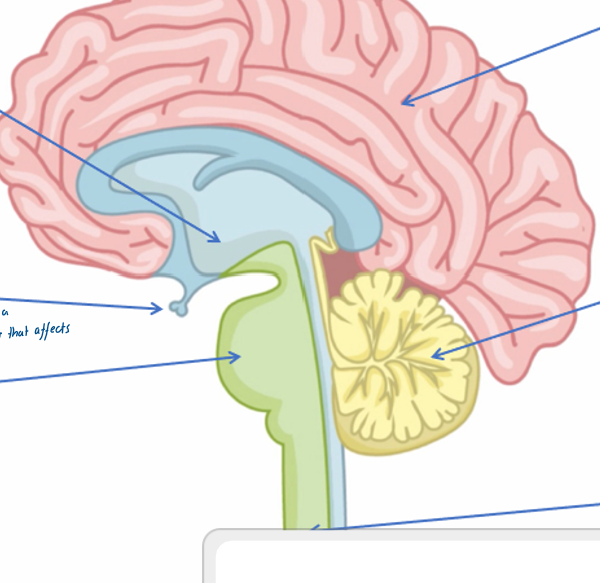
Name the parts of the brain
cerebral cortex
control consciousness, intelligence, memory and languageHypothalamus
helps releases hormones and regulates body temppituitary gland
takes messages from the brain (via hypothalamus) to produce hormones that affects many parts of the bodymedulla (oblongata)
controls unconsciousness activity such as heartbeat, movement of the gut and breathingcerebellum
controls muscle activity and balancespinal chord
a long, thin tubular structure made up of neuron tissue connected to the medulla
investigating brain function and treating brain damage and disease is difficult because:
it is complex and delicate
it is easily damaged
drugs given to treat disease cannot always reach the brian because of the membranes that surround it
it is not fully understood which part of the brain does what
neuroscientists can map out the regions of the brain using a number of methods:
studying patients with brain damage
observing the changes in an individual following damage on a certain area of the brain can provide information on the role this area haselectrically stimulating different parts of the brain which can be done by pushing an electrode into the brain. the stimulation may result in a mental or physical change in the individual, providing information on the role this area of the brain has
using MRI scanning techniques
a magnetic resonance imaging scanner can be used to create an image of the brain. this can be used to show which part of the brain is affected by a tumour, or which part is active during a specific task
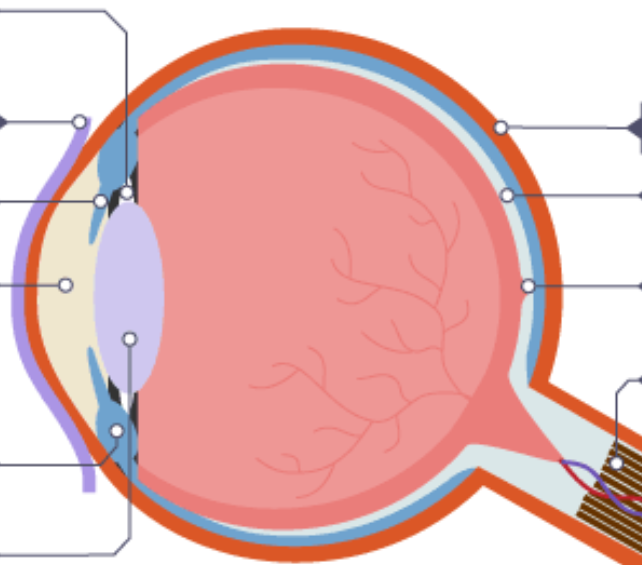
The eye
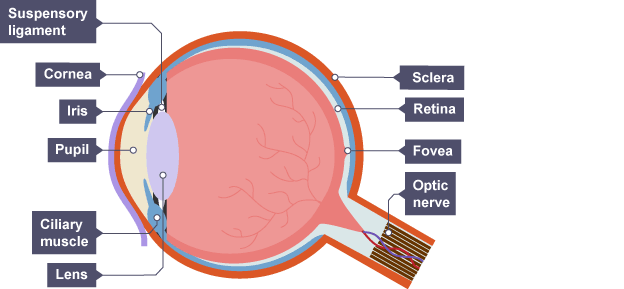
Parts of the eye
Retina: layer of light sensitive cells found at the back of the eye
Optic Nerve: a nerve that leaves the eye and leads to the brain. It carries the impulses from the retina to the brain to create an image
Sclera: white outer layer which supports the structures inside the eye. It is strong to prevent some damage to the eye
Cornea: The see-through layer at the front of the eye which allows light through and the curved surface bends and focuses light onto the retina
Iris: Muscles that surround the pupil. In bright light, the circular muscle contract and radial muscles relax to make the pupil smaller, avoiding damage to the retina
in dim light, the circular muscles relax and the radial muscles contract to make the pupil larger - so more light can enter to create a better imageciliary muscles and suspensory ligaments: hold the lens in place and they control its shape
To focus on a near and far object
near:
- ciliary muscles contract
- suspensory ligaments loosen
- lens is then thicker and more curved this refracts light morefar:
- ciliary muscles relax
- suspensory ligaments tighten
- the lens then becomes thinner so light refracts less
Eye defects
oxxur when light cannot focus on the retina
short sightedness: myopia: lens is too curved and thick or eyeball is too long, distant objects appear blurry
long sightedness: hyperopia: lens is too flat or thin or eyeball is too short so it can not refract light enough
treatment methods for eye defects
spectacle lenses: concave lenses to spread out the light for myopia and convex lenses to bring the rays together to treat hyperopia
contact lenses: work in the same way as glasses but allow acitivites such as sport, hard or soft contact lenses last for different amounts of time
laser eye surgery: lasers can be used to either reduce the thickness of the cornea (so it refracts light less) to treat myopia or change its curvature (so it refracts light more strongly) to treat hyperopia
replacement lens: hyperopia can be treated by replacing the lens with an artificial one made of clear plastic (or adding the plastic on top of the natural lens). the risks include damage to retina or cataracts developing
Control of body temperature
thermoregulatory centre monitors and controls body temp is found in the brain
has receptors that monitor the temp of the blood
has receptors in the skin that sends impulses to the thermoregulatory centre
human body temp is 37.5 degrees celsius
when body temp is too high
sweat (evaporates from the skin surface resulting in increased energy transfer away from the body) is produced from sweat glands
vasodilation means more blood flows closer to the surface of the skin, resulting in increased energy transfer from the body
hairs lay flat which means less nsulating air is trapped next to the skin
when body temp is too low
skeletal muscles contract rapidly (shivering) to generate heat from respiration
hairs stand on end to create an insulating layer trapping warm air
vasoconstriction means blood does not flow so close to the surface, reuslting in less ehat loss
Endocrine system
composed of glands which secrete chemicals called hormones directly into the bloodstream
the blood carries the hormone to a target organ where it produces an effect
the effects are slower but act for longer compared to nervous system
glands
pituitary gland:
- master gland
- secretes hormones into the blood to either have an effect on the body or act on other glands to stimulate them to produce different hormonespancreas:
- secretes insulin
- controls blood glucose levelsthyroid
- secretes thyroxine
- controls metabolic rate, heart rate and tempadrenal gland:
- secretes adrenaline
- involved in fight or flight responseovary:
- secretes oestrogen
- involved in the menstrual cycle and development of female secondary characteristicstestes:
- secretes testosterone
- is involved in production of sperm and development of male secondary sexual characteristics
Control of blood glucose concentration
controlled by pancreas
eating foods that contain carbohydrates increases the glucose levels in the blood
if glucose levels are too high
pancreas produces the hormone insulin
insulin binds to cell in target organs (muscles and liver) causing:
- glucose to move from the blood into muscle cells for respiration
- excess glucose to be converted into glycogen which is stored in the liverblood glucose concentration is reduced
if blood glucose is low
rigorous acitivity (exercise) uses glucose for respiration and therefore there is less in the blood
if glucose levels decrease, the pancreas produces a hormone glucagon
glucagon binds to the liver cells causing glycogen to be broken down into glucose
glucose is released into the blood, increasing the blood glucose conc
negative feedback loop
when blood glucose levels increase/decrease, a hormone is secreted to oppose the change
the action of this hormone cannot occur continually because when the blood arrives at a certain glucose concentration the other hormone is produced resulting in the opposite effect
type 1 diabetes
heridatory
pancreas cannot produce enough insulin
blood glucose level can rise to a fatal amount
glucose is excreted with urine and lots of urine is produced leaving individual very thirsty
it is treated with insulin injections at meal times, which results in glucose being taken up from the bloodstream
it is advised to limit intake of simple carbs which contain lots of glucose
doctors are attempting to cure diabetes with pancreas and pancreatic cell transplants, and genetically engineering pancreatic cells from mice to make insulin
type 2 diabetes
the body cells no longer respond to insulin
blood glucose levels can rise to a fatal amount
obesity can cause this
treatments include reducing number of simple carbs in diet, losing weight and inreasing exercise
there are also drugs to make insulin more effective on body cells, help the pancreas make more insulin or reduce the amount of glucose absorbed from the gut
if water conc of the blood increases
hypothalamus sends signal to pituitary gland
Gland produces little to no hormones (ADH)
The kidney tubules are then less permeable to water and more water is then released into the bladder to be urinated
if water conc of the blood decreases
If there is too little water in the blood, there will be low water potential which is dangerous.
so the hypothalamus sends a signal to the pituitary gland. The gland will produce hormones such as ADH
This travels via the blood to the kidney tubules. They tell the kidney tubule to reabsorb more water back into the blood.
They do this by making the kidney tubules more permeable to water (increases the permeability to water).
More water is reabsorbed back into the blood
example of negative feedback loop
Kidneys
very important to maintain balance of water and other substances in the body
The kidney filters out the blood
ultrafiltration of glucose, ions, water and urea in the nephron (kidney tubules)
selectively reasborbs all of the glucose, some ions, some water, release urea to the bladder
Why is it hard to cool down in humid countries?
Because there is a high concentration in the atmosphere the water doesn't want to evaporate from your skin as evaporation happens from a low to high concentration but there is already a high concentration of water in the atmosphere
Humidity can reduce the rate of sweat evaporation making it difficult to regulate the body's temperature
water
can also leave the body at the lungs as a result of exhalation or from the skin in sweat
can also be lost as urine depending on the conc of water in the blood
Ions
taken into the body via food
if the ion conc is incorrect, then too little or too much water may enter body cells. this is because the water potential of the blood would be altered
they are lost in sweat
in the kidneys, certain amounts of ions are reabsorbed into the blood after it has been filtered to ensure the conc in the blood is maintained
Urea
amino acids are the products of digestion of proteins. Amino acids are deaminated in the liver to form ammonia. As ammonia is toxic it is converted immediately to urea and excreted safely
it is lost in sweat
in the kidneys it is filtered out of the blood
Kidney failure
waste products build up which can be harmful for the body, eventually results in death
Dialysis: function of the kidneys is carried out using an artificial membrane:
- blood moves between partially permeable membranes surrounded by dialysis fluid (has the same conc of ions and glucose as healthy blood)
- useful ions and glucose are not lost from the blood but urea, excess ions and water diffuse across the membrane
- it has to be done three times a week, with the process itself taking 3-4 hours
- it acts as an artificial kidney and keeps people alive while they wait for a transplantkidney transplants: provides individual with healthy kidney
- currently the only cure
- they are transplanted from people who have died suddenly, or from people still alive
- mean that the person does not have to visit the hospital as regularly as they did when undergoing dialysis and it is cheaper than the overall cost of dialysis
Problem for dialysis treatments (5)
posibility of blood clots forming
amount of time it takes
have to follow strict diet
unpleasant experience
build up of waste products between sessions can make you feeling ill
Problems of kidney transplant (4)
rejected from the body as a result of immune system recognising the antigens on the donor organ as foreign
change of this happening can be reduced by using immunosuppressant drugs
however this means that the person can be left vulnerable to other diseases
transplanted kidneys do not last forever
puberty
reproductive hormones begin to be released
causes secondary sexual characteristics to develop in men and women and eggs to mature in women
main male reproductive hormone
testosterone
produced by testes
stimulates sperm production
main female reproductive hormone
oestrogen
produced in ovary
produces physcal changes and is involved in the menstrual cycle
Menstrual cycle
process the body undergoes each month to prepare for a potential pregnancy
day 1-5: uterus lining breaks down and the woman is on her period
day 6-10: repair of uterus lining
day 11-18: uterus lining grows and thickens
day 6-14: maturation of egg in follicle
day 14: ovulation occurs - an egg is released from the ovary and moves to the uterus via the fallopian tube. if a fertilised egg has not been embedded in the lining after 28 days, it begins to break down and the cycle continues
day 14-17: most likely to fertilise
day 19-28: uterus lining thickens futher and becomes more vascular, preparing for implantation, if egg has not been embedded, it begins to break down and cycle continues
when an egg is fertilised, it embeds into the uterus lining which provides it with nutrients and helps cushion the fetus
days 0-13 she is on her period
hormone
chemical messenger produced by endocrine glands and released into the bloodstream to the target organ
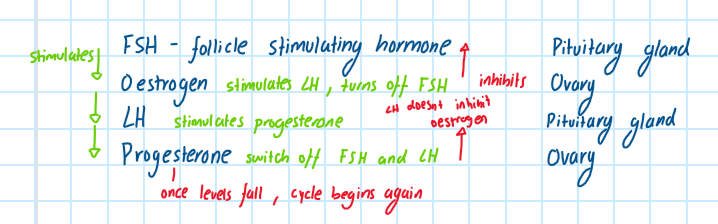
Hormones involved in the cycle
Follicle stimulating hormone (FSH):
- causes maturation of an egg in ovary, within a follicle
- produced in pituitary gland
- stimulates ovaries to produce oestrogenOestrogen: causes lining of uterus to grow again
- produced in ovaries
- secreted as a result of FSH
- stimulates production of LH and inhibits secretion of more FSHLuteinising hormone (LH)
- produced in pituitary gland
- its release results in ovulationprogesterone
- produced in ovaries and secreted from egg follicle
- maintains lining of uterus
- supports a pregnancy if egg is fertilised
inhibits the release of both FSH and LH
once egg is released from mature follicle
leftover mass of cells forms corpus luteum
this produces high levels of progesterone which is important to maintain uterus lining in event that fertilisation occurs
after ovulation this occurs which is called luteal phase
Hormonal methods of contraception (5)
pill
patch
implant
injection
IUD
Contraceptive Pill
must be taken regularly or the bodies own hormones will be released, leading to egg maturing
contains oestrogen and progesterone
this means oestrogen levels are constantly high, inhibiting FSH so no eggs mature
lining also stops developing and the mucus in cervix becomes thick so sperm cannot move through
possible side effects: changes in mood, breast enlargement, increased blood pressure
you can get progesterone only pill which has less side effects
Contraceptive Patch
contains oestrogen and progesterone
small and is stuck on the skin
lasts for one week
Contraceptive Implant
releases a continuous amount of progesterone
this prevents the ovaries from releasing the egg, thickens the mucus in cervix so sperm cannot swim and stops fertilised eggs from embedding in the uterus
lasts for 3yrs
Contraceptive Injection
made up of progesterone
same effect as implant
lasts for 2-3 months
Plastic intrauterine device (IUD)
releases progesterone
same effect as implant
T - shaped, inserted into uterus
Non - hormonal methods of contraception
chemical methods: spermicides: kill or disable sperm but only 70-80% effective
barrier methods: condoms and diaphragms
- condoms are either worn over the penis or are inside the vagina. They also prevent the individual from contracting sexually transmitted diseases. A problem is that it can tear and therefore let sperm through
- a diaphragm is a plastic cup positioned over the cervix, used with spermicidesurgical methods: male and female sterilisation, cutting and tying the fallopian tube or sperm duct. this lasts forever
abstaining from intercourse ensures that an egg is not fertilised. others may only abstain during ovulation
Copper Intrauterine device
works by killing sperm in the uterus and stopping any fertilised embryos from implanting in the uterus lining
copper ions act as a spermicide hindering sperm movement so they cant reach the egg
Hormones to treat infertility
fertility drugs: increase chance of pregnancy
- main hormone used is FSH and LH because they stimulate maturation and release of the egg
- woman can then become pregnant normallyIn Vitro Fertilisation (IVF):
- mother is given FSH and LH to encourage maturation eggs
- these are extracted from the mother and fertilised in the lab using sperm
- fertilised eggs develop into embryos (tiny balls of cells) and then one or two are inserted in the uterus
Bnefits and Cons of hormones of IVF
Pros: provides a way for infertile couple to have a child
Cons: - physically stresfful as women may jave reactions to the hormones, such as feeling sick
- it is emotionally stressful as it may not work: success rate for IVF is 26%
- can lead to multiple births - unexpected and may be a risk to the babies and the mother
- can be expensive if process needs to be repeated
Thyroxine
regulates metabolic rate (how quickly reactions occur). also important in growth and development
released by the thyroid gland
its released is stimulated by the thyroid stimulating hormone
levels of thyroxine is controlled by negative feedback
when levels increase, it is detected by receptors in the brain
inhibits the release of TSH
this inhibits the release of thyroxine so levels fall
Adrenaline
produced in times of stress, stimulates fight or flight response
released by adrenal glands (on top of the kidneys)
stimulated by fear or stress, detected in the brain
effects of adrenaline include:
increased heart and breathing rate to deliver more oxygen and glucose to the brain and muscles for respiration
glycogen stored in the liver is converted to glucose for respiration
pupils dilate to let in more light
blood flow to muscles is increased
blood flow to digestive system is decreased
Plant hormones (tropisms)
needed to cordinate and control growth e.g. tropisms
phototropism: response to light
gravitropism
geotropism
positive phototropism
most plants show this because they grow towards the light source
the plant is exposed to light on one side
auxin moves to the shaded side of the shoot
auxin stimulates cells to grow more there
this means the shoot bends towards the light
the plant recieves more light, meaning photosynthesis can occur at a faster rate
Negative gravitropism
most shoots show this as they grow away from gravity, if a shoot is horizontal:
auxin moves to the lower side
the cells of the shoot grow more on the side with the most auxin, so it stimulates cells to grow more here
this makes the shoot bend and grow away from the ground
this is beneficial as light levels are likely to be higher further away from the ground
Positive gravitropism
most roots show this as they grow towards gravity
if a root is horizontal:
auxin moves to the lower side
the cells of the root grow more on the side with less auxin, so it stimulates cells to grow on the upper side
this makes the root bend and grow downwards
this is beneficial as there are more likely to be increased levels of water and nutrients lower down, and it provides stability for the plant
what happens when auxin distribution becomes equal on both sides
it grows straight up
effect of light or gravity on newly germinated seedlings in varying conditions RP
place germinated seeds in a cardboard box and shining light from one side and one in no light, the seeds growing in no light will grow more as the shoots grow more in order to find light
attaching a petri dish containing seedlings to a wall (effects of gravity
other plant hormones
gibberellins: important to stimulate seed germination
ethene: involved in cell division and ripening of fruits
uses of plant hormones
increase yield
obtain desirable features and to lower costs
Auxin uses
as weed killers:
- many weeds are broad-leaved
- weedkillers, containing auxin have been synthesised so they only affect broad-leaved plants
- the increased amount of auxin causes the cells to grow too rapidly
- leading to the weed dyingas rooting powders:
- plants with desirable features are cloned to make more plants with the same feature
- one way to clone a plant is to take a cutting from the original plant
- rooting powder containing auxin is applied to it and it is placed in the ground
- roots grow and the new plant begins to grow very quicklyto promote tissue culture
- another way to clone a plant is tissue culture
- cells from the plant are taken and placed in a growth medium containing lots of nutrients (petri dish)
- hormones such as auxins are added
- the cells begin to form roots and shoots
Ethene
as it controls ripening, it is used in food industry
fruit is picked when it is not ripe
it is firm which means that during transport it gets less bruised and damaged
when it is needed to be sold, it is exposed to ethene and warmer temps
ethene is involved in cotnrolling cell division and stimulates enzymes that result in fruit ripening
this reduced wastages as more fruit is suitabloe to be sold and it does not ripen too early
Gibberellins
ending seed dormancy:
- in the brewing industry, germination rate of barely seeds is increased to make maltpromoting flowering:
- instead of requiring certain conditions such as longer days and low temps to flower, applying this hormone allows it to flower in any conditions and with bigger flowersincreasing fruit size
- the seeds in fruit produce gibberellins to increase fruit size
- this means that seedless fruit is generally smaller
- seedless fruit can be sprayed with gibberellins to increase their size