Immunoematology final exam review
 Call Kai
 Learn
Learn Practice Test
 Spaced Repetition
 Match
Match Flashcards
 Knowt Play
 Podcast
1/252

There's no tags or description
Looks like no tags are added yet.
Name | Mastery | Learn | Test | Matching | Spaced | Call with Kai |
|---|
No analytics yet
Send a link to your students to track their progress
253 Terms
AHG is a an antibody that will bind to
Other antibodies and/or complement (depending on type used)
After combining the proper amount of a specific antibody suspension (2 drops) with the proper amount of RBC suspension (1 drop), the sample is centrifuged.
On proper agitation the cell button breaks apart completely.
The resulting solution has a completely clear background with no visible suspensions.
What is the appropriate agglutination grading?
0
Alloimmunization (first time exposure to an antigen) is very likely to cause an immediate transfusion reaction. T or F
FALSE
An IgG antibody bound to RBC antigen is very effective at crosslinking to another RBC antigen ON ITS OWN. T OR F
FLASE
IgG antibody attachment to red blood cells most often leads to what transfusion reaction?
Delayed hemolytic transfusion reaction
To test for free floating antibodies in a patient sample, what part of the sample would you analyze?
Plasma
What class of immunoglobulin is most effective at initiating the complement cascade?
IgM
What immune system cell is responsible for identifying foreign antigens and initiating the alloimmunization process?
T helper cells
What innate immune system cell is responsible for taking "flagged for disposal" red blood cells to the spleen?
Monocytes
What is the OVERALL process whereby antibodies attached to red cell antigens, followed by the red blood cells being transported to the spleen for recycling/disposal?
Extravascular hemolysis
A delayed hemolytic transfusion reaction is most often caused by? Antibody
which leads to?
IgG.
Extravascular hemolysis
A delayed transfusion reaction (due to alloimmunization) may occur upon the first exposure to a foreign antigen. T OR F
FALSE
ABO incompatibilities [ Select ] to an incompatible blood group, leading to a(n) [ Select ]
require prior exposure
Immediate HTR
Rh incompatibilities [ Select ] to an incompatible blood group, leading to a(n) [ Select ]
Require a prior exposure
Delayed HTR
AHG that is anti-IgG, C3d will bind to:
Both IgG antibodies and complement (C3d)
Anti-human globulin is an antibody engineered to bind to:
Antibodies and/or complement proteins bound to RBC’s (depending on the type of AHG)
Blood groups (ABO) are defined by:
Specific antigens on the RBC membrane surface
The class of antibodies most often responsible for an immediate hemolytic transfusion reaction is:
IgM
The immunological mechanism responsible for most of the damage caused by an immediate hemolytic transfusion reaction is
Activation of the complement system
All QC test results are valid for 24 hours without exception. T or F
FLASE
You have performed QC for a given set of reagents.
During your shift, you run out of a single bottle of reagent.
That single bottle of reagent has a different lot number than the bottle you performed QC testing on.
Do you have to perform QC on the new bottle of reagent? You have to perform QC;
it is a new lot
How often must QC be performed (at a minimum)?
Every day testing is performed; prior to performing testing that day
Anti-A with A cells: Agglutination
Anti-A with B cells: [ Select ] ["Agglutination", "No agglutination"]
Anti-B with A cells: [ Select ] ["Agglutination", "No agglutination"]
Anti-B with B cells: [ Select ] ["No agglutination", "Agglutination"]
Anti-D with D+ cells: [ Select ] ["Agglutination", "No agglutination"]
Anti-D with D= cells: [antiDd=neg]
AHG with Check Cells [ Select ] ["No agglutination", "Agglutination"]
Saline with Check Cells No agglutination
Answer 1:
Agglutination
Answer 2:
No agglutination
Answer 3:
No agglutination
Answer 4:
Agglutination
Answer 5:
Agglutination
Answer 6:
Agglutination
Answer 7:
No agglutination
A patient requires specific phenotype of blood for which the combined phenotype probability is 0.26.
The patient requires 2 units.
How many units will you potentially need to screen to obtain the 2 units?
Enter your answer as a whole number. Round your calculated value UP from the decimal value to the next whole number.
Example: calculated number = 1.2 units --> round to 2.
8
An individual that is blood group O+ will demonstrate which of the following antigens on their RBC's?
Select all that apply.
d
O
D
A
H
B
No antigens
D and H
An individual that is blood group Oh (Bombay) will demonstrate which of the following antigens on their RBC's?
Select all that apply.
H
No antigens
O
A
B
No Antigen
Genes Jka and Jkb are most completely described as:
Antitheticals
Given the following probabilities...
Fya+ 66%
Jkb+ 77%
Calculate the probability that an individual is Jkb+ AND Fya=.
Enter your answer as a decimal, 2 places past the decimal.
0.26
What chromosome are the ABO genes found on?
Enter your answer as a whole number.
9
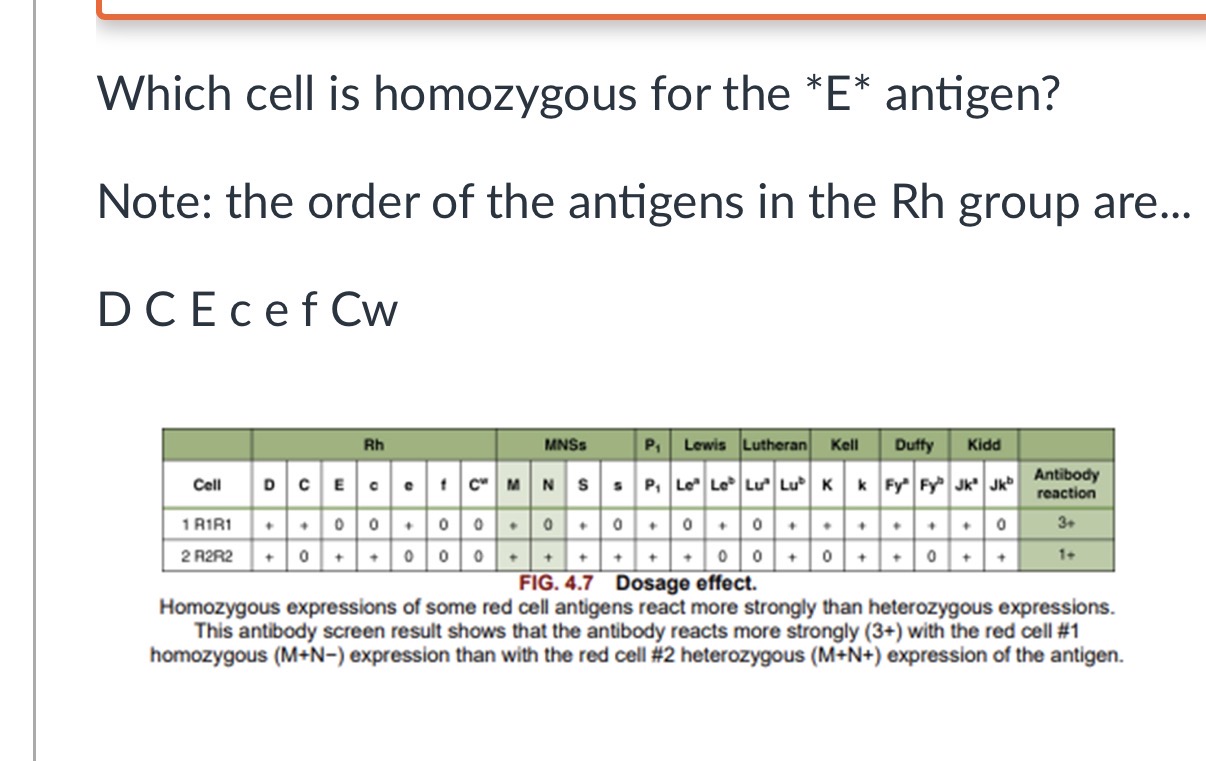
Cell 2
With respect to RhD...
d is an alternate antigen to D antigen.
T OR D
False
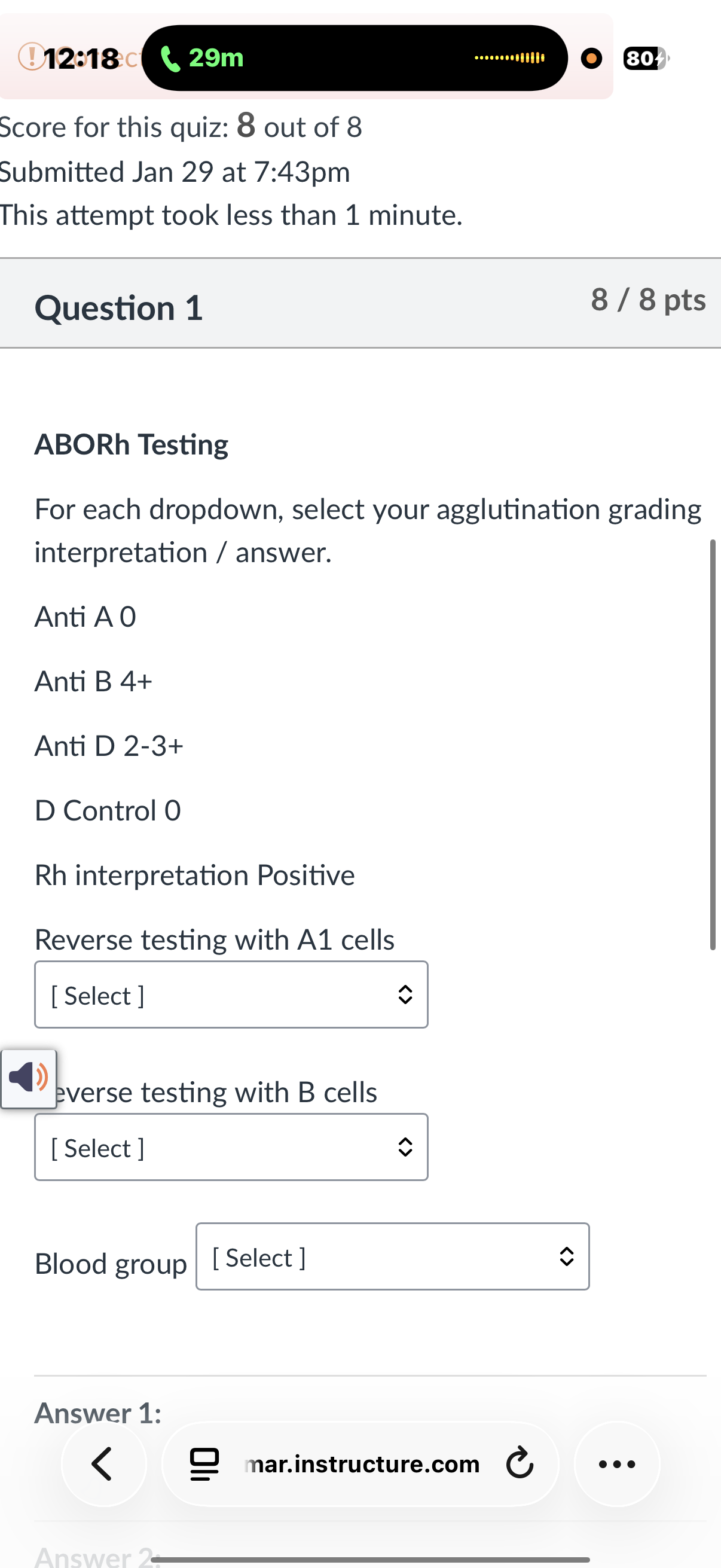
A patient is typed A= (A negative).
That the patient is Rh(D) negative is an example of what genetic pattern?
Recessive
A patient is typed as Bombay (Oh).
Bombay phenotype is an example of what genetic pattern?
Amorph/null
Amount of antigen presentation depending of a patient genotype (example: A antigen presentation in genotypes AA vs AO) is defined as:
Dosage effect
An individual that presents as a Bombay phenotype will LACK what antigen(s)?
A and B and H
Anti-B would likely produce the strongest agglutination with the red blood cells of a patient of what genotype?
BB
Genotype AO will physically present with more/less A antigen than genotype AA?
Less
Physical presentation of inherited traits is defined as:
Phenotype
Select the correct statement with respect to homozygosity vs heterozygosity.
Homozygous; stronger antigen presentation
Which of the following genotypes does NOT demonstrate Ce in trans position to D?
dce / dCe
Which of the following is an example of an antithetical?
Fya vs Fyb (Duffy blood groups)
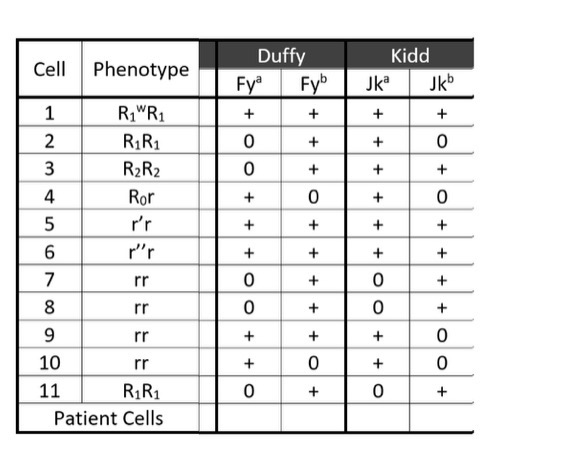
You need a cell that is HOMOZYGOUS with respect to the Kidd B (Jkb) antigen.
Which of the following cells are valid choices? Select all that apply.
7,8,11
d (lower case) is an antithetical to D (upper case).
T OR F
False
An RhD inheritance of genotype dd is considered a null trait.
(asterisks added for emphasis)
T OR F
False
On what number chromosome are the Rh genes found?
Enter your answer as a whole number.
19
What percent of the population is RhD+?
Use the value provided in lecture.
Enter your answer as a whole number. Do not add a % sign.
85
An individual that presents with no Rh antigens (lacks D, C, E, c and e; Rh genotype ---/---) is classified:
Rh null
A mother of blood group phenotype A gives birth to a child of phenotype B; the alleged father is group O.
Select the one best answer.
The alleged father is not the actual father by direct exclusion
A patient has a history of circulating anti-Jkb.
Which of the following blood genotypes from a donor would be safest to transfuse?
Jk(a=b=)
A patient is genotype Jk(a=b+).
Blood from a donor of which genotype would be safest/best to transfuse to the patient?
(you may assume that all other compatibility requirements are met)
Jk(a=b+)
A patient requires 2 units of very particular blood.
The combined probabilities of phenotypes that must be considered equals 0.004 (0.4% probability of the existence of this particular blood).
How many units would you likely have to screen to find the 2 acceptable units?
Enter your answer as a whole number.
500
Potential for an Rh HDFN situation may occur when?
A mother is Rh=, and the fetus is Rh+
As given in lecture, what percent of the population (overall, considering all blood groups) is Rh=?
Enter your answer as a whole number, percent value. Do not include a percent sign.
15
IgG antibodies Can cross the placental barrier, and ["Will not cause", "May cause"] HDFN.
IgM antibodies ["Can cross", "Cannot cross"] the placental barrier
and ["May cause", "Will not cause"] HDFN.
Answer 2:
May cause
Answer 3:
Cannot cross
Answer 4:
Will not cause
Approximately 13% of the population has blood group B (disregarding Rh + or =).
Approximately 85% of the population has Rh+ blood (all blood groups considered).
What is the probability of a person being B=?
Enter your answer as a whole number, percent value. Do not include a percent sign.
Example: a calculated value of 0.1295 should be entered 13.
2
A mother is genotype Fy(a+b+) and a father (alleged) is Fy(a=b+).
The offspring is genotype Fy(a=b+).
The offspring's genotype is a(n):
Potential normal inheritance
In the Rh blood group there are 5 main antigens.
The 5 antigens are coded in 2 separate genes on the same chromosome, but they almost certainly are inherited as a group.
This is an example of what concept?
Linkage
Jkb antigen frequency is 77%
Fya antigen frequency is 66%
What is the percent probability of a Jkb= Fyb= (combined phenotype) unit existing?
Enter your answer as a whole number, percent value. Do not include a percent sign.
8
A mother of phenotype A has a child with a father of phenotype AB.
What is the percent probability the child COULD BE phenotype O?
0%
Attachment of IgG antibodies to RBC's in an IAT is MOST LIKELY to be detected at what phase of the IAT?
AHG
Failure to wash the patient sample before proceeding to the AHG phase of testing will likely lead to a:
False negative result
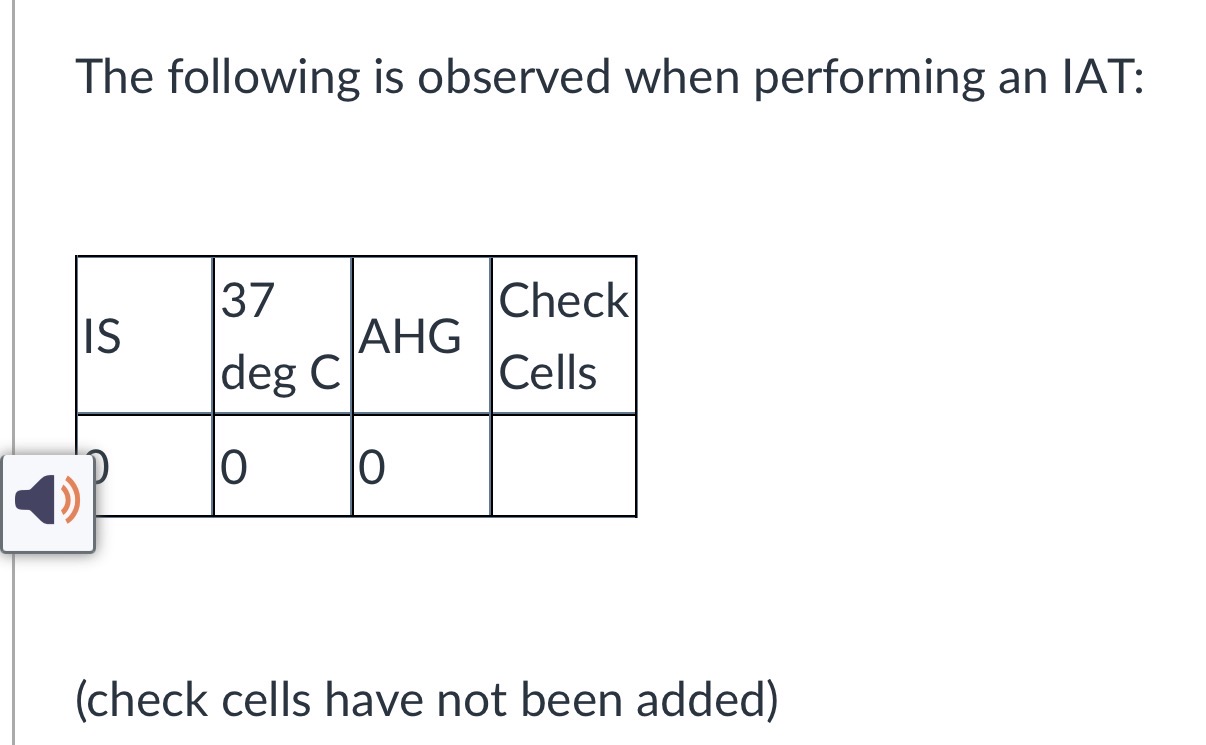
What is the next step?
Add check cells to verify the test results so far. IAT is likely negative but must be verified.
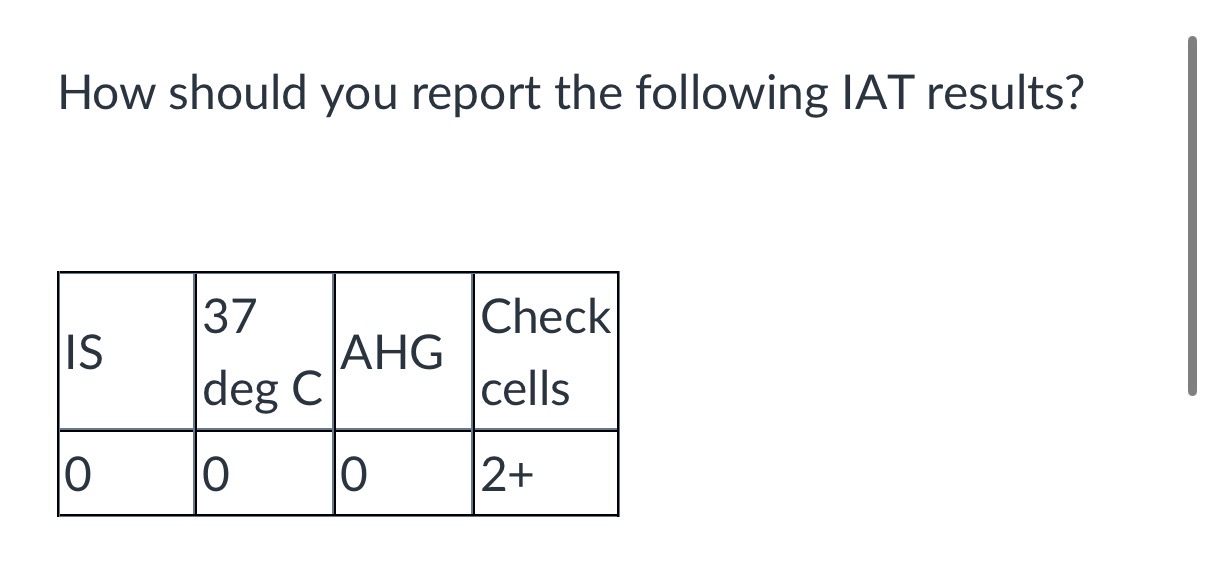
IAT negative; test valid
Select the incorrect statement with respect to the potentiator PEG (polyethylene glycol).
Mechanism of action is to exclude water molecules around RBC's
The IAT method is particularly important/useful for identifying IgM antibodies.
T OR F
False
The indirect antibody test is used to detect:
In vitro attachment of antibodies to RBC's
Which of the following is not a typical application of the IAT?
Detection of HDFN
A and/or B antigens are direct genetic products. This is to say genes instruct the body to directly build A and/or B antigens.
T OR F
False
A1 individuals have A antigen that is a ["Linear", "Branched"]
structure and have a prevalence of approximately ["20", "80"] ,
compared to A2 antigen which is a ["Branched", "Linear"] structure.
Answer 1:
Branched
Answer 2:
80
Answer 3:
Linear
An A2 blood group individual MAY produce antibodies against A1 RBC antigen.
T OR F
TRUE
An individual of blood group A will have MORE Hantigen present on the RBC surface than an individual of blood group AB.
T OR F
TRUE
An individual of blood group O will present with what RBC surface antigens?
H
Anti-A1 produced by an A2 blood group individual is clinically significant.
(this is to say that transfusing an A2 blood group individual with A1 blood may cause a dangerous reaction)
T OR F
FALSE
For each of the blood group antigens, match the immunodominant sugar.
You may use answers more than once.
A
B
H
O
N-acetylgalactosamine
D-galactose
L-fucose
L-fucose
For each of the following, the best answer for relative amounts of H antigen present on RBC's.
Blood group with the LEAST H antigen: ["Oh (Bombay)", "A2B", "A1B", "O", "A", "B"]
Blood group with the MOST H antigen: ["Oh (Bombay)", "A1B", "A", "A2B", "O", "B"]
Answer 1:
Oh (Bombay)
Answer 2:
O
Match each the blood groups to their immunodominant sugars.
A
B
O
A
N-acetylgalactosamine
B
D-galactose
O
L-fucose
Match the blood group discrepancy to the appropriate lectin that would be used to rectify the discrepancy.
Distinguish Bombay phenotype group O from regular group O
Dolichos biflorus
Ulex europaeus
Arachis hypogaea
Vicia graminea
Distinguish subgroup A1 from subgroup A2
Dolichos biflorus
Ulex europaeus
Arachis hypogaea
Vicia graminea
Distinguish Bombay phenotype group O from regular group O
Ulex europaeus
Distinguish subgroup A1 from subgroup A2
Dolichos biflorus
The "H" gene follows what inheritance pattern?
Dominant
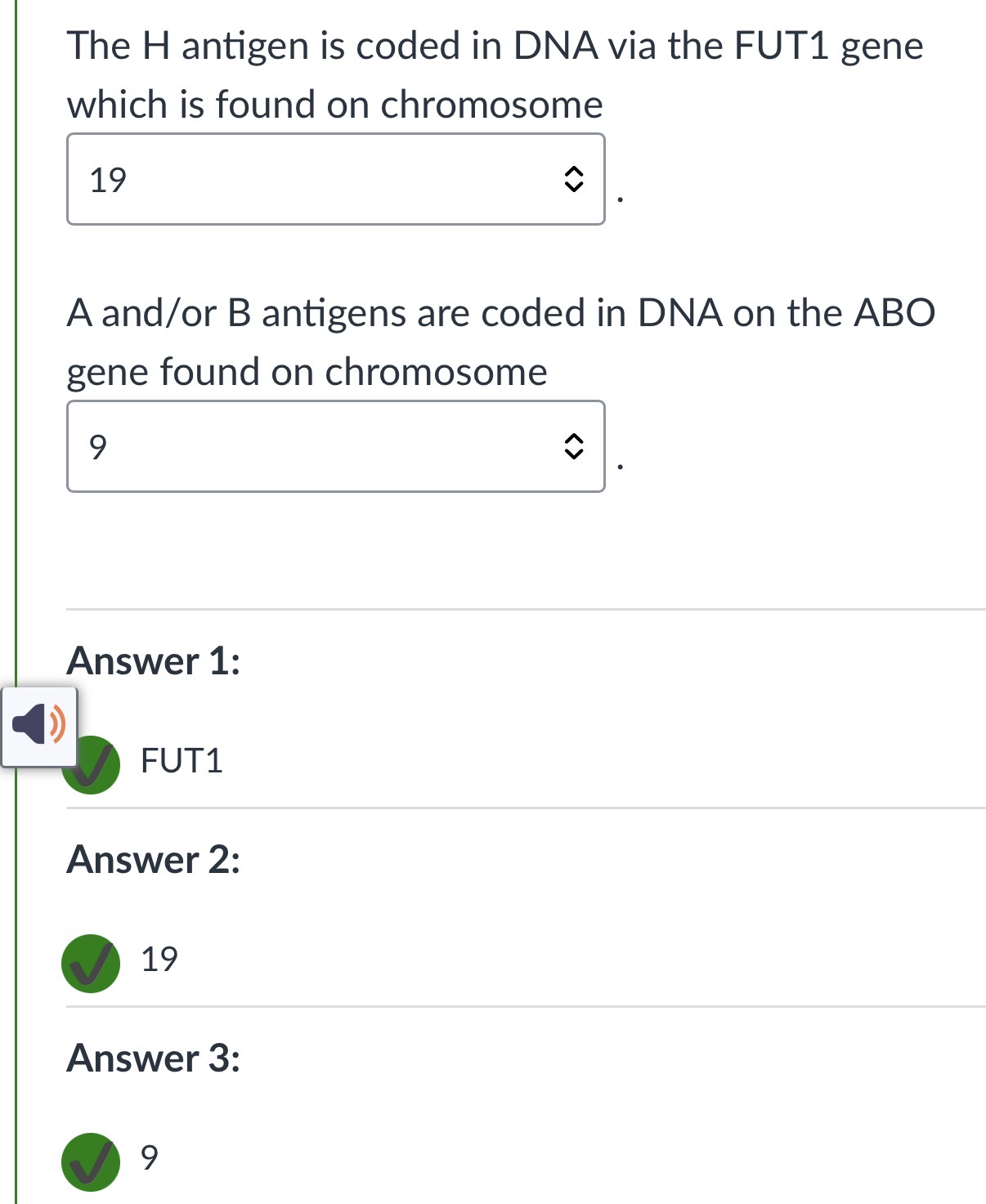
The H antigen is coded in DNA via the FUT1 gene which is found on chromosome ["9", "1", "2", "19"] .
A and/or B antigens are coded in DNA on the ABO gene found on chromosome ["9", "19", "2", "1"] .
Answer 1:
FUT1
Answer 2:
19
Answer 3:
9
The chemical classification of the structure that defines a blood group antigen is:
Glycoprotein
The particular lectin to distinguish between subgroups A1 and A2 reacts with subgroup A2, not subgroup A1.
T OR F
False
The purpose of testing with anti-A,B reagent anti-sera is to detect:
Subgroups of A antigen
What genetic product is responsible for presentation of A and/or B antigens?
Transferases
A patient that is blood group AB can receive plasma from what blood groups?
Select all that apply.
AB
If results for a forward type are...
Anti-A: 4+
Anti-B: 4+
You should expect what results for the reverse typing?
Reverse A: ["Positive; likely 3-4+", "Negative: 0"]
Reverse B: ["Negative: 0", "Positive; likely 3-4+"]
Answer 1:
Negative: 0
Answer 2:
Negative: 0
If results for a forward type are...
Anti-A: 0
Anti-B: 4+
You should expect what results for the reverse typing?
Reverse A: ["", "Positive; likely 3-4+", "", "Negative: 0"]
Reverse B: ["Positive; likely 3-4+", "Negative: 0"]
Answer 1:
Positive; likely 3-4+
Answer 2:
Negative: 0
If you are in doubt about about blood product compatibilities you should:
Check the blood product compatibilities chart that is almost certainly posted in your lab
Platelets ["are not required to be of the same blood group as the recipient", "must be of the same blood group as the recipient"] .
Platelets of mismatched blood groups may lead to a(n) ["shortened lifespan of the platelets", "immediate transfusion reaction", "delayed transfusion reaction"] .
As such platelets are distributed based on ["blood groups matching, without exception", "using the units closest to expiration first, and matching blood groups if possible"]
Answer 1:
are not required to be of the same blood group as the recipient
Answer 2:
shortened lifespan of the platelets
Answer 3:
using the units closest to expiration first, and matching blood groups if possible
Reagents Anti-A, Anti-B, Anti-D...
Contain ________ that bind to ______.
Answer 1:
Antibodies
Answer 2:
antigens on the patient's RBC surfaces
Reagents Anti-A, Anti-B, Anti-D...
Contain Antibodies that bind to antigens on the patient's RBC surfaces .
For some reason you do a reverse typing first and get the following results.
Reverse A: 0
Reverse B: 4+
You should expect what results for the forward typing?
Anti-A:
Anti-B:
Anti-A: Positive; likely 3-4+
Anti-B: Negative; 0
Patients that are RhD+ may/should receive blood that is: ["RhD+ or RhD=", "RhD+", "RhD="] .
Patients that are RhD= may/should receive blood that is RhD= .
An RhD mismatch in a person who has never had an RhD mismatched transfusion previously will MOST LIKELY lead to a(n) ["Delayed transfusion reaction", "Immediate transfusion reaction", "Alloimmunization with a potential for future transfusion reactions"] .
Assume that there are plenty of ABO compatible units available, both RhD+ and RhD=.
Answer 1:
RhD+ or RhD=
Answer 2:
RhD=
Answer 3:
Alloimmunization with a potential for future transfusion reactions
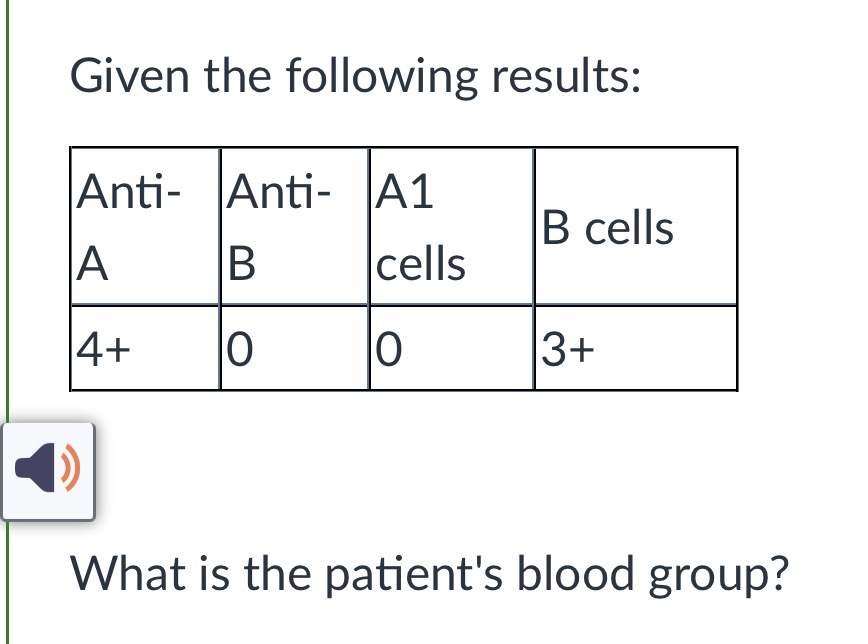
A
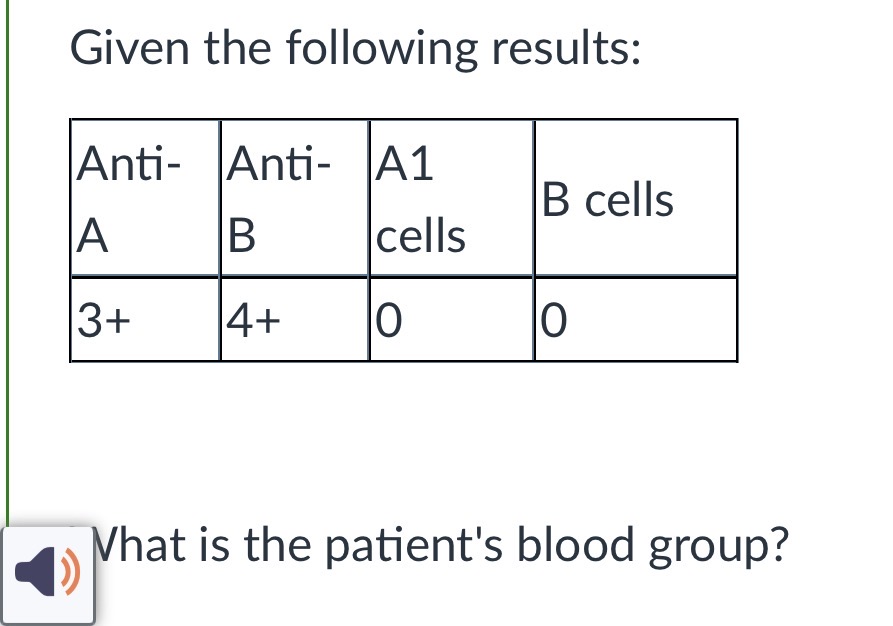
AB
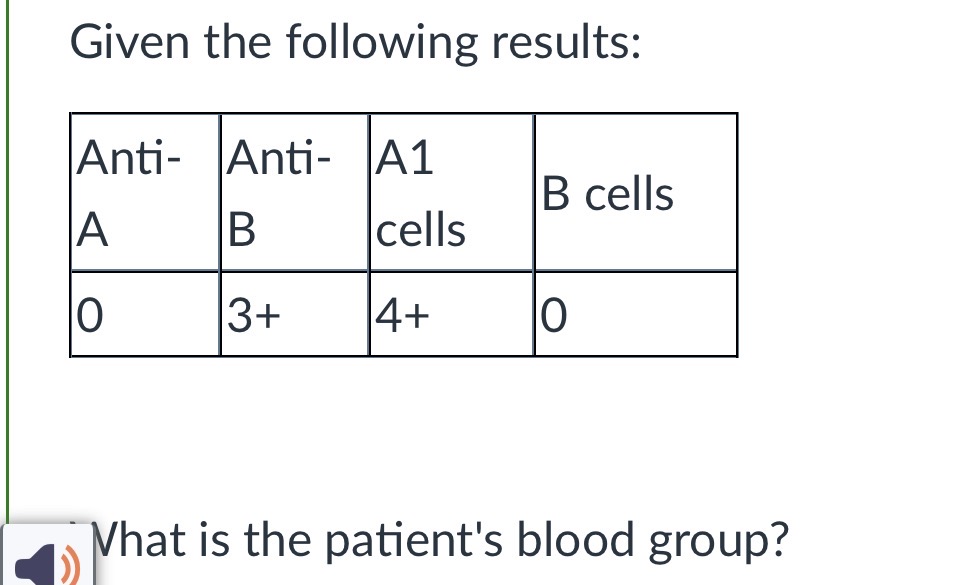
B
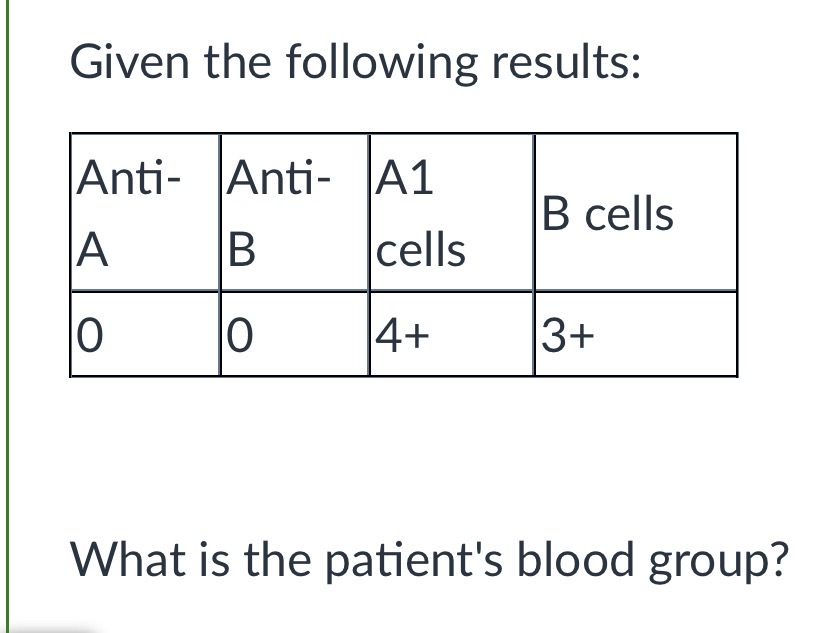
O
Which of the following blood groups is considered a UNIVERSAL DONOR with respect to RBC units?
O=
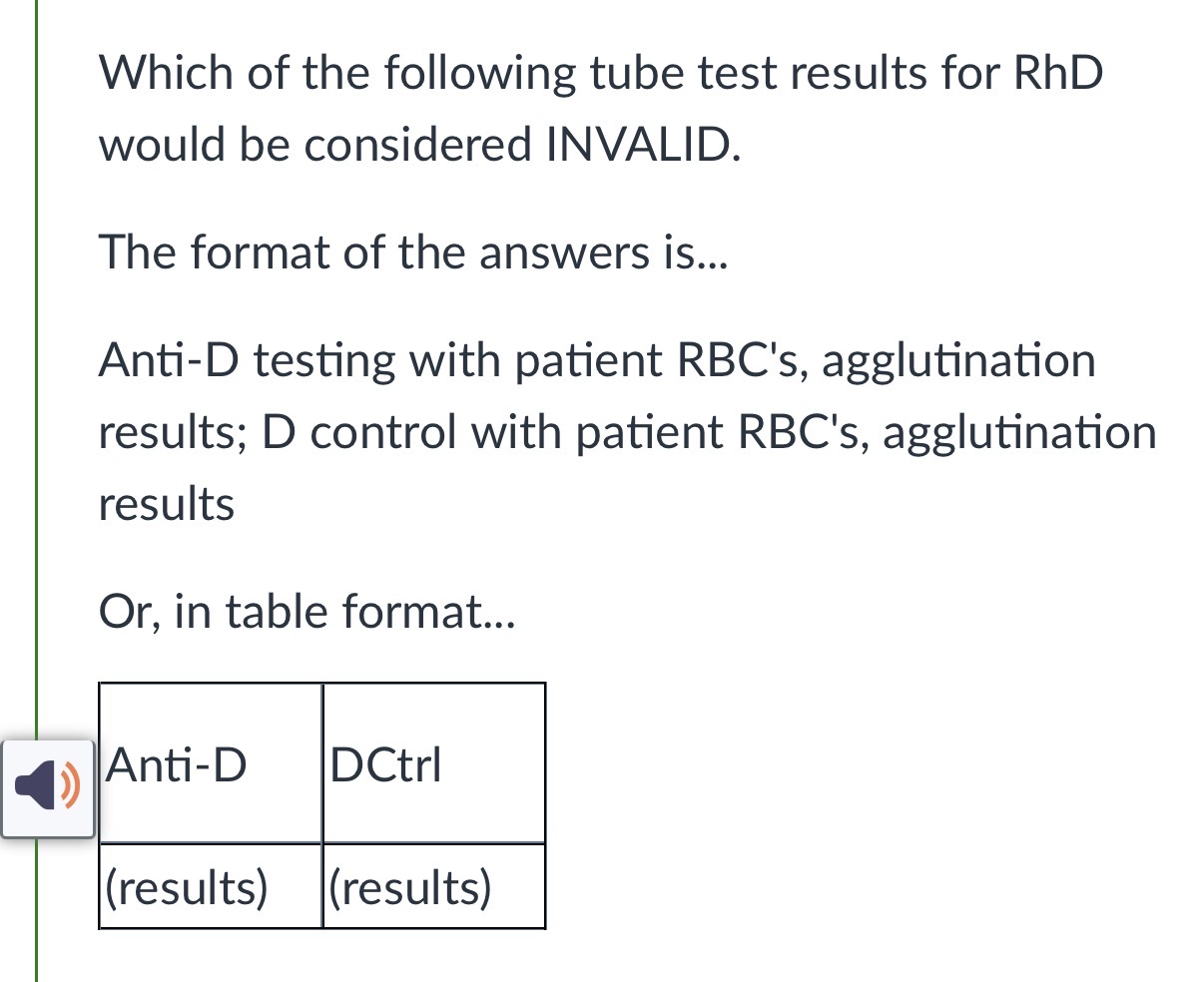
anti-D, 2+; Dctrl, 1+
"D deletion" is due to:
Inactivity of the RHCE gene
According to current Rh genetic theory how many genes directly code for the Rh antigens?
2