Quiz 2 (Labs 3 + 4)

0.0(0)
Studied by 0 people
call kaiCall Kai
learnLearn
examPractice Test
spaced repetitionSpaced Repetition
heart puzzleMatch
flashcardsFlashcards
GameKnowt Play
Card Sorting

1/14

encourage image

There's no tags or description

Looks like no tags are added yet.

Last updated 7:33 AM on 4/13/26
Name
Mastery
Learn
Test
Matching
Spaced
Call with Kai

No analytics yet

Send a link to your students to track their progress

15 Terms

1
New cards

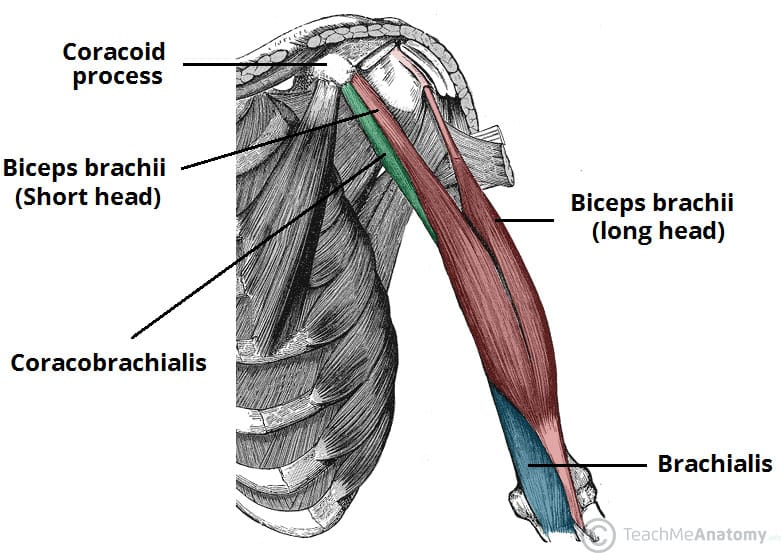
anterior(flexor/supinator) compartment of arm

innervated by musculocutaneous nerve; act to flex arm and forearm and supinate forearm

biceps brachii(muscle belly)

  • short head(medial; more superficial)

    • origin- coracoid process

    • insertion- radial tuberosity

    • main actions- flexion of supinated forearm; supination of flexed forearm

  • long head(most lateral)

    • origin- superior rim of glenoid fossa

    • insertion- radial tuberosity

    • main actions- flexion of supinated forearm, supination of flexed forearm

  • coracobrachialis (medial, dark striation)

    • origin- coracoid process

    • insertion- middle of humerus

    • main actions- flexion of arm, adduction of arm

  • brachialis(deepest, under long head)

    • origin- anterior surface of humerus

    • insertion- coronoid process of ulna

    • main actions- flexion of forearm

<p>innervated by musculocutaneous nerve; act to flex arm and forearm and supinate forearm</p><p>biceps brachii(muscle belly)</p><ul><li><p>short head(medial; more superficial)</p><ul><li><p>origin- coracoid process</p></li><li><p>insertion- radial tuberosity</p></li><li><p>main actions- flexion of supinated forearm; supination of flexed forearm</p></li></ul></li><li><p>long head(most lateral)</p><ul><li><p>origin- superior rim of glenoid fossa</p></li><li><p>insertion- radial tuberosity</p></li><li><p>main actions- flexion of supinated forearm, supination of flexed forearm </p></li></ul></li><li><p>coracobrachialis (medial, dark striation)</p><ul><li><p>origin- coracoid process</p></li><li><p>insertion- middle of humerus</p></li><li><p>main actions- flexion of arm, adduction of arm</p></li></ul></li><li><p>brachialis(deepest, under long head)</p><ul><li><p>origin- anterior surface of humerus </p></li><li><p>insertion- coronoid process of ulna</p></li><li><p>main actions- flexion of forearm </p></li></ul></li></ul><p></p>
2
New cards

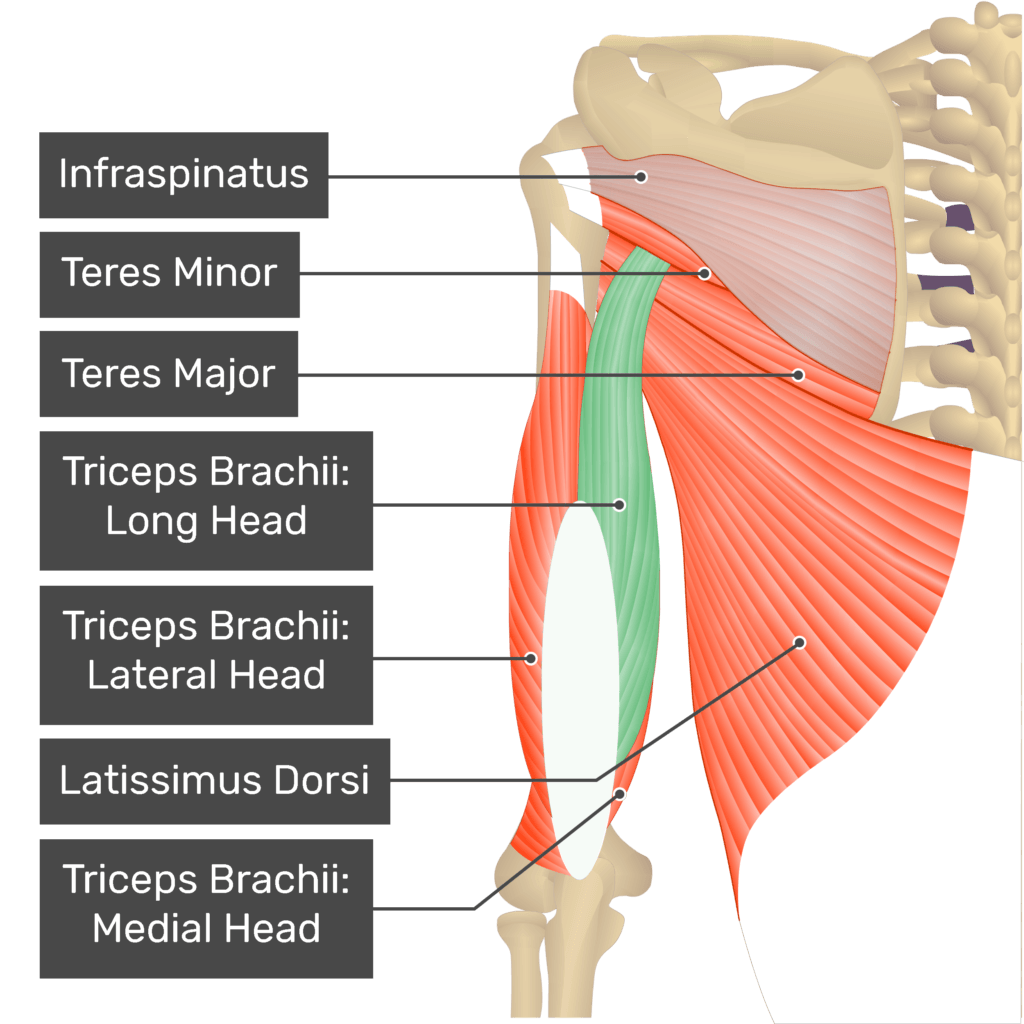
posterior (extensor/pronator) compartment of arm

innervated by radial nerve(goes through radial groove); act to extend forearm

triceps brachii(radial nerve + brachial artery runs through)

  • medial head(deep to other 2 heads)

    • origin- posterior surface of humerus below radial groove

    • insertion- olecranon

    • main actions- extension of forearm

  • lateral head

    • origin- posterior surface of humerus above radial groove

    • insertion- olecranon

    • main actions- extension of forearm

  • long head(separates teres major and teres minor)

    • origin- infraglenoid tubercule of scapula

    • insertion- olecranon

    • main actions- extension of forearm, extension of arm
<p>innervated by radial nerve(goes through radial groove); act to extend forearm </p><p>triceps brachii(radial nerve + brachial artery runs through)</p><ul><li><p>medial head(deep to other 2 heads)</p><ul><li><p>origin- posterior surface of humerus below radial groove</p></li><li><p>insertion- olecranon</p></li><li><p>main actions- extension of forearm</p></li></ul></li><li><p>lateral head</p><ul><li><p>origin- posterior surface of humerus above radial groove</p></li><li><p>insertion- olecranon</p></li><li><p>main actions- extension of forearm</p></li></ul></li><li><p>long head(separates teres major and teres minor)</p><ul><li><p>origin- infraglenoid tubercule of scapula </p></li><li><p>insertion- olecranon</p></li><li><p>main actions- extension of forearm, extension of arm </p></li></ul></li></ul><p></p>
3
New cards

arteries, veins, nerves

  • arteries- thicker, red(when latex injected)

  • veins- thinner wall, blue(when latex injected)

  • nerves- tough, look like wet shoelaces, long way striations

4
New cards

brachial plexus(overall)

organization

  1. roots(C5-T1 ventral primary rami)

  2. trunks

    1. upper(superior)

    2. middle

    3. lower(inferior)

  3. divisions

    1. anterior(3)

    2. posterior (3)

  4. cords

    1. lateral

    2. medial

    3. posterior(looks like chicken foot)

  5. branches

    1. musculocutaneous nerve(trace back to “M”)

    2. median nerve(trace back to “M”)

    3. ulnar nerve(trace back to “M”)

    4. axillary nerve(trace back to chicken’s foot(posterior cord))

      1. posterior humeral circumflex artery w/it)

    5. radial nerve(runs w/deep brachial artery)
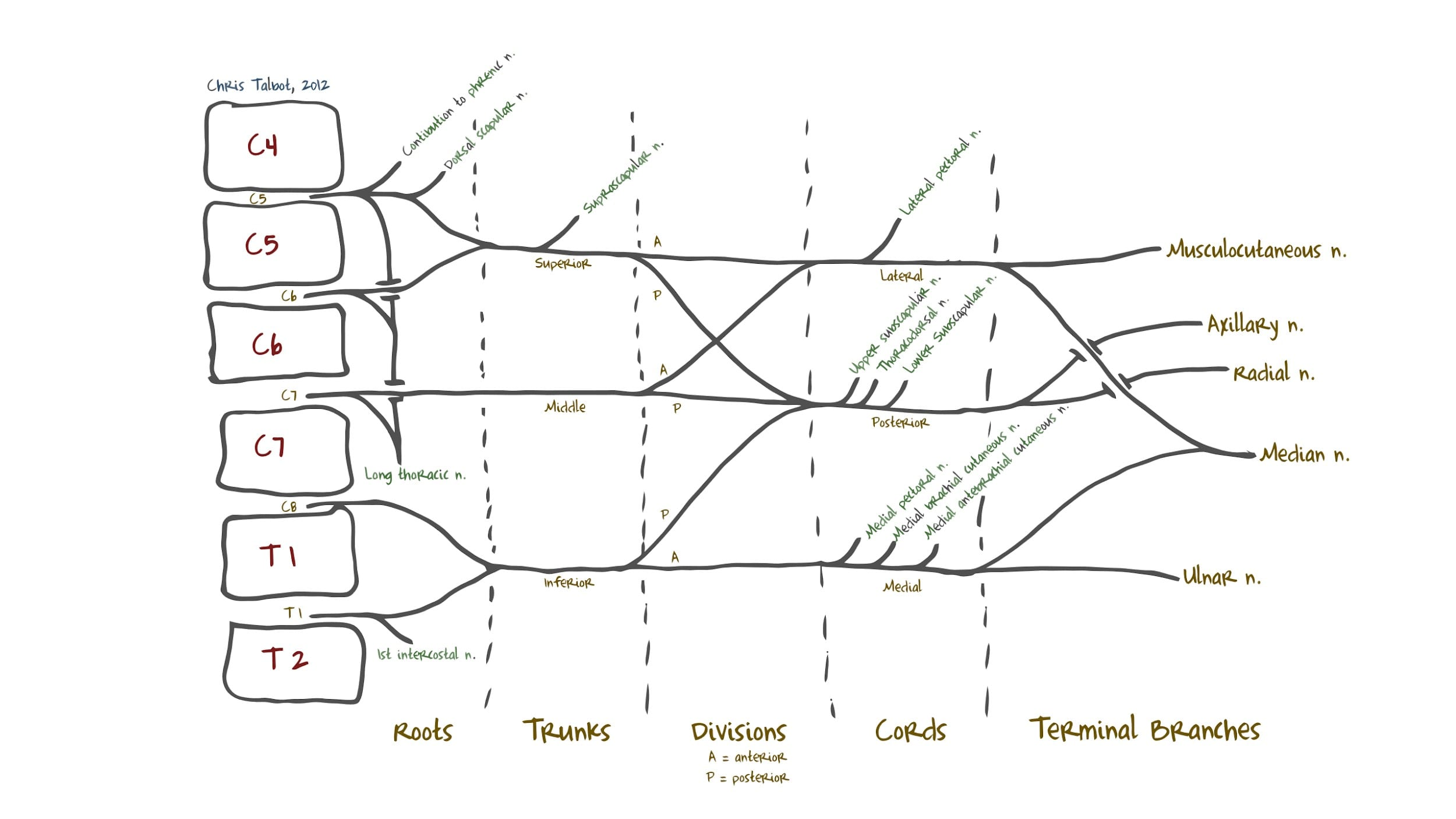
<p>organization</p><ol><li><p>roots(C5-T1 ventral primary rami)</p></li><li><p>trunks</p><ol><li><p>upper(superior)</p></li><li><p>middle</p></li><li><p>lower(inferior)</p></li></ol></li><li><p>divisions</p><ol><li><p>anterior(3)</p></li><li><p>posterior (3)</p></li></ol></li><li><p>cords</p><ol><li><p>lateral</p></li><li><p>medial</p></li><li><p>posterior(looks like chicken foot)</p></li></ol></li><li><p>branches </p><ol><li><p>musculocutaneous nerve(trace back to “M”)</p></li><li><p>median nerve(trace back to “M”)</p></li><li><p>ulnar nerve(trace back to “M”)</p></li><li><p>axillary nerve(trace back to chicken’s foot(posterior cord))</p><ol><li><p>posterior humeral circumflex artery w/it)</p></li></ol></li><li><p>radial nerve(runs w/deep brachial artery)</p></li></ol></li></ol><p></p>
5
New cards

5 major nerves that arises from cords of brachial nerves

musculocutaneous nerve- arises from lateral cord and innervates anterior compartment of arm

  • pierces coracobrachialis

median nerve-arises from medial and lateral cords and innervates 1 ½ muscles of anterior forearm(?)

  • also innervates thenar eminence(3 muscles) in hand and first 2 lumbricals

ulnar nerve- arises from medial and innervates 1 ½ muscles of the forearm(flexor carpi ulnaris and ½ of flexor digitorium profoundus)

  • innervates all but 5 intrinsic muscles of the hand(?)

  • when you bump your elbow, you briefly compress ulnar nerve against medial epicondyle

axillary nerve- arises from posterior cord and innervates deltoid and teres minor muscle

radial nerve- arises from posterior cord and innervates triceps

  • branches from this nerve innervates posterior forearm muscles

6
New cards

addnl nerves branching from brachial plexus

roots

  • long thoracic nerve- formed by branches arising from C5,C6,C7 roots of brachial plexus and innervates serratus anterior muscle

  • dorsal scapular nerve- branches off C5 root of brachial plexus and innervates levator scapulae, rhomboid minor, and rhomboid major muscles

superior trunk

  • suprascapular nerve- innervates supraspinatus and infraspinatus muscles

lateral cord

  • lateral pectoral nerve innervates pectoralis major muscle

  • lateral cord continues as musculocutaneous nerve

medial cord

  • medial pectoral nerve- innervates pectoralis major and pectoralis minor muscles

  • medial brachial cutaneous nerve- provides sensory innervation to skin on medial side of arm

  • medial antebrachial cutaneous nerve- provides sensory innervation to skin on medial side of forearm

  • medial cord continues as ulnar nerve

posterior cord

  • upper subscapular nerve- innervates subscapularis muscle

  • thoracodorsal nerve- innervates latissimus dorsi muscle

    • aka middle subscapular nerve, nerve to latissimus dorsi

  • lower subscapular nerve- innervates subscapularis and teres major muscles

  • posterior cord branches into radial nerve and axillary nerve

7
New cards

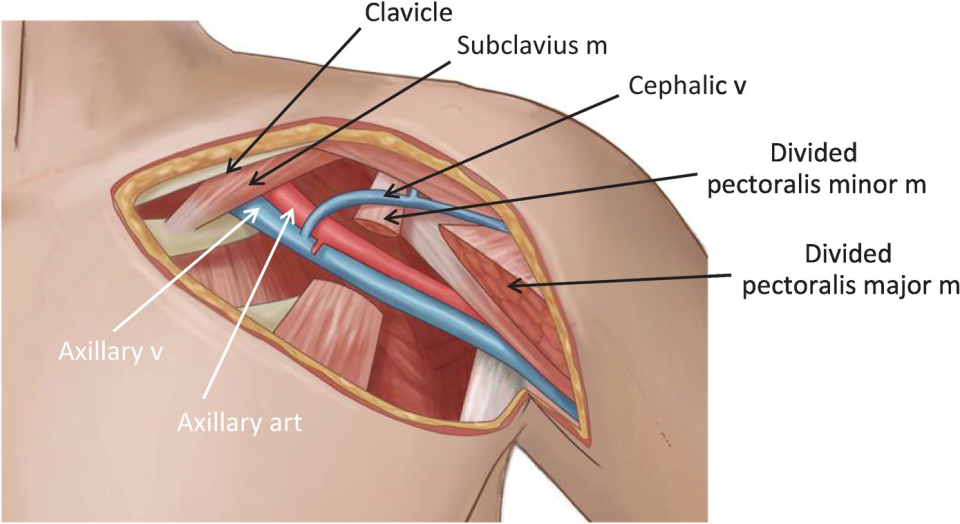
blood supply of pectoral region and shoulder

arteries

  • subclavian artery

    • begins under clavicle; runs from thorax to rib 1

    • becomes axillary artery once it CROSSES RIB 1

  • axillary artery

    • in armpit

    • becomes brachial artery at inferior border of teres major

  • brachial artery

    • distal to teres major

    • in arm

all of these arteries are connected to each other, just transition into each other
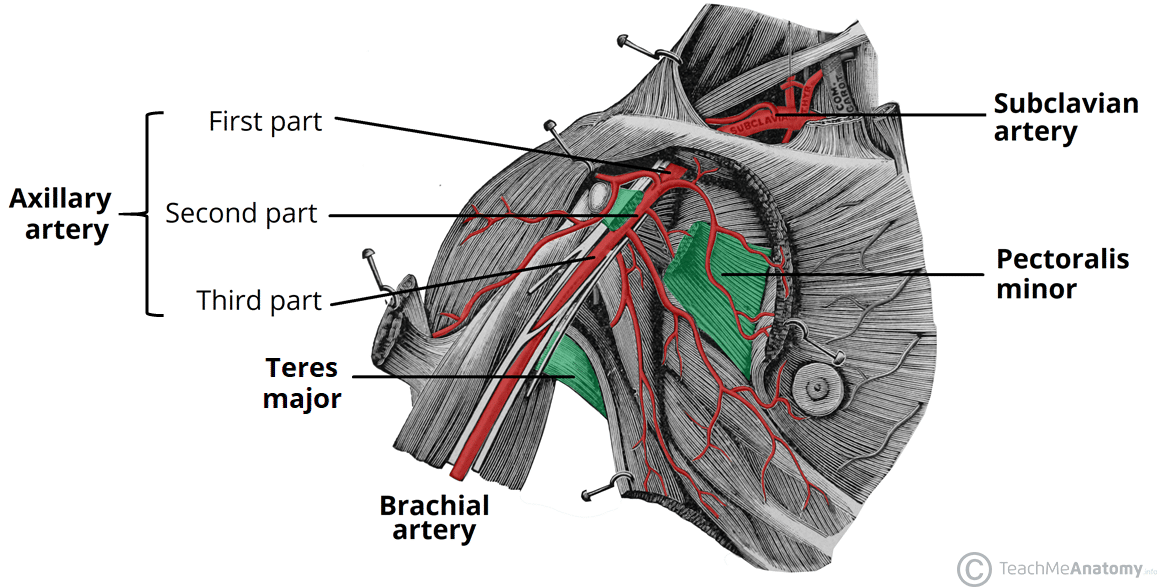
<p>arteries</p><ul><li><p>subclavian artery</p><ul><li><p>begins under clavicle; runs from thorax to rib 1</p></li><li><p>becomes axillary artery once it CROSSES RIB 1</p></li></ul></li><li><p>axillary artery</p><ul><li><p>in armpit</p></li><li><p>becomes brachial artery at inferior border of teres major </p></li></ul></li><li><p>brachial artery </p><ul><li><p>distal to teres major</p></li><li><p>in arm</p></li></ul></li></ul><p>all of these arteries are connected to each other, just transition into each other </p><p></p>
8
New cards

axillary artery branches

part 1: (proximal to pectoralis minor)

  • superior thoracic artery

    • top of ribcage

    • blood goes to top of chest

  • part 2: (deep to pectoralis minor)

    • thoracoacromial trunk(called trunk bc many branches)

      • Clavicular, Acromial, Deltoid, Pectoral branches

      • Cadavers Are Dead People

    • lateral thoracic artery (SALT)

      • goes to breast and lateral chest wall

  • part 3:(distal to pectoralis minor)

    • subscapular artery, which branches into →

      • circumflex scapular artery

        • wraps around humerus

      • thoracodorsal artery

        • goes towards latissimus dorsi

      • anterior humeral circumflex artery

        • smaller

      • posterior humeral circumflex artery

        • larger

    • circumflex= wraps around

Screw (superior thoracic artery)

The (thoracromial trunk)

Lawyer (lateral thoracic artery)

Save (subscapular artery)

A (anterior circumflex humeral artery)
Patient (posterior circumflex humeral artery)
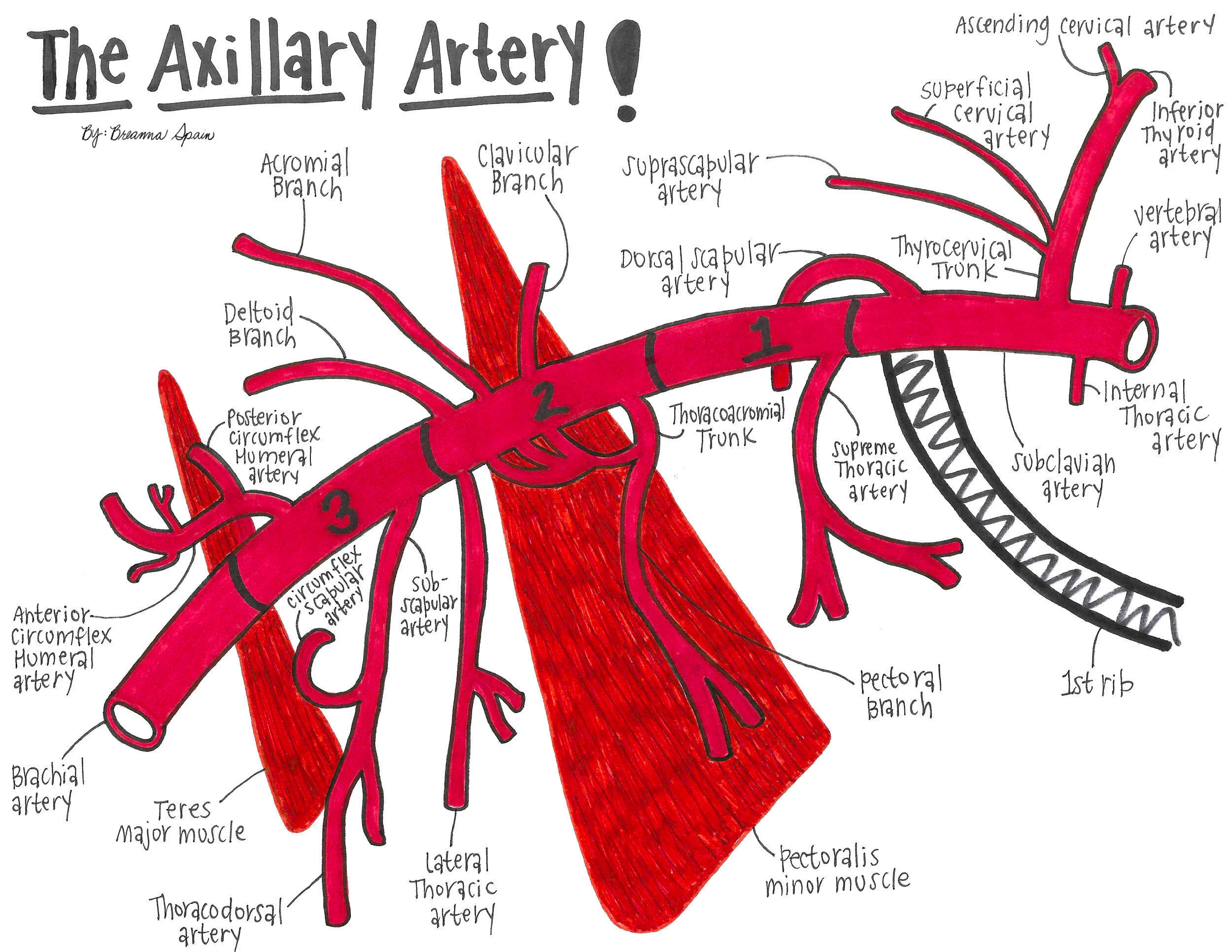
<p>part 1: (proximal to pectoralis minor)</p><ul><li><p>superior thoracic artery</p><ul><li><p>top of ribcage</p></li><li><p>blood goes to top of chest</p></li></ul></li><li><p>part 2: (deep to pectoralis minor)</p><ul><li><p>thoracoacromial trunk(called trunk bc many branches)</p><ul><li><p><strong>C</strong>lavicular, <strong>A</strong>cromial, <strong>D</strong>eltoid<strong>, P</strong>ectoral branches</p></li><li><p>Cadavers Are Dead People</p></li></ul></li><li><p>lateral thoracic artery (SALT)</p><ul><li><p>goes to breast and lateral chest wall</p></li></ul></li></ul></li><li><p>part 3:(distal to pectoralis minor)</p><ul><li><p>subscapular artery, which branches into →</p><ul><li><p>circumflex scapular artery</p><ul><li><p>wraps around humerus</p></li></ul></li><li><p>thoracodorsal artery</p><ul><li><p>goes towards latissimus dorsi</p></li></ul></li><li><p>anterior humeral circumflex artery</p><ul><li><p>smaller</p></li></ul></li><li><p>posterior humeral circumflex artery</p><ul><li><p>larger</p></li></ul></li></ul></li><li><p>circumflex= wraps around </p></li></ul></li></ul><p></p><p>Screw (superior thoracic artery)</p><p>The (thoracromial trunk)</p><p>Lawyer (lateral thoracic artery)</p><p>Save (subscapular artery)</p><p>A (anterior circumflex humeral artery)<br>Patient (posterior circumflex humeral artery)</p><p></p>
9
New cards

veins

axillary

  • in armpit

cephalic

  • in head, top of shoulder

  • typically drains in axillary vein

<p>axillary</p><ul><li><p>in armpit</p></li></ul><p>cephalic</p><ul><li><p>in head, top of shoulder</p></li><li><p>typically drains in axillary vein </p></li></ul><p></p>
10
New cards

lab iii questions

what muscle does musculocutaneous nerve innervate?

  • coracobrachialis

how does the ulnar nerve relate to the funny bone?

  • it sits on top of the medial epicondyle, which corresponds to the humerus

what are alternate names of the thoracodorsal nerve?

  • middle subscapular nerve, nerve to latissimus dorsi

11
New cards

anterior(flexor) compartment in forearm (superficial + middle layers)

medial epicondyle=common flexor origin

innervated by median nerve EXCEPT for flexor carpi ulnaris and medial ½ of flexor digitorum profundus

flex the wrist and fingers and some of them pronate

Pass (pronator teres)

Fail (flexor carpi radialis)

Pass (palmar longus)

Fail (flexor carpi ulnaris)

  • lateral —> medial

superficial layer

pronator teres(divides medial (anterior muscles) and lateral(posterior muscles))

  • origin- medial epicondyle of humerus, coronoid process of ulna

  • insertion- lateral side of middle of radius

  • main action- pronation of forearm, flexion of forearm

flexor carpi radialis (lateral; index side)

  • origin- medial epicondyle of humerus

  • insertion- 2nd metacarpal(index finger)

  • main action- flexion of hand, ABduction of hand

palmaris longus(palm, long tendon, visible in forearm when putting thumb + pinky together)

  • origin- medial epicondyle of humerus

  • insertion- palmar aponeurosis(central part of the deep fascia of the palm)

  • main action- flexion of hand, tightening of flexor aponeurosis

flexor carpi ulnaris(medial, innervated by ULNAR nerve)

  • origin- medial epicondyle of humerus

  • insertion- pisiform, hamate, 5th metacarpal(pinky)

  • main action- flexion of hand, ADduction of hand

middle layer

flexor digitorum superficialis(4 tendons; splits and inserts on middle phalanx)

  • origin- medial epicondyle of humerus

  • insertion- middle phalanx of digits 2-5

  • main actions- flexion of PIP joints(proximal interphalangeal), flexion of MCP(metacarpophalangeal)
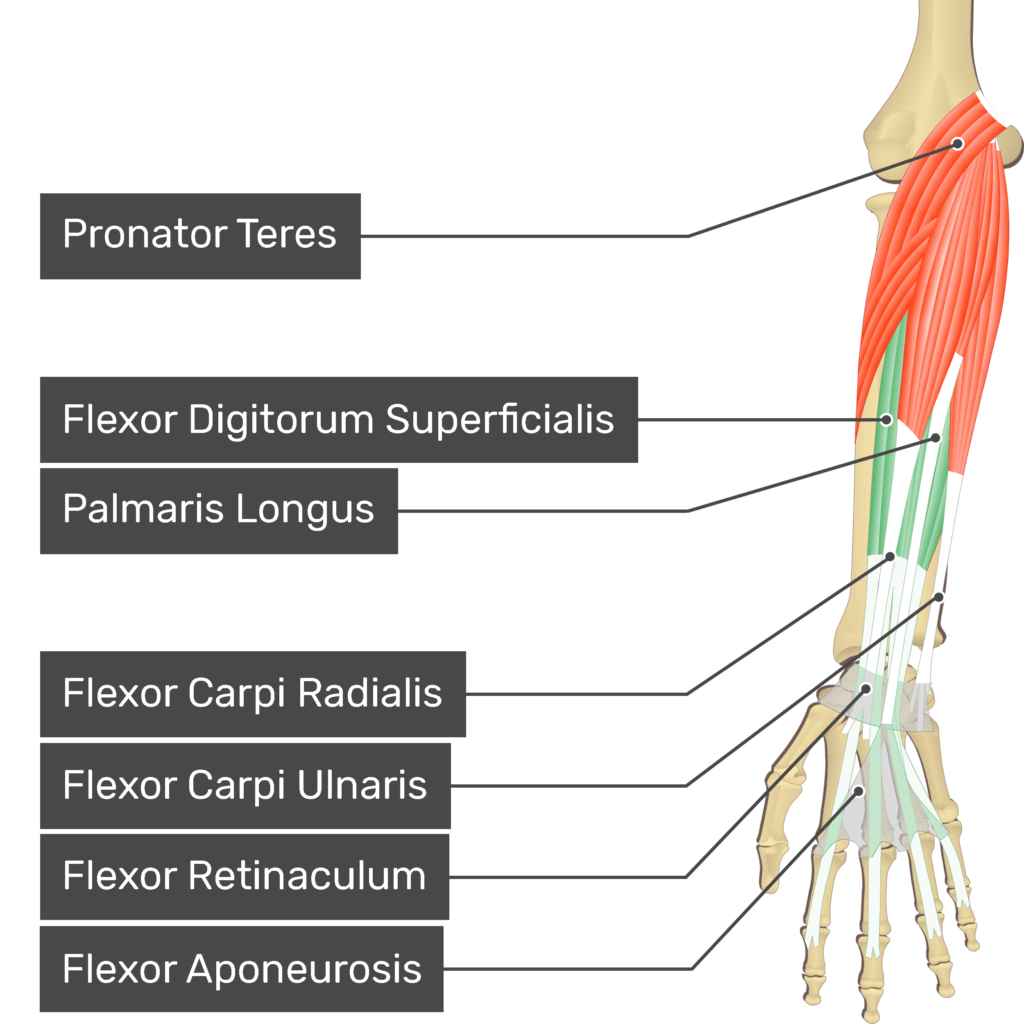
<p>medial epicondyle=common flexor origin</p><p>innervated by median nerve EXCEPT for flexor carpi ulnaris and medial ½ of flexor digitorum profundus </p><p>flex the wrist and fingers and some of them pronate </p><p><strong>P</strong>ass (pronator teres)</p><p><strong>F</strong>ail (flexor carpi radialis)</p><p><strong>P</strong>ass (palmar longus)</p><p><strong>F</strong>ail (flexor carpi ulnaris) </p><ul><li><p>lateral —&gt; medial</p></li></ul><p></p><p></p><p><strong>superficial layer</strong></p><p>pronator teres(divides medial (anterior muscles) and lateral(posterior muscles))</p><ul><li><p>origin- medial epicondyle of humerus, coronoid process of ulna</p></li><li><p>insertion- lateral side of middle of radius</p></li><li><p>main action- pronation of forearm, flexion of forearm</p></li></ul><p>flexor carpi radialis (lateral; index side)</p><ul><li><p>origin- medial epicondyle of humerus</p></li><li><p>insertion- 2nd metacarpal(index finger)</p></li><li><p>main action- flexion of hand, ABduction of hand</p></li></ul><p>palmaris longus(palm, long tendon, visible in forearm when putting thumb + pinky together)</p><ul><li><p>origin- medial epicondyle of humerus</p></li><li><p>insertion- palmar aponeurosis(central part of the deep fascia of the palm)</p></li><li><p>main action- flexion of hand, tightening of flexor aponeurosis</p></li></ul><p>flexor carpi ulnaris(medial, innervated by ULNAR nerve)</p><ul><li><p>origin- medial epicondyle of humerus </p></li><li><p>insertion- pisiform, hamate, 5th metacarpal(pinky)</p></li><li><p>main action- flexion of hand, ADduction of hand </p></li></ul><p></p><p><strong>middle layer</strong></p><p>flexor digitorum superficialis(4 tendons; splits and inserts on middle phalanx) </p><ul><li><p>origin- medial epicondyle of humerus</p></li><li><p>insertion- middle phalanx of digits 2-5</p></li><li><p>main actions- flexion of PIP joints(proximal interphalangeal), flexion of MCP(metacarpophalangeal) </p></li></ul><p></p>
12
New cards

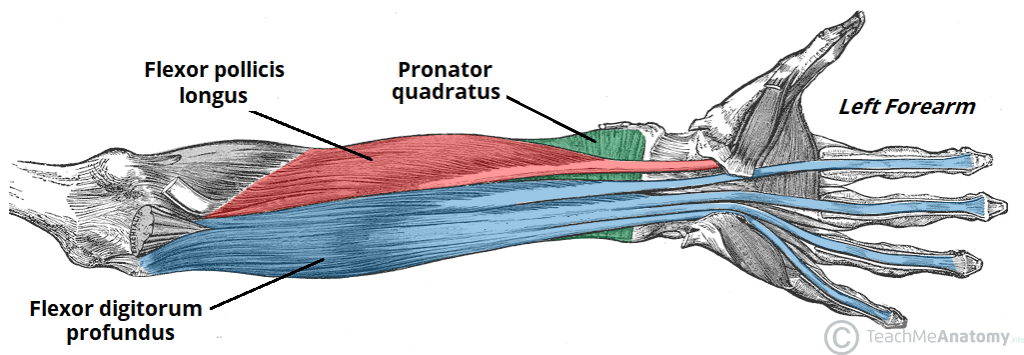
anterior(flexor) compartment of forearm (deep layer)

deep layer

flexor pollicis longus (lateral to profundus)

  • origin- radius, interosseous(b/n bones) membrane

  • insertion- distal phalanx of digit 1 (thumb)

  • main actions- flexion of distal phalanx of digit 1

flexor digitorum profundus(profound aka deep)(innervated by ULNAR nerve)(below superficialis, white)

  • origin- anterior ulna, interosseous membrane

  • insertion- distal phalanx of digits 2-5

  • main actions- flexion of DIP joints(distal interphalangeal), flexion of PIP joints(proximal interphalangeal), flexion of MCP joints(metacarpophalangeal), flexion of wrist

pronator quadratus(square)(deep to everything)

  • origin- distal ulna

  • insertion- distal radius

  • main actions- pronation of forearm

<p><strong>deep layer</strong></p><p>flexor pollicis longus (lateral to profundus)</p><ul><li><p>origin- radius, interosseous(b/n bones) membrane </p></li><li><p>insertion- distal phalanx of digit 1 (thumb)</p></li><li><p>main actions- flexion of distal phalanx of digit 1</p></li></ul><p>flexor digitorum profundus(profound aka deep)(innervated by ULNAR nerve)(below superficialis, white)</p><ul><li><p>origin- anterior ulna, interosseous membrane</p></li><li><p>insertion- distal phalanx of digits 2-5</p></li><li><p>main actions- flexion of DIP joints(distal interphalangeal), flexion of PIP joints(proximal interphalangeal), flexion of MCP joints(metacarpophalangeal), flexion of wrist</p></li></ul><p>pronator quadratus(square)(deep to everything)</p><ul><li><p>origin- distal ulna</p></li><li><p>insertion- distal radius</p></li><li><p>main actions- pronation of forearm </p></li></ul><p></p>
13
New cards

lab iv questions

median nerve damage

  • what forearm muscles would be paralyzed?

    • everything except flexor carpi ulnaris and flexor digitorum profundus

  • what forearm muscle would now act unopposed to the wrist?

    • flexor carpi ulnaris

  • what type of deviation would result?

    • ulnar deviation(ADduction)

ulnar nerve damage

  • what forearm muscles would be paralyzed?

    • flexor carpi ulnaris

  • what forearm muscle would now act unopposed at the wrist?

    • flexor carpi radialis

  • what deviation would result?

    • radial deviation(ABduction)

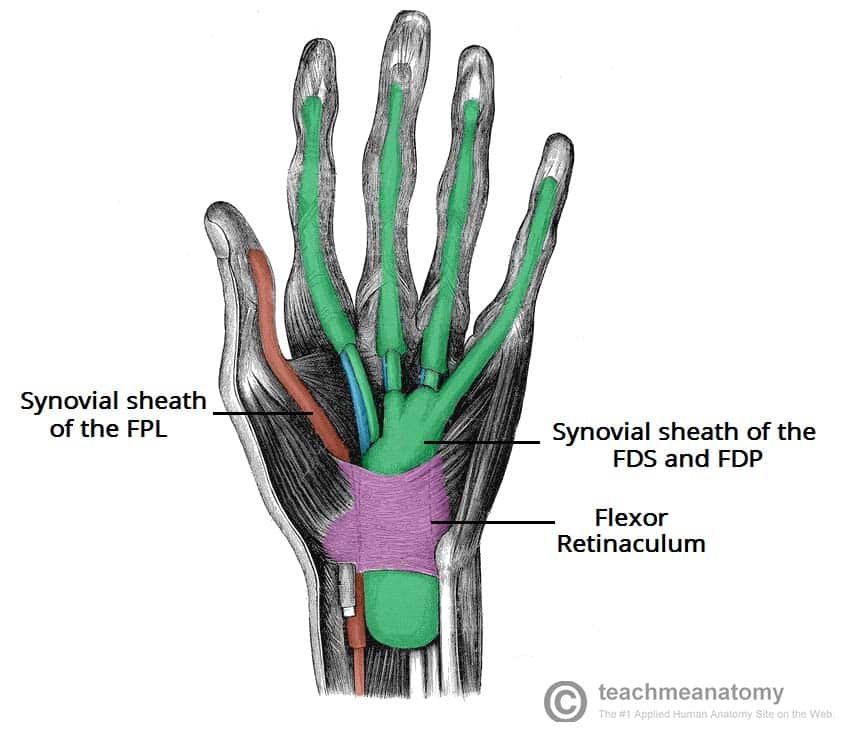
flexor retinaculum(transverse carpal ligament)

  • tape that covers wrist

  • what nerve runs deep to this?

    • median nerve

  • how many tendons pass deep to this? which ones?

    • 9 tendons

      • 4 tendons from flexor digitorum superficialis

      • 4 tendons from flexor digitorum profundus

      • 1 tendon from flexor palmaris longus

      • runs from superficial —> deep

  • what is carpal tunnel syndrome?

    • compression of median nerve under flexor retinaculum due to repetitive wrist movement
<p>median nerve damage</p><ul><li><p>what forearm muscles would be paralyzed?</p><ul><li><p>everything except flexor carpi ulnaris and flexor digitorum profundus</p></li></ul></li><li><p>what forearm muscle would now act unopposed to the wrist?</p><ul><li><p>flexor carpi ulnaris</p></li></ul></li><li><p>what type of deviation would result?</p><ul><li><p>ulnar deviation(ADduction)</p></li></ul></li></ul><p></p><p>ulnar nerve damage</p><ul><li><p>what forearm muscles would be paralyzed?</p><ul><li><p>flexor carpi ulnaris</p></li></ul></li><li><p>what forearm muscle would now act unopposed at the wrist?</p><ul><li><p>flexor carpi radialis</p></li></ul></li><li><p>what deviation would result?</p><ul><li><p>radial deviation(ABduction)</p></li></ul></li></ul><p></p><p>flexor retinaculum(transverse carpal ligament)</p><ul><li><p>tape that covers wrist</p></li><li><p>what nerve runs deep to this?</p><ul><li><p>median nerve</p></li></ul></li><li><p>how many tendons pass deep to this? which ones?</p><ul><li><p>9 tendons</p><ul><li><p>4 tendons from flexor digitorum superficialis </p></li><li><p>4 tendons from flexor digitorum profundus</p></li><li><p>1 tendon from flexor palmaris longus</p></li><li><p>runs from superficial —&gt; deep</p></li></ul></li></ul></li><li><p>what is carpal tunnel syndrome?</p><ul><li><p>compression of median nerve under flexor retinaculum due to repetitive wrist movement</p></li></ul></li></ul><p></p>
14
New cards

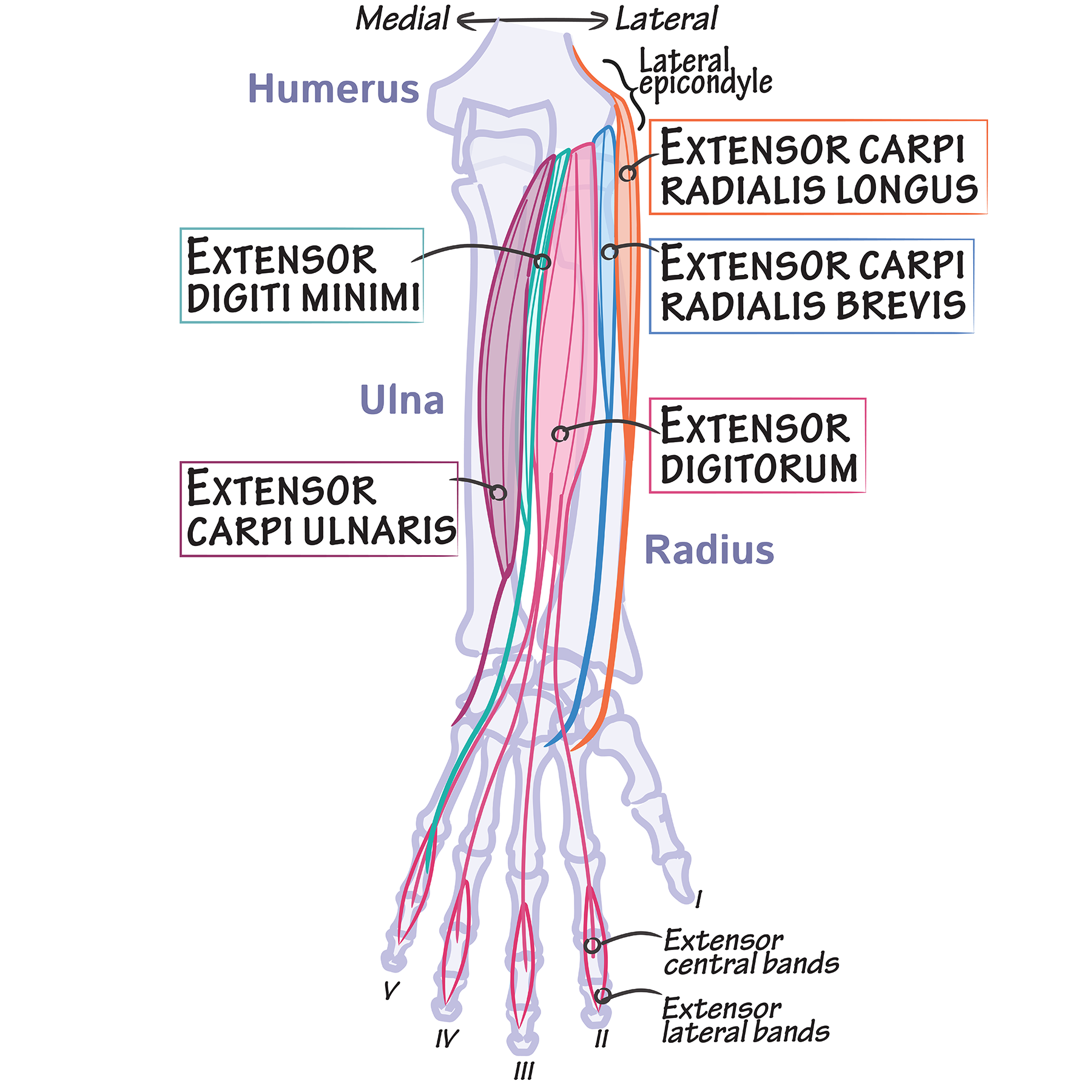
posterior(extensor) compartment of forearm(superficial layer)

innervated by radial nerve

extend the wrist and MCP joints; some supinate forearm

brachioradialis(most anterior and lateral)

  • origin- lateral supracondylar ridge

  • insertion- distal radius

  • main actions- flexion of forearm, supination of forearm

extensor carpi radialis longus (posterior to brachioradialis)(flat)

  • origin- lateral supracondylar ridge

  • insertion- base of 2nd metacarpal

  • main actions- extension of hand, ABduction of hand

extensor carpi radialis brevis (big boy brevis) (sits under longus, bigger)

  • origin- lateral epicondyle of humerus

  • insertion- base of 3rd metacarpal

  • main actions- extension of hand, ABduction of hand

extensor digitorum (communis —> sounds like communist, want to distribute the “wealth” so it is distributed to all digits EXCEPT thumb) (center of arm)

  • origin- lateral epicondyle of humerus

  • insertion- extensor expansion of digits 2-5(specialized connective tissue structure by which the extensor tendons insert onto the phalanges)

  • main actions- extension of MCP joints, extension of wrist

extensor digiti minimi(more medial, goes to pinky)

  • origin- lateral epicondyle of humerus

  • insertion- extensor expansion of digit 5

  • main actions- extension of MCP joint, extension of IP(interphalangeal) joints of digit 5

extensor carpi ulnaris(closer to pinky, ulna, medial)(next to minimi)

  • origin- lateral epicondyle of humerus

  • insertion- 5th metacarpal

  • main actions- extension of hand, ADduction of hand
<p>innervated by radial nerve</p><p>extend the wrist and MCP joints; some supinate forearm</p><p></p><p>brachioradialis(most anterior and lateral)</p><ul><li><p>origin- lateral supracondylar ridge</p></li><li><p>insertion- distal radius</p></li><li><p>main actions- <strong>flexion of forearm</strong>, supination of forearm</p></li></ul><p>extensor carpi radialis longus (posterior to brachioradialis)(flat)</p><ul><li><p>origin- lateral supracondylar ridge</p></li><li><p>insertion- base of 2nd metacarpal</p></li><li><p>main actions- extension of hand, ABduction of hand</p></li></ul><p>extensor carpi radialis brevis (big boy brevis) (sits under longus, bigger)</p><ul><li><p>origin- lateral epicondyle of humerus</p></li><li><p>insertion- base of 3rd metacarpal</p></li><li><p>main actions- extension of hand, ABduction of hand</p></li></ul><p>extensor digitorum (communis —&gt; sounds like communist, want to distribute the “wealth” so it is distributed to all digits EXCEPT thumb) (center of arm)</p><ul><li><p>origin- lateral epicondyle of humerus</p></li><li><p>insertion- extensor expansion of digits 2-5(specialized connective tissue structure by which the extensor tendons insert onto the phalanges)</p></li><li><p>main actions- extension of MCP joints, extension of wrist</p></li></ul><p>extensor digiti minimi(more medial, goes to pinky)</p><ul><li><p>origin- lateral epicondyle of humerus</p></li><li><p>insertion- extensor expansion of digit 5</p></li><li><p>main actions- extension of MCP joint, extension of IP(interphalangeal) joints of digit 5</p></li></ul><p>extensor carpi ulnaris(closer to pinky, ulna, medial)(next to minimi)</p><ul><li><p>origin- lateral epicondyle of humerus</p></li><li><p>insertion- 5th metacarpal</p></li><li><p>main actions- extension of hand, ADduction of hand</p></li></ul><p></p>
15
New cards

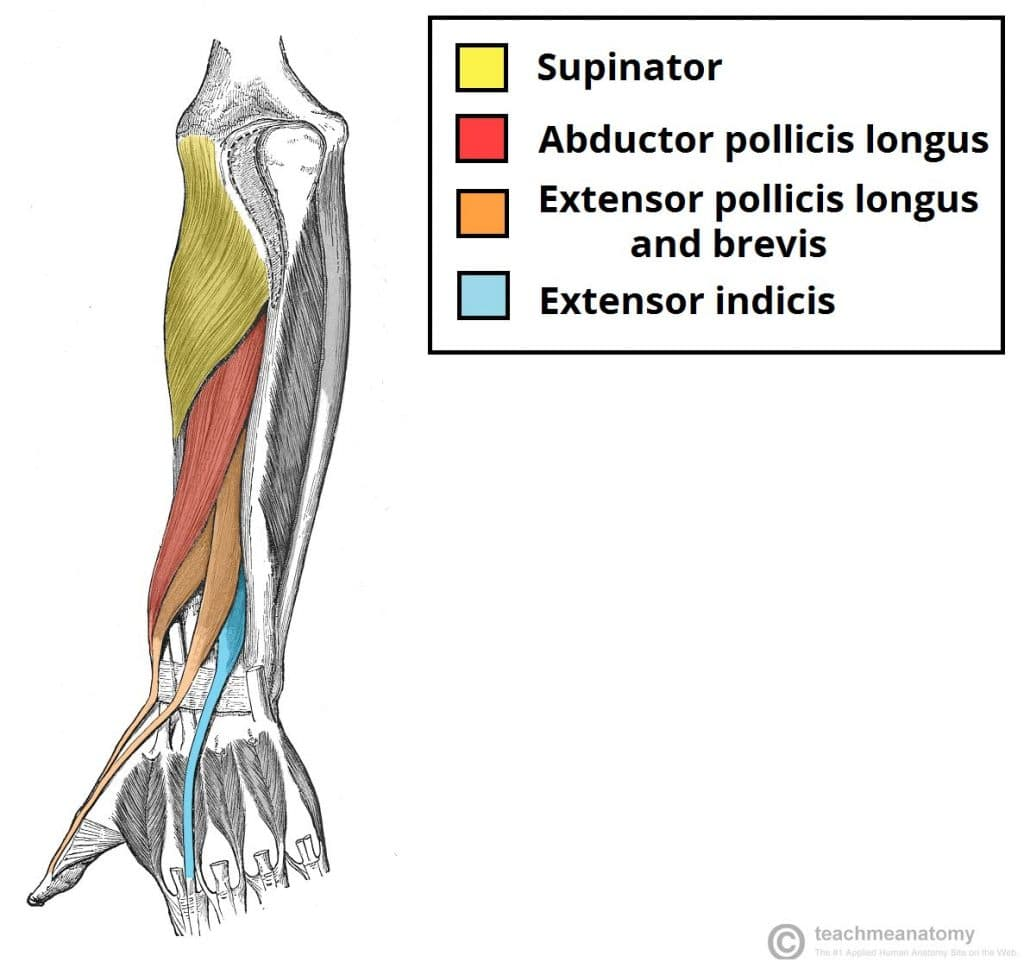
posterior(extensor) muscles of forearm (deep layer)

supinator(horizontal striations)

  • origin- lateral epicondyle of humerus, ulna

  • insertion- shaft of radius(proximal pronator teres)

  • main actions- supination of forearm

abductor pollicis longus(goes deep into arm)(thumb)(most lateral)

  • origin- posterior ulna, radius, interosseous membrane

  • insertion- base of 1st metacarpal

  • main actions- ABduction of digit 1, extension of digit 1 at CMC(carpometacarpal) joint (b/n wrist and and metacarpal)

extensor pollicis brevis(next to ABP longus but brevis is more medial)

  • origin- radius, interosseous membrane

  • insertion- proximal phalanx of digit 1

  • main actions- extension of digit 1 at MCP joint

extensor pollicis longus(goes to thumb, most medial)

  • origin- ulna, interosseous membrane

  • insertion- distal phalanx of digit 1

  • main actions- extension of digit 1 at IP joint

extensor indicis

  • origin- ulna, interosseous membrane

  • insertion- extensor expansion of digit 2

  • main actions- extension of digit 2

*abductor pollicis longus, extensor pollicis brevis, and extensor pollicis longus all form a triangle
<p>supinator(horizontal striations)</p><ul><li><p>origin- lateral epicondyle of humerus, ulna</p></li><li><p>insertion- shaft of radius(proximal pronator teres)</p></li><li><p>main actions- supination of forearm</p></li></ul><p>abductor pollicis longus(goes deep into arm)(thumb)(most lateral)</p><ul><li><p>origin- posterior ulna, radius, interosseous membrane</p></li><li><p>insertion- base of 1st metacarpal</p></li><li><p>main actions- ABduction of digit 1, extension of digit 1 at CMC(carpometacarpal) joint (b/n wrist and and metacarpal)</p></li></ul><p>extensor pollicis brevis(next to ABP longus but brevis is more medial)</p><ul><li><p>origin- radius, interosseous membrane</p></li><li><p>insertion- proximal phalanx of digit 1</p></li><li><p>main actions- extension of digit 1 at MCP joint</p></li></ul><p>extensor pollicis longus(goes to thumb, most medial)</p><ul><li><p>origin- ulna, interosseous membrane</p></li><li><p>insertion- distal phalanx of digit 1</p></li><li><p>main actions- extension of digit 1 at IP joint</p></li></ul><p>extensor indicis</p><ul><li><p>origin- ulna, interosseous membrane</p></li><li><p>insertion- extensor expansion of digit 2</p></li><li><p>main actions- extension of digit 2</p></li></ul><p></p><p>*abductor pollicis longus, extensor pollicis brevis, and extensor pollicis longus all form a triangle </p><p></p>