Nucleic acids and their function
 Call Kai
 Learn
Learn Practice Test
 Spaced Repetition
 Match
Match Flashcards
 Knowt Play
1/65

Earn XP
Description and Tags
Bio exam 2
Name | Mastery | Learn | Test | Matching | Spaced | Call with Kai |
|---|
No analytics yet
Send a link to your students to track their progress
66 Terms
What are the polymers of nucleotides
Nucleic acids
What are the monomers of nucleic acids?
Nucleotides
What are the three components of nucleotides?
phosphate group, five carbon sugar, nitrogenous base
what is a nitrogenous base?
a nitrogen containing base
Where are the nitrogenous bases and phosphate group present in nucleotides?
Bonded to the five carbon sugar
What are the monomers of RNA?
ribonucleotides
What are the monomers of DNA?
deoxyribonucleotides
what five carbon sugar is present in ribonucleotides?
ribose
what five carbon sugar is present in deoxyribonucleotides?
deoxyribose
what does deoxy mean?
lacking oxygen
What are the two groups of nitrogenous bases?
Purines and pyrimidines
What are the some kinds of purines?
Adenine (A) and Guanine (G)
What are the some kinds of pyrimidines?
Cytosine (C), Uracil (U), Thymine (T)
What is bonded to the 2’ carbon in ribonucleotides?
an -OH group
What is bonded to the 2’ carbon in deoxyribonucleotides?
an H
Where is Uracil only found?
found only in ribonucleotides
Where is Thymine only found
found only in deoxyribonucleotides
Are purines or pyrimidines larger
Purines
how many atoms are in purines?
nine atoms in their two rings
how many atoms are in pyrimidines?
six atoms in their one ring
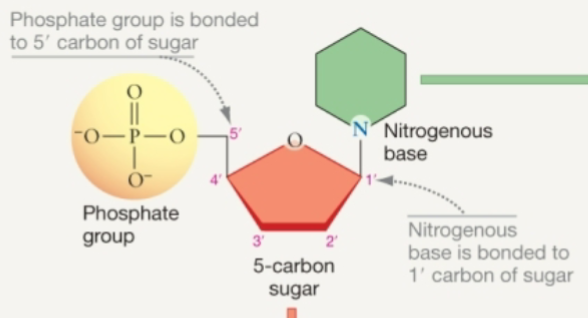
What is this?
A nucleotide
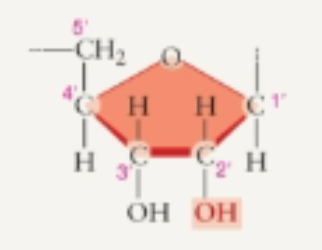
What sugar is this?
Ribose
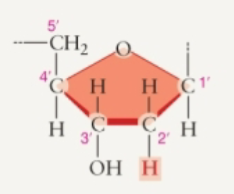
What sugar is this?
deoxyribose
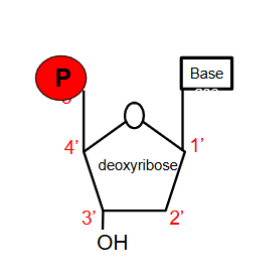
What is this?
deoxyribonucleotide
How do nucleic acids polymerize?
Condensation reactions
Where does phosphodiester linkage occur?
Between the phosphate group attached to the 5’ carbon of one nucleotide and -OH group on the 3’ carbon of another
what polymer(s) are produced from phosphodiester linkage?
RNA and DNA
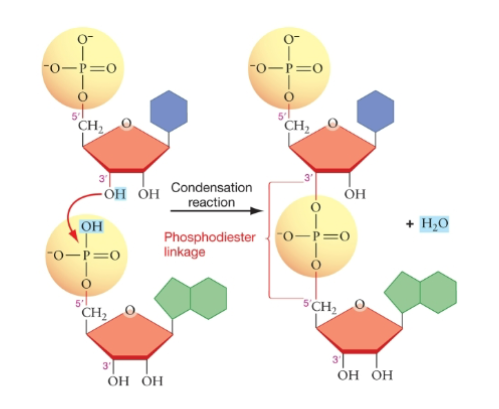
What is this?
phosphodiester linkage +condensation reaction
What do phosphodiester linkages form?
sugar-phosphate backbones
sugar-phosphate backbones are
directional
How is the primary structure of DNA written
listing sequence of bases by single letter abbreviations
5’-ATTAGC-3’
Nucleotide polymerization reaction is
spontaneous, energy is released
What are activated nucleotides?
nucleotides triphosphates, two additional phosphate groups are added to the nucleotide
What is a kind of activated ribonucleotide?
Adenosine triphosphate (ATP)
How is the spontaneity of nucleotides altered to make their polymerization spontaneous?
they are bonded to enzymes, two additional phosphate groups are added
What does antiparallel mean?
parallel but in opposite directions, in DNA this means 5’___3’ and 3’___5’
What is the secondary structure of DNA?
double helix
What causes double stranded DNA to twist into helix shape?
hydrophobic reactions (stacking)
what stabilizes DNA strands?
van der waals interactions
what different sized grooves do DNA have?
major groove
minor groove
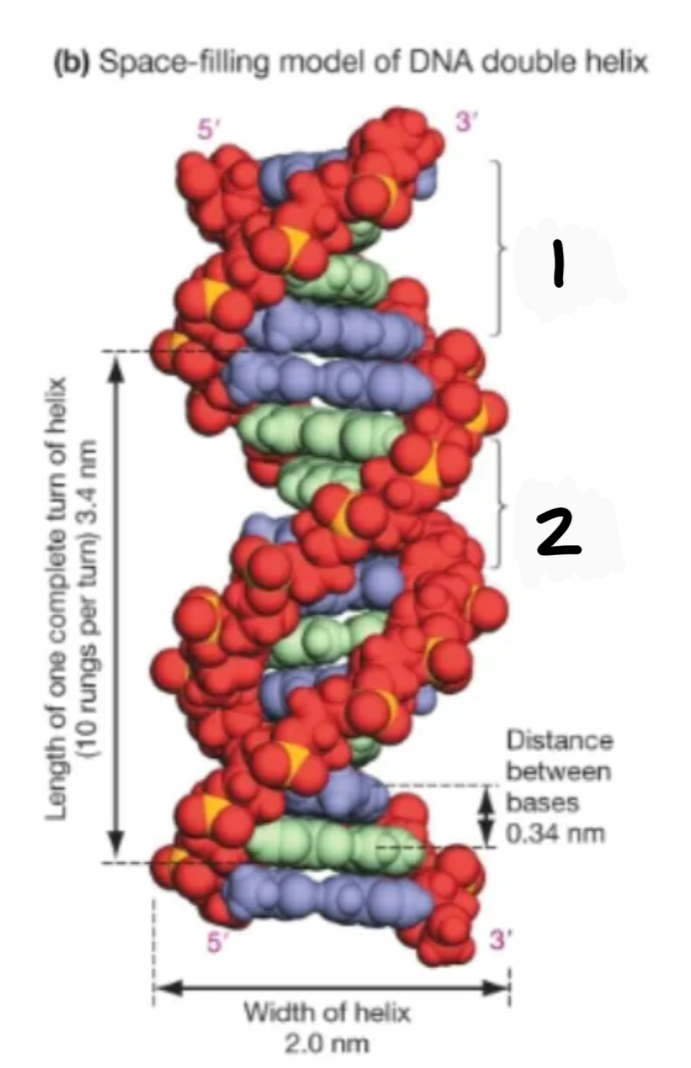
Label 1 and 2
major groove
minor groove
what holds the nitrogenous bases together in a DNA double helix?
hydrogen bonds
DNA strands in a double helix are
complementary and antiparallel
G is to C as
A is to T
What are the forms of DNA tertiary structure?
coils, supercoils, histones
What are histones?
DNA binding proteins that eukaryotic DNA wraps around
what is a nucleosome?
DNA double helix wrapped around groups of histones
what kind of bonds hold DNA double helix together?
phosphodiester linkages, hydrogen bonds, hydrophobic interactions
Why is the stability of DNA important?
needs to be a reliable information-storage molecule
What makes DNA stable and resistant to degredation?
functional groups
What does DNA do?
stores information required for organism’s growth and reproduction
How is information stored on DNA?
on the four nitrogenous bases (function like letters in an alphabet, sequence of bases have meaning)
How many steps are there in DNA replication?
3
What is the first step of DNA replication?
Two strands are separated by breaking hydrogen bonds
What is the second step of DNA replication?
free deoxyribonucleotides form hydrogen bonds w complementary bases on original strand of DNA (template strand)
(phosphodiester linkages form to create new strand (complementary strand))
What is the third step of DNA replication?
complementary base pairing allows each strand to be copied exactly producing two identical daughter molecules
What is the primary structure of RNA?
four types of nitrogenous bases extending from sugar-phosphate backbone
How does the primary structure of RNA differ from DNA?
RNA contains ribose instead of deoxyribose
RNA contains uracil instead of thymine
2’ -OH group on ribose is more reactive than -H
RNA is much less stable than DNA
A is to U as
G is to C
where does RNA form hydrogen bonds?
with complementary bases on the same strand
What is the secondary structure of RNA
hairpin/stem/loop structure
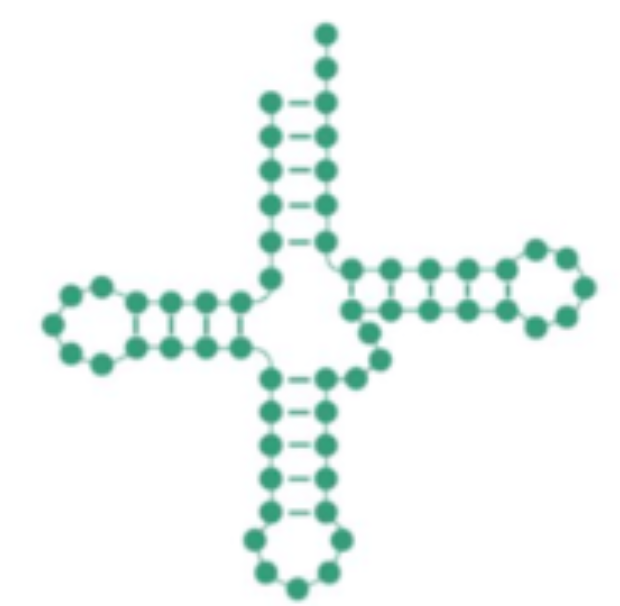
What is this?
RNA secondary structure
How does the secondary structure of RNA form?
Bases on one part of RNA strand fold over and align with bases on other part of the same strand
How does the tertiary structure of RNA formed?
when secondary structures fold into more complex shapes
What can RNA do?
information-containing molecule, capable of self-replication, capable of catalyzing reactions: ribozymes
What is the tertiary structure of DNA?
double helical DNA forms compact structures by wrapping around histone proteins or twisting into supercoils