chap 7 eoc multiple choice
 Call Kai
 Learn
Learn Practice Test
 Spaced Repetition
 Match
Match Flashcards
 Knowt Play
1/10

There's no tags or description
Looks like no tags are added yet.
Name | Mastery | Learn | Test | Matching | Spaced | Call with Kai |
|---|
No analytics yet
Send a link to your students to track their progress
11 Terms
What bacteria have porins, are resistant to bisphenols,
and survive and may grow in quats?
Escherichia coli or Pseudomonads
Which of the following does not kill endospores?
a. autoclaving
b. incineration
c. hot-air sterilization
d. pasteurization
e. All of the above kill
endospores
pasteurization
3. Which of these disinfectants does not act by disrupting the plasma
membrane?
a. phenolics
b. phenol
c. quats
d. halogens
e. biguanides
halogens
4. Which of the following cannot be used to sterilize a heat-labile
solution stored in a plastic container?
a. gamma radiation
b. ethylene oxide
c. supercritical fluids
d. autoclaving
e. short-wavelength radiation
autoclaving
5. Which of the following is used to control microbial growth in foods?
a. organic acids
b. alcohols
c. aldehydes
d. heavy metals
e. all of the above
organic acids
Which of the following is not a characteristic of quaternary
ammonium compounds?
a. bactericidal against gram-positive bacteria
b. sporicidal
c. amebicidal
d. fungicidal
e. kills enveloped viruses
sporicidal
8. Which of the following is most likely to be bactericidal?
a. membrane filtration
b. ionizing radiation
c. lyophilization (freeze-drying)
d. deep-freezing
e. all of the above
ionizing radiation
9. You and your classmates are trying to determine how a disinfectant
might kill cells. You observe that when you spill the disinfectant
in a tube of reduced litmus milk, the litmus turns blue again. You
suggest to your classmates that
a. the disinfectant might inhibit cell wall synthesis.
b. the disinfectant might oxidize molecules.
c. the disinfectant might inhibit protein synthesis.
d. the disinfectant might denature proteins.
e. the disinfectant might damage DNA.
the disinfectant might oxidize molecules.
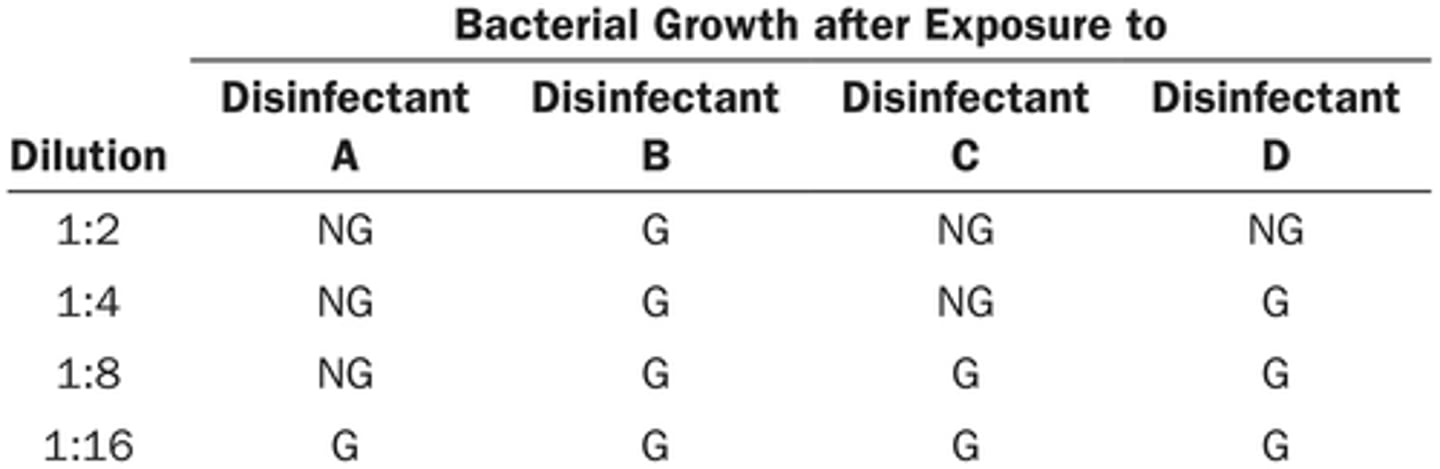
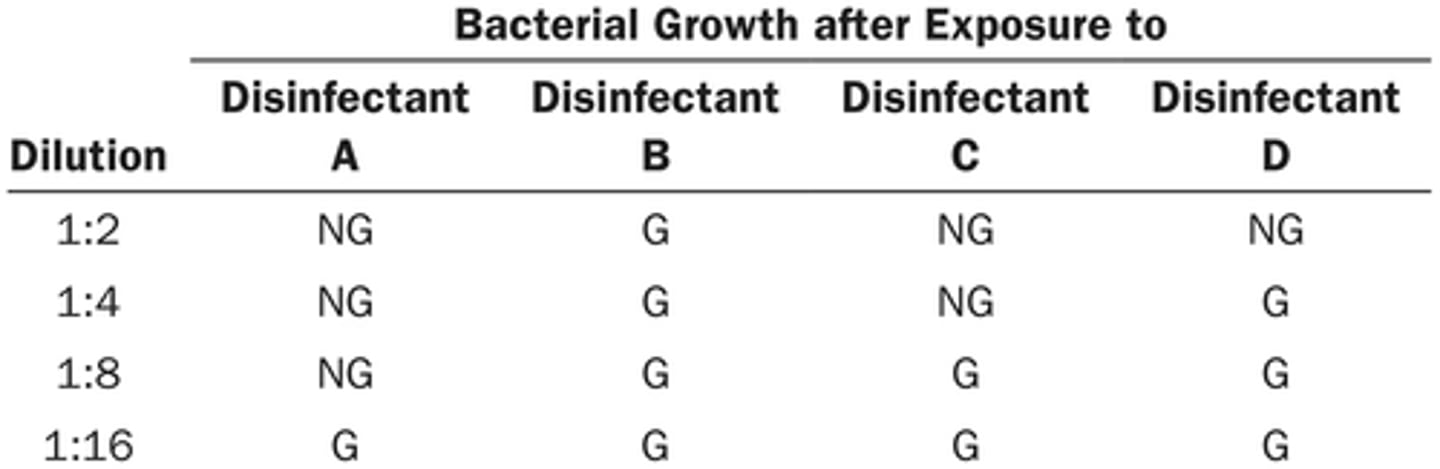
Use the following information to answer questions 6 and 7. The data were obtained from a use-dilution test comparing four disinfectants against Salmonella Choleraesuis. G N = = growth, G no growth
6. Which disinfectant is the most effective?
Disinfectant A
11. Which disinfectant(s) is (are) bactericidal?
a. A, B, C, and D
b. A, C, and D
c. A only
d. B only
e. none of the above
A,C and D
Which of the following is most effective for sterilizing mattresses
and plastic Petri dishes?
a. chlorine
b. ethylene oxide
c. glutaraldehyde
d. autoclaving
e. nonionizing radiation
ethylene oxide