Chapter 6
 Call Kai
 Learn
Learn Practice Test
 Spaced Repetition
 Match
Match Flashcards
 Knowt Play
1/16

There's no tags or description
Looks like no tags are added yet.
Name | Mastery | Learn | Test | Matching | Spaced | Call with Kai |
|---|
No analytics yet
Send a link to your students to track their progress
17 Terms
Hyaline cartilage
frosted glass to provide support with flexibility (most abundant cartilage)
Fibro cartilage
great for strength, shows up in places with a lot of pressure to absorb shock, shows up in places we need to stretch (ex. reproduction-stretches the pubic region)
Elastic cartilage
Only shows up in two places of the human body-ear lobes and epiglottis
Functions of bones:
Support, protection, movement, mineral and growth storage, blood cell formation, triglyceride storage, hormone production
How many bones in the human body?
206
The bones shape consists of:
Long, short, flat, and irregular
The bone location consists of:
Axial-long axis of body, skull, vertebral column, rib cage
Appendicular-bones of upper and lower limbs, girdles attaching limbs to axial skeleton
Long bones
They are longer than they are wide and it has a shaft and two ends ex. forearm
Short bones
Shows up in the wrist, hands, and feet
Flat bones
They are thin, flat, and often curbed (ribs)
Irregular Bones
They would be vertabrate, strongely shaped (pelvic area)
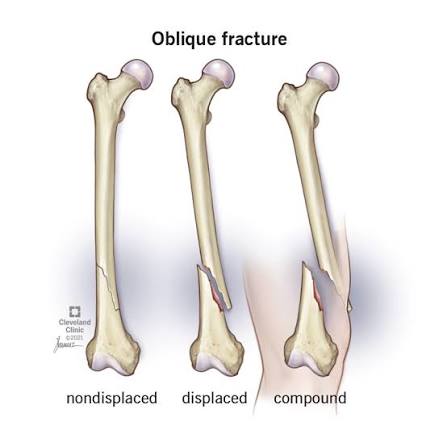
Non displaced fracture:
the end of the bone keeps its normal position, or in general the bone keeps its normal position.
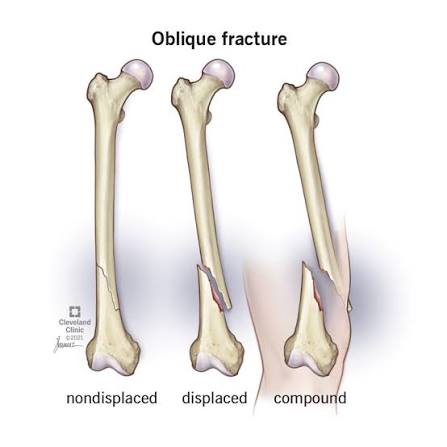
Displaced fracture:
the end of the bone would not be in its normal position
Complete fracture
The bone is broken all the way through
Incomplete fracture
The bone is not broken all the way through, its broken partially
Compound fracture
The bone penetrated through the skin, its visible to the human eye
Simple fracture
The bone did not penetrate through the skin