Atmos
 Call Kai
 Learn
Learn Practice Test
 Spaced Repetition
 Match
Match Flashcards
 Knowt Play
1/43

Earn XP
Description and Tags
God help me
Name | Mastery | Learn | Test | Matching | Spaced | Call with Kai |
|---|
No analytics yet
Send a link to your students to track their progress
44 Terms
Layers of earths atmosphere
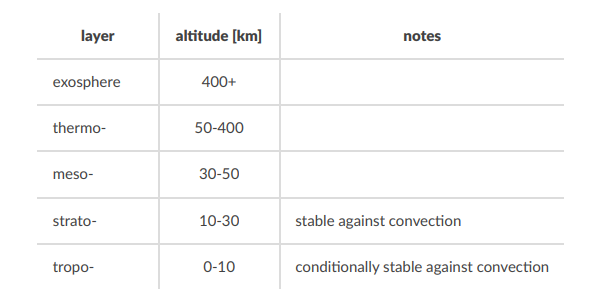
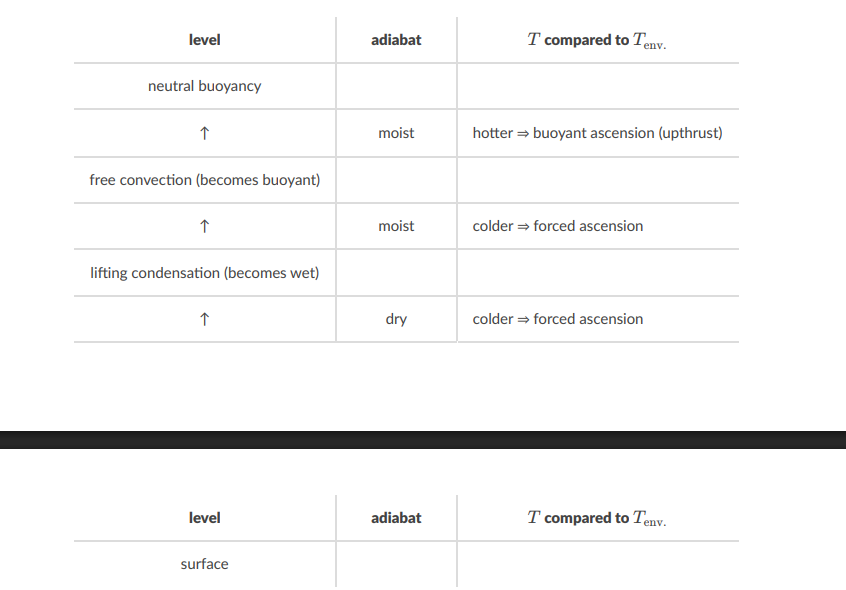
Layers within earth’s troposphere and their adiabat
Relationship between R and Ru (define both)
R = Ru/mu . R = specific gas constant [JK-1Kg-1], Ru = universal gas constant 8.31 [JK-1Mol-1]
Energy (U) of different particle configurations and how to work out deg of freedom
Rotational, vibrational and Transverse modes

Define the mass mixing ratio

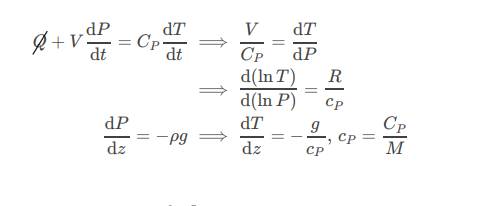
Derive hydrostatic balance

Derive adiabatic lapse rate
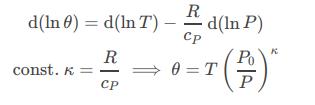
Define potential temperature, theta
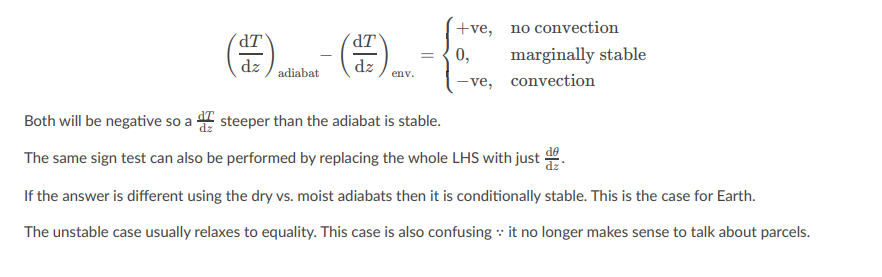
Define convective stability and determine whether an air parcel is stable?
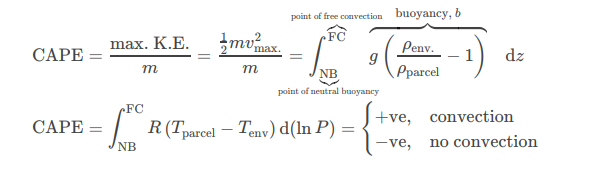
Define CAPE?
Convective available potential energy
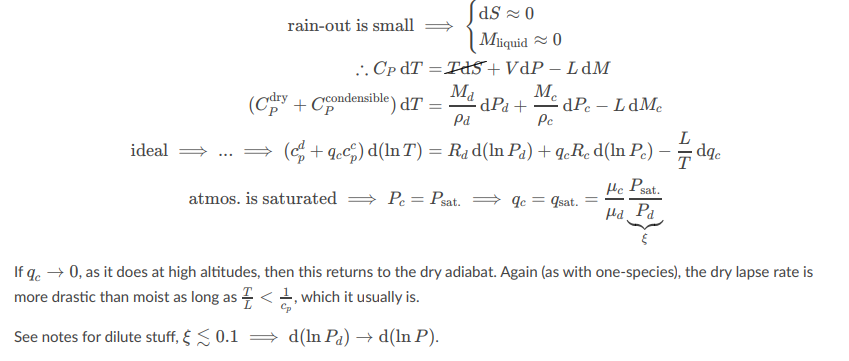
Clausius claperon and simplifying assumption

Derive 2 species moist adiabatic lapse rate
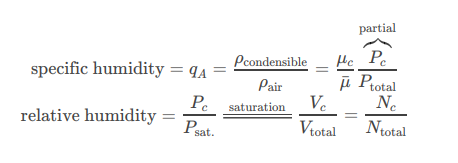
Relative and specific humidity definitions
Radiance, I_nu definition
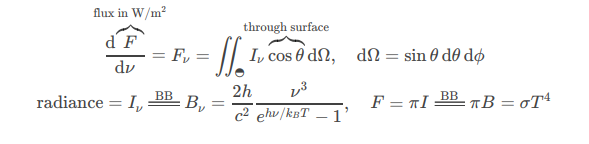
Wien’s law

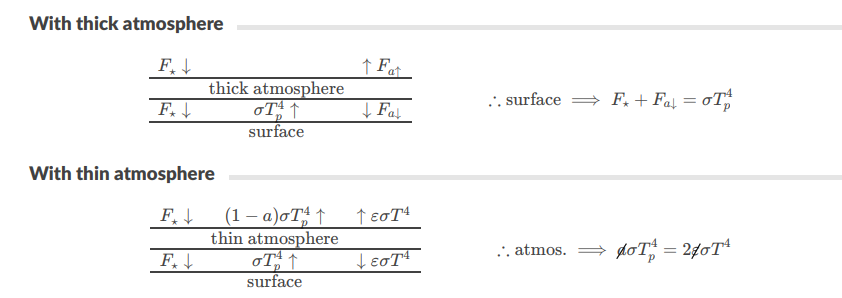
Stefan boltzman equations for thick and thin atmosphere models
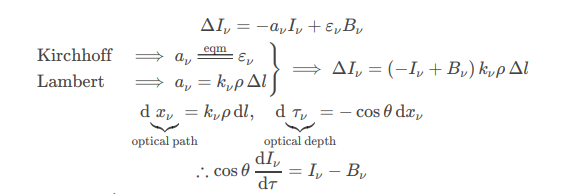
Derive the swatszchild equation for radiative transfer and simplify
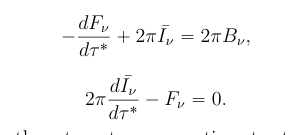
Two stream equations
Omega, beta and f in gfd
f = 2 omega sin(theta), where omega is 2pi/(3600×24), theta is latitude. Beta is df/dy. Potential vorticity (added beta term) can come out to d²u/dy²
How to determine the stability of an atmosphere to convection?
dln(T)/dln(P) < R/cp (for stable)
Geostrophic balance
-fu = 1/rho dP/dy and fv = 1/rho * dP/dy
Angular momentum for calculations on earth
M = (omega*R*cos(theta) + u)*R*cos(theta)
Rossby number and meaning
Ro = U/fL, where f = 2omegasin(theta). A small RO is strongly affected by coriolis (f) forces, whereas a large rossby number is not. Geostrophic balance occurs when Ro is low, cyclostrophic balance occurs when this is high.
Dry adiabat + for diatomic
dln(T)/dln(p) = R / cp, for diatomic: R / cp = 7/2
Schwartzmann eq
