easc lec 4
 Call Kai
 Learn
Learn Practice Test
 Spaced Repetition
 Match
Match Flashcards
 Knowt Play
1/32

There's no tags or description
Looks like no tags are added yet.
Name | Mastery | Learn | Test | Matching | Spaced | Call with Kai |
|---|
No analytics yet
Send a link to your students to track their progress
33 Terms
Plate tectonic theory explains
Distribution of volcanic chains & collisional mountain belts
Distribution of seafloor features
Age & characteristics
Distribution of earthquakes
Distribution of volcanic chains & collisional mountain belts (plate tectonic theory)
Hot spots
Island arcs
Volcanic arcs
Distribution of seafloor features (plate tectonic theory)
Deep-ocean trenches
MOR (Mid-ocean rifts)
Transform fracture systems
Age & characteristics of (plate tectonic theory)
Oceanic crust (+ paleomagnetic ‘stripes’)
Pelagic sediments
Deep-sea trench
A convergent plate margin where oceanic lithosphere is carred down into the mantle at the subduction zone beneath another oceanic or continental plate
Long, narrow regions of the seafloor
Where old, cold oceanic lithosphere subducts
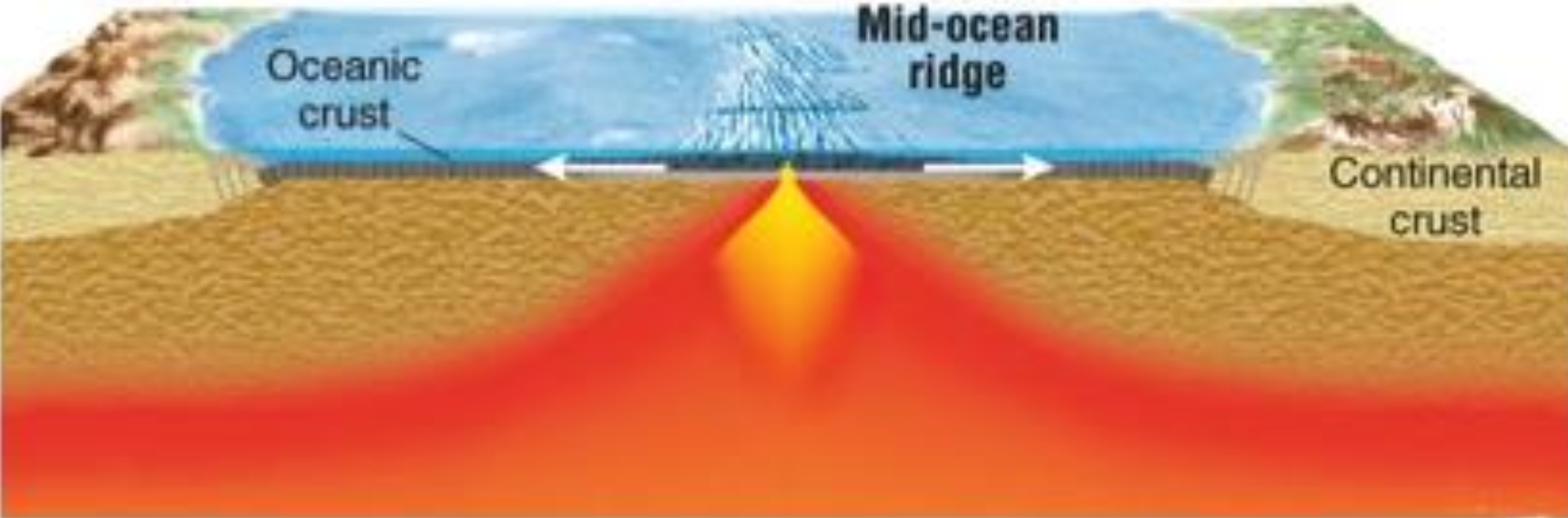
Mid-ocean ridge (MOR)
Occurs at a divergent plate margin where new oceanic lithosphere is formed by the seafloor spreading
Portions of the ___ are offset by long fracture zones
The ridge axis is segmented along its length at fracture zones
Expansive uplifted areas of warm, buoyant oceanic lithosphere
Examples
East Pacific Rise
Mid-Atlantic Ridge
East Pacific Rise (MOR)
Fast spreading (6-16 cm/yr), moving ocean
Moves the Pacific & Nazca plates apart
Mid-Atlantic Ridge
Slow spreading (2-6 sm/yr, moving continents)
Moves the south american & african plates apart
Harry Hess
Use sonar to map the ocean floor ⇒ Determines water depth using soundwaves
Velocity of waves: Distance = Travel time x Velocity
Princeton geologist (During WW2)
Mid-Ocean Ridge mapping
Warm
Buoyant
Young
Slow spreading: 2-6 cm/yr
Abyssal Plain mapping
Cold
Dense
Old
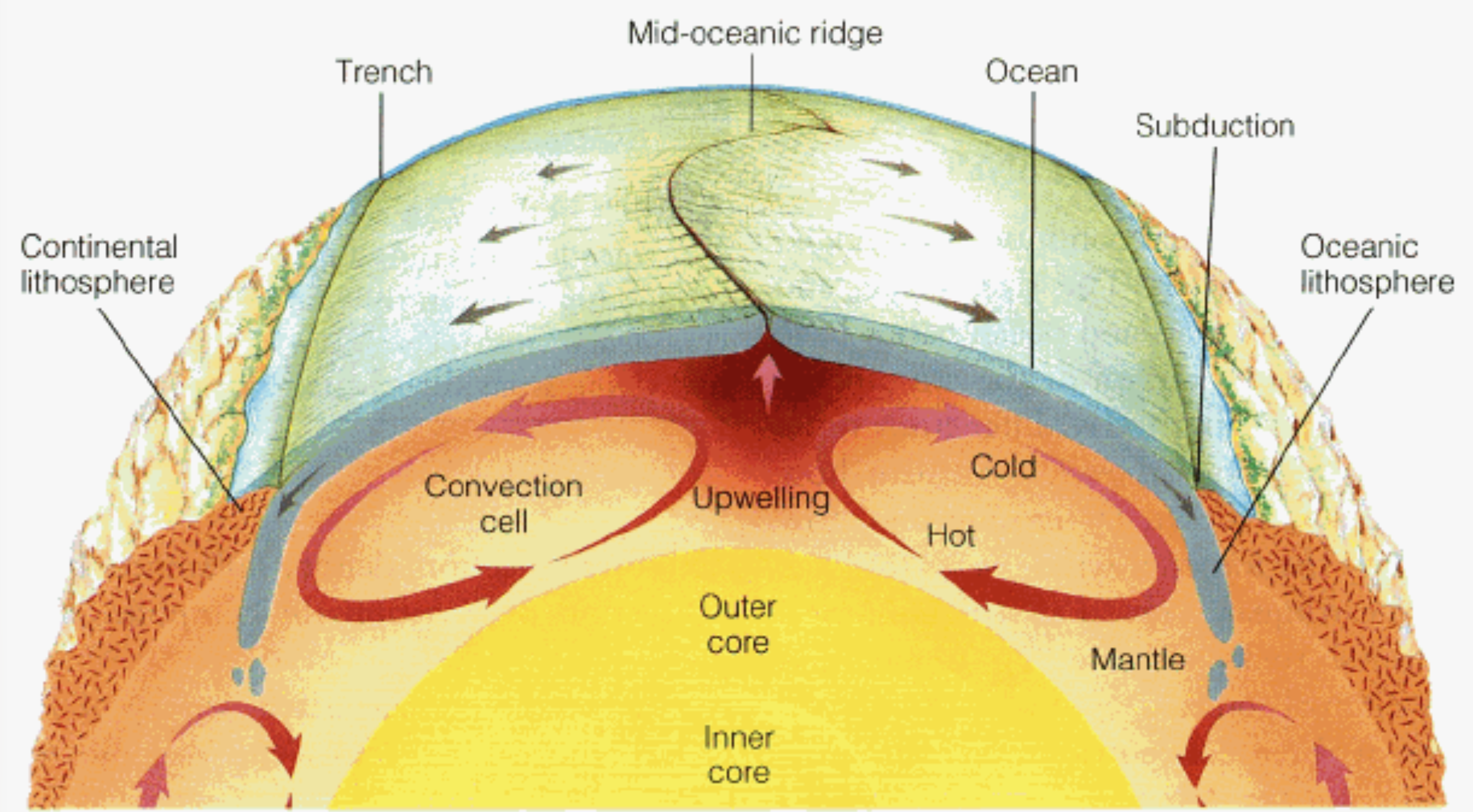
Mantle Convention
Mechanism for plate motion
Motion enhanced by the gravity effects of ridge push & slab pull
Divergent Plate Margins
Convection brings mantle rock towards the surface. Moving to shallower depths, undergoing decompression melting that moves magma upward through fractured lithosphere
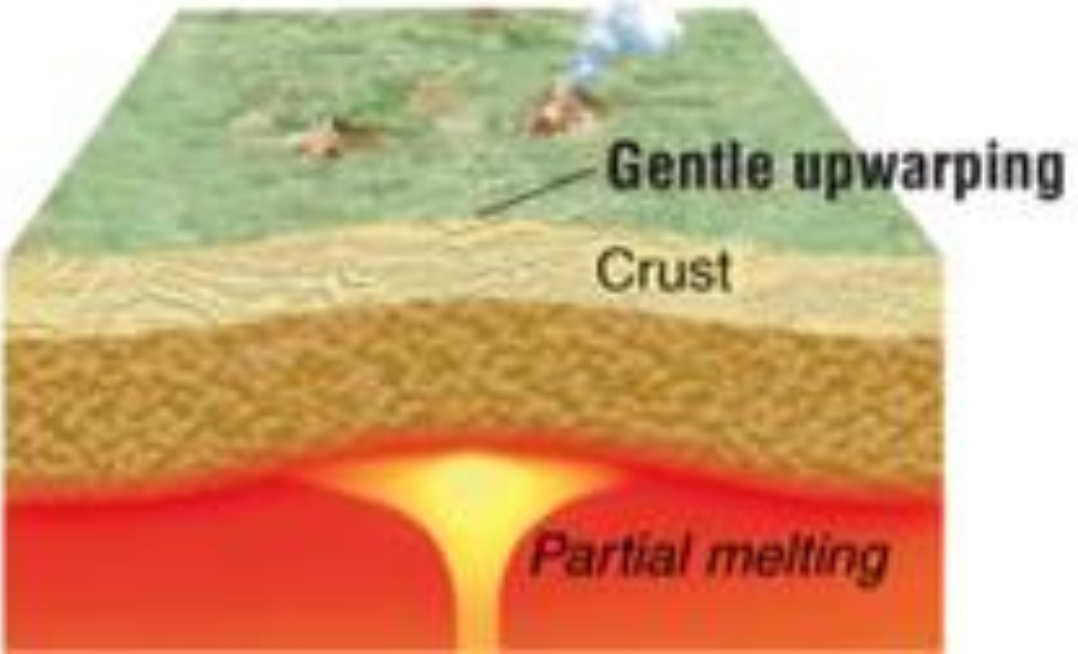
Decompression Melting
Some minerals melt
Deep Mantle Plume
Heats the lithosphere causing doming
Gravity pulls on the flanks of the upwarped crust, results in stretching & thinning
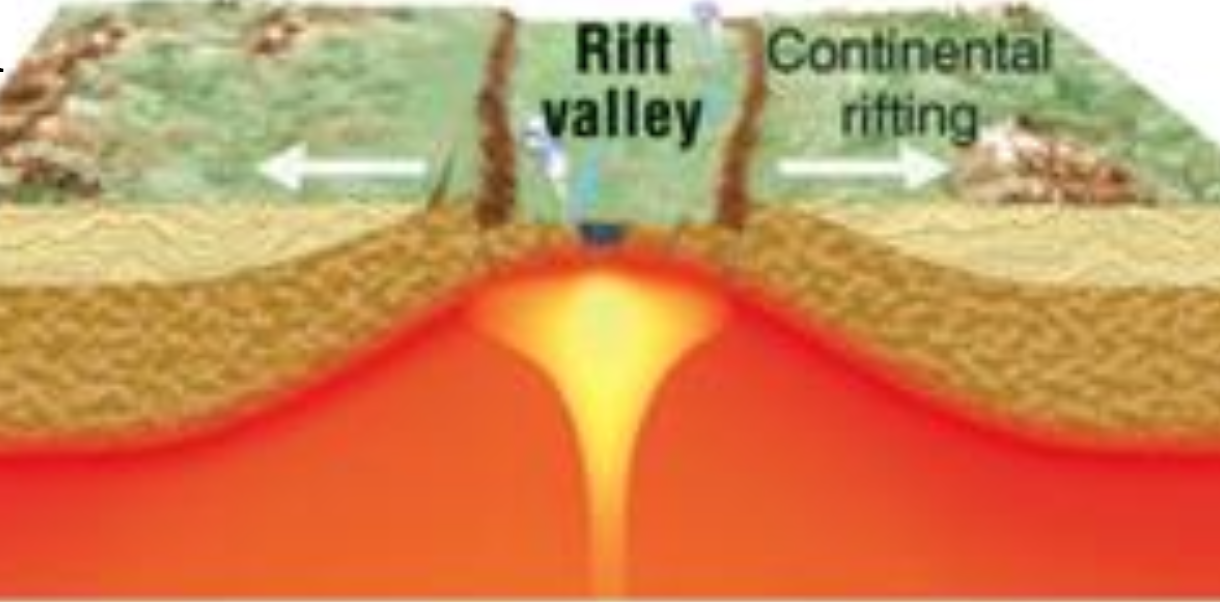
Rift Valley
The stretched & thinned lithosphere
Magma goes upwards through fractures, cooling & creating new lithosphere
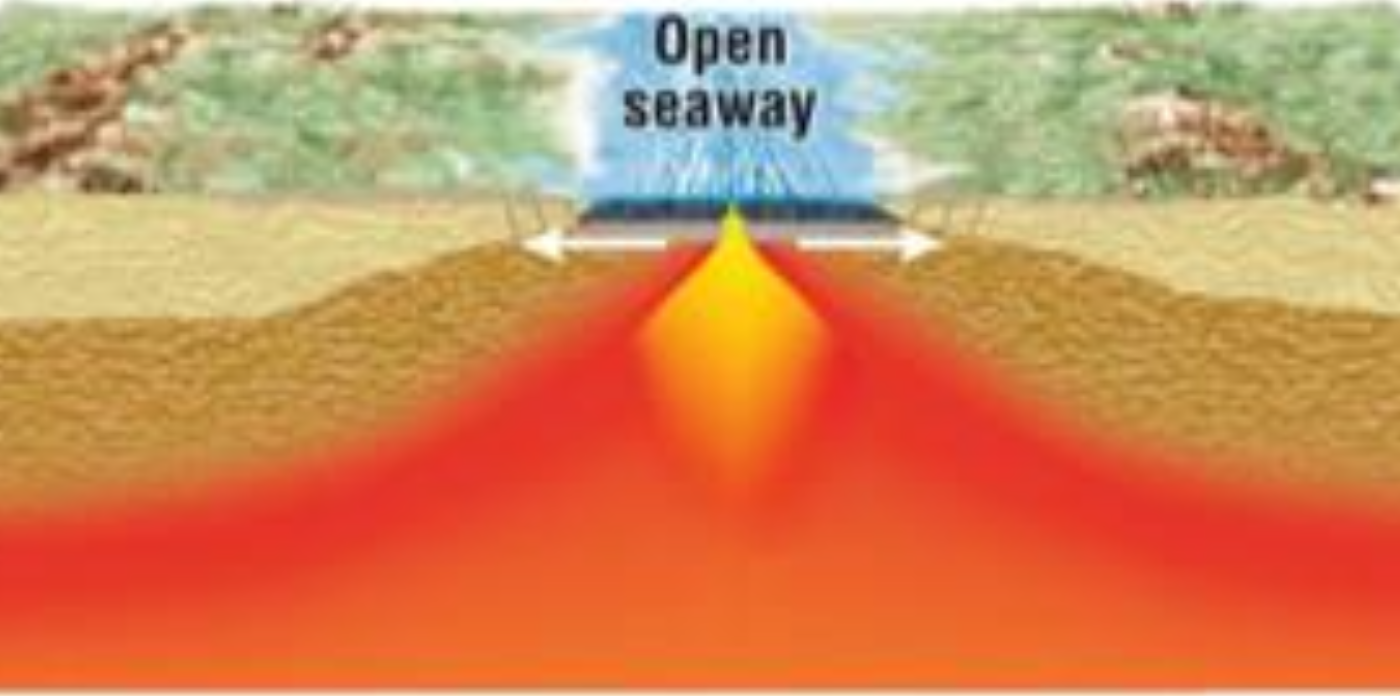
Narrow Seaway
Forms when the rifted lithosphere reaches the continent’s edge
Widening by ~15-20 cm/yr
Wide Ocean Basin
Forms with an expansive MOR
Crossed by transform features
East African Rift System
Driven by the African superplume
3 arms of rifting split the African Plate into the Nubian (left), Somalian (right) & Arabian (top) plates
3 arms ⇒ Red Sea rift (left), Gulf of Aden rift (right) & East African rift (downwards) meet at a triple junction, the Afar Triangle
Sampling from the Deep Sea Drilling Program
Progressively older oceanic crust with distance from the central rift
Pelagic Sediments above the crust increase in age & thickness
Pelagic Sediments
Accumulate from the slow rain of materials settling through the water column down to the deep seafloor
Pelagic Sediments Materials
Plankton, wind brown dust, volcanic ash
Magnetometer
Towed across a MOR records a mirror image of oceanic crust with a striking pattern of ‘magnetic stripes’.
Stronger magnetism
Magnetic signature matches the magnetic field today = Magnetic normal
Weaker magnetism
Magnetic signature is opposite to the magnetic field today = Magnetic reversal
Magnetite (magnetometer)
Accessory mineral within the newly formed oceanic lithosphere
Grains align with the magnetic field at the time of crystallization
Earthrocks: Paleomagnetism (8.5 min)
Convergent Plate Margins
Lithospheric plates collide along continental suture zones & deep sea trenches
Japan trench
Peru Chile trench
Aleutian trench
Continental Suture Zones
Subduction brings islands & continents to a subduction zone
Landmasses are too thick to subduct, thus are added to the edge of the overlying plate
Suture & Accretion
India’s Suture Zone
Rifted from Gondwana during the Cretaceous & was brought by seafloor spreading and subduction to the Eurasian Plate
Suturing began 10M yrs ago & the collision still continues
The Himalayan Mountains & Tibetan Plateau are still rising
Island & Volcanic Arcs
Oceanic lithosphere is subducted at a deep sea trench. In the case of 2 oceanic plates, the older (& thus denser) plate subducts
Seawater carried within sediments & fractured oceanic crust is heated
Becomes water vapour that rises through the overlying mantle rock. Lowers melting temperature & partial melting occurs
Pacific Ring of Fire
Near-continuous chain of island arcs & volcanic arcs along the perimeter of the Pacific Ocean
Transform Plate Margins
Lithospheric plates slide past each other along transform faults
Includes continental transforms & offset MORs
San Andreas Fault
Hotspot
Lithospheric plates carried over a deep mantle plume form a chain of hot spot volcanoes